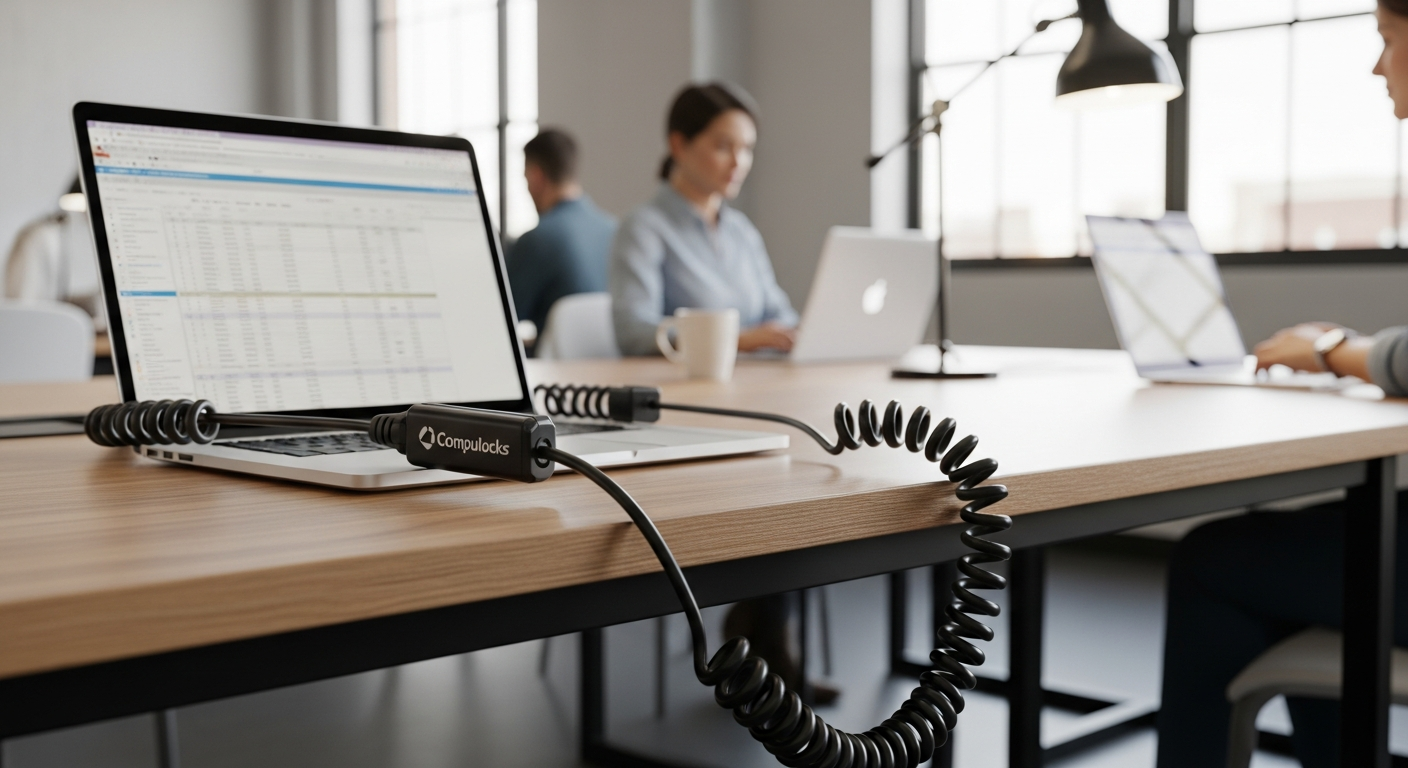
Equipment theft in corporate environments and educational institutions costs businesses an estimated $2 billion annually. Whether it's a laptop left unattended during a meeting or a monitor in a shared lab space, valuable electronics disappear faster than you'd think. The reality? Most theft happens opportunistically, not through elaborate heists—which means even a basic deterrent can make an enormous difference.
The Compulocks Universal Combination Cable Lock has become the go-to security solution for organizations managing multiple devices across shared environments. Unlike traditional key-based locks that invite lost-key headaches, this keyless system eliminates administrative friction while maintaining robust protection.
Why Cable Locks Are Essential for Shared Equipment Environments
The distinction between perimeter security and device-level security in office settings
Perimeter security—access cards, locked doors, surveillance—creates the first line of defense for office buildings. Device-level security operates at a different tier entirely. Even in a locked office with restricted access, equipment sitting on desks remains vulnerable to anyone with physical proximity. A visitor, contractor, or even an opportunistic employee can pocket a wireless mouse, unplug a monitor, or walk off with an unlocked laptop in seconds. The cable lock bridges the gap between perimeter and device security, making individual equipment harder to steal regardless of building access controls.
How opportunistic theft differs from targeted theft and why cable locks address the former effectively
Targeted theft involves planning: a criminal researches valuable equipment, times a theft during low-surveillance hours, and uses specialized tools to bypass security. Cable locks won't stop a determined professional. Opportunistic theft, however, accounts for the majority of workplace equipment loss. Someone sees an unattended laptop, recognizes an easy removal, and acts on impulse. A visible cable lock—even a modest one—disrupts that calculation. The thief needs tools, time, and increased risk of detection. Most will simply move to an easier target.
Statistics on equipment loss in corporate offices, educational facilities, and co-working spaces
Corporate offices report an average of one stolen device per 100 employees annually, with costs extending beyond replacement to include data breach liability and downtime. Educational institutions lose significant numbers of computers and peripherals from labs and classrooms; some universities report 15-20% annual attrition rates in unsecured equipment. Co-working spaces, where access is fluid and accountability is diffused, see particularly high loss rates. The financial impact accumulates quickly: a single stolen monitor costs $300-$500 to replace, but a laptop theft can exceed $1,500 plus recovery costs.
The psychology of deterrence: why visible security measures reduce theft attempts
Psychological research consistently shows that visible security measures—locked doors, alarm stickers, cameras, and cable locks—reduce theft attempts substantially. A locked cable makes the target noticeably more difficult than an adjacent unsecured device. Thieves perform rapid cost-benefit calculations; adding friction through visible security shifts the equation toward walking away. The cable lock's effectiveness partly stems from this deterrent psychology. It signals that the organization values its equipment and isn't leaving things to chance.
Compliance and liability considerations for businesses managing loaned or company-owned devices
Organizations that loan equipment to employees or allow remote work have liability obligations. If a company-provided laptop disappears because security measures weren't in place, the organization may face regulatory scrutiny or insurance coverage denials. Some industries—financial services, healthcare, government—have explicit requirements about device security. A cable lock provides documented evidence of reasonable security practices. If theft does occur despite the lock, the organization can demonstrate due diligence.
Cost comparison between replacing stolen equipment versus investing in preventive security
A single stolen laptop costs between $1,500 and $3,000 to replace. Factor in setup time, data recovery, and productivity loss, and the total cost per incident can reach $5,000. Deploying cable locks organization-wide costs a fraction of that. For a 50-person organization with 75 devices, purchasing cable locks at approximately $42 per unit comes to roughly $3,150—the cost of one laptop replacement. Preventing even a single theft in a year pays for the entire security investment.
Keyless Convenience Meets Practical Security Features
The 4-digit combination mechanism: balancing ease of access with security strength
A 4-digit combination lock offers 10,000 possible combinations, sufficient to deter casual guessing but not so complex that authorized users struggle to remember or enter their code. The keyless design means no physical keys to lose, duplicate, or manage across teams. Users simply rotate the dial to their combination and press the unlock switch. This balance—security without bureaucratic friction—makes adoption across teams straightforward. Unlike key-based systems where lost keys create cascading problems, a forgotten combination is solved with a single password reset or management override.
Why keyless systems eliminate lost-key problems that plague traditional locks
Key-based locks introduce administrative overhead: who holds duplicates? What happens when someone leaves the organization? How many copies exist? Keys get lost, duplicated without authorization, or left in unsecured locations. A keyless combination system sidesteps these issues entirely. When an employee departs, their access is revoked instantly by changing the combination. For organizations managing dozens or hundreds of devices, this operational simplification represents significant time and cost savings. The combination lock becomes a genuine time-saver rather than a security headache.
The T-bar design and K-slot compatibility: understanding universal security standards
Most electronic devices include a standard K-slot (Kensington security slot), a small rectangular opening designed for cable locks. The Compulocks lock uses a T-bar mechanism that inserts into the K-slot and rotates to lock in place. This is the industry standard, meaning the cable lock works with virtually any device that includes a security slot: laptops, monitors, printers, desktop computers, even some tablets. The compatibility is the primary reason this lock remains a consistent bestseller—it genuinely is universal, eliminating the need to purchase different locks for different equipment types.
The 1.8-meter (6-foot) galvanized steel cable: length considerations for various tethering scenarios
Length matters in cable lock selection. Too short, and you can't reach secure anchor points; too long, and you create tangling hazards. The 1.8-meter cable strikes the practical middle ground. It's sufficient to tether a laptop to a desk leg while the device sits on a table, run a cable around a monitor stand and attach it to a desk infrastructure, or secure equipment in a server room to a stationary rack. The galvanized steel construction resists cutting and provides durability across years of daily use in various environments. This length and material quality justify the investment across multiple seasons of protection.
Loop-ended cable design and rotating head technology to prevent tangling and frustration
The loop-ended design—where the cable terminates in a reinforced loop rather than a frayed or fixed end—simplifies attachment to anchor points. No need for additional carabiners or adapters. The rotating cable head prevents the frustrating tangling that occurs with traditional fixed-head designs. Users can rotate the lock head to align with equipment orientation without the cable twisting on itself. These design features may seem minor but accumulate significantly in daily user experience. When security measures are easy to use, teams actually deploy them consistently rather than creating workarounds.
Easy lock/unlock switch and tilting head mechanisms that improve daily usability
The straightforward lock/unlock switch means minimal learning curve for new users. There's no fiddling with mechanisms or deciphering instructions. The tilting head accommodates various security slot angles and device orientations. A monitor might have its K-slot on the side, while a laptop's is on the back. The tilting head adapts to both scenarios without requiring the user to contort the cable. These usability features matter more than they initially appear; security equipment that's annoying to use gets bypassed. The Compulocks design makes consistent security use the path of least resistance.
How the slim profile maintains a professional appearance in workplace settings
Bulky, industrial security equipment can make a workspace feel more like a prison than an office. The Compulocks lock's slim T-bar design maintains a professional appearance even in client-facing environments. A sleek cable loop attached to a laptop looks like legitimate security; a large, chunky padlock looks like operational difficulty. For organizations concerned with workspace aesthetics or client perceptions, this attention to design detail matters. Security and professionalism don't require incompatible choices.
Real-World Applications Across Different Industries
Corporate offices: protecting laptops, monitors, and peripherals in open-plan layouts
Open-plan offices create security challenges: no private spaces to secure equipment, constant flow of employees and visitors, and minimal supervision over individual workstations. Cable locks enable employees to secure laptops to desk legs even when stepping away for meetings. Monitors and peripherals can be tethered to desks, preventing opportunistic removal. IT departments implement organization-wide cable lock policies, reducing equipment loss rates dramatically. The keyless design means each employee can use their combination without IT managing keys.
Educational institutions: securing computer lab equipment and student-borrowed devices
Universities and schools manage hundreds of computers across labs, libraries, and classrooms. Equipment gets borrowed, left overnight, or accessed during off-hours when supervision is minimal. Cable locks enable lab managers to secure equipment to infrastructure, making theft substantially more difficult even when spaces are unsupervised. For student-borrowed devices, a cable lock travels with the equipment, protecting it whether on campus or temporarily taken off-site. The low per-unit cost makes organization-wide deployment feasible even for budget-constrained institutions.
Healthcare facilities: protecting portable diagnostic equipment and administrative computers
Hospitals move portable equipment between patient rooms, operating theaters, and storage areas. Cable locks secure expensive diagnostic devices to mobile carts or stationary infrastructure. Administrative computers in shared spaces—break rooms, administrative offices, supply areas—can be tethered, preventing theft during shift changes or staffing gaps. Healthcare environments have strict compliance requirements around equipment and data security; cable locks provide documented preventive measures that satisfy auditing requirements.
Retail environments: securing point-of-sale systems and checkout monitors
Retail spaces operate with high traffic, multiple access points, and valuable equipment in potentially unsupervised areas. Checkout monitors, POS terminals, and security cameras represent significant investment targets. Cable locks tether expensive equipment to counters, stands, and infrastructure. The visible security measure also serves a psychological function, signaling to employees and customers that the business takes theft seriously. Retailers often use cable locks as part of comprehensive loss-prevention strategies.
Libraries and public spaces: preventing unauthorized borrowing of reference computers
Public libraries and community centers provide computer access but face challenges with equipment unauthorized removal. Cable locks enable these organizations to maintain access while preventing theft. A reference computer secured with a cable lock remains available for its intended purpose but can't be carried out of the facility. The solution satisfies the dual requirement: maintaining public access while protecting organizational assets.
Server rooms and network closets: securing equipment to infrastructure and stationary objects
Server rooms house expensive equipment that rarely moves but remains theft-vulnerable during maintenance or access by contractors. Cable locks secure servers, network switches, and infrastructure to racks or mounting points. The psychological deterrent value remains high; visible security increases the perceived risk for would-be thieves. In sensitive environments, these locks are part of layered security approaches that include access controls, monitoring, and physical barriers.
Co-working spaces: enabling shared responsibility for security without key management overhead
Co-working spaces serve diverse, transient populations; traditional key-based security creates management nightmares. Combination cable locks enable shared security responsibility. Each user can secure their laptop with their combination without needing to check keys in or out. The space operator doesn't manage hundreds of key copies or replacement processes. Security becomes a consistent practice across diverse member populations rather than a management headache.
Budget-Friendly Security Without Compromising Protection
Pricing analysis: affordable entry point compared to replacement costs of stolen equipment
The Compulocks Universal Combination Cable Lock typically costs around $42 CAD or equivalent pricing globally—roughly 12,000 Hungarian Forints in some markets. Compare this to replacement costs: a stolen laptop (frequently targeted) costs $1,500-$3,000; a desktop monitor, $300-$500; a printer, $500-$1,500. Even a single prevented theft pays for dozens of cable locks. The pricing makes organization-wide deployment financially sensible for virtually any business, school, or institution managing multiple devices.
Return on investment calculation: equipment loss versus cable lock expenditure
Organizations experiencing even modest equipment loss—one or two devices annually—see immediate ROI from cable lock deployment. Calculate your organization's historical loss rates and multiply by average replacement cost. For many mid-sized organizations, this calculation shows annual losses exceeding $10,000-$50,000. Deploying cable locks organization-wide often costs under $5,000 initial investment. The break-even point is typically reached within months, with continuing cost avoidance in subsequent years.
Bulk purchasing considerations for organizations managing multiple devices
Volume pricing often improves when purchasing dozens or hundreds of cable locks. Organizations buying in bulk frequently negotiate per-unit costs below retail pricing. A business purchasing 100 cable locks might achieve per-unit costs of $35-$38 compared to $42 for individual purchases. For large deployments, these savings compound substantially. Additionally, bulk purchasing simplifies standardization; all devices use identical locks with unified combination management.
Comparing per-device security costs across different lock types and brands
Cable locks range from $15-$80+ depending on features, materials, and brand. Lower-cost options sacrifice durability or usability; premium options add features that many organizations don't require. The Compulocks offering sits at the practical middle ground: better build quality than budget alternatives, lower cost than premium brands, and proven reliability across broad applications. The per-device cost, when amortized over several years of use, proves remarkably cost-effective.
Hidden costs of equipment theft: downtime, productivity loss, and replacement logistics
Equipment theft creates costs beyond simple replacement. Stolen devices cause immediate downtime; employees lack necessary tools while replacements are ordered and configured. That's productivity loss measured in hours or days per incident. IT departments spend time processing replacements, restoring configurations, and coordinating purchasing. Data may be lost if backup processes weren't current. Security and privacy implications arise from stolen devices containing potentially sensitive information. These indirect costs often exceed the equipment replacement cost itself, sometimes doubling the true cost of a single theft incident.
Scalability: how affordable pricing enables organization-wide deployment
The cable lock's affordability makes comprehensive security deployment practical. Rather than securing only high-value items or limited high-risk areas, organizations can protect all equipment consistently. This universalization prevents thieves from gravitating toward any unprotected devices. It also simplifies user and IT staff workflows; everyone operates under the same security standard rather than managing complex, device-specific policies. Affordable pricing enables the scalable deployment that makes security policies actually effective.
Long-term value: durability and reliability that justify the investment
The Compulocks lock's galvanized steel cable and robust locking mechanism provide durability across years of daily use. The lock doesn't degrade significantly after one year or require replacement. Many organizations use these locks for 5-10+ years, meaning the per-year cost is genuinely minimal. This durability justifies the slightly higher initial cost compared to budget alternatives that may fail or require replacement within 2-3 years. Long-term value analysis consistently shows cable locks as sound economic decisions.
Secure Your Workplace Equipment Today
The Compulocks Universal Combination Cable Lock represents a practical intersection of accessibility, affordability, and genuine security for shared work environments. Its keyless design eliminates administrative headaches while the 6-foot galvanized steel cable and universal K-slot compatibility make it genuinely versatile across equipment types. What makes this solution particularly valuable isn't that it's foolproof; it's that it raises the bar significantly for casual theft while remaining simple enough for entire teams to use consistently.
When combined with security awareness and proper deployment strategies, the cable lock becomes part of a credible defense against equipment loss. Organizations across industries—from corporate offices to educational institutions to retail environments—have adopted this solution specifically because it delivers measurable protection without creating operational friction.
The business case is clear: preventing even a single equipment theft pays for comprehensive cable lock deployment across your entire organization. The psychology of deterrence works; visible security measures genuinely reduce theft attempts. Keyless convenience means your teams will actually use the locks rather than bypass them. Affordable pricing removes financial barriers to protecting your workplace assets.
Leave a Reply