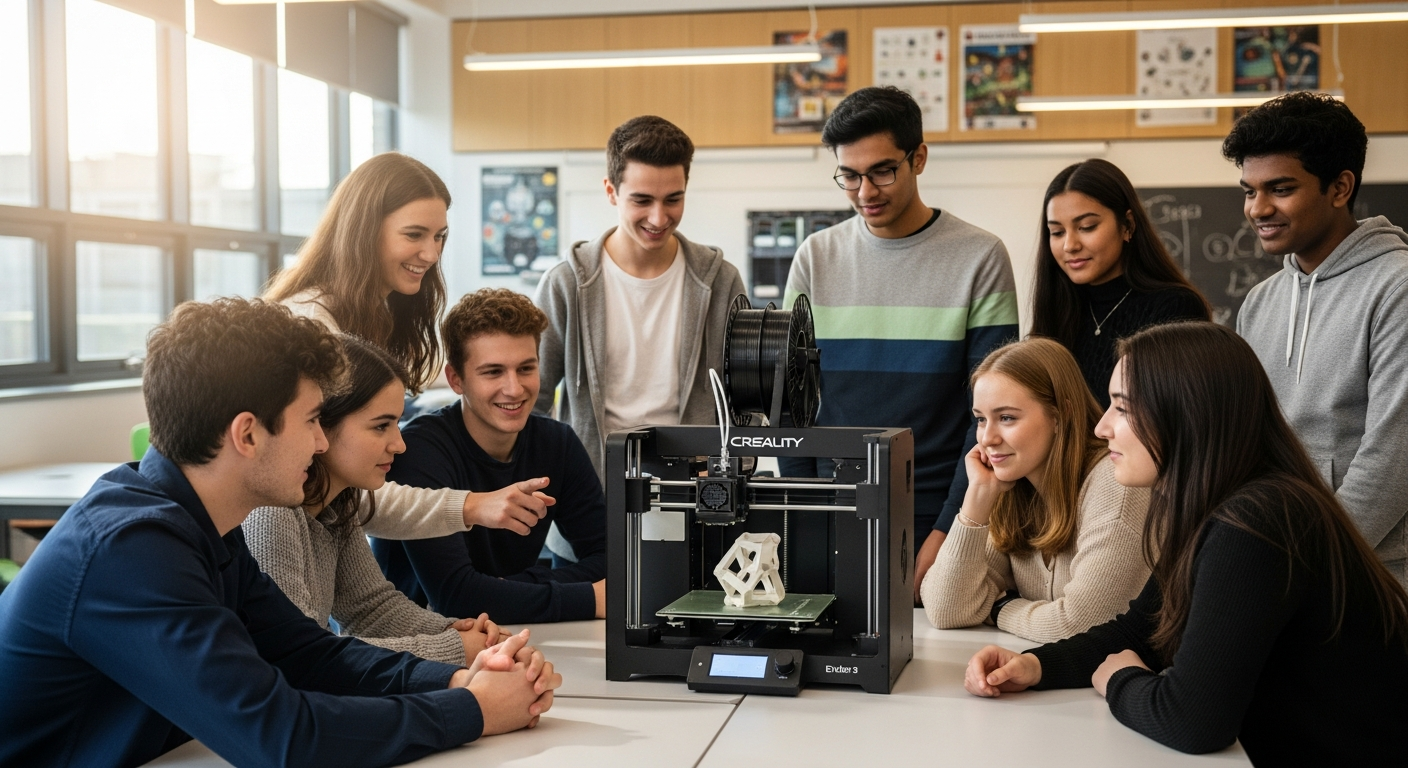
Over 14,000 units of the Creality Ender 3 V3 SE sell monthly on social commerce platforms—a staggering figure that reveals something crucial about modern education. Schools and universities are quietly revolutionizing how students learn design, engineering, and problem-solving. The 3D printer sitting in a classroom today isn't just a tool; it's a gateway to tangible learning that textbooks simply cannot deliver.
The Creality Ender 3 V3 SE was engineered with a specific audience in mind: beginners and students who need reliability without complexity. At approximately $235, this FDM printer shatters the myth that quality 3D printing requires deep pockets or advanced technical knowledge. Educational institutions have embraced it precisely because it balances affordability, ease of use, and consistent performance—three pillars that make or break classroom adoption.
Explore the Creality Ender 3 V3 SE for your educational institution today.
Why Educational Institutions Are Choosing the Ender 3 V3 SE
Cost-effectiveness for school budgets
At $235, schools can equip multiple stations without depleting annual budgets. This aggressive pricing transforms 3D printing from a luxury amenity into an accessible standard for educational facilities. When administrators can purchase five printers for the cost of one premium model, deployment across multiple classrooms and maker spaces becomes feasible.
Minimal technical support requirements
The user-friendly design reduces the need for specialized IT staff. Teachers and students can handle basic troubleshooting independently, freeing up technical resources for other institutional needs. This self-sufficiency accelerates adoption across departments.
Proven reliability in high-use environments
Consistent performance even with frequent student operation distinguishes the V3 SE from less robust competitors. Educational settings demand equipment that withstands daily use from inexperienced hands. This printer delivers.
Low failure rates build student confidence
Successful prints encourage continued engagement with STEM concepts. When students experience predictable, positive outcomes, they develop confidence in their design and problem-solving abilities. Failed prints discourage participation; reliable results fuel curiosity.
Scalability across departments
Affordability enables deployment in multiple classrooms, labs, and maker spaces simultaneously. Architecture departments, engineering programs, biology classes, and art studios can all access 3D printing technology without institutional resource conflicts.
Vendor support and community resources
A strong ecosystem of tutorials and educational materials surrounds the Ender 3 series. Teachers benefit from established curricula, troubleshooting guides, and peer networks. This infrastructure accelerates implementation and reduces the learning curve.
Building Hands-On STEM Curricula with FDM Technology
Integrating 3D design into engineering courses
CAD software paired with physical printing creates tangible learning outcomes. Students move beyond abstract computer-aided design into the realm of functional prototypes. They experience the feedback loop between digital conception and physical reality.
Prototyping projects that teach iteration
Students experience the design-test-refine cycle in real time. A student designs a bracket in CAD, prints it, tests whether it functions as intended, identifies improvements, and prints version two. This iterative approach embodies genuine engineering methodology.
Bridging theory and practice
Abstract concepts become concrete when students hold their printed designs. The distance between theoretical physics and hands-on validation collapses. A student who calculated stress distribution can now see it validated in a printed structure.
Interdisciplinary applications
Architecture, biology, physics, and art classes all benefit from 3D printing capabilities. Architects visualize spatial concepts. Biology students examine anatomical structures. Physics classes validate mechanical theories. Art students explore form and sculpture in ways traditional media cannot.
Project-based learning frameworks
Students tackle real-world problems through additive manufacturing. Rather than completing isolated exercises, learners engage with challenges that demand design thinking, technical problem-solving, and creative iteration.
Documentation and portfolio building
Printed projects become impressive evidence of student achievement. Unlike digital work confined to screens, 3D-printed projects demonstrate tangible capability. They speak powerfully in college applications, job interviews, and professional portfolios.
Classroom Setup and Operational Considerations
Space requirements for student-accessible stations
The compact footprint suits classroom corners and maker spaces. Unlike larger industrial printers, the V3 SE occupies minimal real estate, enabling placement in existing facilities without architectural modifications.
Simplified assembly process
Minimal setup time means faster deployment in educational settings. Teachers can have the unit operational within hours, not days. This efficiency matters in institutional environments where delays cascade through schedules.
Automatic bed leveling features
This technology reduces troubleshooting and allows students to focus on design rather than mechanics. Without automatic leveling, bed calibration becomes a barrier to entry. Students spend frustrating hours adjusting screws instead of learning design principles.
Filament management for group use
PLA and PETG compatibility supports various project types. PLA serves beginner projects beautifully—it's forgiving, biodegradable, and vibrant. PETG enables advanced students to explore durable, functional prototypes. This material flexibility accommodates diverse curriculum needs.
Safety protocols for student operation
The enclosed design and temperature controls protect young users. Unlike exposed heated beds and nozzles, thoughtful engineering reduces burn hazards. Teachers can confidently authorize student operation.
Maintenance schedules that fit school calendars
Preventive care during breaks keeps printers ready for term time. By scheduling maintenance during winter and summer breaks, institutions ensure equipment reliability throughout academic sessions.
Discover how the Ender 3 V3 SE simplifies classroom 3D printing integration.
Supported Materials and Project Possibilities
PLA filament for beginner-friendly projects
Biodegradable, easy to print, and ideal for first-time users, PLA represents the gateway material for student 3D printing. It produces reliable results with minimal troubleshooting, building student confidence in their capabilities.
PETG compatibility for durability
Stronger prints support functional prototypes and repeated-use items. When a robotics team needs custom brackets that withstand competition stress, or an assistive technology project requires durable components, PETG delivers the mechanical properties required.
Build volume (220x220x250mm) constraints and advantages
This capacity proves suitable for most educational projects while maintaining affordability. Students can print life-size anatomical models, functional mechanical components, and architectural scale models without exceeding build dimensions.
Material cost analysis for budget planning
Understanding per-project expenses ensures accurate budgeting. A single filament spool typically costs between $15-30 and produces multiple projects. Educators can calculate material costs per assignment and plan accordingly.
Color variety and visual learning
Aesthetically engaging prints motivate continued student participation. Color selection transforms functional objects into visually compelling creations. This psychological dimension drives engagement, particularly among younger students.
Specialty filaments for advanced coursework
Flexible, composite, and specialty materials support upper-level classes. Advanced students exploring functional design can experiment with flexible thermoplastic, while those studying composite materials can work with carbon-fiber-infused filaments.
Student Success Stories and Real-World Applications
Robotics clubs designing custom parts
Students prototype mechanical components for competition robots. Rather than ordering commercial parts, teams design and print custom brackets, gears, and housings—directly applying engineering principles to competitive challenges.
Architecture students visualizing designs
Scale models help communicate spatial concepts to peers and instructors. A building design lives differently in physical form than on a screen. Architecture students print their concepts to evaluate aesthetics, proportions, and practical considerations.
Biology classes printing anatomical models
3D representations aid understanding of complex biological structures. A student examining a printed heart model grasps cardiovascular anatomy in ways that textbook diagrams cannot convey. The tactile, three-dimensional experience accelerates comprehension.
Assistive technology projects
Students design and print devices that help classmates with disabilities. These projects combine engineering skill with empathy. A student who designs a custom grip for a classmate's utensil or prints adaptive equipment experiences the human impact of technical capability.
Science fair innovations
Award-winning projects often feature 3D-printed components. The ability to fabricate custom parts elevates project ambition. Students tackle more sophisticated challenges when manufacturing constraints disappear.
Entrepreneurship ventures
Student-led businesses use the printer to create and sell products. Young entrepreneurs design desk organizers, phone stands, garden planters, and niche products—then monetize through campus sales or online platforms. This practical business experience transcends traditional classroom learning.
Getting Started: Implementation Roadmap for Schools
Assessing your institution's needs and goals
Determine how 3D printing aligns with curriculum objectives. Does your engineering program need rapid prototyping capabilities? Are art students requesting sculptural tools? Does your robotics team require custom fabrication? Clear alignment ensures sustained institutional support.
Budget allocation and grant opportunities
Identify funding sources specifically for educational technology. Many foundations and government grants prioritize STEM infrastructure. The $235 price point makes grant applications realistic—a single modest grant funds multiple units.
Teacher training and professional development
Prepare educators to guide student learning. Professional development workshops should cover basic operations, material selection, design principles, and troubleshooting. Confident teachers foster confident students.
Creating a usage policy and safety guidelines
Establish clear expectations for student operation. Documented procedures reduce chaos and ensure equipment longevity. A simple checklist—shutdown procedures, material handling, safety protocols—prevents most problems.
Sourcing materials and building supplier relationships
Secure reliable filament and replacement parts. Establishing accounts with reputable suppliers ensures consistent material availability and institutional pricing discounts.
Measuring impact through student outcomes
Track improvements in engagement, creativity, and technical skills. Quantifiable metrics—project completion rates, student feedback, GPA improvements in STEM courses, participation in advanced projects—demonstrate value to administrators and justify continued investment.
Your Classroom's Next Innovation Awaits
The Creality Ender 3 V3 SE isn't just another piece of educational equipment—it's a catalyst for transformation. I've seen firsthand how this printer shifts the dynamic in classrooms: students who seemed disengaged suddenly lean in when they watch their digital designs materialize into physical objects. That moment of wonder, when a student holds their first successful print, is when real learning happens.
What makes the V3 SE exceptional for educational settings is its refusal to get in the way. Teachers don't spend hours troubleshooting mechanical issues. Students don't waste project time fighting with complex software. Instead, everyone focuses on what matters: creative problem-solving, design thinking, and hands-on learning. The $235 price point means schools can invest in multiple units, democratizing access across departments and grade levels.
If you're an educator exploring 3D printing for your institution, the Ender 3 V3 SE deserves serious consideration. Start small with a single unit, pilot a project with one class, and watch how quickly the demand spreads. Your students are ready to design, create, and innovate—they're just waiting for the tools to make it possible.
Get your Creality Ender 3 V3 SE and transform your educational environment now.
Leave a Reply