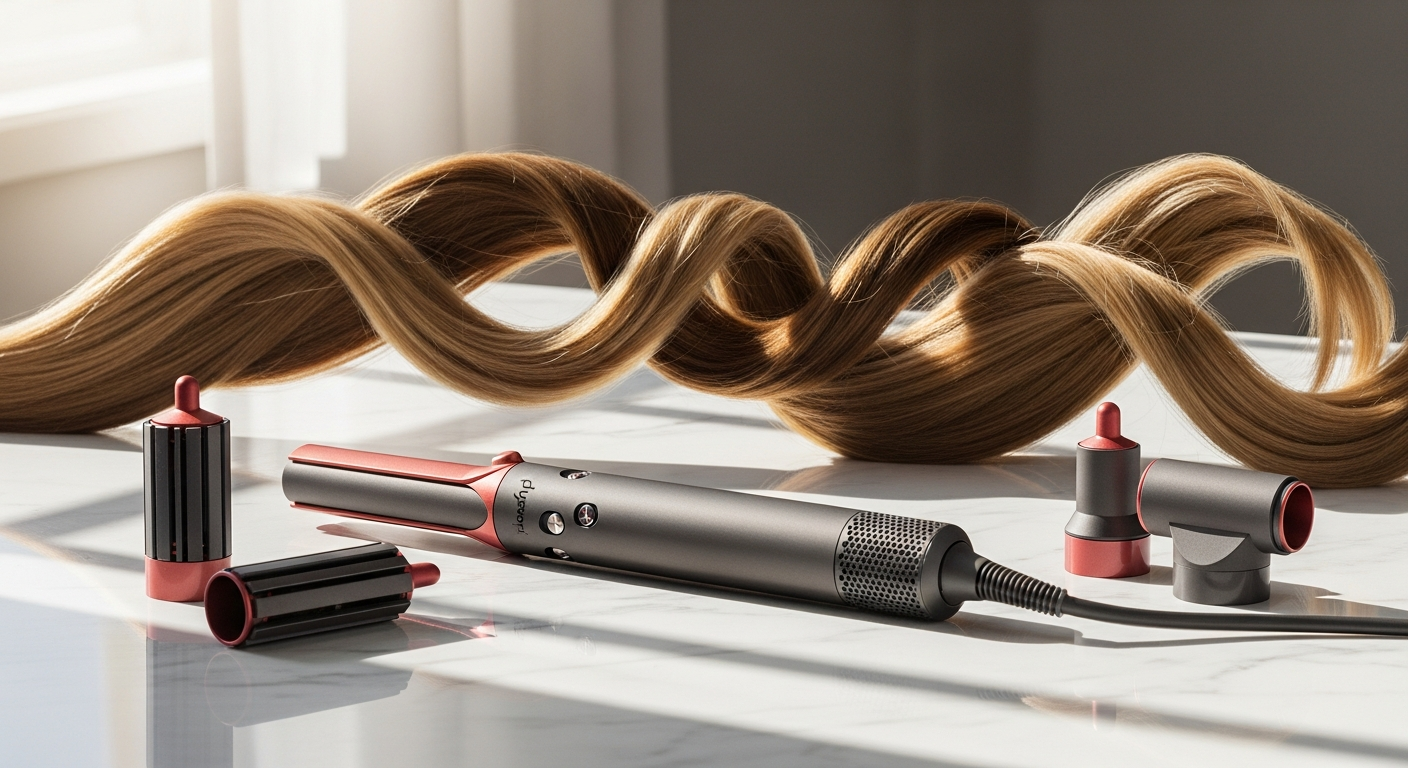
Forty times per second. That's how often the Dyson Airwrap measures your hair's temperature to prevent damage—a level of precision that traditional styling tools simply can't match. If you've spent years battling frizz, breakage, and heat-damaged strands from conventional blow dryers and curling irons, this innovative approach might feel like a game-changer for your hair health.
The Dyson Airwrap Multi-Styler represents a fundamental shift in how we think about hair styling. Rather than relying on scorching temperatures to curl, wave, or smooth hair, it harnesses an aerodynamic principle called the Coanda effect—essentially using intelligent airflow to wrap and style your strands. This technology emerged from years of research into hair science, and it's designed specifically for people who want professional results without sacrificing their hair's integrity.
Discover the revolutionary Dyson Airwrap Multi-Styler and transform your hair care routine today.
Throughout this article, I'll walk you through how the Airwrap actually works, which attachment types suit different hair goals, the real learning curve you'll face, and whether the premium price tag aligns with what you'll actually get. You'll also discover which hair types see the most dramatic transformations and what honest trade-offs come with this luxury styling tool.
The Coanda Effect: Understanding the Technology Behind Heat-Free Styling
What the Coanda effect is and how it differs from traditional heat-based styling methods
The Coanda effect represents a fundamental physics principle that Dyson leveraged to reimagine hair styling. Rather than using extreme heat to manipulate hair structure, the Coanda effect uses fast-moving air to create a pressure differential that naturally attracts and wraps hair around barrels or brushes. This aerodynamic phenomenon occurs when a high-velocity jet of air follows a curved surface, creating lower pressure that pulls objects toward it.
Traditional hot tools operate on straightforward thermodynamics: they apply intense heat to temporarily alter hair's protein structure, forcing it into desired shapes. The Airwrap works fundamentally differently. It uses airflow as the primary styling mechanism, with heat playing only a supporting role—maintaining hair's set without the damage associated with extreme temperatures.
How air pressure and velocity work together to wrap hair around barrels and brushes
The Airwrap generates approximately 13.5 liters per second of airflow, which creates the conditions necessary for the Coanda effect to occur. When you position a barrel or brush near wet or damp hair, the high-velocity air stream creates a pressure difference between the inside and outside of the barrel. Hair naturally moves toward the lower-pressure zone, wrapping itself around the styling surface.
The velocity of this airflow is critical. Too slow, and hair won't wrap properly. Too fast, and you lose control. Dyson engineered the barrels and brushes with specific curves and diameters to optimize the Coanda effect at the device's operating speed, ensuring that hair flows where it should without requiring manual force or extreme heat.
Real-world physics: why this aerodynamic approach reduces breakage and split ends
Heat-induced styling damages hair through protein denaturation. When temperatures exceed 300°F, hair's keratin proteins unwind and reform in new shapes. The higher the temperature and the longer the exposure, the more permanent damage occurs. This process weakens the hair shaft, leading to breakage and split ends that accumulate over time.
The Airwrap's airflow-based approach sidesteps this damage mechanism entirely. Since air at normal temperatures cannot denature keratin, the primary styling force doesn't inherently damage hair structure. Over weeks and months of consistent use, hair maintains stronger protein bonds, resulting in visibly healthier strands with fewer split ends.
Comparison of Coanda effect styling versus conventional blow dryers and curling irons
Conventional blow dryers typically reach 140–160°F, while curling irons often reach 350°F or higher. The Airwrap operates with heat settings of 320°F, 300°F, 280°F, and 260°F—but here's the critical difference: the heat isn't the primary styling force. The airflow does the work, and heat merely sets the style. This distinction fundamentally changes the risk profile.
A curling iron held on hair for 10 seconds at 350°F causes measurable damage. The Airwrap can style the same section in 10 seconds at 280°F with the airflow doing most of the work, resulting in dramatically less heat stress. Over the course of a year, this difference accumulates into noticeably healthier hair.
How intelligent airflow creates volume, waves, and curls without extreme temperatures
Different barrel sizes and brush shapes create different styling effects through the same Coanda principle. A tight curling barrel wraps hair tightly around its surface, creating defined ringlets. A wave barrel features a different curve that allows hair to flow and fold, creating S-shaped wave patterns. Volumizing brushes use paddle-like surfaces that lift hair away from the scalp while airflow sets it in place.
The genius lies in the attachment design. Each barrel and brush shape optimizes the Coanda effect for specific results, meaning you're not fighting the physics—you're working with it. Volumizing becomes a matter of lifting hair correctly, not blasting it with hot air until it's dry and puffy.
The role of negative ions in reducing static and enhancing shine
Negative ions are charged particles that coat the hair shaft's outer layer. This coating smooths the cuticle and reduces the friction between hair strands, which decreases frizz and static while improving light reflection—essentially creating shine. The Airwrap incorporates negative ion emission into its airflow, so as you style, the air itself is working to polish your hair's appearance.
Traditional blow dryers can produce static through friction. The Airwrap's negative ions counteract this effect, so your finished style emerges not just shaped correctly but also smoother and shinier than conventional hot-tool styling typically produces.
Why this technology appeals to hair professionals and dermatologists
Hair professionals recognize that the Coanda effect delivers salon-quality results without the heat damage that accumulates in their clients' hair. Dermatologists and trichologists appreciate that the technology removes a major source of hair damage, making it possible for people with fragile or previously damaged hair to style at home without additional risk.
This professional endorsement matters because it signals that the Airwrap isn't just a marketing gimmick—it's built on legitimate physics and produces measurable improvements in hair health. When professionals who spent years studying hair recommend a tool, you're not betting on hype.
Intelligent Heat Control: The 40-Times-Per-Second Safety Feature
How the Airwrap monitors temperature continuously throughout your styling session
The Airwrap's intelligent heat control system samples the airflow temperature 40 times per second. This means that at any moment, if temperature creeps above your selected setting, the device automatically reduces power to bring it back in line. The monitoring is continuous and dynamic—not something that happens once at startup, but throughout your entire styling session.
This real-time adjustment prevents the thermal spikes that happen with conventional tools. A curling iron might maintain an average of 350°F, but temperatures can spike to 400°F+ during use. The Airwrap's 40-times-per-second monitoring prevents these harmful peaks, keeping heat exposure consistent and predictable.
The three to four heat settings explained: which settings work best for different hair types
The four heat settings are 320°F, 300°F, 280°F, and 260°F. Think of these as a scaling system based on hair robustness. Fine or damaged hair works best on the coolest settings (260°F–280°F), where the airflow does most of the styling work and heat merely sets the result. Medium hair typically works well at 300°F. Thick or coarse hair can handle 320°F, though even this setting is significantly cooler than conventional tools.
Most users find they need to experiment to discover their optimal setting. What matters is that the Airwrap gives you granular control in a temperature range that's inherently safer than traditional tools. You're not choosing between 200°F and 400°F—you're working within a narrower, more protective range.
Temperature thresholds and how they protect against heat damage
Hair's major protein denaturation occurs above 300°F. While some styling can happen at this temperature, the damage risk rises sharply beyond it. The Airwrap's maximum setting of 320°F sits just above this threshold, but the critical detail is that this is the air temperature, not the hair temperature. Hair itself reaches slightly cooler temperatures because the airflow is moving, not holding still.
Additionally, because the airflow is the primary styling mechanism at these temperatures, exposure time is shorter than with traditional tools. You're not pressing a curling iron barrel into hair for 10 seconds; the air is wrapping and setting hair in 3-5 seconds. The combination of moderately elevated temperature plus brief exposure plus moving air keeps cumulative heat damage minimal.
Real-time feedback mechanisms that adjust airflow automatically
When temperature rises above your selected setting, the Airwrap reduces airflow power automatically. This is a negative feedback loop designed to maintain stability. If you hover the Airwrap too close to your scalp and temperature rises, the system compensates by reducing intensity, protecting your scalp from burns.
Users don't see this happening—it's transparent and automatic. You simply notice that the tool maintains consistent performance throughout your session without the unpredictable temperature variations common with conventional styling tools.
Why consistent temperature monitoring matters for long-term hair health
Hair damage is cumulative and primarily thermal. Every time you style with conventional tools, a small amount of keratin denatures, weakening the hair shaft slightly. After 100 styling sessions with inconsistent heat spikes, the damage becomes visible as dryness, frizz, and breakage. The Airwrap's consistent temperature prevents these thermal spikes, so each styling session causes minimal incremental damage.
Over six months to a year, this difference becomes pronounced. Hair styled with the Airwrap looks visibly healthier—shinier, stronger, with fewer split ends—compared to hair styled with conventional tools, even if those tools are high-quality.
Comparison of heat damage risk between Airwrap and traditional hot tools
A typical ceramic curling iron reaches 350°F and can spike to 400°F+. Flat irons often reach 450°F or higher. Blow dryers typically operate at 140–160°F but create thermal stress through sustained exposure over many minutes. The Airwrap's maximum 320°F with real-time monitoring and brief exposure times represents a fundamentally lower damage risk across all three styling categories.
If you currently style with a 350°F curling iron for 10 minutes daily, switching to the Airwrap at 300°F with 5-minute sessions reduces your cumulative heat exposure by approximately 60% weekly. Compounded over months, this difference translates to measurably healthier hair.
User testimonials on reduced frizz and improved hair texture after switching
Users consistently report that after two to three weeks of Airwrap use, their hair appears noticeably smoother and shinier. This improvement accelerates over weeks as damaged cuticles begin to heal. Many users with previously fried hair from years of conventional styling describe the texture improvement as dramatic—hair that was dull and fragile becoming bouncy and strong again.
These testimonials matter because they represent real-world evidence that the temperature and technology differences translate to visible improvements. People don't report minor changes—they report their friends asking what they did differently because the improvement is so apparent.
Attachment Versatility: Choosing the Right Barrel, Brush, and Dryer
The complete attachment lineup: curling barrels, wave barrels, smoothing brushes, and volumizing brushes
The standard Airwrap kit includes multiple attachments designed for different styling goals. Curling barrels come in 1.2-inch and 1.6-inch diameters, creating tighter and looser curls respectively. Wave barrels produce S-shaped wave patterns. Smoothing brushes flatten and polish hair. Volumizing brushes lift hair at the roots while drying. A Coanda smoothing dryer attachment prepares hair and manages flyaways.
This diversity means you're not buying a one-trick pony. One device with interchangeable attachments replaces what would previously require three to five separate tools: a blow dryer, curling irons in two sizes, a flat iron, and possibly a round brush. The attachment system is the core of the Airwrap's versatility advantage.
How different barrel sizes create different curl patterns and wave formations
The 1.2-inch barrel creates tighter, more defined curls—ideal for dramatic ringlets or vintage-style waves. The 1.6-inch barrel produces looser, bouncier curls that appear more modern and relaxed. Wave barrels don't create curl formations at all; instead, they fold hair into S-curves that look like waves. This distinction matters because it means you can achieve different aesthetic results depending on your mood or event.
The physics here relates back to the Coanda effect. A smaller barrel creates a tighter curve that the Coanda effect follows, resulting in tighter wrapping. A larger barrel creates a gentler curve, allowing hair to wrap more loosely. Wave barrels interrupt the circular wrap pattern, allowing hair to fold instead of spiral.
The Coanda smoothing dryer attachment and its pre-styling preparation role
The Coanda smoothing dryer isn't an attachment for final styling—it's a preparation tool. You use it first to dry damp hair and smooth the cuticle. Its paddle-like design straightens hair while drying, creating a smooth foundation for curling or waving. It also reduces frizz and flyaways before you apply other attachments.
Think of it as the primer step in the styling process. Many users report that proper use of the smoothing dryer dramatically improves the final result of subsequent curling or waving, because the foundation is smoother and more aligned.
Which attachments work best for fine, medium, thick, and curly hair types
Fine hair benefits from the volumizing brush and smaller curling barrel (1.2-inch), which create definition without weighing strands down. The Coanda smoothing dryer should be used on lower heat settings to avoid stress.
Medium hair works well with both curling barrels and the wave barrel, adapting easily to various styles. Thicker hair handles all attachments equally well and can use higher heat settings without concern.
Curly or textured hair can use the Airwrap to enhance natural curl patterns or create new ones. Some users with natural curls skip the curling barrel entirely and use the smoothing dryer to define their existing curl pattern with less frizz.
Compatibility across different Airwrap models and attachment storage solutions
Most Dyson Airwrap models use the same attachment system, so if you own an older standard Airwrap and upgrade to the newer i.d. model, your existing attachments remain compatible. This cross-compatibility matters if you're considering adding attachments over time or upgrading later.
Storage typically involves a magnetic stand or drawer organizer that keeps all attachments visible and accessible. The magnetic stand clips to a wall or counter, keeping attachments organized and your bathroom uncluttered.
Mixing and matching attachments for custom styling combinations
Advanced users discover that combining attachments creates custom results. For example, using the smoothing dryer first to prepare hair, then curling the crown with the 1.2-inch barrel for volume and the sides with the wave barrel for shape, creates a blended style that would require multiple conventional tools. This flexibility allows personal expression and experimentation.
Maintenance and cleaning tips for keeping attachments in optimal condition
Attachments should be cleaned after each use by wiping them with a damp cloth and allowing them to air dry completely. Product buildup in crevices can reduce the Coanda effect's effectiveness over time. A soft brush can gently remove debris from small spaces. Never submerge attachments in water or expose them to extreme heat.
Proper maintenance ensures attachments maintain their aerodynamic properties and last for years without degradation. Neglected attachments can eventually lose some styling effectiveness as buildup reduces airflow precision.
Personalization Through Technology: The MyDyson App and Airwrap i.d.
How Bluetooth connectivity transforms the Airwrap i.d. into a smart styling device
The Airwrap i.d. represents the evolution of the original Airwrap, adding Bluetooth connectivity that links the device to your smartphone via the MyDyson app. This connection enables two-way communication: the app sends styling instructions to the Airwrap, and the device sends performance data back to the app.
This connectivity means your styling device can now learn your preferences, remember your settings, and guide you through routines with real-time feedback. It's the difference between using a tool and using an intelligent system designed specifically for you.
MyDyson app features: hair type assessment and personalized routine creation
When you first open the MyDyson app with an Airwrap i.d., it walks you through a detailed hair assessment. You answer questions about your hair type, texture, thickness, current condition, and styling goals. Based on this information, the app creates a personalized styling routine adapted to your specific hair.
If you have fine, wavy hair with some damage, the app creates a routine using the wave barrel at reduced heat settings with specific timing. If you have thick, straight hair and want curls, the app suggests the 1.2-inch barrel at higher heat with extended wrapping time. This personalization removes guesswork.
Adaptive technology that adjusts heat, airflow, and timing based on your specific hair
The personalized routine isn't static. As you use the Airwrap i.d. and provide feedback through the app (telling it whether results met your expectations), the app refines the routine. Over several styling sessions, the device learns your actual hair response and adjusts heat, airflow duration, and barrel speed accordingly.
This adaptive learning means your styling experience improves over time. Settings that felt slightly off in week one feel perfectly calibrated by week three because the system has learned your hair's specific characteristics.
Step-by-step guidance through the app during styling sessions
When you start a styling session, the app provides real-time guidance. It tells you which section to style first, which attachment to use, how long to hold the Airwrap in each position, and when to move to the next section. This step-by-step guidance dramatically reduces the learning curve for new users.
Instead of figuring out the technique through trial and error, you're essentially receiving instruction from an expert system. Users report that following app guidance produces noticeably better results than attempting the same styles without guidance.
Saving multiple profiles for different styling goals (curls, waves, smoothing)
You can create multiple profiles within the app. "Everyday Waves" might use wave barrels at moderate settings for quick five-minute styling. "Special Occasion Curls" might use tighter barrels with extended times for defined ringlets. "Smoothing & Polish" might focus on the smoothing brush for a sleek look.
This flexibility means you're not limited to one styling routine. You adapt the device's behavior to match your needs on any given day, and the app remembers all your preferences.
Software updates and new features rolled out through the app
Dyson periodically releases software updates that add new features or routines. Rather than your device becoming dated, the app pushes improvements directly to your Airwrap i.d. You might receive a new routine optimized for a trending style or an updated algorithm based on feedback from thousands of users.
This continuous improvement cycle means your investment remains current without hardware replacement.
Privacy and data considerations with connected beauty devices
When you use the MyDyson app, Dyson collects usage data—which routines you use, how often you style, what adjustments you make. For some users, this data collection raises privacy concerns. Dyson's privacy policy allows you to opt out of certain data collection, but using the device to its full potential does involve some data sharing.
You should review Dyson's current privacy policy to understand exactly what data is collected and how it's used before committing to the i.d. model if data privacy is a significant concern.
The Learning Curve: Mastering Technique and Attachment Transitions
Initial setup and understanding barrel direction (clockwise versus counterclockwise)
The first thing new users must understand is that the Airwrap barrels rotate in specific directions. The 1.2-inch barrel typically rotates clockwise to curl hair toward your face on the front sections and counterclockwise on the back sections. The 1.6-inch barrel reverses these directions. Wave barrels operate differently and require their own technique.
This directional aspect confuses many new users. They'll position a barrel correctly but hold it the wrong way, resulting in hair not wrapping properly. Understanding and internalizing the correct directions for each attachment takes practice, but once established becomes automatic.
Common beginner mistakes and how to avoid them
The most common beginner mistake is expecting hair to wrap on its own. The Coanda effect does pull hair toward the barrel, but the user must still guide hair slightly to ensure proper wrapping. Too much guidance and you're fighting the airflow; too little and hair won't wrap evenly.
Another frequent mistake is using the Airwrap on hair that's too dry. The Coanda effect works best on damp hair (about 60% wet). If you've completely dried your hair, wrapping becomes difficult. Most users learn to style immediately after the smoothing dryer step, when hair is still slightly damp.
A third mistake involves holding the barrel too close to the scalp, which can cause discomfort or burns. The Airwrap should hover just above the scalp, not pressed directly against skin.
Time investment required to move from awkward to confident styling
Most users report that the first styling attempt feels unnatural and takes 20–30 minutes. By the third attempt, they're down to 15 minutes and noticing improved results. By the tenth styling session, many users achieve results comparable to what they'd get from a salon. Full confidence and speed—styling in under 10 minutes—typically takes four to six weeks of regular practice.
This timeline matters because it means the Airwrap isn't immediately gratifying for everyone. If you're accustomed to five-minute styling with conventional tools, you'll experience an initial slowdown before reaching comparable speed. Some users find this trade-off acceptable given the hair health benefits; others find it frustrating.
Tutorial resources: official Dyson videos, YouTube creators, and community forums
Dyson provides excellent official tutorial videos on their website and YouTube channel, with specific guidance for each attachment and hair type. Beyond official resources, popular beauty YouTubers and TikTokers have created thousands of Airwrap tutorials, many focusing on specific styles or hair types.
Reddit communities and Facebook groups dedicated to the Airwrap offer peer support. You can post photos of your attempts and get feedback from experienced users. This community aspect has become crucial to the Airwrap's popularity because the learning curve is real, but it's entirely surmountable with good instruction.
Styling techniques for different sections of hair (crown, sides, back)
The crown typically requires the most care. Hair at the crown sets curl patterns that frame your face, so spending extra time here pays dividends. The sides require less wrapping time but benefit from precise positioning. The back is hardest because you can't see what you're doing—many users practice this section repeatedly or use mirrors strategically.
Most tutorials recommend starting with the crown (while your hands are freshest and most steady), then moving to visible sides, and finally tackling the back. This sequence minimizes frustration by dealing with visible areas first.
Troubleshooting when curls don't wrap or waves fall flat
If curls don't wrap, the most common cause is that hair is too dry. Add moisture and try again. If waves fall flat, you might be using the barrel when you should be using the wave attachment, or you might be releasing hair too early before the style sets. Most troubleshooting problems resolve with adjustment to timing, moisture level, or technique.
Why some users master the tool in days while others need weeks of practice
People with prior blow-drying or curling iron experience often adapt quickly because they understand how hair wraps and how to guide it into position. Complete beginners often need more practice. Additionally, fine hair and curly hair require less technique refinement than straight, thick hair, which requires more precise positioning and longer wrapping times.
Personal patience also factors in—some users eagerly practice daily, while others use the tool once weekly and thus learn more slowly. The variation in learning speed is normal and doesn't reflect on the tool's quality.
Hair Type Compatibility: Who Sees the Most Dramatic Results
Fine and thin hair: how the Airwrap creates volume without weighing strands down
Fine hair represents the Airwrap's greatest success story. Traditional styling tools heat-dry fine hair, which typically results in limp, flat appearance by midday. The Airwrap's volumizing brush lifts fine hair while the Coanda effect sets it in place, creating volume that lasts longer than conventional hot-tool styling.
Fine-haired users report that the Airwrap is genuinely transformative—their hair looks fuller and bouncier than it ever did with conventional tools. The reduced heat stress also means fine hair becomes stronger over time, thickening slightly as the cumulative damage reverses.
Medium hair: achieving balanced curls and waves with consistent hold
Medium hair adapts to all Airwrap attachments and heat settings without compromise. Users with medium hair rarely encounter issues—curls wrap reliably, waves form consistently, and smoothing produces excellent results. For this hair type, the primary benefit is reduced heat damage rather than improved styling capability, since conventional tools work reasonably well on medium hair.
That said, even medium-haired users report improved shine and texture within a few weeks of Airwrap use, suggesting that even this hair type accumulates less heat damage with the Coanda effect approach.
Thick and coarse hair: whether the Airwrap provides enough styling power
This is the Airwrap's most problematic hair type category. Thick, coarse hair requires significant styling force to wrap and hold shape. Some users with very thick hair report that curls don't wrap reliably or waves fall flat, requiring multiple passes or extended styling times.
The Airwrap can work on thick hair, but it's not optimal. Users with this hair type often see the best results by ensuring hair is fully damp before styling, using the highest heat setting (320°F), and spending extra time on each section. Even then, results sometimes fall short of what a conventional 350°F+ curling iron would achieve.
Curly and textured hair: using the Airwrap to enhance natural patterns
Users with natural curls find the Airwrap useful for defining and smoothing their existing curl pattern without creating entirely new curls. The smoothing dryer reduces frizz while preserving curl structure, and careful use of the wave or curling barrels can enhance natural curl definition.
Some curly-haired users skip traditional styling attachments entirely and use the Airwrap as an advanced blow dryer that reduces frizz while drying. This approach produces excellent results and plays to the device's strengths rather than asking it to do something conventional tools handle better.
Damaged and fragile hair: how reduced heat helps restore health over time
Users with previously heat-damaged hair from years of conventional styling or chemical treatments see the most dramatic long-term improvements. After weeks of Airwrap use, damaged hair visibly strengthens and becomes shinier. The reduced heat stress allows hair's natural repair processes to catch up with damage accumulation.
For people with fragile hair that breaks easily, the Airwrap can be genuinely life-changing—it allows styling without the guilt and fear that comes with knowing you're damaging your hair further.
Straight hair that resists curling: realistic expectations and technique adjustments
Straight hair that naturally resists holding curls is challenging for the Airwrap. The Coanda effect works, but without significant curl-holding products (mousses or setting sprays), straight hair sometimes reverts to its natural shape within hours.
Users with straight, curl-resistant hair report best results by applying styling products before using the Airwrap, using the smallest barrel (1.2-inch) to create tighter curls, and holding hair in curled position longer before releasing. Even with these adjustments, curl longevity may fall short of what conventional curling irons achieve. This is an honest limitation rather than a device flaw—some hair types are simply resistant to lasting curls regardless of tool choice.
Hair length considerations: optimal results for short, medium, and long hair
Short hair (pixie cuts, very short bobs) can be difficult because there's limited length for the Coanda effect to work with. Short hair can be styled with the Airwrap, but results are less dramatic than with longer lengths. Medium-length hair (chin-length to shoulder-length) is optimal—long enough for good wrapping, short enough for quick styling. Long hair works excellently but requires longer styling times due to volume.
The Airwrap works across all lengths, but optimal results appear in the shoulder-length to mid-back range where there's sufficient length for meaningful wrapping but not so much that styling becomes tedious.
The Price-to-Value Equation: Is the Premium Investment Justified?
Breakdown of the $549.99–$749.99 price range across different models
The standard Dyson Airwrap Multi-Styler typically retails around $549.99 and includes the core attachments (smoothing dryer, two curling barrels, wave barrel, smoothing brush, and volumizing brush). The Airwrap i.d., which adds Bluetooth connectivity and app integration, typically costs around $679.99. Limited editions or bundles that include additional attachments can reach $749.99.
Within this range, the primary variable is whether you get the standard version (no app connectivity) or the i.d. model (with app features). Both versions cost significantly more than traditional hot tools, which typically range from $50–$200 for individual devices.
Cost comparison: Airwrap versus buying multiple individual styling tools
If you currently use a $150 blow dryer, a $100 curling iron, and a $80 flat iron, you've already invested $330 in styling tools. A quality ceramic blow dryer ($200+), multiple curling irons in different sizes ($150 each × 2 = $300), and a flat iron ($150) totals $650 or more.
The Airwrap at $549.99 replaces this entire toolkit with a single device. From a raw cost perspective, it's comparable to what you'd spend on equivalent quality individual tools. The advantage is consolidation: one device, less clutter, and one learning curve rather than learning to use three separate tools effectively.
Long-term savings through reduced heat damage and extended hair health
The less obvious financial benefit involves hair health. Users who damage their hair with conventional styling often need professional treatments: deep conditioning at salons ($50–$100 per session, every 2–4 weeks), regular trims to remove split ends ($40–$80 per cut, every 6–8 weeks), and eventually hair rebuilding treatments or color corrections ($200–$500+).
The Airwrap reduces or eliminates many of these expenses. Users report needing fewer salon treatments and less frequent trims. Over a year, these savings could total $500–$1,500 depending on current damage and treatment intensity. Viewed over three to five years, the Airwrap can pay for itself through reduced professional hair care costs.
Financing options and where to find the best deals
Dyson products are available through various retailers, and some offer financing options (typically 12 or 24 months interest-free on purchases over a certain amount). Sephora and Ulta carry the Airwrap and sometimes offer promotional discounts. Amazon occasionally discounts Dyson products, though official Dyson prices remain consistent across most retailers.
The best deals typically appear during major sales events (Black Friday, Cyber Monday) or as part of promotional bundles. Buying directly from Dyson ensures authenticity and full warranty coverage.
Warranty coverage and what it includes
Dyson typically offers a two-year limited warranty on the Airwrap, covering manufacturing defects and malfunctions. This warranty does not cover cosmetic damage, damage from misuse, or normal wear. Extended warranties are sometimes available for additional cost.
The warranty provides some peace of mind for a $550+ investment, though it doesn't cover accidental drops or damage, which is worth considering if you have a history of damaging electronics.
Resale value and market demand for used Airwrap models
The Dyson Airwrap maintains strong resale value. Used models in good condition typically sell for $350–$450 on secondary markets like eBay or Facebook Marketplace, representing a 35–40% depreciation from retail. For comparison, most electronics depreciate 50% or more in secondary markets.
This resale value matters if you think you might sell the device later. You have some financial recovery option if you decide it's not right for you after a trial period.
Alternative budget-friendly styling tools and how they compare functionally
If the $550+ price point is prohibitive, several alternatives exist. Traditional blow dryers paired with curling irons ($200–$300 total) cost much less but don't offer the heat reduction benefits. Some brands offer Coanda-effect-inspired styling tools at lower price points ($200–$350), though these typically lack the Dyson's intelligent heat control and attachment variety.
The honest assessment is that you cannot get the Airwrap's specific technology and sophistication for significantly less. Budget alternatives represent a trade-off between cost and features—they're not cheaper ways to access the same technology.
Real-World Performance: What Users Actually Experience
Styling time: does the Airwrap truly dry and style simultaneously?
The Airwrap can dry and style simultaneously in the sense that you don't need a separate blow-drying step. However, actual styling time varies significantly based on experience and hair characteristics.
A skilled user with medium-length, medium-thickness hair might complete a full dry-and-style routine in 8–12 minutes. A beginner with the same hair type might need 20–25 minutes. Users with thick hair or longer lengths often need 15–30 minutes. The claim of simultaneous drying and styling is accurate but
Leave a Reply