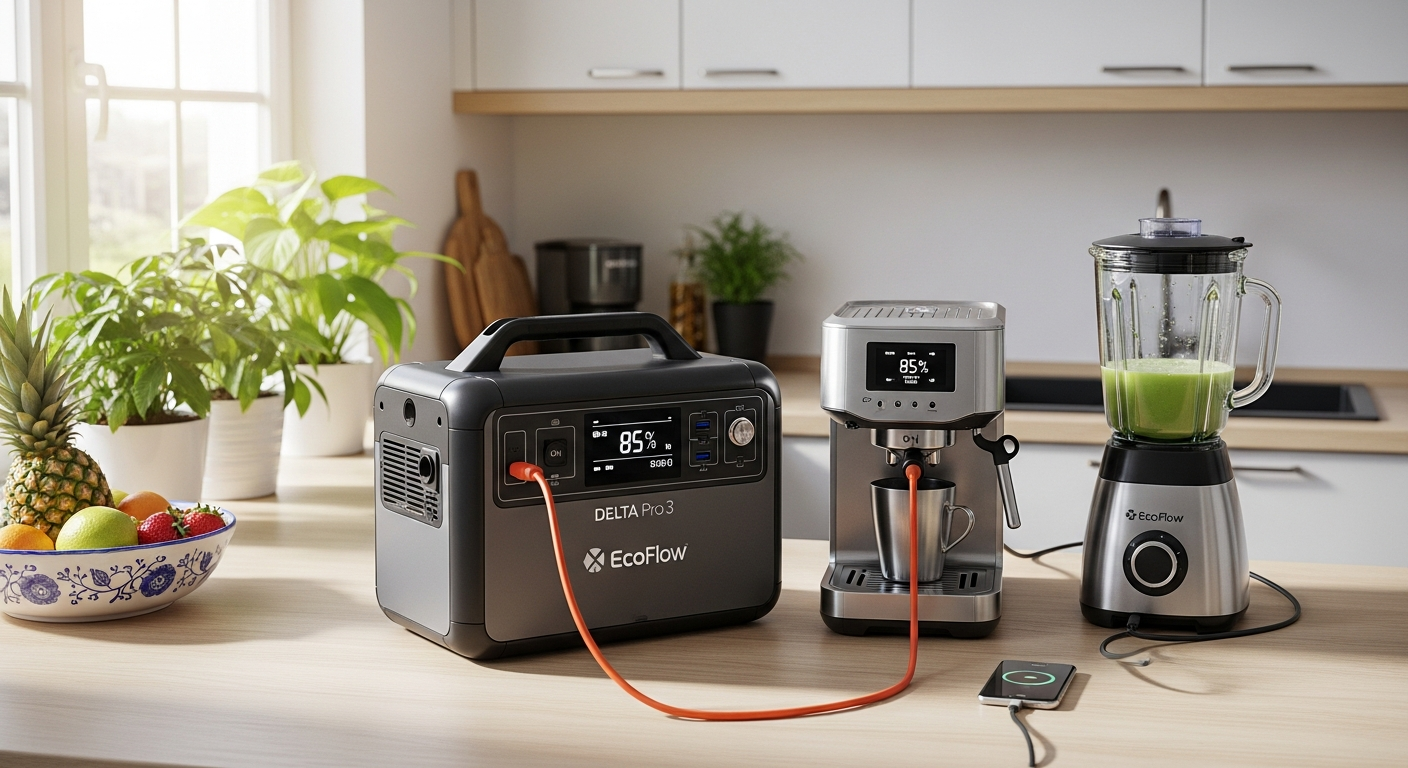
Power outages cost American households an average of $5,000 annually in lost productivity and spoiled goods—yet most homeowners remain unprepared. The EcoFlow DELTA Pro 3 changes that equation entirely. This portable power station represents genuine capacity without compromise, delivering the kind of reliable energy backup that serious users demand.
EcoFlow has built its reputation on bridging the gap between portable convenience and serious power capacity, representing the company's answer to a growing segment of users who refuse to compromise—whether they're preparing for grid instability, embracing off-grid living, or powering demanding outdoor operations. The DELTA Pro 3 stands out as one of EcoFlow's best-selling products, particularly in the German market and globally, due to its robust capabilities for home backup and off-grid applications.
Explore the EcoFlow DELTA Pro 3 and discover energy independence today. Throughout this guide, I'll walk you through the DELTA Pro 3's architecture, reveal what makes its LiFePO4 battery technology a game-changer, examine real-world performance scenarios, and help you determine whether this investment aligns with your energy needs.
Understanding the DELTA Pro 3's Core Architecture
The DELTA Pro 3 operates on a foundation of impressive specifications designed to scale from individual use to whole-home backup without requiring unit replacement. Its 4096Wh base capacity expands up to 48kWh through modular battery additions—a flexibility that accommodates evolving energy demands as your situation changes.
The power output speaks to its versatility: 4000W continuous delivery with 8000W surge capability means it powers virtually all household appliances simultaneously, including refrigerators, air conditioning units, and power tools. Most competitive alternatives struggle with this combination of sustained output and peak demand handling.
Battery technology forms the backbone of long-term reliability. The LiFePO4 chemistry delivers 4000 charge cycles to 80% capacity with a projected 10+ year lifespan—a genuine advantage over conventional lithium-ion alternatives. This isn't marketing hyperbole; the chemistry inherently resists degradation that plagues cheaper battery technologies.
An intelligent battery management system continuously optimizes performance through AI-powered algorithms that monitor health in real-time and extend battery longevity. The unit weighs approximately 113.5 lbs, making it transportable while maintaining serious capacity—a critical balance between portability and power.
EcoFlow backs this hardware confidence with a comprehensive 5-year manufacturer warranty, reflecting genuine faith in product durability and standing behind real-world performance.
The LiFePO4 Advantage: Why This Battery Technology Matters
Understanding why LiFePO4 chemistry matters requires examining what differentiates it from conventional lithium-ion. Superior thermal stability creates safer operation by reducing fire risk—a fundamental advantage when storing energy in your home or campsite. The chemistry doesn't suffer from the thermal runaway conditions that affect traditional alternatives.
Exceptional cycle longevity transforms the economics of battery ownership. Four thousand cycles to 80% capacity translates to genuine decade-plus performance, shifting the cost-per-cycle calculation dramatically in favor of upfront investment. A cheaper battery costing half as much but lasting one-third as long represents poor economics.
Minimal degradation trajectory means the DELTA Pro 3 maintains usable capacity far longer than conventional battery types. After five years, you'll experience minimal power loss. After ten years, the system remains substantially viable for essential home systems—most competitors would require replacement.
Temperature resilience matters for real-world deployment. LiFePO4 operates reliably across wider environmental ranges than conventional lithium-ion, performing adequately in cold climates and hot conditions where competitors falter.
Environmental sustainability receives increasing attention from conscious consumers. LiFePO4 chemistry is more recyclable and less toxic than legacy battery technologies, aligning with renewable energy adoption philosophies.
The cost-per-cycle analysis justifies the higher upfront investment through extended operational lifespan. Safety certifications confirming compliance with rigorous international standards for residential and off-grid applications provide additional assurance.
Charging Speed and Solar Integration Capabilities
Multi-source charging flexibility distinguishes the DELTA Pro 3 from single-input competitors. AC outlets, solar panels, and car chargers all work simultaneously, enabling hybrid charging scenarios that accelerate recharge times beyond any individual input method.
The unit accepts up to 2600W solar input capacity, pairing perfectly with EcoFlow's portable solar panel lineup for rapid off-grid recharging. For users committed to energy independence, this solar capacity creates genuine self-sufficiency when properly configured.
EcoFlow's proprietary fast-charging technology minimizes downtime between power cycles. AC charging speeds enable reaching full capacity in under 5 hours from standard household outlets—substantially faster than competitors requiring 8-12 hours for equivalent capacity.
Smart charging prioritization through app-controlled algorithms optimizes which input source charges first, protecting battery health during rapid recharge cycles. The system understands that different charging sources have different characteristics and manages them accordingly.
Hybrid charging scenarios combine solar and AC input for accelerated recharge times, particularly valuable in regions with variable sunlight. The intelligent system automatically balances inputs to maximize total charge speed while protecting battery longevity.
Visit EcoFlow to explore charging solutions and solar integration options.
Real-World Power Scenarios: What You Can Actually Run
Essential home systems operate for 24-48+ hours on a single charge—refrigeration, heating/cooling, lighting, and water pumps function reliably during extended grid outages. This capacity covers the critical period when most people restore power or relocate to safer locations.
Remote work setups maintain full functionality across multiple devices. Laptops, monitors, routers, and peripherals draw surprisingly modest power when properly configured, enabling full workdays without grid connection. Professionals can maintain productivity while others lack basic utilities.
Medical equipment represents a crucial use case. CPAP machines, oxygen concentrators, and dialysis equipment require continuous operation regardless of grid status—the DELTA Pro 3's reliability addresses life-critical needs where failure creates genuine danger.
Heavy-duty tools operate at full capability. Circular saws, angle grinders, and air compressors demand substantial surge power that smaller units cannot deliver. Contractors and DIY enthusiasts appreciate uninterrupted operation during projects.
Entertainment and comfort systems run without compromise. TVs, sound systems, and gaming equipment consume manageable power when added to other loads, maintaining normalcy during stressful outage periods.
Outdoor adventures gain household conveniences without generator noise or fuel logistics. Camping, RV travel, and glamping setups include refrigeration, charging stations, and entertainment systems that transform basic trips into comfortable experiences.
Backup for renewable systems pairs seamlessly with home solar installations for complete energy independence. The DELTA Pro 3 stores daytime solar production for nighttime use, maximizing renewable energy utilization and minimizing grid dependence.
Expandability: Building Your Perfect Energy Ecosystem
The modular architecture distinguishes the DELTA Pro 3 from fixed-capacity competitors. Battery modules stack to add up to 11 additional DELTA Pro batteries for 48kWh total capacity—approximately the equivalent of premium home installation systems at significantly lower cost.
Expand incrementally as budget and needs evolve rather than committing to maximum capacity upfront. This approach suits users with uncertain energy requirements, allowing growth as lifestyle changes increase power demands.
Parallel connection options enable multiple units to work together for distributed energy systems. This redundancy provides backup if one unit requires service, while expanding total capacity and output capability simultaneously.
Future-proofing investment becomes possible when the base unit remains valuable as expansion modules become more affordable. Avoid obsolescence by upgrading capacity instead of buying entirely new systems that render previous investments worthless.
Scalability without replacement means avoiding the frustration of outgrowing equipment shortly after purchase. As household electrification accelerates through heat pump adoption and EV charging, the expandable architecture accommodates growing demands.
Integration with home energy management works seamlessly when expandable systems connect with existing solar and smart home infrastructure. The DELTA Pro 3 becomes the centerpiece of a comprehensive energy ecosystem rather than an isolated backup solution.
Cost-effective capacity growth spreads investment over time rather than requiring massive upfront commitment. Users can start with base capacity and add modules as finances allow, reaching desired capacity through strategic incremental purchases.
Smart Features and App-Based Control
Real-time monitoring dashboards track power consumption, battery percentage, and input/output in live-time through intuitive interfaces accessible on smartphones. Users understand exactly how their energy flows and predict runtime remaining before recharge requirements.
Remote management capabilities enable controlling and monitoring the power station from anywhere via smartphone, providing peace of mind for off-grid deployments or monitoring home systems while away. Critical outage situations become manageable from remote locations.
Wi-Fi connectivity enables seamless integration with home networks for continuous data access. The system communicates with other smart home devices, creating automated responses to power fluctuations or outages.
AI-powered battery management implements machine learning algorithms that optimize charging patterns and extend lifespan through intelligent load management. The system learns your consumption patterns and adjusts accordingly.
Customizable power modes adjust performance profiles based on current energy priorities. Users toggle between maximum power output for demanding equipment and efficiency mode for extended runtime during outages.
Scheduled charging windows automate charging during off-peak hours for cost optimization, particularly valuable for users with time-of-use electricity rates. The system charges when grid power costs least, maximizing financial benefits.
Predictive analytics estimate runtime based on current consumption patterns, enabling planning for recharge timing and workload adjustments. Users never face surprising power depletion when intelligent forecasting provides advance warning.
Portability vs. Power: Honest Assessment of Weight and Mobility
The 113.5 lbs weight classification places the DELTA Pro 3 heavier than casual camping gear but lighter than fixed home battery installations. This positioning reflects design choices prioritizing capacity and output over ultralight portability.
Integrated carrying handles facilitate two-person transport or dolly-assisted movement, though the unit isn't designed for frequent relocation by single individuals. Strategic placement near power sources and solar arrays minimizes mobility requirements.
Stationary versus mobile use cases reveal that the DELTA Pro 3 performs better with semi-permanent placement than constant relocation. Users purchasing this unit should expect to position it somewhere relatively stable rather than moving it between locations regularly.
Vehicle transport considerations require planning for placement within SUVs and trucks. The unit fits in most larger vehicles, though dimension verification prevents unpleasant surprises at purchase time.
Setup location strategy matters substantially. Proximity to solar panels and AC outlets affects practicality, with extended cable runs reducing charging efficiency. Planning electrical layout before installation maximizes real-world performance.
Comparison to alternatives reveals that competitive options either weigh more with similar capacity or weigh less while sacrificing significant power output. The DELTA Pro 3 occupies a practical middle ground between ultraportable units and immobile installations.
Accessibility for different user demographics acknowledges that elderly or mobility-limited users may require assistance. Single-person operation isn't practical for everyone, affecting purchase viability in certain situations.
Investment Analysis: Price-to-Performance and Long-Term Value
The starting price point positions the DELTA Pro 3 at the premium tier, reflecting advanced features and substantial capacity. While not the absolute cheapest option, the feature set and longevity justify premium positioning when cost-per-cycle calculations span the full operational lifespan.
Cost-per-watt-hour analysis becomes favorable when calculated across the full 10+ year lifespan. Premium upfront investment distributes across thousands of charging cycles, creating competitive or superior economics compared to cheaper alternatives with shorter operational spans.
Comparison to traditional home battery systems reveals the DELTA Pro 3 as significantly more affordable than Powerwall alternatives while delivering comparable capacity and reliability. The cost differential makes genuine home backup accessible to broader market segments.
ROI through reduced outage vulnerability becomes quantifiable through avoided spoilage, productivity loss, and temporary relocation costs during extended grid failures. Conservative estimates suggest payback periods between three and six years through risk mitigation alone.
Electricity cost offset potential materializes through solar charging integration that reduces grid dependence over time. Users in high-cost electricity regions see measurable savings accumulate through decreased utility consumption.
Resale value trajectory favors high-quality LiFePO4 units retaining value substantially better than degrading lithium-ion competitors. Secondary markets value reliable batteries over time as grid instability increases demand.
Warranty and support investment reduces long-term ownership costs through comprehensive 5-year coverage. Manufacturing defect protection eliminates financial risk from unexpected failures during critical first years of operation.
Financing and payment plan options through various retailers reduce upfront burden by spreading costs across monthly installments, making energy independence accessible to budget-conscious consumers.
Competitive Positioning: How DELTA Pro 3 Stacks Up
Market leadership in capacity-to-price ratio distinguishes the DELTA Pro 3 from competitors offering similar wattage at higher costs. Independent analysis consistently ranks EcoFlow offerings as best-value alternatives in their performance tier.
Superior battery chemistry choice through LiFePO4 advantage over conventional lithium-ion in competing products creates meaningful differentiation. Competitors cutting costs through cheaper battery chemistry sacrifice longevity and safety—trade-offs that compound through extended ownership.
Expandability edge reflects modular design that outpaces fixed-capacity alternatives. Competitors forcing replacement purchases to increase capacity create customer frustration and lower lifecycle value.
Charging speed comparison reveals EcoFlow's proprietary technology as faster than most competitors, minimizing downtime and maximizing usable capacity during critical periods. The hybrid charging advantages compound through daily use cycles.
Brand reliability reputation establishes established track records in German and global markets, providing confidence in long-term support and product quality. Newer competitors lack the operational history that builds consumer trust.
Ecosystem integration enables seamless compatibility with EcoFlow solar panels and accessories, creating synergies unavailable through isolated competitors. Comprehensive ecosystems outperform point solutions in real-world deployment.
Customer support and warranty coverage through 5-year terms exceeds many competitors offering shorter protection periods. Extended warranty reflects manufacturer confidence while protecting consumers from premature failure risks.
Common Misconceptions and Questions Addressed
Portability questions receive nuanced answers: Yes, it's truly portable with caveats. The DELTA Pro 3 moves between locations better than fixed installations but suits semi-permanent rather than constantly mobile setups. Treating it as permanently stationed equipment maximizes practicality.
Battery degradation concerns dissolve upon examining LiFePO4 chemistry ensuring minimal degradation over decade-plus lifespans. Users concerned about battery replacement can reasonably expect the unit to remain substantially viable for essential systems after ten years of daily use.
Whole-house power capacity depends on household size and consumption patterns. The DELTA Pro 3 typically supports 24-48 hours of essential systems—refrigeration, heating/cooling, lighting, and water—rather than indefinite full-capacity operation. Realistic expectations prevent disappointment.
Price justification becomes apparent through cost-per-cycle analysis demonstrating competitive economics with alternatives. Premium features and longevity justify upfront investment when calculated across operational lifespan rather than initial purchase price.
Solar panel requirements generate frequent questions: Not required, but they dramatically improve off-grid viability and reduce electricity costs. Grid-connected users benefit from solar integration but maintain functionality without panels.
Learning curve concerns resolve quickly—the app interface proves intuitive for basic operation while advanced features remain optional for users preferring simplified control. Most consumers master essential functions within minutes.
Failure scenarios trigger warranty discussions: The 5-year warranty covers manufacturing defects while customer support responsive across markets addresses operational questions. Real-world failure rates remain exceptionally low with LiFePO4 technology.
Choosing the Right Use Case for Your Situation
Home backup priority identifies ideal candidates among grid-reliability concerned users. If grid stability concerns dominate your decision-making, the DELTA Pro 3 addresses this priority directly through reliable capacity and expandability.
Off-grid living commitment designates this system as essential component for permanent or extended remote residence. The scalability and solar integration create sustainable energy solutions supporting decades of off-grid operation.
Outdoor adventure enabler motivation suits extended camping and RV travel users refusing to compromise on comfort. The system supports conveniences without generator noise or fuel logistics, transforming basic trips into comfortable experiences.
Renewable energy storage applications position the DELTA Pro 3 as perfect complement to rooftop solar installations. Maximum self-consumption of solar production requires adequate storage—this unit delivers that capacity at competitive pricing.
Business continuity applications power remote offices and critical equipment during outages, protecting productivity and revenue during grid failures. Professionals and entrepreneurs justify investment through concrete economic protection.
Emergency preparedness goals achieve realistic outcomes through genuine backup capacity in natural disaster-prone regions. Peace of mind carries measurable value when facing genuine risk scenarios.
Sustainability goal alignment materializes through reduced carbon footprint from renewable energy integration. Users committed to environmental impact reduction find meaningful carbon reduction through grid independence.
Your Path to Energy Autonomy Starts Here
The EcoFlow DELTA Pro 3 represents a genuine inflection point in how consumers approach energy security. It's not just another portable power station—it's a scalable, intelligent system that grows with your ambitions while delivering the reliability of established home battery technology at a fraction of the cost. The LiFePO4 battery chemistry, coupled with EcoFlow's proven fast-charging capabilities, creates a compelling foundation for anyone serious about energy independence.
I've examined the weight trade-offs, the premium pricing, and the learning curve required to maximize features. Honestly, none of these drawbacks outweigh the core value proposition: genuine home backup capacity, expandable architecture, and a decade-plus operational lifespan. Whether you're preparing for grid instability, embracing off-grid living, or simply refusing to be caught unprepared during the next outage, this power station delivers on its promises.
The real question isn't whether the DELTA Pro 3 is capable—it absolutely is. The question is whether energy independence aligns with your priorities and lifestyle. If it does, this unit deserves serious consideration. Start by calculating your household's essential power requirements, exploring EcoFlow's solar panel options, and mapping out your expansion timeline. Your future self—the one sitting comfortably during the next outage—will thank you for the investment.
Begin your energy independence journey with the EcoFlow DELTA Pro 3 today.
Leave a Reply