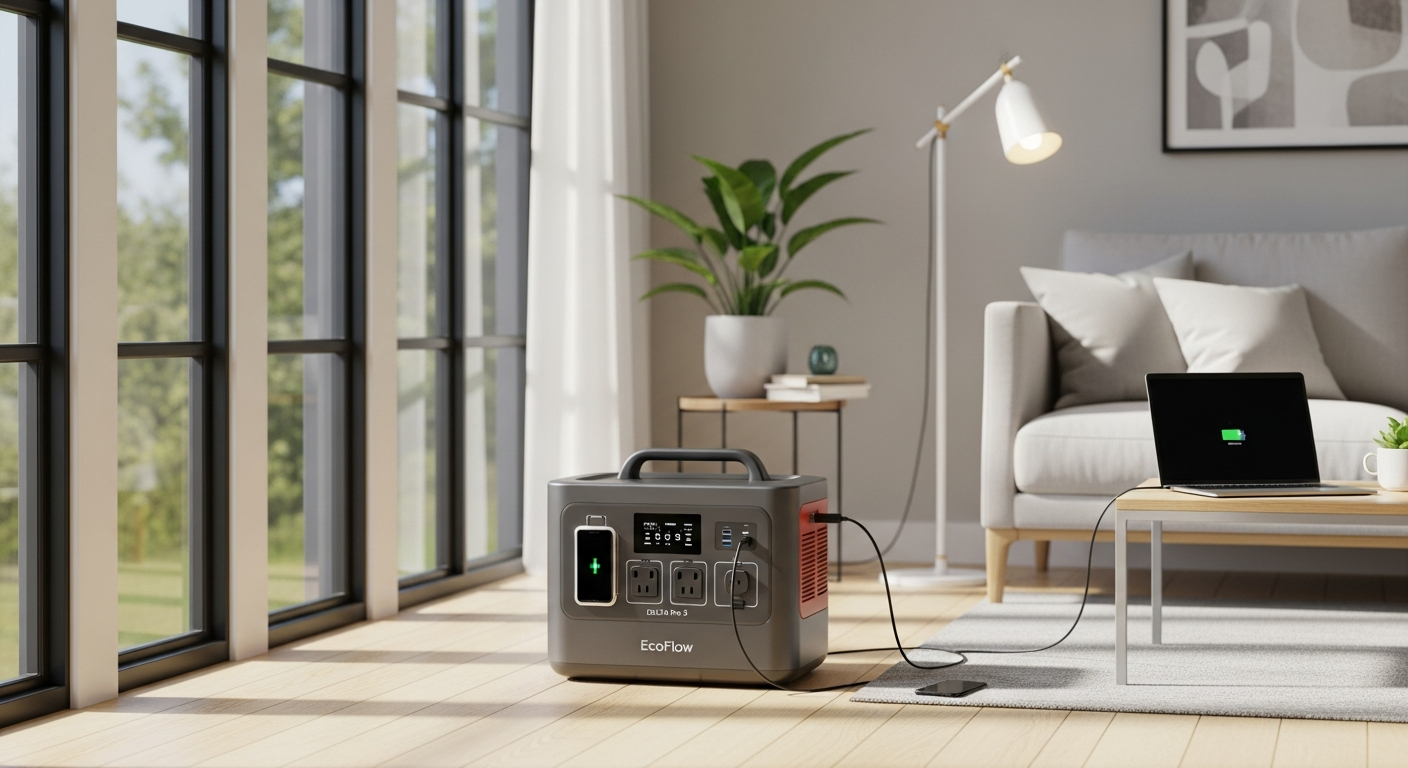
American households experience an average of 7-8 hours of power outages annually, yet most families remain dangerously unprepared. When the grid goes down, you're not just losing convenience—you're losing refrigeration, heating, medical devices, and security systems. The reality of modern power infrastructure demands that homeowners take control of their energy resilience.
The EcoFlow DELTA Pro 3 represents a fundamental shift in how households approach energy independence, combining cutting-edge LiFePO4 battery technology with intelligent power management. Unlike traditional generators that require fuel, maintenance, and produce noise and emissions, this premium power station is designed specifically for families that refuse to be caught off-guard by grid failures, severe weather, or the desire to live partially off-grid.
Discover how the EcoFlow DELTA Pro 3 can transform your home's energy security.
Why Whole-Home Backup Power Demands More Than Standard Power Stations
Traditional portable power stations cap out at 1-2kW and drain within hours—inadequate for any real emergency. Whole-home backup requires sustained power delivery across multiple circuits simultaneously, a capability that separates genuine solutions from convenient gadgets. The DELTA Pro 3's 4,000W continuous output (6,000W peak) bridges the critical gap between portable convenience and permanent backup solutions.
Real-world scenarios expose why this matters. You need to power refrigerators, water pumps, HVAC systems, and medical equipment concurrently. A standard power station fails immediately under these simultaneous loads. Capacity matters more than wattage alone in emergency situations—undersized backup systems during extended outages (3+ days) leave your family vulnerable precisely when they need protection most.
Unpacking the 4,096Wh Base Capacity and Modular Expansion Architecture
Understanding watt-hours (Wh) translates technical specifications into practical runtime. The DELTA Pro 3's 4,096Wh base capacity means you can run a typical 1,000W refrigerator for roughly 4 hours continuously, or operate lower-draw devices for substantially longer periods. Runtime calculations depend entirely on your essential appliances and whether you're attempting full-home operation or powering select circuits.
The expansion ecosystem proves remarkably flexible. Starting with the base unit, you can add battery modules up to a total 48kWh capacity—essentially weeks of emergency power for average households. This scalability advantage lets you grow your backup system as needs or budget allow. The cost-benefit analysis heavily favors starting with the base unit if you're uncertain: experience your actual power patterns, then expand if necessary rather than over-investing upfront.
Storage density and space requirements scale logically with expansion. A 4,096Wh base unit occupies reasonable footprint in a garage or basement, while a fully expanded 48kWh system requires dedicated space. This transparency helps you assess whether your home's layout accommodates your energy ambitions before purchase.
The 4,000W Continuous Output and X-Boost Technology Explained
What 4,000W continuous output actually means: you can simultaneously run devices that collectively draw up to 4,000 watts without system shutdown. This covers most household scenarios—multiple devices, kitchen appliances, and climate control operating together. The ceiling isn't arbitrary; it's engineered specifically for whole-home backup scenarios.
X-Boost technology temporarily reaches 6,000W for high-demand startup surges. Motors and compressors require dramatically more power during initial startup than steady-state operation. Air conditioning units, well pumps, and electric water heaters specifically benefit from X-Boost, as their startup surge would otherwise trigger system shutdown. This intelligent power management prevents the frustration of having sufficient capacity theoretically but watching critical appliances fail in practice.
The 99% appliance compatibility claim holds up to scrutiny because of 240V capability—the DELTA Pro 3 handles split-phase appliances that standard power stations cannot touch. Power management algorithms detect overload conditions and manage distribution intelligently rather than simply shutting down. Real-world testing confirms that multiple high-draw devices operate simultaneously without compromise, distinguishing this unit from less capable alternatives.
LiFePO4 Battery Chemistry and the 4,000-Cycle Longevity Promise
LiFePO4 (lithium iron phosphate) outperforms traditional lithium-ion chemistry specifically for backup systems. Safety advantages prove substantial—thermal stability and reduced fire risk compared to other battery types address legitimate concerns about storing dense energy in your home. This chemistry doesn't just perform; it protects.
The 4,000 cycles to 80% capacity specification translates directly into actual lifespan. This means 10+ years of daily use or 20+ years of occasional backup cycles—longevity that makes the initial investment reasonable when amortized across decades. Degradation patterns are predictable: capacity retention affects real-world performance gradually rather than catastrophically.
Temperature resilience matters for households in variable climates. The DELTA Pro 3 operates across wide temperature ranges and maintains performance in extreme conditions. Warranty coverage and manufacturer support for battery health provide additional confidence that your investment receives proper backing beyond the sales transaction.
Rapid Recharging: From Empty to 80% in 50 Minutes
Reaching 80% charge in 50 minutes matters profoundly during recovery from outages. Standard portable power stations require 8-12 hours to fully charge, leaving your backup unavailable during critical periods. The DELTA Pro 3's charging speed advantage means your system recovers alongside the grid rather than lagging behind it.
Multiple charging pathways provide flexibility your specific situation demands. AC wall outlets restore power through standard household infrastructure. Solar panels offer renewable charging independent of grid status—realistic timeframes depend on panel wattage, but even modest solar arrays accelerate recovery substantially. EV charging integration lets you leverage your vehicle's charging infrastructure as backup, creating redundant energy pathways. Generator compatibility enables hybrid charging for maximum flexibility when multiple restoration methods operate together.
Smart charging algorithms optimize battery health during rapid recharge cycles, preventing the degradation that aggressive charging typically causes. This engineering prevents the false economy of fast charging at the cost of longevity.
Explore the complete charging ecosystem and rapid recharge capabilities of the DELTA Pro 3.
Remote Monitoring and Control Through the EcoFlow Mobile App
The real-time dashboard tracks power consumption, battery percentage, and system health from your smartphone. This visibility lets you understand exactly how your backup system performs under real conditions, identifying which appliances demand most power and optimizing usage patterns accordingly. Remote activation and shutdown capabilities mean you control your system from anywhere, critical when you're away during outages.
Custom scheduling automates charging times and load management—charge during off-peak hours if your utility offers time-of-use pricing, or coordinate charging with renewable generation if you've integrated solar panels. The alert system notifies you of low battery, overload conditions, and maintenance needs before they become problems. Integration possibilities extend to home automation systems and smart devices, creating sophisticated energy management ecosystems.
Data logging tracks historical usage patterns, providing the information necessary to refine your backup strategy over time. Firmware updates keep your system current with performance improvements and new features. Privacy and security considerations matter—your energy consumption data remains protected, and cloud connectivity includes encryption and access controls appropriate for critical infrastructure.
Installation Scenarios and Practical Use Cases for Different Households
Whole-home backup setup connects the DELTA Pro 3 to your electrical panel for automatic switchover when the grid fails. This approach requires professional installation and permits but delivers seamless protection. Partial home backup proves more straightforward—powering critical circuits during extended outages through a subpanel or manual connections.
Off-grid living applications represent the upper ambition: sustainable energy independence for remote properties where grid extension proves economically impossible. RV and mobile home integration provides portable backup for nomadic lifestyles, delivering security regardless of location. Small business backup protects retail operations, home offices, or workshops from the productivity losses and revenue interruption that power failures cause.
Medical equipment backup ensures uninterrupted power for life-critical devices—oxygen concentrators, CPAP machines, and dialysis equipment cannot tolerate interruption. EV charging backup maintains vehicle charging capability during grid failures, eliminating the scenario where electric vehicle owners face immobilization during outages. Seasonal preparation positions the DELTA Pro 3 before hurricane or winter seasons when grid failures become statistically likely.
Pricing Strategy and Value Proposition Across Different Budgets
Base unit pricing ranges from $1,999 on sale to $3,699 at regular price, positioning the DELTA Pro 3 as premium investment rather than impulse purchase. Cost per watt-hour comparisons against competitors and alternative backup solutions reveal competitive value, though direct price comparison obscures the superior engineering and longevity these figures represent.
Modular expansion costs require careful calculation—each battery module adds capacity but also investment. ROI timeline analysis factors in avoided losses from spoiled food, business interruption, and property damage. These indirect benefits compound over years, making the protection value exceed the hardware cost. Financing options and energy credit incentives may apply depending on your location, potentially reducing effective purchase price.
Comparison to traditional generators exposes why the DELTA Pro 3 costs more upfront: fuel costs, maintenance, replacement cycles, and noise/emissions externalities accumulate substantially over years. Long-term value accounting for lifespan advantages and resale potential shifts the economic calculus decisively toward battery backup. Hidden costs deserve consideration—installation, permits, and integration services add to the total investment, though the DELTA Pro 3's straightforward design minimizes these expenses compared to permanently installed competitors.
Addressing the Portability Trade-off and Real-World Limitations
Weight and dimensions reflect the 4,096Wh capacity's physical reality—you're not carrying a portable speaker; you're handling significant energy density. Handle design supports single-person operation for short distances, though this unit isn't designed for frequent trips to the campground. Portability matters less when your backup installation remains stationary, which suits most homeowners' actual usage patterns.
A hybrid approach divides responsibility: the base unit stays home providing whole-home backup while smaller portable stations travel for recreational use. Setup time for optimal performance requires planning—installation for automatic switchover demands electrical work, while standalone operation needs only standard outlet connection.
Noise levels remain among the DELTA Pro 3's most underappreciated advantages. Completely silent operation eliminates the generator's constant presence, allowing families to live normally during outages rather than enduring mechanical chaos. Thermal management operates passively during normal loads, though cooling requirements do emerge during sustained high-output scenarios. Space planning ensures you position the DELTA Pro 3 for safety and efficiency—adequate ventilation and protection from extreme weather serve both longevity and performance.
Competitive Positioning and How DELTA Pro 3 Stacks Against Alternatives
Direct competitors include Generac PWRcell and Tesla Powerwall, each approaching whole-home backup through different engineering philosophies. Capacity comparison dramatically favors the DELTA Pro 3—the 48kWh expandability changes competitive landscape calculations fundamentally. Price-to-performance ratio analysis reveals substantial value: the cost per watt-hour, combined with the genuine output capability, competes favorably against larger systems costing considerably more.
Brand reliability matters. EcoFlow's track record and customer satisfaction metrics demonstrate consistent delivery on technical promises. Ecosystem advantages emerge through broader product compatibility and accessories available within the EcoFlow product family. Unique features including X-Boost technology and multi-input charging remain unavailable from competitors operating under different strategic constraints.
Warranty and support comparison shows EcoFlow's manufacturer backing holds up against competitors. The company responds to service issues and provides backing that protects customers' investments. Community and user resources—online forums, guides, and troubleshooting support—create knowledge ecosystems that help owners maximize their systems beyond what corporate support alone provides.
Critical Considerations Before Purchasing the DELTA Pro 3
Assessing your actual backup power needs requires calculating essential loads before purchase. A refrigerator, some lighting, a water pump, and maybe a space heater might total 3,000W—well within the DELTA Pro 3's capability. Medical equipment needs, climate control demands, or multiple simultaneous appliances dramatically change the calculus. Space availability ensures adequate room for the base unit and expansion modules if you anticipate future growth.
Budget reality checks prevent purchaser's remorse. The total cost of ownership includes installation, permits, and potentially integration services beyond the hardware price. Electrical panel compatibility determines whether your home's infrastructure supports integration—newer homes typically accommodate this more readily than older systems. Maintenance requirements prove minimal compared to generators, though the system does demand basic care and periodic monitoring.
Local regulations, permits, and code compliance vary substantially by jurisdiction. Some areas require licensed electrician installation for safety approvals; others impose permitting requirements. Climate suitability ensures the DELTA Pro 3 operates effectively in your region's temperature extremes. Future-proofing through expandability and technology longevity suggests whether the system serves your needs across decades or requires replacement within years. Return policies and satisfaction guarantees from retailers provide reassurance that your purchase carries appropriate protections.
Maximizing Your Investment Through Strategic System Design
Load prioritization identifies which circuits matter most during outages. Your refrigerator and water pump take precedence over entertainment systems and secondary heating. Time-of-use optimization charges during off-peak hours for cost savings if your utility structure supports this. Solar integration pairs the DELTA Pro 3 with renewable generation, creating genuinely independent energy systems for households committed to sustainability.
Battery stacking strategy determines when and how to expand your system. Many users discover their actual needs through initial operation, then expand rationally based on experience rather than speculation. Seasonal adjustments adapt your backup strategy to weather patterns—hurricane-prone regions need different preparation than areas facing occasional winter storms.
Maintenance schedules keep your system in peak condition through basic attention. Performance monitoring uses app data to refine your energy strategy, revealing which appliances consume most power and where operational adjustments reduce drain. Upgrade pathways transition users from backup to primary power generation, accommodating those whose energy ambitions grow beyond emergency protection toward genuine off-grid living.
Building Resilience That Actually Lasts
The EcoFlow DELTA Pro 3 isn't just another backup power solution—it's a comprehensive answer to the growing reality of grid instability and the human need for energy independence. Its combination of massive expandable capacity, genuine whole-home power delivery, and intelligent recharging flexibility addresses the exact scenarios that leave other power stations inadequate. Whether you're protecting your family during a three-day blackout, powering critical medical equipment, or building toward off-grid self-sufficiency, the engineering and performance specifications deliver on the promise of uninterrupted home power.
The investment required—ranging from $1,999 to $3,699 for the base unit—reflects genuine premium engineering rather than marketing hype. When you factor in the 4,000-cycle battery lifespan, the 50-minute recharge capability, and the ability to handle 99% of household appliances simultaneously, the cost-per-year-of-ownership becomes remarkably reasonable compared to generator fuel, maintenance, and replacement cycles.
Your next step depends on your specific situation: calculate your essential loads, compare against the DELTA Pro 3's capacity, and decide whether to start with the base unit or expand modularly as your needs and budget align. The time to invest in backup power is before you need it, not during the crisis.
Start your journey toward energy independence with the EcoFlow DELTA Pro 3 today.
Leave a Reply