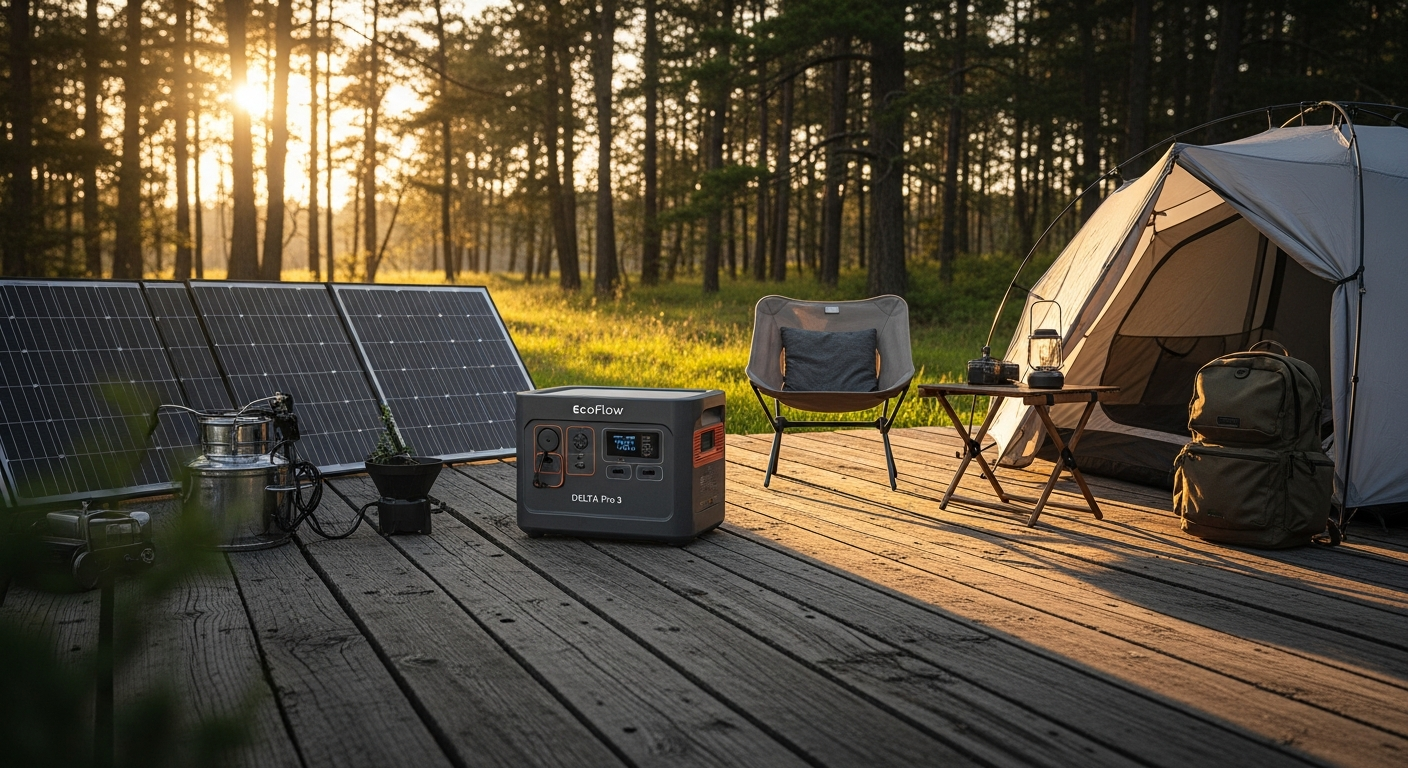
Off-grid living isn’t a pipe dream anymore—it’s becoming increasingly achievable for homeowners willing to invest in the right technology. The fantasy of complete energy independence has transformed into a practical reality, driven by advances in battery storage and renewable energy systems that actually work in remote environments. Serious off-grid seekers are moving beyond theoretical discussions into real implementations powered by systems engineered specifically for these demanding conditions.
The EcoFlow DELTA Pro 3 represents a fundamental shift in how energy independence works, offering expandable 4kWh to 36kWh capacity with dual-voltage output designed specifically for whole-home applications. This isn’t a camping gadget masquerading as serious infrastructure—it’s a platform built from the ground up for properties where grid connection simply isn’t an option. The system accommodates everything from seasonal cabins to full-time homesteads, scaling as your needs evolve rather than forcing you into a one-size-fits-all solution.
This guide reveals how the expandable capacity transforms your independence strategy, why 240V capabilities matter for actual homes beyond smartphone charging, and whether the investment makes genuine sense for remote living scenarios. You’ll examine real-world energy demands, explore the technology that separates this system from competitors, and honestly assess whether this represents the right approach for your specific situation.
Explore the EcoFlow DELTA Pro 3 capabilities and current pricing
Off-Grid Energy Requirements: Why Capacity Matters More Than You Think
Off-grid systems fail not from lack of technology but from fundamental miscalculation of actual power consumption. A remote home operates entirely differently from a grid-connected residence—there’s no backup from neighboring infrastructure, no surge capacity from distant power plants, and no second chances when seasonal demands peak simultaneously.
Understanding baseline power consumption for remote homes
Baseline loads define the minimum power your system must deliver continuously. A typical off-grid home consumes 10-20 kilowatt-hours daily through heating systems, cooling equipment, water pumping, refrigeration, lighting, and appliances. Mountain cabins in winter demand significantly more than summer retreats. A well pump pulling water 200 feet from underground requires sustained power that cannot be interrupted. Electric water heaters consume enormous amounts of energy. Heating systems—whether air-source heat pumps or resistance heating—dominate winter energy budgets in cold climates.
These baseline demands continue whether you’re home or away, awake or sleeping. They represent non-negotiable consumption that your system must support without exception.
The difference between peak demand and continuous draw in off-grid scenarios
Peak demand occurs when multiple appliances activate simultaneously. Running a well pump while heating water while cooking while operating HVAC systems creates instantaneous power requirements far exceeding baseline consumption. Most systems can handle peaks for short durations through capacitor discharge and battery inverter surge capacity, but only if the underlying system has sufficient storage to support it.
Continuous draw represents the power your system maintains indefinitely. A refrigerator cycles on and off, averaging perhaps 200 watts continuous draw. A heating system might run 40% of the time during cold seasons. These sustained demands determine whether your battery reserves deplete or stabilize over days and weeks.
Peak power matters tremendously—you need it to start motors and power resistance elements. Continuous draw matters even more—it determines whether you wake up with depleted batteries or sufficient reserves for tomorrow’s demands.
Why undersized systems fail during critical moments
Undersized off-grid systems fail predictably: on cold winter mornings when heating demand peaks, during multi-day cloudy periods when solar charging stops, when equipment failures force extended runtime on backup systems, or during seasonal transitions when weather becomes unpredictable. These aren’t hypothetical scenarios—they’re recurring situations in remote properties.
A system that works fine in summer suddenly becomes inadequate when days shorten and heating demands triple. A drought period lasting weeks can deplete a system designed for average conditions. Equipment failures force extended runtime on backup systems at exactly the moment when that capacity matters most.
How the DELTA Pro 3’s expandable design addresses varying seasonal demands
The DELTA Pro 3 begins with 4kWh—sufficient for light off-grid use, emergency backup, or supplementary power. This base capacity handles 1-2 days of typical consumption with adequate solar charging. For permanent off-grid living, most users expand to 8-12kWh, supporting 2-3 days of autonomy with moderate consumption. Extreme applications—full winter heating, no solar production, minimal consumption control—require 20-36kWh systems.
The genius of expandable architecture emerges here: you don’t purchase maximum capacity upfront. You begin with realistic baseline needs, then add modules as usage patterns emerge and seasonal demands become clear. A summer cabin might stay at 4-8kWh. A full-time homestead with heating demands probably expands to 16-24kWh. A property combining heavy loads with unreliable weather could require the full 36kWh capability.
This modularity prevents both undersizing (failing during critical moments) and wasteful oversizing (purchasing capacity you never use). You scale based on honest assessment of your actual requirements.
Calculating your specific power requirements before investing
Calculate daily consumption by totaling the wattage of every device you’ll operate and the hours of daily use. A well pump drawing 1500 watts for 2 hours daily consumes 3 kilowatt-hours. A heating system drawing 5000 watts for 6 hours during cold months consumes 30 kilowatt-hours. Refrigeration at 200 watts for 24 hours consumes 4.8 kilowatt-hours. Lighting, cooking, hot water, and entertainment add another 5-10 kilowatt-hours.
Real off-grid homes with heating typically demand 30-60 kilowatt-hours daily during winter. Summer consumption drops to 10-20 kilowatt-hours as heating and hot water demands decline. Peak winter mornings might demand 15-20 kilowatts simultaneously.
This calculation determines what you actually need. Then multiply daily consumption by 3-5 days to establish reserve capacity for cloudy periods or solar production shortfalls. A property consuming 40 kilowatt-hours daily during winter months needs 120-200 kilowatt-hours of storage to maintain 3-5 days of autonomy. The DELTA Pro 3 at maximum expansion (36kWh) provides roughly 1 day of winter autonomy for such a property—adequate only with robust solar generation or generator backup.
The DELTA Pro 3 excels when actual consumption aligns with its capacity range: seasonal cabins, moderate-consumption homesteads, properties with supplementary solar and generator backup, or grid-adjacent locations using it for emergency backup rather than exclusive power.
Expandable Architecture: From 4kWh to 36kWh Without Replacement
The modular battery approach fundamentally changes how you approach off-grid investment. Rather than guessing your needs and committing to fixed capacity, you build capacity as experience informs requirements. This flexibility prevents both the waste of oversizing and the disappointment of undersizing.
Base 4kWh capacity and what it realistically powers
The base DELTA Pro 3 provides 4 kilowatt-hours—enough for approximately one full day of moderate off-grid consumption without solar charging. A property using 4kWh daily (typical for minimal consumption, high efficiency, or part-time occupancy) can operate indefinitely with just this base unit and reliable solar charging. Most remote homes exceed this consumption, especially during winter or when heating is required.
Real-world applications for 4kWh systems include emergency backup for grid-connected homes, seasonal cabin support with supplementary solar, RV power, or temporary off-grid applications. As standalone off-grid infrastructure for full-time habitation with heating, it’s genuinely undersized for most climates and use cases.
Modular expansion strategy and how additional battery modules integrate seamlessly
Additional DELTA Pro 3 battery modules connect through standardized interfaces, expanding total capacity without replacing existing hardware. The system manages charge distribution, load balancing, and discharge across all modules automatically. You don’t reconfigure wiring or reprogram settings—you physically add modules and the system adapts.
This seamless expansion means your initial investment in the base unit and inverter infrastructure remains productive regardless of how much you eventually expand. The first module you purchase works identically whether you’re adding one expansion unit or eventually expanding to maximum capacity. No legacy equipment becomes obsolete as you scale.
Scaling your system as energy needs grow or change
Expansion follows your actual experience with off-grid demands rather than theoretical projections. Your first winter in a remote property reveals actual heating consumption. Your first summer drought period shows whether solar charging keeps pace with usage. Year two might bring livestock or a new structure, increasing baseline consumption. Year three might add a backup generator, reducing required battery capacity.
Rather than committing to estimated needs, you scale based on honest assessment of what your property actually demands. Properties that prove more efficient than projected never purchase maximum capacity. Properties with unexpected consumption growth expand as needed rather than regretting an undersized initial choice.
Cost-effectiveness of expansion versus purchasing a new system outright
Expanding the DELTA Pro 3 costs substantially less than purchasing an entirely new backup system. You’re adding battery modules without duplicating the inverter, power management electronics, or charging infrastructure. Each expansion module integrates with existing equipment, spreading infrastructure costs across larger capacity.
Purchasing a competing 16kWh system outright might cost more than expanding the DELTA Pro 3 from 4kWh to 16kWh, especially considering the remaining useful life of equipment you’ve already purchased. The modular approach rewards early commitment to the platform.
Compatibility considerations when adding extra battery modules
All DELTA Pro 3 expansion modules are compatible—older modules work alongside newer ones without firmware conflicts or performance degradation. The system’s power management handles variations in battery age and cycle count, distributing loads intelligently across available capacity.
Your base unit purchased today remains fully compatible with expansion modules purchased years later, preserving your initial investment and making long-term planning feasible.
Future-proofing your investment through modular design
Modular architecture protects against obsolescence. Rather than replacing the entire system if your needs evolve, you add or subtract components. If you eventually connect to grid power, the DELTA Pro 3 transitions from primary power source to supplementary backup. If you add solar panels, the system integrates them seamlessly. If you install a generator, the DELTA Pro 3 manages charging from multiple sources simultaneously.
This flexibility extends the useful life of your initial investment and prevents the painful experience of outgrowing equipment that still functions perfectly.
Dual-Voltage Output and Whole-Home Appliance Support
Standard backup systems provide 120V power, adequate for lights, electronics, and small appliances but utterly useless for heavy equipment. The DELTA Pro 3 delivers both 120V and 240V simultaneously, fundamentally expanding what an off-grid system can power. This dual-voltage capability transforms it from “backup power for essentials” to “whole-home power source.”
120V versus 240V power delivery and which appliances require which voltage
120V powers most household electronics: lights, televisions, computers, microwave ovens, and standard outlets. These devices work fine on battery backup power, requiring modest current flow at lower voltage.
240V powers heavy-duty equipment requiring sustained power delivery: electric water heaters, HVAC systems, electric resistance heating, air conditioning compressors, well pumps, electric ranges, and clothes dryers. These appliances demand substantial power that 120V systems cannot provide regardless of battery capacity. A 4000-watt water heater simply cannot operate on 120V power—the current required would demand impossibly large gauge wiring and create excessive losses.
Home electrical systems are 240V at the service entrance, split into 120V circuits throughout the house. True whole-home backup requires 240V capability at significant power levels.
X-Boost technology and how it extends power capacity to 6000W
The DELTA Pro 3 delivers continuous 4000W at 240V, with X-Boost technology extending instantaneous output to 6000W for short durations. This boost capacity starts motors drawing high inrush current and powers surge loads without battery damage or inverter shutdown.
A well pump might draw 8000W instantaneously during startup, settling to 4000W continuous operation once running. X-Boost allows the system to handle this startup surge, then sustain continuous operation within normal power ratings.
Running heavy-duty equipment: HVAC systems, well pumps, electric water heaters
The DELTA Pro 3 can power full-sized HVAC systems during extended outages. Air conditioning units typically draw 3000-4000W continuously, fitting within standard power ratings. Heat pumps demand similar continuous power but higher startup surge. Well pumps drawing 4000W continuous operation run indefinitely with sufficient battery capacity and solar charging.
Electric water heaters present different challenges—their 4000-5000W draw is sustainable, but they consume enormous daily energy. A family using 40 gallons of hot water daily requires 3-4 kilowatt-hours just for water heating. In an off-grid system with limited total capacity, running electric water heating limits capacity for other essential loads.
The DELTA Pro 3 can technically power any of these devices. The question is whether your total system capacity supports running them while meeting other essential loads simultaneously.
Simultaneous multi-appliance operation and power management
Multiple appliances draw power simultaneously in any functional home. Cooking while heating water while cooling the house while running the well pump creates total demand potentially exceeding 15,000 watts. A 4000W (or 6000W boosted) system cannot handle this combined load.
Off-grid living requires conscious load management—deliberately staggering when major appliances operate to prevent simultaneous high-demand periods. Heating water at off-peak times, cooking during solar production hours, running irrigation or well pumps during daylight, and scheduling energy-intensive tasks around available solar output becomes routine behavior.
The DELTA Pro 3 handles simultaneous loads up to its power rating, but full-time off-grid residents learn to choreograph their daily routines around available power rather than expecting unlimited simultaneous consumption.
Avoiding overload situations in real off-grid scenarios
System overload triggers automatic shutdown—protection that prevents damage but leaves you without power at the moment you need it most. Avoiding overload requires both sufficient instantaneous capacity and deliberate user discipline about load management.
Inverters incorporate load-shedding capabilities: non-essential circuits disconnect automatically when total demand approaches maximum, preserving power for essential equipment. The DELTA Pro 3’s management systems handle this automatically, but the result is inconvenience at critical moments.
Understanding your system’s capabilities and intentionally managing loads prevents these situations. Running a backup generator handles simultaneous heavy loads while charging batteries simultaneously—the DELTA Pro 3 accepts charging from multiple sources including generators, allowing you to power heavy equipment through the generator while charging batteries with excess capacity.
Comparing the DELTA Pro 3’s output to typical home circuit breaker capacity
Typical residential service provides 100-200 amp capacity at 240V—roughly 24,000-48,000 watts continuous available power. The DELTA Pro 3 at 4000W provides roughly 2-4% of typical home electrical capacity.
This comparison reveals the honest reality: the DELTA Pro 3 isn’t a replacement for full home electrical service. It’s a substantial backup system, equivalent to one or two major circuits in a conventional home. It powers essential loads—heating, water, refrigeration, lighting—but not simultaneously with heating, cooking, and other heavy demands.
This constraint isn’t a failure—it’s reality. Off-grid living requires accepting different usage patterns from grid-connected convenience. Backup power systems extend the functionality of remote properties substantially beyond what’s possible without them, but they don’t replicate unlimited grid power availability.
Safety features and automatic load balancing
The DELTA Pro 3 incorporates thermal management, overload protection, short-circuit detection, and automatic shutdown mechanisms preventing damage from user error or equipment failures. The system balances loads across multiple battery modules automatically, preventing individual module overload while others remain underutilized.
These safety systems protect your investment and prevent dangerous situations in remote locations where professional service isn’t immediately available. The intelligence built into the system handles edge cases and failure modes transparently, requiring no user intervention.
Check current specifications and safety certifications for the DELTA Pro 3
Multi-Source Charging for Remote Locations
Off-grid power systems survive through diversified charging—no single source reliably powers an off-grid home year-round. Solar production varies seasonally and weather-dependent. Generators provide backup but consume expensive fuel. Grid charging works seasonally or partially. The DELTA Pro 3 accepts power from all these sources, adapting to whatever resources your location offers.
Solar charging integration and optimal panel configurations
Solar panels represent the primary energy source for off-grid systems. The DELTA Pro 3 accepts DC input from solar arrays, converting it to charging current for battery storage. Optimal configurations match panel array size to system capacity and location’s solar production potential.
A 4kWh system in a good solar location (8+ peak sun hours daily) might charge fully from a 2-3kW solar array. The same system in a poor location (4-5 peak sun hours, seasonal shading) requires 4-5kW capacity just to maintain baseline charging. Full 36kWh systems demand substantial solar arrays—10-15kW—to charge in reasonable timeframes.
The DELTA Pro 3’s charging circuitry adapts to available solar input, accepting power from small arrays on cloudy days and scaling to handle maximum array output during peak sun. Multiple battery modules increase charging capacity proportionally.
AC charging capabilities when grid connection is available (seasonal or partial)
Many off-grid properties maintain seasonal grid connections—powered during winter months when generation drops, then disconnecting during abundant summer. Others maintain partial grid connections for specific loads or emergency situations. The DELTA Pro 3 accepts AC power for charging from any standard outlet, meaning it can charge from generators, grid connections, or any AC source available.
Charging speed from AC sources far exceeds solar charging—the system can charge from 0 to 80% in roughly 50 minutes, a dramatic advantage during brief grid availability windows or when emergency AC power becomes available.
EV charging compatibility and implications for electric vehicle owners
Off-grid properties increasingly feature electric vehicles, creating interesting power dynamics. The DELTA Pro 3 can charge EVs from stored battery power (during peak sun or after generator charging), managing the extremely high power draw EV charging demands. DC fast charging requires more power than the system can deliver, but AC Level 2 charging works within the system’s capacity.
For off-grid EV owners, this means charging vehicles during peak solar production hours or delaying charging until generator-powered battery charging sessions complete. The vehicle’s battery effectively acts as secondary storage, extending energy storage across multiple vehicles and creating flexibility around charging schedules.
Generator backup charging for emergency situations
Generators charging the DELTA Pro 3 create interesting efficiency dynamics—generators are inefficient at partial load, so running them specifically to charge batteries (rather than powering loads directly) makes sense only during peak demand periods or when generator runtime is otherwise necessary.
The DELTA Pro 3 accepts generator charging while simultaneously powering loads, meaning a generator can handle heavy instantaneous loads (well pump startup, HVAC operation) while charging batteries for later use. This hybrid approach stretches generator fuel supply and reduces runtime requirements.
Charging speed comparisons across different input methods
Solar charging depends on sun angle and weather—optimal conditions produce charging rates matching system capacity, but cloudy days reduce this dramatically. Cold, clear winter days provide minimal solar charging despite abundance of sunshine (high angle, low irradiance).
AC charging at 3000W input charges a 4kWh battery in roughly 90 minutes, or 0-80% in 50 minutes as rated. This speed makes emergency charging feasible if AC power becomes available.
Generator charging varies with generator output and charging circuit limitations. A 7500W generator can charge while simultaneously powering loads, effectively multiplying available power temporarily.
Most off-grid systems rely on solar for baseline charging, with generators as occasional backup and AC charging for emergency or seasonal supplementation.
Efficiency losses and realistic charging timelines in real conditions
Charging efficiency varies by method: solar charging loses 10-15% in wiring and conversion, generator charging loses 15-20% accounting for generator efficiency and charging circuit losses, AC charging loses roughly 10% in conversion. These losses mean real-world charging takes longer than nameplate specifications suggest.
A 4kWh system on marginal solar might take 8-10 hours to charge fully, not the 2-3 hours theoretical maximum. Generator charging under high load (powering equipment while charging) stretches this further. AC charging achieves closest to nameplate speeds.
Planning realistic charging timelines around actual conditions—accounting for weather, seasonal variation, and load management—prevents the disappointment of expecting faster charging than your location supports.
Weather and seasonal impacts on solar charging performance
Winter months in many climates produce half the solar power of summer, not due to reduced daylight hours alone but because of lower sun angle and increased atmospheric thickness. A system producing 8kWh daily in summer might produce 3-4kWh daily in winter.
Extended cloudy periods (common in many climates) reduce solar charging to 10-20% of clear-day potential. Storm seasons and monsoon periods can eliminate solar charging entirely for days.
The DELTA Pro 3’s expandable capacity addresses this reality—winter power demands increase while solar production decreases, requiring substantial battery reserves to bridge the gap. Systems in seasonal climates must either expand significantly or incorporate generator backup for winter survival.
LiFePO4 Battery Technology and Long-Term Reliability
Battery chemistry determines longevity, safety, and usability of backup power systems. The DELTA Pro 3 uses LiFePO4 (lithium iron phosphate) chemistry rather than conventional lithium-ion, a fundamental advantage for off-grid applications where reliability and lifespan matter profoundly.
Why LiFePO4 chemistry outperforms traditional lithium-ion for off-grid use
LiFePO4 batteries tolerate deep discharge cycles better than lithium-ion—traditional lithium chemistry degrades rapidly when repeatedly discharged below 20% capacity, while LiFePO4 maintains performance even after thousands of complete discharge cycles.
LiFePO4 demonstrates superior thermal stability, remaining safe even when overcharged or short-circuited—critical for remote locations where immediate professional service isn’t available. The chemistry doesn’t experience thermal runaway under abuse conditions that would trigger fires in traditional lithium-ion cells.
LiFePO4 cycles better in extreme temperatures, maintaining functionality in both cold and hot climates where lithium-ion performance degrades significantly. Off-grid properties in challenging climates benefit profoundly from this resilience.
3,000+ charge cycles to 80% capacity and what that means in practice
The DELTA Pro 3 specification promises 3,000 complete charge cycles while maintaining 80% capacity—meaning after 3,000 full charge/discharge cycles (equivalent to roughly 8 years of daily cycling), the battery retains 3.2kWh capacity from the original 4kWh.
For off-grid users operating daily cycles, 3,000 cycles represents 8-10 years of service. A remote property drawing 4kWh daily cycles the full battery daily, reaching 3,000 cycles in roughly 8 years. Properties drawing 2kWh daily (half the battery capacity) require 15,000 charge cycles to reach 3,000 complete cycles, extending lifespan to 20+ years.
This longevity fundamentally changes cost-of-ownership calculations. A system lasting 15-20 years costs far less annually than one requiring replacement every 5-7 years.
Expected 10+ year lifespan and total cost of ownership calculations
The manufacturer’s specification of 10+ year expected lifespan assumes roughly daily cycling under normal conditions. Real-world experience varies based on actual cycling patterns, temperature management, and charging discipline.
Systems cycled less than daily (properties sized conservatively or with excellent solar production) likely outlast specifications, while systems pushed to maximum capacity daily might experience degradation beyond the rated cycle count.
Cost-of-ownership calculations including battery replacement must account for this longevity advantage. A 15-year lifespan at $1,999 installed cost equals roughly $133 annual depreciation plus electricity cost to charge it (primarily solar cost in off-grid applications—essentially free beyond initial panel investment).
Compare this to generator-based backup: 15 years of generator operation at 500 hours annually (conservative for off-grid use) consumes roughly 3,750 gallons of fuel at $4-6 per gallon—$15,000-22,500 in fuel costs alone, plus maintenance and replacement equipment.
Safety advantages in remote locations without immediate service access
LiFePO4’s thermal stability means the system won’t spontaneously catch fire if accidentally overcharged, short-circuited, or exposed to temperature extremes. This safety advantage becomes critical in remote locations where fire rescue services are hours away.
The DELTA Pro 3’s management system prevents abuse situations entirely, but the underlying chemistry provides failsafe protection if management systems somehow fail. Remote users can trust the battery chemistry itself won’t betray them.
Thermal management and performance in extreme off-grid environments
The DELTA Pro 3 incorporates active thermal management, monitoring battery temperature and adjusting charge/discharge rates to maintain safe operating ranges. In extreme heat, the system reduces charging current to protect battery longevity. In cold conditions, the system actively manages temperature to prevent damage.
This thermal awareness becomes essential in remote properties without climate control. A battery storage system in an uninsulated shed experiences temperatures from -20°F in winter to 130°F in summer. The DELTA Pro 3’s management handles these extremes better than passive battery systems, but thermal management still imposes limits on charging/discharge rates in extreme conditions.
Warranty coverage and manufacturer support for extended use
EcoFlow provides substantial warranty coverage—five years on the base unit and batteries, covering defects and degradation beyond rated specifications. This warranty only applies to the purchaser at the original location, meaning off-grid properties are fully covered if they remain in your ownership.
Manufacturer support for genuine off-grid systems is limited—EcoFlow’s primary market is emergency backup and portable power, not full-time off-grid infrastructure. For serious off-grid operations, you’re largely self-sufficient regarding maintenance and support. The warranty provides fallback protection against manufacturing defects, but ongoing support depends on your own capabilities.
Degradation patterns and realistic battery performance over time
LiFePO4 batteries degrade gradually and predictably. After 3,000 cycles, capacity drops to 80% and continues declining roughly 1-2% annually thereafter. After 10 years, a DELTA Pro 3 retains roughly 60-70% of original capacity—still useful for supplementary backup but no longer suitable as primary power source for demanding off-grid applications.
At this degradation point, users typically expand the system with additional modules, adding capacity while allowing the aged system to continue functioning. Eventually, the cost of module replacement justifies decommissioning aged systems, but useful life extends 15-20 years even with significant degradation.
The Investment Reality: Price, Value, and ROI for Off-Grid Living
The DELTA Pro 3 commands a substantial price reflecting its capabilities and LiFePO4 chemistry. Understanding true cost-of-ownership—including installation, integration, expansion, and opportunity cost—determines whether this investment makes financial sense for your specific situation.
$1,999 current pricing versus $3,699 MSRP and discount availability
The DELTA Pro 3 carries an MSRP of $3,699 but regularly sells for $1,999—roughly 46% off list price. This discount reflects both aggressive marketing and the genuine commodity nature of battery storage (prices declining rapidly as production scales).
Current pricing of $1,999 represents genuine value for the capabilities included. The discount from MSRP is real and sustainable—EcoFlow’s business model depends on volume sales at lower prices rather than premium positioning. Future price declines are likely, but waiting for lower prices risks opportunity cost from delayed backup system implementation.
Total system cost including necessary solar panels, wiring, and installation
A functional off-grid system requires more than the battery unit. A 4kW solar array supporting the DELTA Pro 3 costs roughly $3,000-4,000 installed. Proper wiring, disconnects, and safety equipment add $1,000-2,000. Professional installation and permitting add $2,000-3,000 in most areas.
Total system cost: $1,999 (DELTA Pro 3) + $4,000 (solar) + $2,000 (wiring) + $2,500 (installation) = $10,500 minimum for a basic off-grid system. Expanding to 8kWh battery capacity adds $2,000-3,000. Adding generator backup adds another $3,000-5,000.
A modest off-grid installation runs $12,000-15,000. A comprehensive system with expansion capacity and generator backup reaches $20,000+. These costs make sense only if your property’s value and quality-of-life improvement justify the investment.
Comparing cost-per-watt-hour to other premium backup solutions
The DELTA Pro 3 costs roughly $0.50 per watt-hour at the $1,999 price point (4kWh base). Expanded to 36kWh, this drops to roughly $0.055 per watt-hour—genuinely competitive with grid-scale battery storage.
Competing premium backup systems range from $0.30 to $0.80 per watt-hour depending on chemistry and features. The DELTA Pro 3’s cost positioning reflects its LiFePO4 advantage and expandable architecture—you’re not paying premium prices for luxury; you’re paying for longevity and reliability.
Cheaper lead-acid systems cost $0.15-0.25 per watt-hour but require replacement every 5-7 years, making true cost-of-ownership comparable to the DELTA Pro 3 despite lower upfront cost.
ROI timeline for off-grid homeowners versus grid-connected backup users
ROI calculations differ dramatically based on context. A grid-connected homeowner using the DELTA Pro 3 purely for emergency backup sees 10-15 year payoff (calculating fuel savings versus generators and reduced blackout costs). A property frequently experiencing extended outages might reach payoff within 5-7 years.
An off-grid property eliminating generator dependence through solar plus battery backup reaches payoff within 8-10 years, factoring in fuel savings and avoiding generator replacement. Properties that avoid land acquisition costs by becoming sustainable see dramatically better ROI.
The most compelling ROI emerges for off-grid properties where battery backup enables livability that would otherwise require grid connection or constant generator operation. If you’re choosing between $50,000 grid extension or $15,000 off-grid system, the DELTA Pro 3 ROI becomes essentially infinite—it enables your project where alternatives fail.
Financing options and payment plans for substantial investments
EcoFlow and retailers offer financing plans for purchases exceeding $1,000, spreading payments across 12-24 months at variable interest rates. Credit card rewards sometimes offset financing costs. Some solar installers bundle battery purchase with panel installation, offering better financing terms through renewable energy programs.
For remote properties without established credit or bank access, financing options might not exist. Property owners in developing regions or off-grid locations should investigate available options before committing.
Hidden costs: installation, permits, professional setup, and integration
Professional installation costs vary wildly by region: $500-1,500 in rural areas with experienced installers, $2,000-3,000 in competitive markets, $3,000+ in major metropolitan areas. DIY installation saves this cost but risks electrical safety issues and code violations.
Permitting varies from absent (rural properties with limited regulation) to expensive (locations requiring engineering certifications and professional installation). Budget $500-1,500 for permits and inspections in regulated areas.
Grid connection removal or conversion adds cost if existing wiring must be reconfigured. Integration with existing systems (solar arrays, generators, water systems) adds complexity and professional fees.
Many remote properties skip formal permits and professional installation, accepting risk in exchange for cost savings. Others spend substantially more than their budget to meet local code requirements. Know your local situation before calculating true cost.
Long-term savings through reduced generator fuel consumption
The clearest financial benefit emerges from generator elimination. Off-grid properties operating generators 500+ hours annually spend $2,000-3,000 on fuel alone. Add maintenance, equipment wear, and noise pollution, and generator operation becomes expensive.
Solar plus battery backup eliminates generator operation on good weather days and reduces it during poor conditions. A property reducing generator operation from 500 to 100 hours annually saves $1,600-2,400 fuel cost, plus $500+ annual maintenance. Over 15 years, this accumulates to $25,000-40,000 in savings.
The DELTA Pro 3 becomes financially attractive primarily when it eliminates generator dependence or prevents grid extension costs that would otherwise exceed system cost substantially.
Practical Limitations and Honest Trade-Offs
The DELTA Pro 3 represents a genuine advance in off-grid technology, but honest assessment requires acknowledging limitations and requirements that might not align with every situation or expectation.
Weight and physical footprint despite portability claims
The base DELTA Pro 3 weighs roughly 62 pounds—legitimately portable but not something you carry casually. Each expansion module adds similar weight. A fully expanded 36kWh system exceeds 400 pounds, requiring permanent installation rather than portability.
The “portable” designation applies relative to home backup systems (which are permanently mounted) rather than relative to camping equipment. Off-grid homesteads accept this weight as trade-off for capacity. Properties requiring truly portable power should consider smaller units.
Space requirements for base unit plus expandable modules
The base unit occupies roughly 2 feet × 1.5 feet × 1 foot. Each expansion module requires similar footprint. A 36kWh fully expanded system occupies roughly 20-30 cubic feet, equivalent to a large refrigerator or small closet.
Off-grid installations typically dedicate a small equipment shed or closet to power equipment. Aesthetic concerns drive some installations to hide the system entirely. Space requirements are manageable for dedicated installations but present challenges for compact properties.
Installation considerations for permanent off-grid setups
The DELTA Pro 3 ships ready to operate from standard outlets—you can unbox and operate immediately. Permanent off-grid installation requires proper mounting, environmental protection, and hardwired electrical connections bypassing standard outlets.
Professional installers handle these connections, but DIY installers must understand electrical safety and local codes. Improper installation creates fire risk or damage to expensive equipment.
Noise levels during operation (compared to generators)
The DELTA Pro 3 operates
Leave a Reply