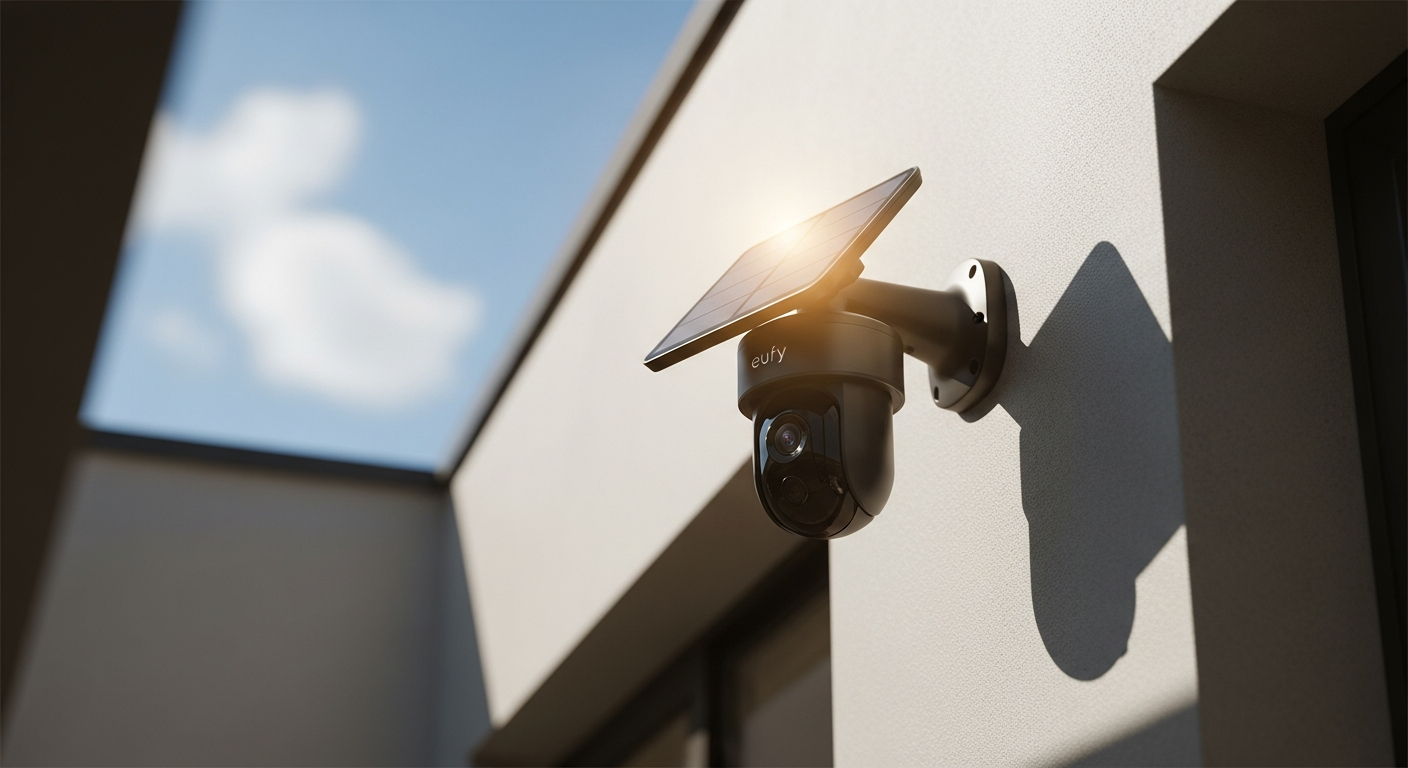
Most homeowners ditch their security systems within a year. The culprits? Constant battery replacements, subscriptions that drain your wallet month after month, and the creeping anxiety about where your footage actually lives. The EufyCam 3 S330 flips this script entirely—solar panels that genuinely work, local storage that means no monthly fees, and AI smart enough to know the difference between your pet and an actual intruder.
What makes this system stand out isn’t just one feature. It’s the combination of solar-powered operation, the HomeBase 3 hub with expandable local storage, and Bionic Mind AI all working together to create something rare: a security investment that actually improves with time instead of becoming a financial burden.
This guide breaks down how the EufyCam 3 truly functions in real conditions, from how those solar panels keep batteries running through winter to why local storage matters far more than cloud promises. You’ll understand what 4K resolution actually captures, how the AI reduces the notification fatigue that exhausts most users, and whether weatherproof ratings translate to real durability.
The Solar Revolution in Wireless Security Cameras
How Integrated Solar Panels Charge the EufyCam 3 Batteries
The solar panels built into each EufyCam 3 camera aren’t marketing gimmicks—they’re engineered to handle real-world conditions. These integrated panels work by converting sunlight directly into charging current that flows to the camera’s internal battery. The system doesn’t require constant, intense sunlight. A few hours of daily exposure is genuinely sufficient to maintain charge cycles, even during less-than-ideal seasons.
The charging mechanism works intelligently. When sunlight hits the panel, the camera prioritizes charging the battery before powering other functions. This hierarchy ensures that even on cloudy days, the system captures what it can and stores energy for later use. The batteries themselves are designed with substantial capacity to bridge gaps between sunny periods.
Why Solar-Powered Cameras Eliminate Frequent Manual Recharging
Traditional wireless cameras become possessions you resent. Every 2-3 months, you’re climbing ladders to swap batteries, fumbling with connectors, and hoping you don’t drop your phone while balancing on a roof. Solar-powered alternatives flip this burden entirely. Once installed, an EufyCam 3 with functional solar panels requires virtually no manual intervention.
This freedom matters more than it initially sounds. Consistency in security monitoring depends on whether your system actually works day after day. Manual recharging creates gaps—the period when cameras are offline while you retrieve the ladder and find replacement batteries. Solar charging runs continuously, seamlessly, without ever asking for your attention.
Geographic Location, Seasonal Sunlight, and Charging Efficiency
Not all locations receive equal sunlight throughout the year. This isn’t a flaw in the system; it’s reality that EufyCam 3’s design acknowledges. A camera positioned on a south-facing wall in southern France will charge more efficiently than one in a northern location during winter months. Seasonal variations matter.
However, the system accounts for this variability. Battery capacity is sized to handle periods of reduced charging. During winter months with shorter days, the camera slows its power consumption slightly, extending the time it can operate on stored energy. This adaptive approach means the EufyCam 3 functions across diverse geographic zones without requiring constant intervention.
Orientation and obstruction matter more than raw location. A camera pointed north or shaded by trees will charge more slowly than one receiving direct afternoon sunlight. Seasonal leaf coverage or seasonal snow can temporarily reduce efficiency, but these are temporary variations, not permanent limitations.
Battery Capacity Specifications and 24/7 Operation
EufyCam 3 cameras incorporate substantial battery capacity designed to support continuous operation. The internal battery stores enough energy to keep the camera running through multiple cloudy days or nights without solar input. This capacity ensures that 24/7 monitoring isn’t dependent on perfect weather.
The system calculates power consumption carefully. Video recording, AI processing, spotlight activation—each function draws power strategically. The camera doesn’t drain its battery running unnecessary processes. Instead, it streams what’s necessary for security while conserving energy for critical functions.
Local Storage Without Monthly Subscriptions—The HomeBase 3 Advantage
Built-in Storage and Expandable Capacity
The HomeBase 3 ships with 16 GB of built-in storage, which handles days of footage. More importantly, this storage is expandable up to 16 TB through additional hard drives or solid-state drives. This capacity isn’t theoretical—it’s practical storage that actually accommodates months or years of video depending on your configuration.
Compare this to cloud storage, which typically caps at a few terabytes before requiring enterprise-level pricing. Your HomeBase 3 becomes a dedicated security server, storing footage without limits beyond your physical hardware choices. You control how much storage you maintain—a crucial distinction that separates ownership from subscription dependency.
How Local Storage Eliminates Cloud Subscription Fees
Cloud storage subscriptions represent the hidden cost of most security systems. Eufy’s cloud plans typically range from €5-15 monthly, depending on storage capacity and camera count. Over five years, a single camera with basic cloud storage costs approximately €300-900 in subscriptions alone. Add multiple cameras, and these fees become substantial.
The HomeBase 3 eliminates this treadmill entirely. Your footage stays on hardware you own, connected to your network, processed locally. No recurring payments. No negotiating with a company about storage policies. No wondering whether your data might be sold or accessed without your knowledge.
Long-term Cost Comparison: HomeBase 3 Investment vs. Cloud Storage
A 3-camera EufyCam 3 kit runs approximately €523.87 initially. A 4-camera kit with 1TB hard drive costs around €429.99. These are substantial upfront investments, but the math shifts dramatically over time.
A comparable cloud-based system with similar camera count and storage capacity accumulates costs relentlessly. At €10 monthly per camera (a conservative estimate), three cameras generate €360 annually in subscription fees alone. Over five years, that’s €1,800 in recurring costs—nearly matching or exceeding the initial EufyCam 3 investment. Add a fourth camera, and five-year costs approach €2,400.
The HomeBase 3 with expandable storage breaks this cycle. Once purchased, your storage costs stabilize. A 2TB external drive costs €50-80 once, not monthly. This fixed-cost model means the system becomes increasingly economical as months pass.
Data Ownership and Privacy Benefits
Cloud storage means outsourcing control of your security footage to a third party. You’re trusting that company’s security practices, privacy policies, and business decisions. If they’re acquired or change their terms, your options are limited.
Local storage through HomeBase 3 restores ownership. Your footage lives on your hardware, accessed through your network, processed by algorithms running locally rather than on remote servers. No company intermediaries. No encryption keys held elsewhere. No terms of service that change unexpectedly.
AI-Powered Detection That Actually Reduces False Alarms
Bionic Mind AI and Local Video Processing
Eufy’s Bionic Mind AI runs directly on the HomeBase 3, not on distant servers. This local processing changes how the system functions. Instead of sending raw video to cloud servers for analysis, the HomeBase 3 analyzes video locally, immediately, and continuously. The speed eliminates delays inherent in cloud-based systems.
This architecture offers a critical advantage: smarter filtering. The AI examines every frame, identifying not just motion but actual people, vehicles, pets, and recognized faces. Local processing means these analyses happen instantly, enabling real-time decision-making about what warrants a notification.
Person, Face, Pet, and Vehicle Recognition Capabilities
Bionic Mind AI distinguishes between different types of movement. A person walking across your yard triggers different logic than a leaf blowing in the breeze or a branch moving in wind. This categorization forms the foundation of the system’s ability to reduce false alarms.
Face recognition adds another layer. The system can learn your family members’ faces, your regular visitors, and your neighbors. When these recognized faces appear, the system logs the event differently than unknown persons. This intelligence allows you to prioritize notifications—alerting you to unfamiliar people while quietly noting trusted visitors.
Pet recognition functions similarly. Many security systems trigger constantly for household pets. EufyCam 3’s AI recognizes dogs and cats, distinguishing them from potential security threats. Vehicle recognition works the same way, identifying cars and classifying them as your own vehicles or unfamiliar ones based on training.
Customizable Detection Zones and Activity Filtering
You control which areas of your footage trigger notifications. Rather than every motion activating alerts, you define zones of interest. The driveway generates notifications, but wind-blown trees in the background don’t. Windows facing the street stay monitored, but motion near landscaping remains logged without constant alerts.
This customization extends to activity types. You can filter for people-only detection, ignoring vehicle movement if your driveway camera’s primary concern is pedestrian activity. Alternatively, you emphasize vehicle alerts for parking areas. The flexibility adapts the system to your specific security priorities.
Reducing Notification Fatigue Through Intelligent Filtering
Notification fatigue breaks security systems. When every shadow, rustling bush, and passing vehicle generates alerts, you stop reading notifications. Your phone becomes noise. Critical alerts blend into the endless stream of irrelevant events.
EufyCam 3’s intelligence filters aggressively. By processing locally and understanding what’s actually happening in the footage, the system separates signal from noise. You receive notifications about actual security events—unknown persons, suspicious vehicles, unusual activity. The constant chatter of false alarms stops.
This reduction in noise paradoxically increases security. You’re more likely to respond to notifications because they’re meaningful rather than reflexive. Your attention sharpens. Your response time improves. The system serves its actual purpose instead of becoming a source of frustration.
4K Video Quality and Night Vision Performance in Real Conditions
3840 x 2160 Pixel Resolution Benefits
4K resolution means 3840 x 2160 pixels per frame, representing roughly four times the detail of 1080p alternatives. This difference matters for security. When you examine footage of an incident, higher resolution captures distinguishing features—facial details, license plate numbers, clothing patterns, distinctive tattoos or scars.
Daytime footage particularly benefits from 4K’s detail. A person’s face captured at this resolution remains identifiable across frames. A vehicle’s license plate becomes readable rather than pixelated. These details matter when security incidents occur and you need to identify individuals or provide information to authorities.
Daytime Image Clarity, Color Accuracy, and Dynamic Range
EufyCam 3 cameras deliver bright, clear daytime footage with accurate color representation. Shadows don’t crush into featureless blacks, and bright areas don’t blow out into white overexposure. This dynamic range—the camera’s ability to handle both bright and dark areas simultaneously—creates footage that preserves detail across diverse lighting conditions.
Color accuracy extends to identification. Clothing, vehicle colors, and environmental details remain true to reality rather than appearing distorted or heavily color-cast. This accuracy matters when sharing footage with others or reviewing events that occurred outside your presence.
Color Night Vision with Integrated Spotlight Functionality
Many security cameras surrender color information in low light, reverting to infrared black-and-white vision. EufyCam 3’s integrated spotlight changes this equation. When the camera detects activity during darkness, the spotlight activates automatically, illuminating the scene and enabling color vision.
This approach offers several advantages. Color footage provides better identification detail than infrared. The spotlight’s brightness deters intrusion attempts—most would-be criminals prefer darkness. The psychological effect of illuminated cameras proves as valuable as the improved visibility.
The spotlight isn’t a continuous floodlight draining batteries constantly. It activates intelligently based on detected activity, preserving battery life while providing visibility when needed.
Low-Light Performance Limitations and Distance Effectiveness
No system performs perfectly in all conditions. EufyCam 3’s infrared night vision mode (when the spotlight isn’t activated) functions well at close to moderate distances but becomes less detailed at extreme distances. A person 10 feet away appears clearly in infrared; at 50 feet, detail diminishes.
The spotlight addresses this limitation to a degree. Its illumination range extends farther than infrared, enabling color visibility at greater distances. However, extremely distant nighttime activity still relies on infrared detail that naturally becomes less sharp with distance.
This limitation is honest rather than a flaw. Most security incidents occur within moderate distances of properties. Doorways, pathways, and common intrusion routes fall within ranges where the camera excels. Distant perimeter monitoring faces inherent limitations regardless of camera brand.
Weatherproof Design and Outdoor Durability Standards
IP67 Weatherproof Rating and Its Practical Meaning
IP67 rating means the camera withstands dust and water immersion. The “6” signifies complete dust protection—no particles penetrate the housing. The “7” indicates water resistance up to 1 meter depth for 30 minutes. For practical purposes, this rating ensures rain, snow, and even hose washing don’t damage the camera.
This rating doesn’t mean the camera is indestructible. Submersion beyond the rated depth, extreme pressure, or physical damage can compromise the seal. However, for typical outdoor installation in most climates, IP67 provides genuine protection.
Temperature Range Specifications and Seasonal Performance
EufyCam 3 cameras function across temperature ranges typical of most European climates. Extreme temperatures—far below freezing or above standard operating ranges—can affect performance. However, normal seasonal variations from winter cold to summer heat fall well within operational specifications.
Battery performance changes slightly with temperature. Cold reduces chemical efficiency slightly, meaning charging and discharge rates may decrease in winter. This is expected behavior with lithium batteries, not a defect. The system’s capacity accounts for this variation.
Housing Materials and Resistance to UV Damage, Corrosion, and Physical Impact
The camera housing uses materials selected for outdoor durability. UV-resistant plastics prevent sun degradation that would make white cameras yellow and brittle over years of exposure. Metal components use corrosion-resistant materials to withstand weather and salt air (relevant for coastal installations).
Physical impact resistance is adequate for typical mounting environments. The cameras won’t survive being dropped from heights or struck directly, but normal installation on walls, under eaves, or on poles involves no such forces. The housing survives accidental bumping during cleaning or maintenance.
Longevity Expectations and Multi-Year Reliability Data
EufyCam 3’s popularity in the French market provides real-world longevity data. Many systems installed 2-3 years ago continue functioning reliably. The most common point of failure involves battery degradation after extended use, a predictable outcome of rechargeable battery technology.
A well-maintained EufyCam 3 system typically delivers 4-5 years of primary service, with cameras remaining functional but potentially requiring battery replacement around year four. This lifespan matches or exceeds cloud-based alternatives while costing substantially less over the ownership period.
Your Path Forward: Building a Security System That Pays for Itself
The EufyCam 3 S330 represents something genuinely different in home security—not incremental improvement, but fundamentally different economics. You’re acquiring 4K resolution that captures stunning detail, solar panels that genuinely sustain operation, and a HomeBase 3 that terminates the subscription treadmill.
The mathematics work in your favor. That €429-523 initial investment becomes progressively more valuable with each month you avoid cloud storage fees. Five-year ownership costs plateau while cloud-based alternatives accumulate relentlessly. You’re potentially saving hundreds of euros while maintaining absolute control of your footage and privacy.
Bionic Mind AI fundamentally changes the notification experience. False alarms diminish. Meaningful alerts rise to prominence. You’re not ignoring constant noise; you’re receiving actual intelligence about your property. This shift transforms security from frustrating overhead into genuinely useful information.
Privacy concerns disappear when your footage never leaves your network. No third-party company holds encryption keys. No distant servers store your front-door footage. No terms-of-service changes suddenly alter how your data is handled. Your security remains yours.
If recurring fees frustrate you, if privacy matters, and if you’re ready to own your security infrastructure outright, the EufyCam 3 S330 deserves serious consideration. This isn’t a compromise solution. It’s the direction home security is moving.
Leave a Reply