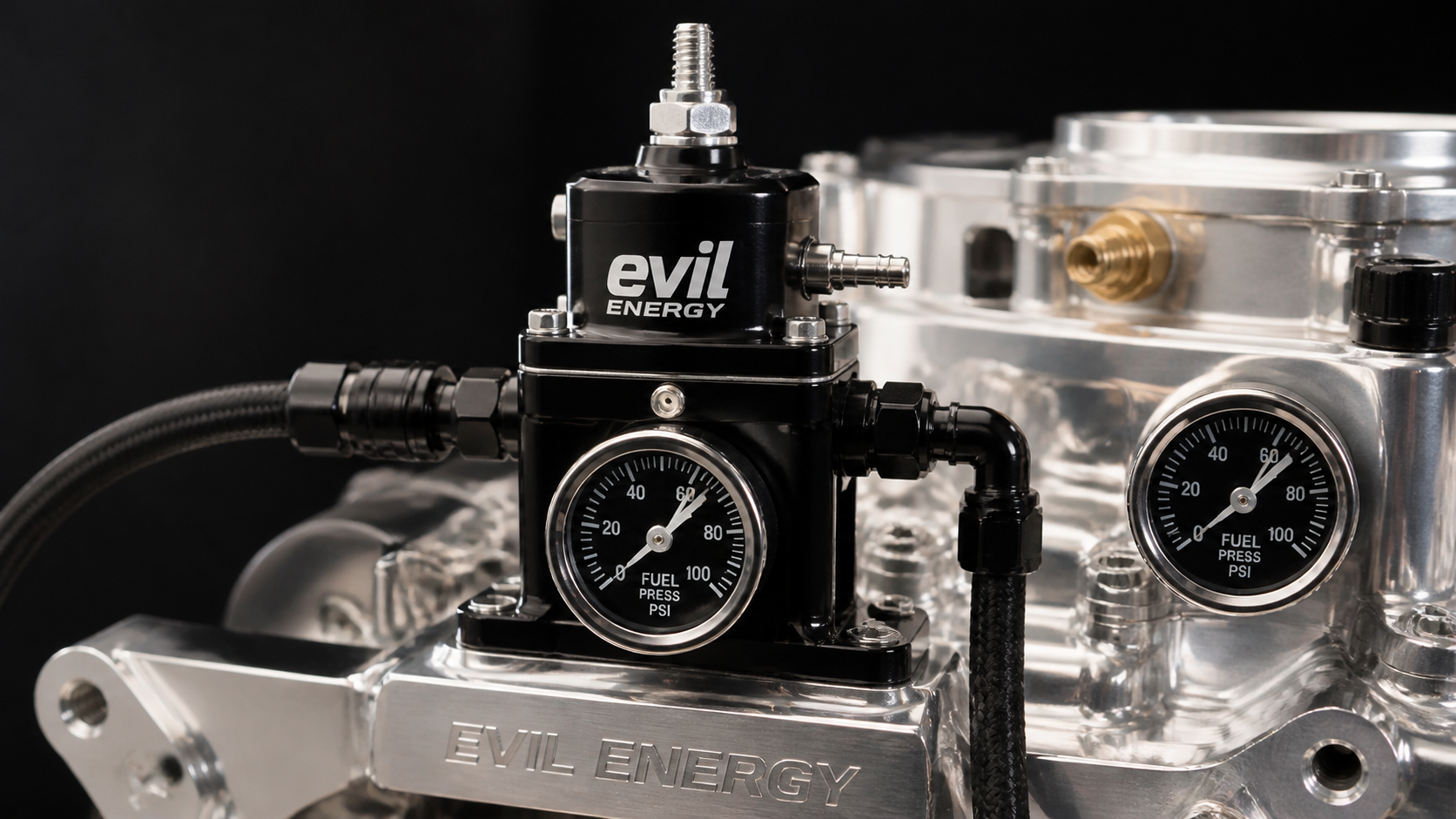
Improper fuel pressure stands as one of the most overlooked performance killers in modified engine builds. Rough idle, hesitation, and lost horsepower often trace back to pressure fluctuations that most builders never address. When you're running forced induction or a custom fuel injection setup, even minor swings of 2-3 PSI can erase your carefully planned performance gains.
The Evil Energy Fuel Pressure Regulator has become the default choice for builders who demand functionality without excessive spending. This aluminum-constructed component bridges the gap between budget builds and premium motorsport setups, delivering adjustable pressure settings, vacuum reference capability, and gauge options that competitors charge three times more to include. The practical combination of affordability and genuine reliability explains its dominance across DIY and professional tuning communities.
Discover how the Evil Energy Fuel Pressure Regulator can transform your fuel delivery today.
What Makes the Evil Energy Fuel Pressure Regulator Different?
Direct Comparison to OEM and Premium Alternatives
Stock fuel regulators were designed for reliability and emissions compliance—not performance. They maintain a fixed pressure point with minimal adjustment capability, making them inadequate for any significant engine modification. OEM systems simply can't adapt to the increased fuel demands of turbocharged, supercharged, or custom EFI configurations.
Premium motorsport regulators deliver superior materials and tighter tolerances, but the cost jump to $150–$300 leaves many builders hesitant. The Evil Energy regulator occupies the practical middle ground. It provides the adjustability and control you need without requiring you to raid your build budget entirely.
The Affordability Advantage
At $25–$60 depending on kit contents, the Evil Energy regulator represents exceptional value. This price point accounts for the aluminum body, threaded AN-style ports, vacuum reference capability, and often an integrated pressure gauge. Competitors offering equivalent features typically demand significantly higher prices. For first-time fuel system upgrades, this accessibility factor makes the difference between builders actually completing their projects or shelving them indefinitely.
Brand Philosophy and Market Positioning
Evil Energy built their reputation on performance-first thinking at accessible price points. Rather than chasing premium brand positioning, they've focused on delivering functional components that serious builders can afford. This philosophy resonates strongly in the DIY community, where budget constraints often shape which upgrades actually happen. Their market position reflects this reality—they're the brand people recommend when someone says, "I need this to work, and I don't have a lot to spend."
Why It's the Default Choice for First-Time Upgrades
Builders choosing their first fuel system upgrade encounter a decision: invest heavily in premium equipment or start with something proven and affordable. The Evil Energy regulator has become the standard answer to this question. Its reputation for reliable performance across diverse applications means your first fuel system upgrade has minimal risk of costly failure.
Technical Specifications and Construction Details
Aluminum Body and Corrosion Resistance
The aluminum construction provides strength while keeping weight minimal. This material choice resists corrosion better than bare steel, which matters for longevity in harsh engine bay environments. Aluminum also facilitates the compact design that makes installation feasible in space-constrained applications.
Adjustable Pressure Range
The regulator's adjustable range typically spans 4–9 PSI, though specific models may vary. This adjustment capability allows precise tuning to your engine's exact requirements. A simple external adjustment screw lets you dial pressure on-the-fly without disassembly, enabling quick optimization during testing and tuning sessions.
AN-Style Threaded Ports
Universal compatibility comes from the AN (Army-Navy) standard threaded ports. These threaded connections accept braided hoses, rubber fuel lines, and hard-line fittings through simple adapter combinations. This versatility eliminates fitment guessing—you work with what you have or what's available from any performance fuel system supplier.
Vacuum Reference Port Functionality
The vacuum reference port enables boost-referenced fuel delivery for forced induction applications. By running a line from engine vacuum to the regulator, fuel pressure rises proportionally with boost levels. This automation maintains consistent fuel-to-air ratios across the entire power range, delivering more stable performance than fixed-pressure setups.
Integrated Pressure Gauge Options
Many Evil Energy kits include a mechanical pressure gauge mounted directly on the regulator body. This gauge provides real-time pressure monitoring without additional installation complexity. While not laboratory-grade accurate, the gauge readability proves adequate for tuning and troubleshooting purposes on most street and track applications.
Fuel Line Compatibility
The regulator accepts rubber automotive fuel hose (most common), braided stainless steel hose (popular in performance builds), and 3/8" or 1/2" hard lines (OEM-style installation). This flexibility means you can integrate the regulator into virtually any existing fuel system without expensive line modifications.
Flow Rating and Engine Compatibility
Most Evil Energy regulators handle 60–80 GPH flow capacity, which covers engines up to approximately 500 horsepower on gasoline. Larger displacement engines, significant nitrous systems, or ultra-high injector counts may exceed this capacity, but standard turbocharged and supercharged street builds fall comfortably within the range.
Compact Design Advantages
The regulator's small footprint accommodates engine bay mounting, fuel tank integration, or fuel rail installation without excessive space demands. This compactness particularly benefits street cars where engine bay real estate gets consumed quickly by turbochargers, intercoolers, and other performance modifications.
Installation Essentials: Getting It Right the First Time
Pre-Installation Checklist
Before beginning installation, verify fuel system pressure requirements for your specific engine combination. Confirm the regulator's adjustment range matches your target pressure. Gather all required tools—wrenches fitting your AN port sizes, thread sealant rated for fuel systems, and potentially hose clamps or braided hose adapters. Having everything ready prevents mid-installation complications.
Mounting Location Options
Three primary mounting locations suit different build strategies. Engine bay mounting offers easy accessibility for adjustment and monitoring but exposes the regulator to heat. Fuel tank mounting provides cooler operation and cleaner engine bay appearance but demands tank removal for any service. Fuel rail mounting works well for custom EFI conversions where the regulator becomes part of the fuel delivery network.
Port Orientation and Thread Sealant
Orient the adjustment screw for accessibility—pointing upward or forward typically works best. Use thread sealant rated specifically for fuel systems (not plumber's tape, which breaks down in gasoline). Apply sealant to male threads only, using three to four wraps for adequate sealing without excessive material that could block ports.
Vacuum Line Routing
Route vacuum reference lines carefully to avoid kinks or pinches that restrict flow. Use fuel-resistant vacuum hose rated for the application. Keep vacuum lines separate from other engine compartment clutter to prevent confusion during troubleshooting. Mark each line clearly if running multiple vacuum-referenced components.
Pressure Gauge Installation
Mount the gauge where you can observe it easily during driving or dyno sessions. Engine bay mounting works for track-focused builds; cabin mounting (via gauge lines run through the firewall) suits street cars where monitoring during driving matters. Ensure gauge lines don't route near engine exhaust or moving engine components.
Common Installation Mistakes
Forgetting thread sealant causes fuel leaks that become apparent during initial startup. Installing the vacuum reference backwards reduces fuel pressure instead of increasing it. Mounting the regulator below fuel level in the tank without a check valve allows gravity to drain fuel back into the tank. Taking time to understand the installation before beginning prevents these costly errors.
Leak Testing and Pressure Verification
After installation, perform a static pressure test with the engine off and fuel pump running. Listen for any hissing sounds indicating leaks, and visually inspect all connection points. With the engine running, verify idle pressure matches your target baseline. Record this pressure for reference during future tuning sessions.
Fuel System Compatibility Verification
Confirm that existing fuel injectors, fuel pump, and feed lines can handle your target pressure and flow requirements. Installing a regulator on a system with undersized pumps or incompatible injectors creates problems that the regulator can't solve. Cross-reference your fuel system components before committing to final pressure settings.
Start your fuel system upgrade journey with Evil Energy's trusted fuel pressure regulator.
Performance Applications: Where This Regulator Shines
Turbocharged Engine Setups
Boost-referenced tuning represents the regulator's ideal application. As turbo boost increases, fuel pressure rises proportionally to maintain proper fuel-to-air ratios. This automation eliminates the need for external boost controllers or complex tuning logic, delivering reliable performance across the entire boost range. Street turbo builds benefit tremendously from this simplicity.
Supercharged Applications
Superchargers demand consistent fuel delivery regardless of load conditions. The Evil Energy regulator maintains steady pressure under constant supercharger operation, preventing lean conditions that damage pistons and valves. Positive displacement superchargers particularly appreciate the regulator's ability to hold pressure steady during aggressive acceleration.
Custom EFI Conversions
Converting carbureted engines to fuel injection requires precise fuel pressure control. The Evil Energy regulator integrates seamlessly into EFI conversion kits, providing the pressure foundation that custom ECU tuning requires. Classic car builders and hot rod enthusiasts rely on this regulator as a core component of their conversion strategy.
Nitrous Oxide Systems
Nitrous systems demand fuel pressure stability when making peak power. The regulator maintains pressure consistency during nitrous activation, preventing lean spikes that cause detonation. Pairing a nitrous system with proper fuel pressure regulation separates reliable power from expensive engine damage.
Street Performance Builds
Daily-driver modifications benefit from the regulator's tuning flexibility. Adjusting pressure between street and strip settings takes seconds, allowing the same vehicle to deliver reliable commuting performance and respectable track results. Weekend warriors appreciate this versatility.
Track-Focused Applications
Repeatability matters at the dragstrip and road course. The Evil Energy regulator maintains consistent pressure run after run, eliminating variables that cause performance inconsistency. Data logging pressure readings reveals how pressure behaves under various track conditions, enabling smarter tuning decisions.
Fuel System Upgrades for Higher Flow
Upgrading to larger injectors requires corresponding fuel pressure capability. The regulator's adjustability accommodates higher pressure settings that maximize injector flow. This scaling allows progressive performance upgrades without replacing the regulator each time you upsize injectors.
Idle Quality and Drivability Enhancements
Improper fuel pressure often manifests as rough idle or stumbling during low-speed driving. Dialing in correct pressure eliminates these symptoms, transforming the driving experience. Street cars that idle erratically often transform completely once fuel pressure gets optimized to spec.
Real-World Pros That Owners Actually Experience
Simple Adjustment Mechanism
The external adjustment screw responds intuitively. Clockwise increases pressure; counterclockwise decreases it. No special tools or disassembly required. During dyno sessions or troubleshooting, dialing pressure changes takes seconds rather than hours.
Build Quality for the Price
The aluminum construction feels substantial in hand. Ports are cleanly threaded, and adjustment mechanisms operate smoothly across their range. For $25–$60, the build quality exceeds expectations from budget-oriented components.
Value Proposition
Equivalent feature-sets from premium brands cost significantly more. Builders consistently report that the Evil Energy regulator performs equivalently to regulators costing twice as much, making the value comparison impossible to ignore.
Easy Aftermarket Integration
The universal AN-style connections mean the regulator integrates into virtually any fuel system without special adapters or modifications. Performance fuel system vendors stock compatible components, ensuring no installation dead-ends.
Reliable Performance Across Configurations
Whether installed on small-displacement forced induction builds or large-displacement naturally aspirated engines, the regulator performs reliably. This versatility explains its popularity across such diverse build types.
Customer Support and Availability
Evil Energy maintains strong retailer networks across major online marketplaces. Finding the regulator takes minutes, and customer support responds to technical questions promptly. This accessibility removes friction from the upgrade process.
Minimal Maintenance Requirements
The regulator requires no regular service beyond periodic inspection. No internal components need replacement under normal operation. The long-term cost of ownership stays minimal.
Gauge Readability
The included mechanical gauge provides reliable pressure readings adequate for tuning and monitoring. While not laboratory-grade precise, the gauge accuracy suffices for real-world applications.
Honest Limitations and Potential Drawbacks
Variable Fitment
Depending on your specific fuel system layout and vehicle platform, finding the ideal mounting location might require adaptation. Some installations require custom brackets or hose routing that adds complexity beyond the regulator itself.
Installation Complexity for Inexperienced Builders
First-time fuel system work presents a learning curve. Understanding vacuum reference concepts, proper thread sealant application, and pressure verification procedures requires research. Inexperienced builders sometimes struggle with aspects that experienced tuners find straightforward.
Occasional Quality Control Inconsistencies
Some users report receiving units with inconsistent gauge accuracy or sticky adjustment screws. While outliers exist, quality issues appear rare enough that they don't reflect the overall product consistently.
Gauge Accuracy Variance
The mechanical gauge provides approximate readings rather than laboratory precision. Readings may drift slightly over time, and unit-to-unit variance means two regulators might read slightly different pressures at identical settings.
Vacuum Line Confusion
Builders new to vacuum-referenced setups sometimes connect vacuum lines incorrectly, achieving the opposite of intended pressure changes. This confusion stems from operator knowledge gaps rather than product defects, but it remains a common installation mistake.
Limited Flow Capacity
The 60–80 GPH flow ceiling excludes extreme fuel system demands. Engines exceeding approximately 500 horsepower on gasoline, or those running significant nitrous systems, might exceed capacity. Knowing your fuel requirements prevents disappointment.
OEM Fuel Rail Compatibility Questions
Some stock fuel rails include integrated pressure regulators or use non-standard port configurations. Verifying compatibility before purchasing prevents fitment problems that surface during installation.
Pressure Setting Precision Requirements
Setting pressure too high causes rich conditions and poor fuel economy; too low delivers lean running. Finding the correct baseline requires methodical testing. Casual installation without proper pressure verification leaves performance on the table.
Tuning Tips and Optimization Strategies
Baseline Pressure Recommendations
Naturally aspirated engines typically run 43.5–50 PSI. Turbocharged applications usually target 45 PSI idle pressure plus 1 PSI per PSI of boost. Supercharged engines often use 50–55 PSI static pressure. These starting points provide a foundation for further refinement based on your specific combination.
Boost-Referenced Pressure Calculation
Configure vacuum reference by running a line from manifold vacuum to the regulator's vacuum port. This arrangement increases pressure proportionally with boost—typically 1:1 ratio, meaning 10 PSI boost yields 10 PSI pressure increase. Some tuners adjust this ratio using different vacuum supply points or restrictor jets for custom pressure curves.
Vacuum Reference Line Setup
Use only fuel-rated vacuum hose for reference lines. Avoid cloth-covered hose which absorbs fuel vapors and deteriorates. Keep reference lines routed away from engine heat sources. Test for vacuum leaks by listening for hissing sounds during engine operation.
Pressure Monitoring During Break-In
Log pressure readings during initial startup and break-in driving. Document baseline pressure, idle stability, cruise behavior, and wide-open-throttle response. This baseline becomes your reference for evaluating tuning changes.
Fine-Tuning for Idle Stability
Rough idle often improves dramatically through proper fuel pressure. Start at manufacturer recommendations, then adjust pressure gradually while monitoring idle quality. Even 1-2 PSI changes can eliminate stumbling and improve smoothness.
Cruise Drivability Optimization
Street cars spend most time cruising, making cruise quality important. Test pressure settings under steady cruise conditions and note throttle response transitions. Proper pressure eliminates hesitation and delivers linear throttle feel.
Pressure Ranges for Various Power Levels
Stock power levels typically use 43.5–50 PSI. Mild modifications with stock injectors run similar pressures. Moderate builds with larger injectors move to 50–60 PSI. Extreme builds might require 70+ PSI, pushing the limits of standard equipment. Know your injector flow ratings and fuel system capacity before exceeding standard pressure ranges.
Troubleshooting Erratic Gauge Readings
Fluctuating pressure readings suggest vacuum leaks, fuel pump issues, or regulator problems. Static testing with the engine off isolates whether the issue is pressure source or regulator-related. Inspect vacuum lines first, then test with a mechanical pressure gauge to verify gauge accuracy.
Comparing Evil Energy to Competing Regulators
Budget-Brand Comparison
Other budget options in the $25–$60 range exist, but Evil Energy consistently outperforms them in build quality and reliability reporting. Competitive products sometimes work adequately but lack the refined adjustment mechanism and gauge accuracy that Evil Energy provides.
Premium Brand Analysis
Premium regulators costing $150–$300 deliver superior materials and tighter tolerances. For professional race teams or ultimate precision requirements, premium options justify their cost. For street and mild track builds, the Evil Energy regulator delivers 95% of the premium experience at 20% of the cost.
OEM Regulator Limitations
Stock regulators provide no adjustability and deliver fixed pressure based on design parameters. They function adequately for unmodified engines but become inadequate immediately upon modification. The Evil Energy regulator's adjustability solves the fundamental limitation of OEM equipment.
Adjustability Differences
Budget competitors often feature narrower adjustment ranges or less intuitive adjustment mechanisms. Evil Energy's broad range and smooth adjustment screw operation stand out in comparisons.
Build Quality and Material Durability
Premium brands incorporate aerospace-grade materials and precision manufacturing. Evil Energy uses appropriate materials for the price point but doesn't attempt to match premium durability. For typical street and track applications, the material selections prove more than adequate.
Warranty Coverage
Evil Energy provides reasonable warranty protection covering defects. Premium brands often offer extended warranties reflecting their higher price point. Standard operation rarely requires warranty claims on either product tier.
Customer Service Responsiveness
Evil Energy's support reputation stands solid. Response times to technical questions remain reasonable, and customer-centric approaches address issues pragmatically. This service quality exceeds what you typically expect from budget-tier products.
Resale and Long-Term Investment Value
Evil Energy regulators hold used value reasonably well due to strong demand. Premium regulators sometimes carry better resale premiums, but the Evil Energy's affordable initial cost means resale concerns matter less.
Maintenance, Longevity, and Reliability Insights
Routine Inspection Intervals
Inspect the regulator annually or before major driving events. Check all connection points for seepage, verify gauge function, and confirm adjustment screw operation. This simple maintenance catches problems before they affect reliability.
Fuel Filter Compatibility
Clean fuel protects all fuel system components, including the regulator. Install quality fuel filters at the pump inlet and maintain appropriate change intervals. Dirty fuel causes internal regulator wear and gauge accuracy degradation.
Gauge Maintenance
Mechanical gauges require no special maintenance. If a gauge becomes unreliable, verify pressure with a separate mechanical gauge before assuming regulator failure. Sometimes the gauge itself fails while the regulator functions perfectly.
Seal and Gasket Durability
Fuel system materials selected by Evil Energy resist typical automotive fuels adequately. Ethanol-blended fuel and exotic fuel additives occasionally cause compatibility issues, but standard fuel works without problems. Seals remain reliable under normal conditions.
Seasonal Storage and Winterization
For vehicles stored seasonally, slightly elevated pressure during cold storage prevents internal corrosion. Use fuel system stabilizer to prevent varnish buildup in the regulator during extended dormancy. Upon return to service, verify pressure settings again.
Expected Lifespan
Under normal operation, the Evil Energy regulator typically lasts 5–10 years or more. Aggressive tuning, ethanol fuels, and poor fuel quality reduce lifespan. Conservative operation with quality fuel extends reliability substantially.
Warranty Details
Most Evil Energy regulators carry 12-month manufacturer warranty against defects. This coverage provides recourse for factory issues while reflecting the product's overall reliability.
Life Extension Strategies
Maintaining proper fuel pressure prevents stress on internal components. Installing quality fuel filters protects against contamination. Avoiding extreme tuning parameters and using quality fuel extends component life significantly.
The Real Cost of Ownership: Budget Breakdown
Initial Purchase Price
Standard Evil Energy regulators retail between $25–$60 depending on kit contents. Basic kits include the regulator and necessary fittings. Premium kits add gauges and additional adapters. Budget for the mid-range option ($40–$50) if purchasing separately.
Installation Labor Costs
DIY installation requires a few hours of research and work but no professional labor. Professional shop installation typically runs $100–$200 depending on fuel system complexity and mounting location. Many builders handle installation themselves to minimize costs.
Required Additional Components
Fuel hose, fittings, and adapters might need purchasing depending on your existing system. Budget $30–$80 for quality fuel line and appropriate AN adapters. Vacuum reference hose adds minimal cost if not already on-hand.
Pressure Gauge Upgrades
The included mechanical gauge often suffices, but some builders upgrade to digital or more accurate gauges. Aftermarket gauges range from $20–$100. This expense remains optional for most applications.
Fuel Filter Upgrades
Installing a quality fuel filter during regulator installation improves system longevity. Performance fuel filters cost $20–$50 and represent worthwhile investment in component protection.
Tuning Software Considerations
Custom EFI conversions sometimes require tuning software to integrate fuel pressure control. Budget tuning software ranges from free open-source options to $500+ for professional-grade packages. This expense applies primarily to complex builds rather than simple regulator installations.
Long-Term Maintenance Costs
Annual inspections cost nothing if performed personally. Professional inspections run $50–$100 but rarely reveal problems on well-maintained systems. Replacement parts (gaskets, seals) cost $10–$30 if ever needed.
Return on Investment
Improved fuel economy from proper pressure settings often offsets regulator cost within 1–2 years on street cars. Performance gains justify costs for track-focused builds where consistency directly impacts results. The investment typically returns value through improved reliability and drivability.
Your Path Forward: Making the Evil Energy Regulator Work for Your Build
The Evil Energy Fuel Pressure Regulator occupies a rare space in automotive performance—delivering genuine capability without forcing compromises on budget or build timeline. This regulator consistently performs beyond what its price point suggests, making it the logical choice for builders seeking control over fuel delivery without excessive spending.
Throughout this guide, I've addressed the technical foundation, real-world applications, and honest trade-offs to help you make an informed decision aligned with your specific build requirements. Whether you're managing boost on a turbo platform, dialing in a carb-to-EFI conversion, or simply upgrading fuel delivery precision, this regulator repeatedly proves its worth on diverse applications.
Success comes from understanding your fuel system's specific pressure requirements before purchasing. Take time to research your engine combination's baseline pressure needs, verify existing fuel system component compatibility, and plan your installation approach. Following best practices during installation—using fuel-rated thread sealant, properly routing vacuum reference lines, and performing thorough pressure verification—sets the foundation for reliable performance.
The adjustment and tuning phase rewards methodical approach. Start with manufacturer recommendations, monitor results during initial operation, and adjust pressure gradually based on actual drivability observations. Document baseline readings and pressure ranges to build your personal tuning reference.
Questions or uncertainties shouldn't stop you. Evil Energy's support team responds to technical inquiries, and your local tuning community provides valuable installation experience. Building your first fuel system upgrade alongside experienced enthusiasts makes the entire process more manageable and educational.
Begin your fuel system transformation with the Evil Energy Fuel Pressure Regulator today.
Leave a Reply