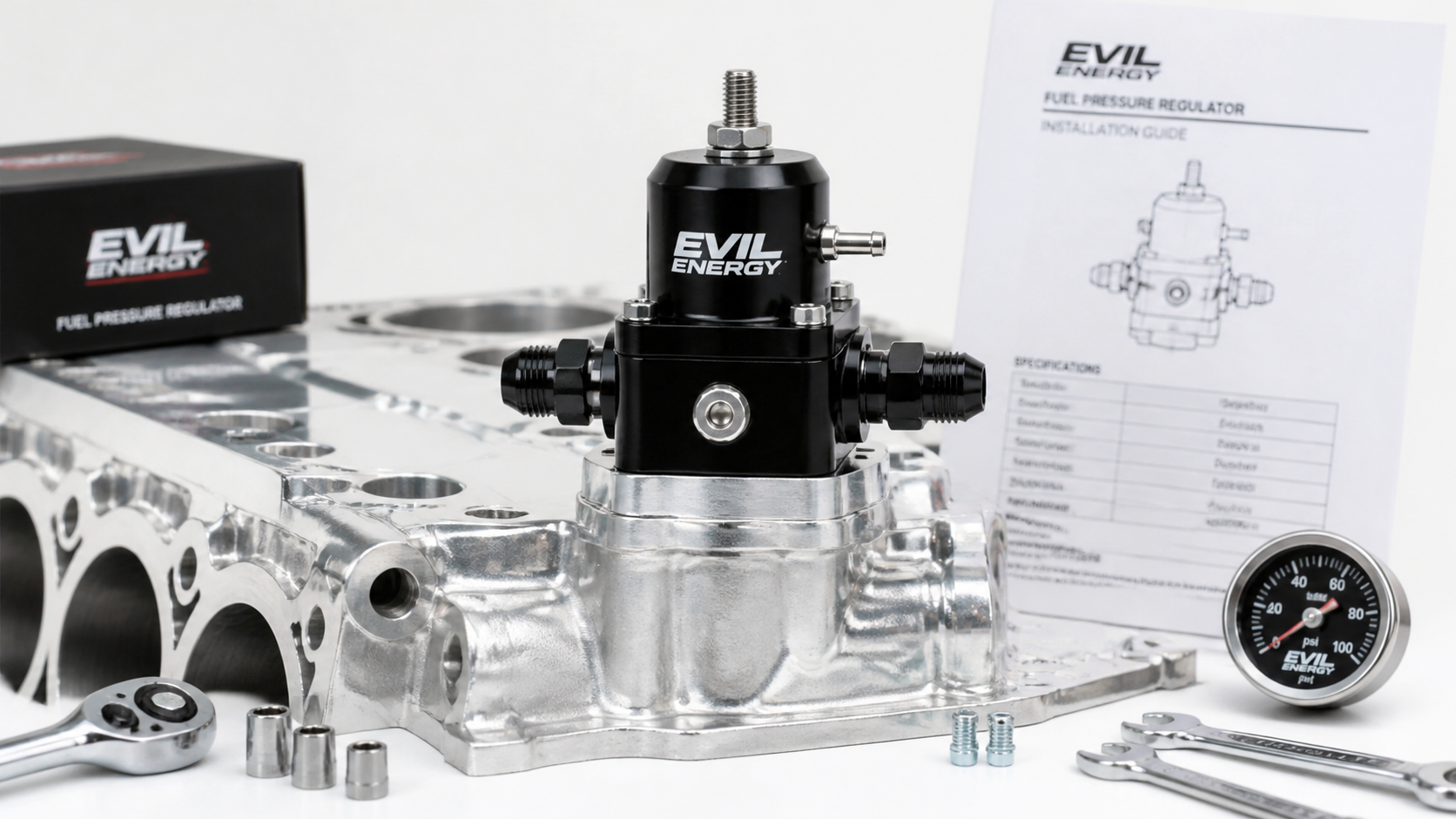
Over 70% of DIY engine builders prioritize fuel system reliability above almost everything else—yet many still settle for regulators that drain their budgets without delivering results. When you're pouring money into turbochargers, injectors, and engine management, the last thing you need is a fuel pressure regulator that can't keep pace with your modifications. The EVIL ENERGY Fuel Pressure Regulator enters the conversation as a solution built specifically for performance enthusiasts who demand stability without the premium price tag.
This aluminum-bodied regulator has earned its reputation among street car builders and track-focused projects alike, engineered to handle the demands of turbocharged and modified engines while maintaining precise fuel pressure even when conditions get aggressive. At $20–$60, it represents one of the smartest value plays in the aftermarket fuel system space.
Understanding Fuel Pressure Regulator Fundamentals for Performance Builds
What fuel pressure regulators do and why they're critical for modified engines
A fuel pressure regulator maintains consistent fuel pressure throughout your fuel system, acting as the guardian between your fuel pump and injectors. In stock applications, this component sits quietly in the background. But when you modify an engine—adding turbos, changing injector sizes, or tuning for more aggressive timing—that regulator becomes mission-critical. It's the difference between a smooth power delivery and a stumbling, hesitant mess.
How pressure stability impacts fuel delivery consistency and engine performance
Fuel pressure fluctuates naturally as your engine demands change. Under acceleration, the pump works harder. At cruise, it backs off. Without a regulator maintaining that sweet spot, injectors receive inconsistent fuel volume, throwing off your fuel map and creating dead spots throughout the RPM range. Stable pressure means consistent injector pulse widths, which translates directly to predictable engine behavior and smooth power delivery.
The difference between return-style and dead-head regulator designs
Return-style regulators bleed excess fuel back to the tank, maintaining pressure by controlling bypass flow. Dead-head (or bypass) regulators do the same but are optimized for systems without a return line. The EVIL ENERGY regulator is built for return-style systems, making it ideal for most traditional fuel system setups where you've got a return line running back to your tank.
Why pressure regulation matters more in turbocharded and supercharged applications
Turbocharged engines live at the edge. Boost pressure spikes suddenly, demanding immediate fuel response. If your regulator can't react fast enough, you'll get fuel starvation on initial spool-up. Conversely, if pressure creeps too high under boost, you'll over-enrich the mixture and waste fuel or create excessive smoke. The regulator becomes your first line of defense, holding steady regardless of what boost pressure throws at it.
Common pressure ranges for street cars, daily drivers, and track-focused builds
Stock fuel systems typically run 40–50 PSI. Street cars with mild modifications often sit at 50–60 PSI. Track-focused builds with aggressive tuning and turbochargers might demand 70–85 PSI or higher depending on injector size and boost levels. The EVIL ENERGY regulator's adjustable range means you can dial in exactly what your specific build needs without hunting for multiple regulators.
How EFI systems rely on precise pressure control for proper fuel mapping
Modern EFI systems calculate fuel delivery based on injector pulse width, assuming a known, stable fuel pressure. If that pressure varies, the entire fuel map falls apart. A regulator that holds tight across your entire RPM and boost range keeps your engine management system functioning as intended, translating tuning inputs directly into the performance your map promises.
EVIL ENERGY Regulator Construction and Design Features
Durable aluminum body construction and corrosion resistance
The EVIL ENERGY regulator starts with a premium aluminum casting, chosen for its strength-to-weight ratio and resistance to corrosion. This isn't plastic or pot metal—it's the same material you'd find in higher-priced competitors. The aluminum resists rust and degradation, meaning your regulator will maintain its seal integrity and functionality for years of hard use.
AN-style port compatibility and what this means for your fuel lines
AN fittings represent the standard in performance fuel systems, offering reliable connections that won't leak under pressure. The EVIL ENERGY regulator uses these ports, meaning you can confidently source fuel line fittings from any performance supplier. This compatibility eliminates custom adapter hunts and ensures tight seals across your entire fuel line network.
Adjustable pressure settings and the range of tuning capability available
A simple adjustment screw on the regulator lets you dial pressure up or down within its operational range. This adjustability means one regulator can serve multiple applications or accommodate tuning changes without swapping hardware. You're not locked into a fixed pressure—you've got control.
Integrated gauge port functionality for real-time pressure monitoring
The gauge port gives you a window into what's actually happening in your fuel system. Connect a fuel pressure gauge here and watch how pressure behaves under idle, cruise, acceleration, and sustained boost. This real-time feedback is invaluable for tuning and troubleshooting.
Return-style fuel system compatibility and how it affects your setup
Return-style systems send excess fuel back to the tank rather than pressurizing a closed loop. The EVIL ENERGY regulator thrives in this configuration, managing bypass flow with precision. If you're running a traditional fuel system with both supply and return lines, this regulator fits like it was designed specifically for you.
Comparison of different EVIL ENERGY models and their pressure specifications
Different versions of the EVIL ENERGY regulator accommodate various pressure ranges and port configurations. Some are optimized for lower-pressure street applications, while others handle the demands of high-boost turbocharged builds. Matching the right model to your pressure requirements ensures you're not running your regulator at the edge of its capabilities or in an unnecessarily oversized setup.
Quality control standards and manufacturing consistency
EVIL ENERGY builds regulators to perform reliably, with consistent manufacturing that means one unit functions like the last. You're not gambling with inconsistent quality—you're buying a component that's proven itself across thousands of builds.
Start building your bulletproof fuel system with the EVIL ENERGY Fuel Pressure Regulator now.
Installation Strategies for DIY Builders and Professional Setups
Pre-installation checklist and tools you'll actually need
Before touching a single fitting, gather your tools: wrenches (adjustable or fixed), AN fitting tools if needed, a fuel pressure gauge, braided fuel line, and sealing supplies like Teflon tape or thread sealant. Check that your regulator pressure range matches your application and that you have all necessary fittings. A quick inventory prevents mid-install frustration.
Proper mounting location and orientation considerations
Mount your regulator where it won't be crushed, submerged, or exposed to extreme underhood temperatures. The gauge port should point downward or sideways for accurate readings. The regulator itself should sit between your fuel pump and injectors, allowing fuel to reach the regulator before splitting to the injectors and return line.
Fuel line connection best practices and seal integrity tips
Use quality braided stainless steel fuel line rated for your pressure requirements. When threading AN fittings, hand-tighten first, then use a wrench to snug them down. Don't over-tighten—pressure and vibration do the work of holding connections. If you use Teflon tape, wrap it clockwise around male threads before connection.
Pressure gauge installation and wiring for accurate monitoring
Connect your fuel pressure gauge directly to the regulator's gauge port using a short line of appropriate rating. Mount the gauge where you can see it during operation. Many builders run a gauge to their dashboard or instrument cluster for constant visibility—this setup reveals pressure behavior during different driving conditions.
Vacuum line connection for manifold-referenced pressure regulation
The vacuum port on your regulator connects to manifold vacuum, allowing pressure to track boost events. This dynamic adjustment keeps fuel pressure appropriate across different driving states. Route the vacuum line carefully, avoiding sharp bends or abrasion points that could cause leaks.
Common installation mistakes that lead to leaks or performance issues
Over-tightening fittings is the number-one culprit—it deforms seals and causes immediate or premature leaks. Backwards fuel flow is another hidden killer; ensure fuel flows in the correct direction through the regulator. Forgetting to check fitting compatibility before assembly creates complications that surface only after startup.
Testing procedures before firing up your engine
Fill your fuel tank and pressurize the system without starting. Check every fitting for leaks. Confirm gauge readings match your target pressure. Only after visual inspection and static pressure verification should you fire the engine. This methodical approach catches problems before they become expensive or dangerous failures.
Pressure Tuning and Calibration for Your Specific Application
Baseline pressure settings for naturally aspirated versus turbocharged engines
Naturally aspirated engines typically run 43–50 PSI without vacuum reference. Turbocharged engines start higher—often 55–65 PSI at base—because boost requires additional fuel delivery. Your baseline depends on injector size, fuel pump capacity, and your tuning target. Start conservative and adjust upward as needed.
How to adjust pressure for different fuel injector sizes and flow rates
Larger injectors demand higher pressure to maintain the same flow rate. If you upgrade from 42 lb/hr to 60 lb/hr injectors, your base pressure might shift. The regulator's adjustability lets you dial in exactly what your new injector size requires without swapping hardware.
Tuning strategy for EFI systems and custom engine management
Modern engine management systems calculate fuel delivery around an assumed pressure. If your actual pressure differs from what your tune expects, your air-fuel ratio suffers. Use your gauge port to verify actual pressure while monitoring EFI data logs, then adjust the regulator until reality matches your tune's assumptions.
Pressure requirements for various boost levels and boost profiles
Manifold-referenced regulators automatically increase pressure proportionally to boost. A 1:1 ratio means 20 PSI boost adds 20 PSI fuel pressure. At 15 PSI boost with 60 PSI base, you'd see roughly 75 PSI at the regulator outlet. Understanding this relationship helps you dial in pressure that keeps fuel delivery stable across your entire boost range.
Fine-tuning techniques to eliminate fuel starvation and over-fueling
Watch your fuel pressure under full acceleration. If it dips below target, increase it. If it climbs too high, back it off. Small adjustments (2–3 PSI at a time) reveal pressure sweet spots where your engine runs cleanest and pulls hardest. This methodical approach beats guessing.
Using your gauge port to dial in optimal pressure under load
Take your car on a test drive while monitoring fuel pressure. Watch how it behaves during cruise, light acceleration, and full throttle. Pressure should remain stable and predictable. Erratic readings or unexpected drops indicate installation or regulator issues that need attention.
Seasonal adjustments and temperature-related pressure considerations
Temperature affects fuel density and pressure slightly. Cold weather can creep pressure higher, while hot weather may lower it. Seasonal fine-tuning—especially for high-performance applications—keeps your fuel system dialed regardless of conditions. Most enthusiasts adjust slightly between summer and winter for optimal consistency.
Real-World Performance Benefits and Practical Applications
Improved fuel delivery consistency under acceleration and sustained load
A regulator holding steady pressure means your injectors deliver consistent fuel volume throughout acceleration. No hesitation, no lean spots, just smooth power progression from part throttle to full boost. The EVIL ENERGY regulator's reputation comes directly from this consistency.
Enhanced throttle response and reduced hesitation in modified engines
Throttle hesitation often traces back to fuel delivery inconsistency. When pressure varies with driving conditions, injectors pulse differently than your tune expects. Upgrading to a stable regulator eliminates this variable, returning the sharp throttle response that makes driving modified engines satisfying.
Reliability gains for street cars running aggressive tuning
Street cars pushing 10+ PSI boost with custom tuning live at the edge. A regulator that can't hold pressure under these conditions creates unpredictability. The EVIL ENERGY regulator's proven track record in this environment means you're running a component tested by thousands of builders doing exactly what you're doing.
Benefits for project builds transitioning from stock to performance fuel systems
Stock fuel systems weren't designed for performance. As you add power, your original regulator becomes the weak link. Swapping to the EVIL ENERGY regulator is often one of the first fuel system upgrades serious builders make, transforming reliability and drivability immediately.
Track-day performance advantages with stable pressure delivery
On track, sustained high-RPM running and aggressive throttle transitions expose fuel system weaknesses. A regulator that holds pressure ensures your engine receives consistent fuel supply, eliminating one variable during your quest for lap time improvements.
Testimonials from DIY builders on durability and value
Across performance forums and builder communities, the EVIL ENERGY regulator consistently earns praise for reliability and affordability. Builders report thousands of miles and years of use with zero regulator-related issues. This real-world track record beats any marketing claim.
Compatibility with common fuel pumps and system configurations
The EVIL ENERGY regulator plays well with industry-standard fuel pumps and system layouts. Whether you're running a Walbro, AEM, or other quality pump, this regulator integrates seamlessly. That compatibility and flexibility make it the go-to choice for builders sourcing components independently.
Value Proposition and Cost-Benefit Analysis
Price-to-performance ratio compared with premium regulator brands
Premium regulators from established names cost $150–$300+. The EVIL ENERGY delivers 90% of their performance at 25–33% of the price. You're sacrificing brand prestige and marginal refinements, not core functionality.
Long-term savings from reliable fuel system management
A regulator that works reliably eliminates costly failures and emergency replacements. Over a year or two of active driving, the peace of mind and avoided downtime represent real financial value beyond the initial purchase price.
Affordability factor for builders on tight budgets
Building a performance engine demands budget prioritization. The EVIL ENERGY regulator lets you allocate more of your budget toward engine modifications—turbochargers, injectors, tuning—without sacrificing fuel system stability. That's the real value proposition.
Resale value and upgrade path considerations
If you eventually move to a premium regulator, your EVIL ENERGY unit retains value in the used market. Performance enthusiasts recognize the value and durability, making these regulators attractive secondhand purchases.
ROI when paired with other fuel system upgrades
Pairing the EVIL ENERGY regulator with quality fuel lines, a solid pump, and proper injectors creates a cohesive fuel system that transforms engine performance. The regulator, being the most affordable component, maximizes your ROI across the entire system investment.
Hidden costs to avoid (poor installation, incompatible fittings)
Cheap fittings or improper installation can cost far more than the initial savings. Buy quality fuel line and fittings, take time with the installation, and you'll avoid expensive leaks and repairs. The regulator itself is the bargain—don't undercut the installation.
Why budget-friendly doesn't mean compromising on core functionality
The EVIL ENERGY regulator is affordable because EVIL ENERGY manufactures at scale and prioritizes essentials over aesthetic refinements. It still delivers rock-solid pressure stability, adjustability, and durability. Budget-friendly simply means no premium pricing for brand recognition.
Durability Expectations and Maintenance Considerations
Typical lifespan under normal street driving conditions
Properly installed and maintained, the EVIL ENERGY regulator routinely delivers 50,000–100,000+ miles of reliable service. Street driving—even aggressive street driving—rarely stresses regulators to their limits, so longevity is typically measured in years, not miles.
Wear factors in high-boost or extreme performance applications
Sustained high-boost running, constant track use, or extreme pressure cycling ages regulators faster. A regulator handling 20+ PSI boost daily experiences more wear than one managing 10 PSI occasionally. This isn't a weakness unique to EVIL ENERGY; all regulators experience reduced lifespan under these conditions.
Maintenance intervals and inspection recommendations
Inspect your regulator annually, checking for leaks and verifying pressure stability. No routine maintenance is required beyond these checks. If you notice pressure fluctuations or leaks, investigate immediately.
Seal replacement procedures and parts availability
The EVIL ENERGY regulator's seals can be replaced if they degrade, extending component life without full replacement. EVIL ENERGY supplies seal kits at reasonable cost, though many builders find complete regulator replacement more practical than attempting seal renewal.
Factors that extend or shorten regulator longevity
Quality fuel (free of contaminants) extends life dramatically. Ethanol-blend fuels and poor fuel quality degrade seals faster than quality gasoline. Proper installation with correct thread sealant also matters. Vibration, underhood heat, and pressure cycling shorten lifespan; isolation mounts and careful routing help here.
Comparison of durability against higher-end competitors
Premium regulators cost more partly because of refined seals and materials that extend longevity under extreme conditions. For typical builds, the EVIL ENERGY regulator's durability matches competitors closely. At extreme duty cycles, premium regulators might outlast it, but the difference rarely justifies the cost premium for street or occasional track use.
Warning signs that indicate replacement is needed
Persistent pressure fluctuations despite multiple adjustment attempts signal seal degradation. Fuel weeping from the adjustment screw or connections indicates internal wear. If your pressure won't hold steady and inspection reveals no external issues, replacement is likely necessary.
Troubleshooting Common Issues and Installation Pitfalls
Pressure fluctuations and their root causes
Fluctuating pressure usually traces to one of three culprits: a failing fuel pump (output decreasing under load), a leaking regulator seal (pressure can't hold), or incorrect vacuum line routing (allowing unwanted pressure modulation). Start with static tests—pressurize without running—to distinguish between pump and regulator issues.
Fuel leaks at connections and how to prevent them
Over-tightened fittings crush seals and cause leaks. Hand-tighten, then apply modest wrench pressure until resistance increases. If a connection leaks, back off and retighten slightly rather than cranking harder. Teflon tape on male threads also helps create a tighter seal.
Sealing problems and proper fitting installation techniques
AN fittings have crush washers that must be replaced each time you disconnect them. Using an old crush washer leads to sealing failures. Always install fresh washers, and ensure they're seated properly before tightening the fitting.
Fitment challenges with specific engine bay layouts
Some engine bays don't offer ideal regulator mounting locations. Secure the regulator firmly to prevent vibration-induced fitting looseness. Use vibration-dampening mounts if necessary. The goal is preventing regulator movement that stresses fittings.
Pressure creep under boost and adjustment strategies
If pressure climbs higher than expected under boost, your vacuum line might be blocked or reversed. Verify vacuum signal by monitoring with a vacuum gauge while boosting. A clogged vacuum line prevents the regulator from properly sensing manifold pressure, causing over-fueling.
Gauge port issues and accurate pressure reading
Connect your gauge directly to the regulator with a short, rigid line. Long fuel lines to distant gauges introduce lag and can register incorrectly. If your gauge reading seems off, verify connection quality and line routing.
When to seek professional help versus DIY solutions
If you've verified the installation is correct and pressure still behaves erratically, the regulator itself may be faulty. At this point, contacting EVIL ENERGY support or seeking professional guidance makes sense. For basic installation and tuning, most enthusiasts successfully handle the work themselves.
Choosing the Right EVIL ENERGY Model for Your Project
Pressure range requirements based on engine modifications
Identify your target fuel pressure, then select a regulator model rated for that range with headroom. If your build targets 65 PSI, don't buy a 50–70 PSI regulator that runs at its limit. Choose something with margin, like a 50–90 PSI unit.
Port size and configuration compatibility with your fuel lines
EVIL ENERGY offers regulators with different port sizes and thread types. Ensure your chosen model matches your fuel line fittings. AN-10, AN-8, and other sizes have specific regulator variants. Mismatched sizing creates fitment nightmares.
Return-style system requirements and fuel tank setup
Confirm your fuel system includes both supply and return lines. The EVIL ENERGY regulator is designed for this configuration. Dead-head systems (no return line) require different regulator designs that won't work here.
Application-specific model recommendations (street, daily driver, track)
Street and daily driver applications typically use 50–65 PSI models with standard ports. Track-focused builds might jump to 65–85 PSI variants. EVIL ENERGY's model lineup accommodates this spectrum—identify your application tier and select accordingly.
Compatibility with existing fuel system components
Review your fuel pump's maximum output pressure, your injector size, and your engine management expectations. The regulator must work harmoniously with these components. A regulator too aggressive for your pump creates starvation; one too conservative wastes potential.
Future upgrade considerations and scalability
Building incrementally? Choose a regulator that accommodates future power increases. If you might add boost later, buying a regulator rated for that boost level today prevents replacement later.
Consulting resources and community recommendations
Performance forums, local car clubs, and engine builder communities are goldmines of real-world experience. Ask what regulator models others chose for similar builds. That crowdsourced wisdom steers you toward the right choice faster than solo research.
Fuel System Confidence: Making Your Build Bulletproof
The EVIL ENERGY Fuel Pressure Regulator punches well above its weight in the budget aftermarket space. You're getting a precision-engineered component that handles the demands of modified engines, turbocharged applications, and aggressive tuning—all without breaking the bank. The aluminum construction, adjustable pressure settings, and gauge port functionality deliver the control you need to dial in your fuel system with confidence.
What really sets this regulator apart is its accessibility. Installation is straightforward for anyone comfortable working on fuel systems, the tuning flexibility accommodates everything from mild street builds to serious performance projects, and the $20–$60 price point makes it an obvious choice when you're allocating your build budget. If you're building or upgrading a modified fuel system and you want rock-solid pressure delivery without premium pricing, the EVIL ENERGY regulator deserves serious consideration.
Start with an honest assessment of your pressure requirements, follow proper installation procedures, and use that gauge port to dial in your setup. Your engine will thank you with consistent power delivery and the peace of mind that comes from knowing your fuel system can handle whatever you throw at it.
Order your EVIL ENERGY Fuel Pressure Regulator and build the fuel system you deserve.
Leave a Reply