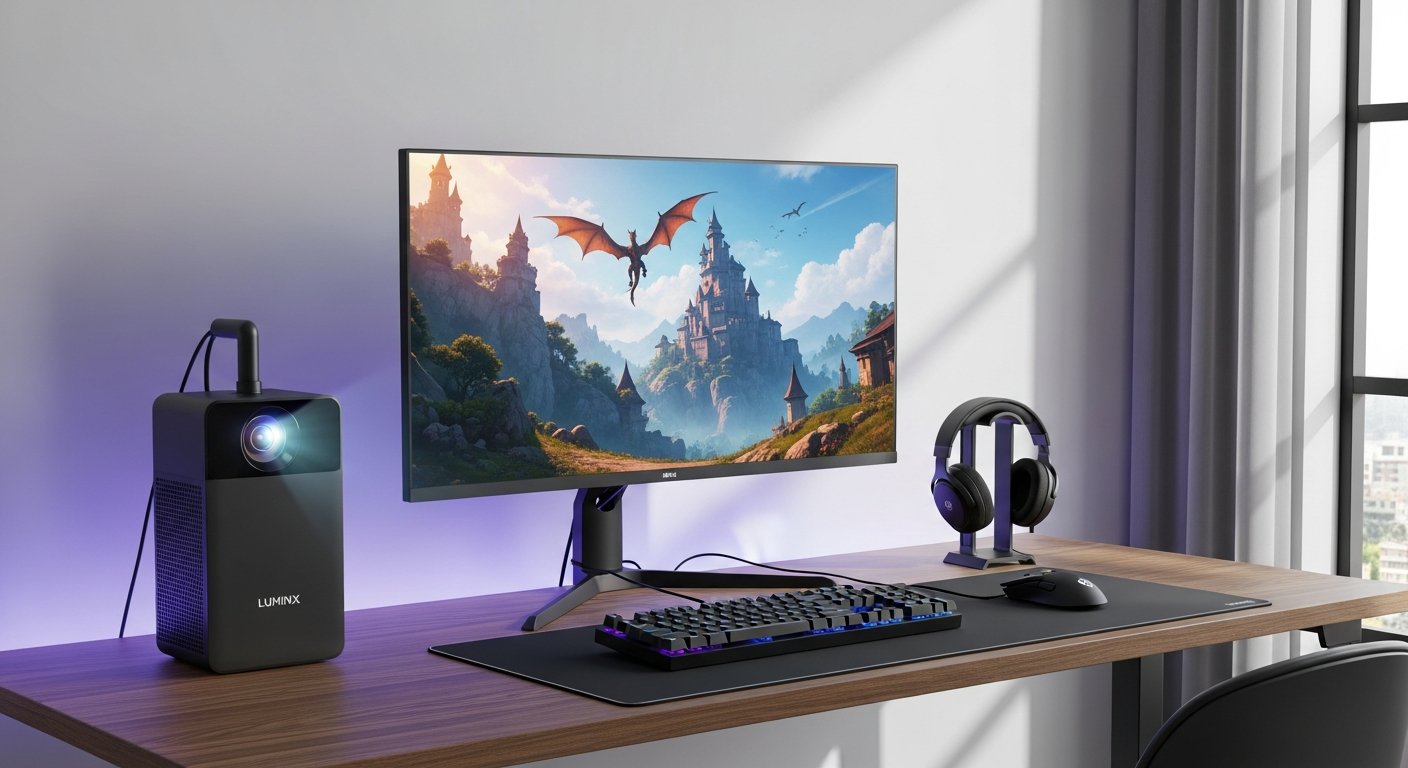
The Competitive Gamer's Secret Weapon: Why the Valerion VisionMaster Max Shatters Display Compromises
The esports and competitive gaming world has always obsessed over response times—but what if your gaming display could deliver cinematic immersion AND competitive-level performance simultaneously? The Valerion VisionMaster Max 4K projector is shattering the assumption that premium home theater equipment can't handle fast-paced gaming. With input lag as low as 4ms at 1080P@240Hz and 15ms at 4K@60Hz, this isn't just a lifestyle projector; it's a game-changer for serious gamers who refuse to compromise on either performance or visual quality.
Most gamers face an exhausting binary choice: lightning-fast response times from gaming monitors or the gorgeous, immersive displays of home theater projectors. The Valerion VisionMaster Max collapses that false choice entirely. By combining triple-laser 4K technology with gaming-grade latency specifications, it opens a completely new category of competitive gaming hardware—one that doesn't exist anywhere else in the market.
Explore the VisionMaster Max and transform your gaming setup today.
The Input Lag Advantage: Why 4ms Response Time Matters for Competitive Gaming
Understanding the Latency Breakdown
Four milliseconds at 1080P@240Hz and 15ms at 4K@60Hz—these numbers tell a specific story about how the VisionMaster Max processes gaming inputs. At 1080P with 240Hz refresh rates, the 4ms latency sits squarely in the territory of high-end gaming monitors. At 4K@60Hz, the 15ms response time remains competitive with premium television displays designed for gaming. The distinction matters because different gaming scenarios demand different refresh-to-latency ratios.
How These Specs Compare to Traditional Gaming Hardware
Traditional gaming monitors typically deliver 1-3ms input lag, but they're constrained to screen sizes between 24 and 32 inches. Premium gaming televisions often add 20-40ms of latency, requiring advanced optimization modes just to approach acceptable performance. Conventional projectors? They often hover around 50ms or higher, making them practically unusable for competitive play. The VisionMaster Max operates in a completely different performance band—one that gaming-focused projectors rarely reach.
The Psychological and Performance Impact
The difference between 4ms and 30ms input lag feels almost imperceptible in slow-paced strategy games, but in fast-paced shooters or fighting games, it becomes the deciding factor between winning and losing. Your brain processes visual feedback and translates it into controller input. At 4ms, that entire feedback loop completes within a single frame at 240Hz. At 30ms, you're already four frames behind. Professional esports players operate within this margin constantly—and the VisionMaster Max keeps you competitive rather than handicapped.
Triple-Laser 4K Visuals: Color Accuracy Meets Gaming Performance
RGB Laser Technology and Visual Fidelity
The RGB triple-laser system generates vibrant colors without the color-shifting limitations of traditional lamp-based or single-laser projectors. Each color channel operates independently, allowing simultaneous deep blacks and bright highlights—a technical achievement that separates premium laser projectors from everything else on the market. In gaming contexts, this translates to enemy players emerging from shadows without losing color detail, environmental lighting shifting naturally as you move through spaces, and the entire visual environment maintaining crispness from edge to edge.
Brightness and Real-World Gaming Conditions
The VisionMaster Max delivers 3000 ISO lumens, a brightness specification that matters far more than casual gamers typically realize. In competitive gaming, you need to see subtle details—the glint of an opponent's weapon in a darkened hallway, the outline of a player crouched behind cover, the brake lights of a competitor's vehicle in a racing sim. At 300 inches, maintaining consistent brightness across the entire projection surface keeps the image readable in various lighting conditions without requiring you to black out your gaming room entirely during daytime play.
Contrast Ratios and Shadow Detail
A 15000:1 contrast ratio means the projector can display true black next to true white without losing detail in either extreme. For gaming, this advantage becomes particularly obvious in atmospheric titles where environmental storytelling happens in shadowed areas. Horror games become genuinely terrifying when you can actually see what's lurking in the darkness. Stealth-focused gameplay rewards players who can detect enemy positions in dimly lit environments. The VisionMaster Max gives you that advantage through superior contrast handling.
Projection Scale: Gaming on a 300-Inch Canvas
The Psychological Shift at 300 Inches
Playing a first-person shooter on a 27-inch monitor versus a 300-inch projection surface creates fundamentally different neurological experiences. Your peripheral vision fills completely with game content. Your brain stops processing the projection as "a display you're watching" and starts processing it as "a space you're inhabiting." This shift isn't trivial—it's the difference between gaming and presence. Competitive gamers accustomed to monitor setups often report needing 30 minutes to adjust to projection scale before their spatial awareness fully catches up with the new visual field.
Screen Size and Competitive Performance
Counterintuitively, larger screens can enhance competitive performance in certain scenarios. In racing simulations, the expanded field of view improves your ability to judge apexes and detect competitor positioning through peripheral vision. In team-based shooters, the scale helps you track multiple threat vectors simultaneously. However, screen size also demands different positioning—you can't sit two feet from a 300-inch screen. The VisionMaster Max's interchangeable lens system accommodates various room configurations, ensuring you get the optimal image size and viewing distance for your specific space and gaming style.
Immersion Across Gaming Genres
Open-world games transform completely at 300 inches. The horizon extends naturally across your entire visual field. Vertical architecture—skyscrapers in cyberpunk cities, cathedral ceilings in fantasy environments—suddenly feels towering rather than depicted. First-person exploration becomes genuinely disorienting at scale, which enhances both horror and wonder depending on the game's design. This immersion factor doesn't improve your twitch reflexes, but it fundamentally changes how engaging extended gaming sessions feel, reducing fatigue and increasing enjoyment during marathon play sessions.
Smart Gaming Integration: Connectivity and Ecosystem Features
AI-SoC Chipset Processing Power
The MT9618 AI-SoC Chipset with 4GB RAM and 128GB ROM handles real-time image processing, input buffering, and smart feature coordination simultaneously. For gaming specifically, this architecture means the projector isn't just receiving a video signal and displaying it—it's actively optimizing that signal in real-time. The Enhanced Black Level Algorithm adjusts shadow detail based on content characteristics. The Anti-RBE Technology prevents rainbow artifacts during rapid camera pans. The Speckle Reduction system eliminates DLP chip artifacts. All of this happens without adding latency because the processing occurs in parallel with image delivery.
Wireless Streaming and Game Launching
Airplay 2, Chromecast, and Miracast compatibility means you can launch games wirelessly from phones or tablets directly to the VisionMaster Max without physical connections cluttering your gaming space. For console gamers, this matters less, but PC gamers who occasionally stream content from multiple sources appreciate the flexibility. The wireless functionality also enables rapid switching between gaming and entertainment modes—finishing a competitive session, then immediately pivoting to streaming content or video calls without physical cable swapping.
Smart Home Automation for Gaming Setup
Integration with Google Home, Apple HomeKit, and Alexa allows voice-controlled environmental adjustment. "Alexa, game mode" could trigger lighting reduction, speaker activation, and display optimization simultaneously. You can create custom automation routines that prepare your entire gaming space with a single command. For competitive gaming where every second matters, eliminating manual adjustments—dimming lights, adjusting speakers, optimizing display settings—through automation shaves friction from your pre-game ritual.
Discover how smart integration elevates your gaming experience.
Gaming Performance Across Genres: Real-World Applications
Fast-Paced FPS Gaming and Latency Requirements
Games like Call of Duty, Valorant, and Counter-Strike 2 demand sub-20ms input latency for competitive play. The VisionMaster Max delivers exactly that specification at 4K@60Hz or better at lower resolutions. Frame-perfect headshots and split-second positioning changes become possible because the projector isn't introducing artificial delay between your input and the visual feedback. Players transitioning from gaming monitors report that the 4ms performance at 1080P feels nearly identical to their previous displays, except now they're operating at 300-inch scale.
Fighting Game Performance and Input Responsiveness
Street Fighter and Tekken operate on frame-perfect mechanics where a single frame of delay can mean the difference between connecting a combo and getting punished. The VisionMaster Max's 4ms latency at 1080P@240Hz positions it alongside the best gaming monitors for this category. The psychological advantage of executing frame-perfect inputs at 300-inch scale—seeing your character's animation play out across your entire visual field—creates a feedback intensity that smaller displays simply cannot match.
Racing Simulator Experiences and Motion Clarity
iRacing, Assetto Corsa, and similar simulators benefit tremendously from the VisionMaster Max's motion handling and contrast capabilities. The 300-inch projection creates realistic perspective distortion—your visual cortex interprets the massive display as actual environmental depth rather than a flat image. The RGB triple-laser brightness ensures you can see competitors' vehicles clearly during high-speed passes. The 15ms latency at 4K@60Hz keeps your inputs responsive enough for precision racing without the distraction of input lag affecting your braking points and apex judgments.
Price-to-Performance Reality Check: Is the $3,999 Investment Worth It?
Understanding the $3,999 Price Point
The VisionMaster Max carries a sale price around $3,999, typically discounted from a higher MSRP. For context, premium gaming monitors top out around $1,000-1,500 for high-end models. Gaming televisions reach $2,000-3,000 for top-tier offerings. Competing premium gaming projectors from established brands occupy similar price territory. The VisionMaster Max positions itself in the luxury gaming hardware category, alongside equipment designed for serious enthusiasts rather than casual players.
Total Cost of Ownership Beyond the Purchase Price
The projector's price is only the entry point. Professional installation typically costs $500-1,500 depending on ceiling modifications and cable routing complexity. Lens optimization and calibration add $200-400. The interchangeable lens system—a major advantage—means acquiring additional lenses for different room configurations might run $800-1,200 per lens. Ceiling mounts, acoustic treatments, and cable management infrastructure add another $1,000+. Over five years of ownership, budget for occasional maintenance and lamp/laser servicing. The total cost of ownership easily reaches $6,000-8,000 when accounting for all variables.
Comparison to Alternative Gaming Display Investments
A high-end gaming monitor ($1,500) offers immediate gaming performance but delivers a 32-inch experience. Multiple premium monitors ($3,000) create surround-view setups but fragment your focus across separate displays. A premium gaming television ($2,500) provides 85-inch immersion with good gaming features but inferior input lag compared to monitors. The VisionMaster Max at $3,999 delivers 300-inch immersion with gaming-grade latency—a category that simply doesn't exist elsewhere at any price point. If you're evaluating whether the investment makes sense, ask yourself whether you'd pay an additional $1,500-2,500 to triple your screen size while maintaining competitive gaming performance. For some gamers, that's an obvious yes. For others, it represents excessive spending on a nice-to-have rather than a must-have upgrade.
Your Next Gaming Frontier Awaits
The Valerion VisionMaster Max 4K projector occupies a rare space in the gaming hardware landscape—it refuses to force compromise. You're receiving competitive-grade input lag without sacrificing the breathtaking visual scale that transforms gaming from a screen-based activity into a fully immersive experience. The triple-laser 4K technology, 300-inch projection capability, and smart gaming integrations combine to create something genuinely different from what traditional gaming displays offer.
For gamers who've been chasing the perfect balance between performance and presence, the VisionMaster Max represents a genuine breakthrough. Your competitive edge doesn't have to come at the cost of immersion. Your immersive experience doesn't require accepting mediocre input latency. The real question isn't whether this projector can handle gaming—it demonstrably can across every genre that demands responsive performance. The question is whether you're ready to reimagine what gaming becomes when you stop accepting the limitations of traditional displays.
Step into the future of competitive gaming with the VisionMaster Max today.
Leave a Reply