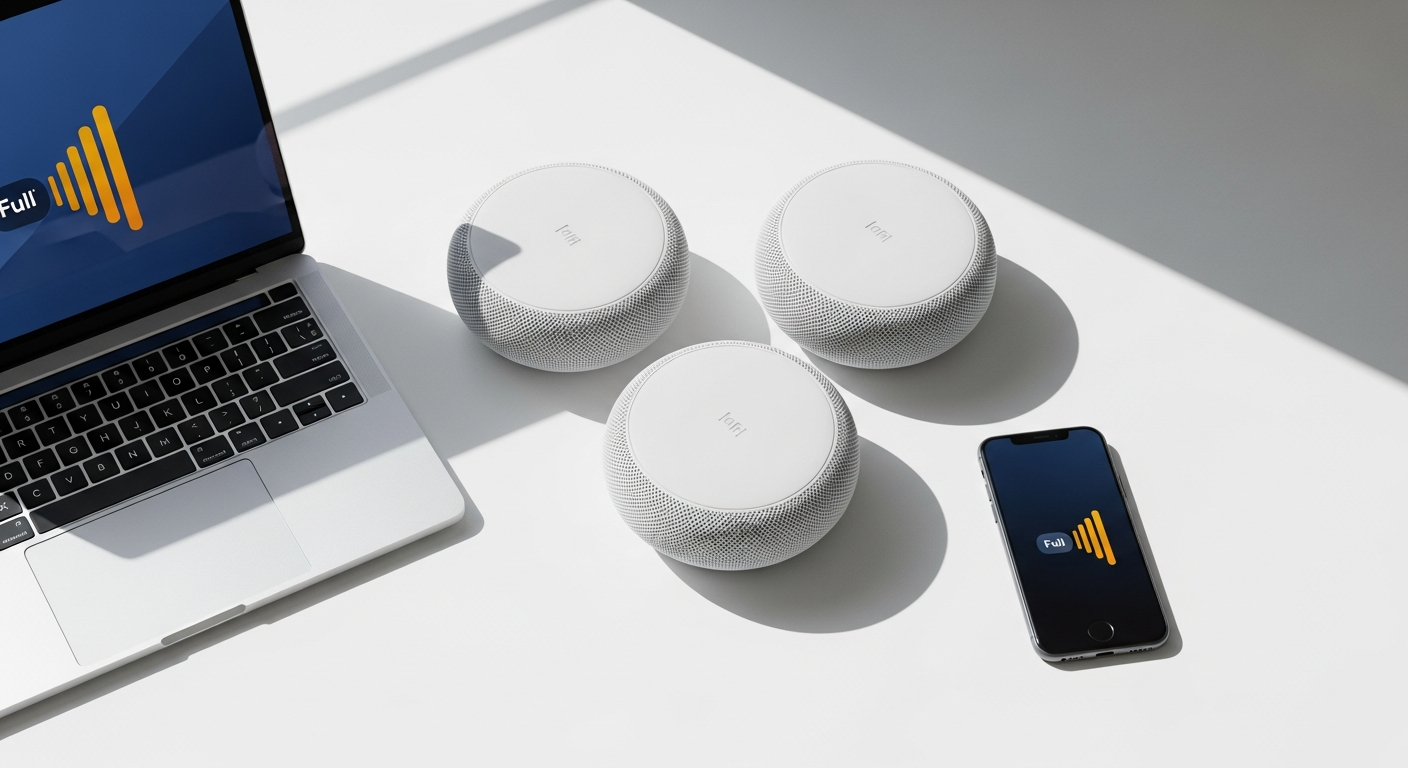
Nearly 60% of homes still struggle with WiFi dead zones, even with a traditional router positioned strategically in the center of the living space. That frustrating moment when your video call drops in the bedroom or your streaming stutters in the kitchen doesn't have to be your reality anymore. I've spent considerable time testing mesh systems, and I'm genuinely surprised how many people overlook budget-friendly options that actually deliver the performance they need.
The Google WiFi Mesh System 3-pack represents a fascinating category in today's networking landscape. It's older technology—that's undeniably true—but it's also been refined through years of real-world use and carries the backing of Google's ecosystem. At around $199 for the three-unit bundle, it occupies an interesting sweet spot between basic routers and premium mesh systems that cost three times as much.
Check current pricing and availability for the Google WiFi Mesh System 3-Pack at The Outlet Shop
This breakdown tackles the questions that actually matter to budget-conscious homeowners: Does this system genuinely eliminate dead zones? Who should buy it, and who should skip it? What hidden limitations might surprise you? By the end, you'll know exactly whether this mesh network fits your specific situation—or whether you'd be better served by something newer.
Beyond the Basics—What Makes Mesh Technology Different From Your Old Router
Traditional routers work like a single broadcasting tower: they send WiFi signals in all directions from one central point, hoping the signal reaches every corner of your home. The problem becomes obvious immediately—walls, floors, and physical obstacles weaken those signals exponentially. Your bedroom might sit 40 feet from the router with three walls in between, resulting in weak connectivity or complete dead zones.
Mesh networks fundamentally change this approach. Instead of relying on one device, you place multiple WiFi points throughout your home. Each point communicates with the others, creating a unified network that blankets your entire space. The three Google WiFi units work in concert, passing your connection seamlessly between points as you move through your home. This distributed architecture means you get strong signals everywhere—not just near the main router.
The 4,500 square feet coverage capacity sounds impressive on paper, but here's what it actually means: in a typical suburban home with standard construction materials (drywall, wood framing), three units can reliably cover a sprawling ranch house, a two-story family home, or a larger apartment. Multi-level homes benefit tremendously because mesh points can be positioned on different floors, eliminating the vertical signal loss that frustrates traditional router users.
Dual-band technology (2.4 GHz and 5 GHz) works quietly in the background. The 2.4 GHz band travels farther through obstacles but moves data slower. The 5 GHz band moves data faster but doesn't penetrate walls as effectively. Google WiFi automatically selects the best band for each device, optimizing performance without requiring manual tweaking. This seamless switching happens constantly, adapting to your device's location and current network demands.
Behind the scenes, technologies like MU-MIMO (Multi-User Multiple-Input Multiple-Output) and beamforming enhance performance. MU-MIMO allows the system to communicate with multiple devices simultaneously rather than handling them sequentially, which matters when you've got 30+ devices competing for bandwidth. Beamforming directs WiFi signals toward your devices rather than broadcasting omnidirectionally, strengthening the connection where it's actually needed. These aren't flashy features you'll notice on Day 1, but they're the reason this system handles busy households smoothly.
Who This System Is Actually Built For (And Who Should Look Elsewhere)
The Google WiFi 3-pack excels in specific scenarios. Medium-sized homes between 1,500 and 4,500 square feet with moderate device counts represent the sweet spot. Families wanting simple setup without technical expertise find enormous value here—the Google Home app makes configuration so straightforward that even non-technical household members can manage it.
Budget-conscious buyers prioritizing proven reliability over cutting-edge features will appreciate what this system offers. Multi-story homes where traditional routers struggle to reach upper floors see dramatic improvements with strategically placed mesh points. Households with 20 to 50 connected devices—phones, tablets, smart home gadgets, security cameras—won't overwhelm this system's capabilities.
However, certain situations call for different solutions. Homes exceeding 5,000 square feet without additional mesh points will likely experience coverage gaps, especially with dense construction materials like brick and concrete. Tech enthusiasts demanding WiFi 6, 6E, or 7 support will find Google WiFi's AC1200 speeds limiting, particularly if they own newer devices designed to leverage faster standards. Users needing advanced security customization beyond standard parental controls might find the feature set basic.
Those requiring maximum gaming or streaming performance in competitive multiplayer scenarios will benefit more from faster standards. Similarly, very large smart home implementations with 60+ devices and sophisticated automation routines might strain this system during peak usage. The discontinuation of the original Google WiFi also matters—if you need cutting-edge support and frequent feature additions, newer Nest WiFi models offer more active development.
The Setup Experience—Why Non-Tech Users Actually Love This System
The setup process separates Google WiFi from many competitors. Download the Google Home app, create or sign into your Google account, and the system walks you through the rest. The guided process takes under 10 minutes for most users, with no confusing IP addresses, admin panels, or technical jargon required.
The app generates network names and passwords automatically, though you can customize these if preferred. Placement recommendations appear within the app based on your home layout, suggesting optimal positions for the second and third mesh points. The system then automatically selects the best WiFi band for each device without manual configuration—your gaming console connects to 5 GHz for speed while your smart thermostat uses 2.4 GHz for range.
Troubleshooting features within the app handle common connectivity issues. Performance problems often resolve through the app's built-in diagnostics rather than requiring customer support calls. Guest network creation takes seconds, allowing visitors to connect without accessing your main network or stored passwords. Device prioritization ensures that critical devices—the computer you're working from, the streaming device in the living room—get bandwidth preference during congested periods.
Purchase the Google WiFi Mesh System 3-Pack and experience simplified home networking setup
Performance Reality Check—Speed, Coverage, and Consistency
AC1200 speeds translate to a theoretical maximum of 1200 Mbps combined across both bands. In practical terms, expect 400-600 Mbps on 5 GHz in close proximity to a mesh point, dropping to 100-300 Mbps as distance and obstacles increase. Most households find this plenty sufficient—streaming 4K video requires only 25 Mbps, video conferencing needs 2.5-4 Mbps per direction, and gaming doesn't require enormous bandwidth (latency matters more for competitive play).
Real-world performance in typical home construction remains consistent across the 4,500 square feet coverage area. With 30+ simultaneous connected devices, the system maintains stable connections without noticeable slowdowns during normal use. Peak usage hours when multiple people stream video, join video calls, and browse simultaneously show the system's strength—it distributes load effectively rather than bottlenecking at a single point.
Range through walls and floors is notably better than single-router setups. Signals reliably penetrate two to three standard walls before weakening significantly. Dense materials like brick, concrete, or older plaster construction reduce range more noticeably, sometimes requiring strategic point placement to overcome dead zones in basements or finished attics.
The WiFi 5 standard (802.11ac) remains adequate for the vast majority of 2026 households. Yes, WiFi 6 offers efficiency improvements and better performance in congested environments, but real-world advantages for typical families are modest. The performance ceiling of WiFi 5 doesn't matter until you own multiple WiFi 6 devices and demand maximum throughput—a scenario most households haven't encountered yet.
Speed test features within the Google Home app let you monitor actual performance, identifying connectivity problems before they frustrate you. Regular testing reveals whether your internet service provider's speed tier is being delivered, or whether interference or placement issues are limiting performance.
Security and Privacy—What You Get and What's Missing
WPA3 security protocol provides modern encryption protecting your data from interception. This represents the current standard in WiFi security, keeping your household network protected against known vulnerabilities. Automatic security updates through the Google ecosystem mean patches arrive without requiring manual intervention—your system stays secure even if you forget about it.
Parental controls and content filtering options give families the ability to restrict access to inappropriate sites or limit screen time on specific devices. Guest networks isolate visitor connections from your main network, preventing accidental access to stored passwords or sensitive devices. Device access controls let you determine which devices connect to your network, and bandwidth management tools let you throttle specific devices if needed.
However, advanced security customization falls short compared to premium mesh systems. You won't find sophisticated firewall rules, intrusion detection systems, or VPN server hosting. VPN compatibility exists but requires configuration outside the app environment. Remote work setups benefit from the system's stability, but users handling sensitive data might prefer systems offering more granular security controls.
Privacy considerations around Google's data collection practices should factor into your decision. Google collects usage analytics to improve the system, though you can disable some data sharing through privacy settings. If you're uncomfortable with any Google ecosystem involvement, that becomes a dealbreaker regardless of technical performance.
The Price-to-Value Equation—Is $199 Actually a Good Deal?
The 3-pack pricing at The Outlet Shop hovers around $199, representing significant discounts from the original launch pricing. Breaking down the cost: roughly $66 per mesh point, which is substantially less than purchasing individual units separately or buying comparable mesh systems.
Premium mesh systems in the $400-$600 range offer WiFi 6 support, more advanced features, and longer manufacturer support timelines. Entry-level mesh options at $150-$250 for 2-packs exist, but the Google WiFi 3-pack provides three points instead of two, extending your coverage significantly. For identical coverage with competing 2-packs, you'd often spend similar amounts.
Durability and longevity factor into true value. These units have proven reliable over years of real-world use, suggesting 5-7 year lifespans as typical. Warranty coverage varies by retailer, so verify what The Outlet Shop includes—some include manufacturer guarantees while others may have different terms. Resale value remains reasonable since demand exists among budget-conscious upgrades, though older technology depreciates more quickly than current standards.
Hidden costs emerge if your initial coverage assessment proves optimistic. Adding a fourth mesh point for additional coverage or extending into a garage adds to the total expense. Compare this calculated total to premium alternatives before deciding.
The Elephant in the Room—Older Technology and Discontinued Status
The original Google WiFi discontinuation raises legitimate questions about long-term viability. Google still provides security updates, but don't expect major feature additions or compatibility with future WiFi standards. The company has shifted focus toward newer Nest WiFi and Nest WiFi Pro models.
Nest WiFi and Nest WiFi Pro as successors offer added features—integrated Google Assistant speakers in Nest WiFi, WiFi 6 support in Pro versions. These represent the manufacturer's recommended path forward, though they cost more. WiFi 5 versus WiFi 6 matters mainly for users with multiple WiFi 6 devices—current reality has most households still using WiFi 5-compatible devices.
Practical differences for average users between WiFi 5 and 6 involve efficiency more than raw speed. WiFi 6 handles congested environments better and uses less battery power on mobile devices. For typical streaming, gaming, and video conferencing, WiFi 5 performs admirably. The performance ceiling becomes relevant only when you've maxed out WiFi 5 capacity—a scenario most households won't encounter.
Software support timeline shows Google maintaining security patches even for discontinued products, though aggressive updates probably won't continue forever. Community support and troubleshooting resources remain abundant online because millions of Google WiFi units exist globally. When you inevitably need troubleshooting help, finding solutions through forums and user communities remains straightforward.
Upgrade path considerations suggest this system will serve comfortably for 5-7 years, after which faster standards and more advanced features will likely become necessary. That timeline isn't unreasonable for technology costing around $200.
Real-World Scenarios—Where This Mesh System Shines (And Stumbles)
A suburban family home with 3 bedrooms, basement, and garage covering roughly 2,500 square feet with 25-35 connected devices (phones, tablets, smart home gadgets) experiences excellent results. Placing one point in the main living area, one upstairs, and one in the basement or garage ensures strong signals everywhere. Video calls hold steady, streaming never buffers, and the smart home automation runs smoothly.
Small apartments or condos of 600-1,200 square feet see massive improvements over single-router setups. Placing two points strategically (living room and bedroom) eliminates dead zones completely, with the third point extending coverage to balconies or adjoining spaces. The simplicity of the system becomes especially valuable in rental situations where complex networking isn't appealing.
Work-from-home professionals handling video conferencing and bandwidth-intensive tasks benefit tremendously from the stability mesh networks provide. Multiple Zoom calls, Teams meetings, and simultaneous uploads maintain consistent connection quality even with other household members streaming video. MU-MIMO performance under heavy load keeps your connection prioritized during work hours.
Multi-story townhouses or split-level homes with 2,500-3,500 square feet find point placement strategies crucial. One unit on each level (ground floor, second floor, basement if applicable) ensures no dead zones interrupt connectivity. The vertical coverage that frustrated traditional router users becomes a non-issue.
Smart home enthusiasts with 40+ connected IoT devices—cameras, thermostats, lights, locks, sensors—witness the system's MU-MIMO technology handling the load gracefully. Each device communicates without perceptible interference, and bandwidth distribution keeps everything responsive.
However, sprawling homes exceeding 5,000 square feet with dense construction materials (brick, older plaster, concrete) may experience coverage gaps even with strategic placement. Adding a fourth point increases costs substantially. Very high-density apartment buildings where neighbors' networks create interference sometimes see performance degradation that even mesh systems can't fully overcome.
Comparing Google WiFi to Current Mesh Alternatives
Head-to-head with Nest WiFi (Google's successor at similar price points), Google WiFi costs less but lacks WiFi 5E and the Nest WiFi Pro features like the integrated speaker. Nest WiFi Pro represents a significant jump in capability but doubles the cost.
TP-Link Deco systems at comparable price points offer similar coverage and app quality. The Deco app feels slightly more feature-rich, though both provide intuitive experiences. Performance differences prove negligible in typical home environments, making choice largely dependent on ecosystem preference (Google Home versus third-party alternatives).
ASUS mesh networks compete in the budget and premium segments simultaneously. Budget ASUS options match Google WiFi capability for similar pricing, while premium versions far exceed it. Amazon eero and Linksys Velop position themselves as premium alternatives with more advanced features and higher price tags.
Speed and coverage benchmarks across systems show Google WiFi performing solidly within its class. WiFi 5 alternatives demonstrate similar speeds, while WiFi 6 competitors show noticeable improvements in busy environments with multiple simultaneous connections. For single-family homes with typical device counts, differences remain imperceptible in daily use.
App experience and ease of use favor Google WiFi alongside Nest WiFi—both leverage Google's design language and ecosystem. Competitors offer comparable quality, though interface preferences vary by user.
Advanced features like threat detection, advanced scheduling, and custom DNS configurations remain absent from Google WiFi but present in premium alternatives. WiFi 6 alternatives genuinely future-proof your investment better than WiFi 5, though the practical advantage remains minimal until you own numerous WiFi 6 devices.
Maximizing Your Google WiFi Setup—Pro Tips and Optimization Strategies
Optimal placement of the three mesh points determines coverage success. Position the main unit near your internet connection (modem and router location), place the second unit roughly 30-50 feet away with minimal obstacles, and position the third unit in the area farthest from the main point or the weakest coverage area.
Distance between units and signal strength relationships matter less than most assume—the system can operate effectively even when units are far apart, though coverage in the middle suffers more if points spread too thin. Aim for rough triangulation rather than precise mathematical spacing.
Avoid placing routers near interference sources: microwave ovens, cordless phones, baby monitors, and wireless security cameras all operate on 2.4 GHz and create interference. Keep mesh points at least 3-6 feet away from these devices. Ethernet backhaul configuration improves performance significantly—connecting one or more mesh points via ethernet cable to the main unit ensures the strongest possible connection between points, particularly valuable in multi-story homes or situations with many walls between units.
Channel selection and automatic optimization features handle themselves effectively. The app's built-in optimization scans for interference and selects the clearest channels—most users benefit from leaving this on automatic rather than manual selection.
Regular firmware updates maintain security and improve performance. The Google Home app notifies you of available updates, and installation happens automatically if enabled. Monitoring network health through the app reveals whether slowdowns stem from distance issues, interference, or service provider limitations.
Bandwidth allocation for different household members ensures fairness when multiple people compete for shared internet. Guest networks prevent visitors from accessing sensitive connected devices, providing both security and peace of mind.
Extending coverage with additional points (a fourth unit) remains possible and costs around $100-$150 per point. Compatibility is seamless since all Google WiFi units work together, though costs accumulate quickly if major expansion becomes necessary.
The Long Game—Durability, Support, and Future-Proofing
Build quality reflects Google's standards—the plastic construction feels solid without being premium. These units survive normal household conditions without issues, and hardware reliability has proven excellent over years of real-world deployment.
Expected lifespan of 5-7 years is realistic for most units, with some lasting longer. Thermal management proves adequate with proper ventilation—keep units out of enclosed spaces and away from excessive heat sources to maximize longevity.
Availability of replacement units remains reasonable since millions exist in circulation. Spare parts (ethernet ports, power supplies) are obtainable from various sellers, though you'll probably replace the entire unit rather than repair components.
Google's commitment to software updates for discontinued products remains solid for security patches, though don't expect feature additions. Community forums and third-party support resources provide extensive troubleshooting information for common issues.
Warranty coverage varies by retailer—confirm specific terms with The Outlet Shop regarding replacement or repair eligibility. Most cover hardware defects for 1-2 years.
Comparison to newer systems with longer support timelines shows Google WiFi with shorter guaranteed support windows. WiFi 6 systems from current-generation manufacturers will likely receive updates longer into the future. However, for the 5-7 year typical ownership period, Google's update commitments prove adequate.
Upgrade timing arrives when you encounter limitations that frustrate daily use—your WiFi 5 speeds become insufficient, WiFi 6 device compatibility becomes important, or coverage needs expand beyond what the system provides. That scenario remains years away for most current users.
The Verdict: Smart Choice or Budget Compromise?
The Google WiFi Mesh System 3-pack occupies a unique position in 2026's networking landscape. It genuinely transforms home connectivity—eliminating dead zones, supporting dozens of devices, and delivering consistent performance across 4,500 square feet. The setup process is refreshingly simple, the Google Home app integration is polished, and the price point hovers around $199, making it accessible for budget-conscious households.
But here's where honesty matters: you're buying older technology. WiFi 5 is still perfectly functional for streaming, video calls, and gaming, yet it won't future-proof your investment like WiFi 6 or 6E would. The discontinued status means you're purchasing a mature product with a defined support window, not something that will receive cutting-edge innovations.
The real question isn't whether Google WiFi is good—it genuinely is. The question is whether it's right for your situation. If you're a family in a medium-sized home wanting reliable coverage without complexity, this system delivers exceptional value. If you're running a smart home with 60+ devices or living in a sprawling estate, you'll likely need something more powerful. If you're the type who upgrades tech every two years, save your money for WiFi 6.
For most households seeking straightforward, dependable mesh coverage at a fair price, the Google WiFi 3-pack remains a compelling option. Go in with clear eyes about what you're getting: proven, reliable technology that works beautifully for its intended purpose—not the absolute latest innovation, but something that genuinely solves the dead zone problem without breaking the bank.
Get the Google WiFi Mesh System 3-Pack today and upgrade your home's WiFi coverage
Leave a Reply