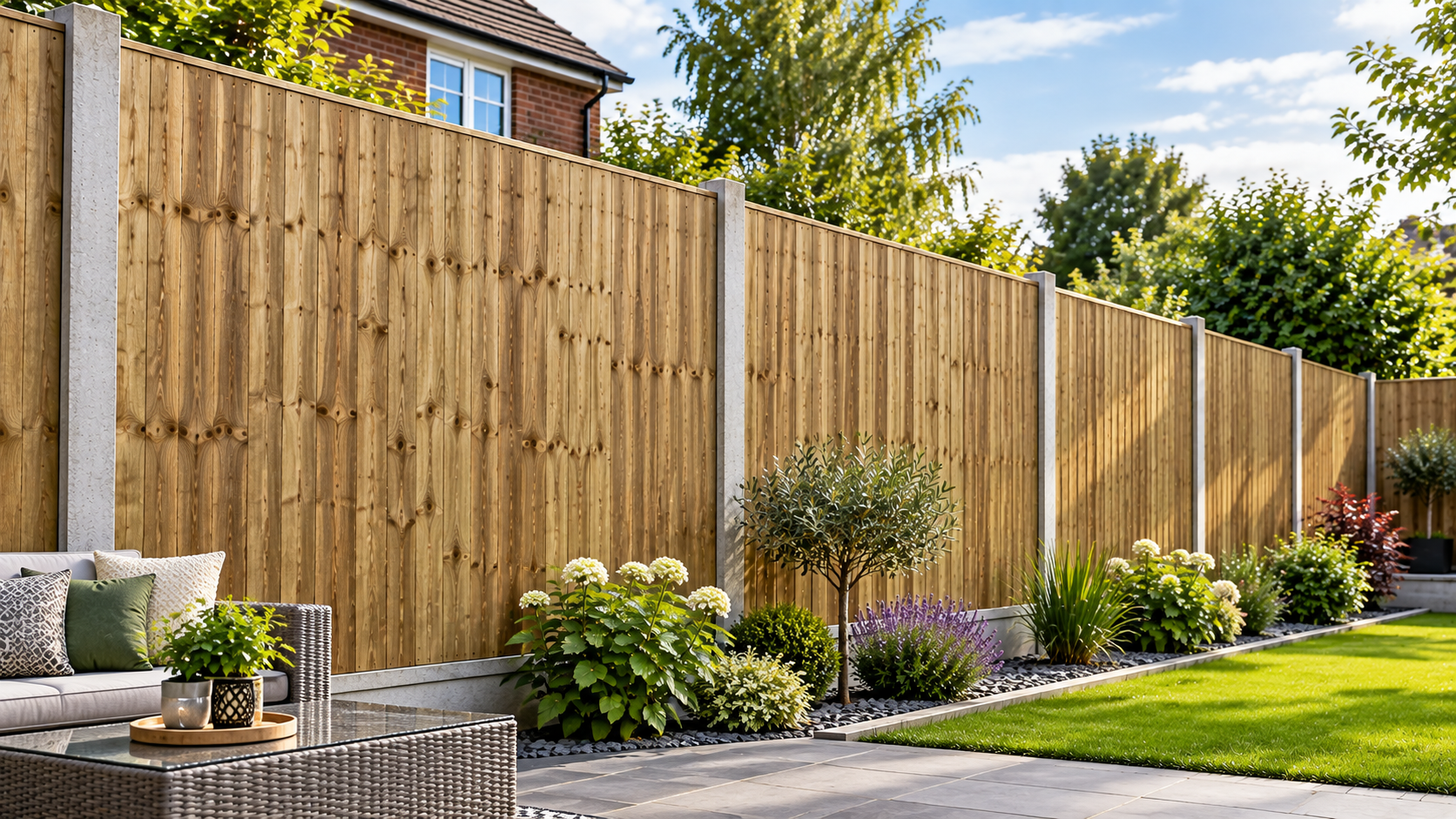
If you are replacing a garden boundary or planning a new fencing project, Heavy Duty Featheredge Fence Panels UK products are worth researching when strength, privacy, and a traditional timber appearance matter.
These panels typically use overlapping vertical boards fixed to a supporting timber frame, creating a solid boundary with limited gaps between boards.
Yet products described as “heavy duty” can differ significantly between suppliers. Board thickness, framing, timber treatment, panel height, capping, and construction can all affect what you receive.
What Are Heavy Duty Featheredge Fence Panels UK?
Heavy Duty Featheredge Fence Panels UK products generally use vertically positioned timber boards that overlap along their edges. This construction is commonly associated with feather edge fencing and closeboard-style boundaries.
Bradfords describes feather edge panels as using tapered overlapping vertical boards fixed to horizontal supporting rails. This differs from traditional lap panels, which typically arrange their boards horizontally.
The overlap creates a relatively solid face, making the design useful for boundaries where privacy is a priority. However, there is no single universal specification defining every panel marketed as heavy duty.
Frame dimensions, number of rails, board dimensions, timber species, treatment, and panel depth can differ by manufacturer.
Six Features to Check Before Buying
1. Panel Construction
Start by examining how each panel is built rather than relying on the “heavy duty” label alone.
Look at:
- board dimensions
- frame dimensions
- number and position of supporting rails
- panel depth
- type of capping
- treatment method
- stated timber specification
Some suppliers publish detailed construction information. For example, Daws Heath Timber lists a 6 x 4 ft panel constructed with 18 pressure-treated 125mm featheredge boards and three rear horizontal rails measuring 35mm x 45mm.
Those specifications should be treated as details for that particular supplier rather than standards applying to every panel sold in the UK.
2. Pressure Treatment
Timber used outdoors is exposed to moisture and biological decay, so treatment deserves close attention. Many pressure treated fence panels have preservative forced into the timber during manufacturing.
Several current UK listings specify pressure-treated timber. Grange, for instance, lists its Standard Featheredge Panel in pressure-treated golden brown or green finishes, while MBS Building Supplies lists pressure treatment for its featheredge range.
Do not assume every treatment carries the same warranty or expected service conditions. Read the manufacturer’s care instructions and guarantee terms before ordering.
3. Height and Width
A common format among UK suppliers is approximately 1.83 metres or 6 feet wide, with several height choices.
Current listings illustrate the range available. Bradfords lists panels approximately 1,828mm wide in 3ft, 4ft, 5ft, and 6ft heights. Grange likewise lists several heights with widths of approximately 1,828mm.
This makes 6ft fence panels easy to find, though the phrase can refer to width, height, or both. Always check the dimensions in millimetres before placing an order.
4. Frame Strength
The visible boards are only one part of the panel. The supporting structure behind them matters too.
A stronger frame can help keep the individual boards securely positioned and support the panel during handling and installation. When assessing heavy duty fence panels, compare rail dimensions and frame construction alongside board thickness.
For example, A&P Fencing describes one of its framed featheredge products as fully framed with six backing rails, while CMR Timber Group states that its heavy-duty panels use 47mm x 32mm rails and 22mm x 125mm featheredge boards. These are supplier-specific specifications.
5. Capping
Some featheredge panels include a timber cap across the upper edge.
Capping can give the boundary a finished appearance and protect exposed upper edges. MBS Building Supplies lists a profiled panel cap on its featheredge panels, while Grange specifies a capping rail on its Standard Featheredge Panel.
If a cap matters to your installation, check whether it comes pre-fitted, is supplied separately, or needs to be purchased as an accessory.
6. Timber Sourcing
For buyers interested in sourcing, check whether the manufacturer or retailer identifies a recognised timber certification.
For instance, MBS states that its listed panels use FSC-certified timber, while some Forest Garden products sold through UK retailers are also described as using FSC-certified timber.
Certification details can differ between ranges, so verify the exact product rather than applying one manufacturer’s credentials to another.
Featheredge Panels vs Other Common Fence Panel Types
When researching timber garden fencing, it helps to understand how featheredge construction differs from other familiar options.
| Panel type | Typical board arrangement | Privacy | What to check |
|---|---|---|---|
| Featheredge | Overlapping vertical boards | High | Board thickness, rails, frame and treatment |
| Traditional lap | Overlapping horizontal boards | High | Frame strength and board thickness |
| Decorative slatted | Spaced horizontal or vertical boards | Varies | Gap spacing and privacy level |
| Trellis | Open lattice | Low | Batten dimensions and intended use |
Featheredge construction can suit homeowners who want a traditional solid timber boundary. Decorative slatted or trellis designs may suit locations where airflow, light, or an open appearance takes priority.
Are Featheredge and Closeboard Panels the Same?
The terms are frequently used together in UK fencing retail, although individual construction details can differ.
CE Clarke describes its closeboard fence panels as featheredge panels built from overlapping vertical timber boards. Bingley Fencing similarly describes featheredge boards as overlapping boards attached to a supporting framework.
When shopping, focus on the published construction specifications rather than the product name alone.
Which Height Should You Choose?
Your preferred height depends on where the fencing will be installed and what you want the boundary to achieve.
A shorter panel may suit front gardens, internal garden divisions, or installation above an existing wall. Taller panels are commonly researched when privacy is the main priority.
Before purchasing, measure the entire fence line and account for posts, gravel boards, ground levels, gates, corners, and changes in elevation.
If replacing existing panels between fixed posts, measure the actual opening instead of assuming the old panels use current standard dimensions.
You should also check applicable planning requirements before installing or increasing the height of a boundary fence.
Should You Use Timber or Concrete Posts?
Both systems are commonly paired with timber fence panels.
Timber posts create a consistent wooden appearance and can be straightforward to work with. Concrete posts avoid placing timber posts directly in the ground and are commonly paired with concrete gravel boards.
Your choice can depend on the existing boundary, installation method, budget, appearance, ground conditions, and the weight and dimensions of the chosen panel.
Are Gravel Boards Worth Adding?
Gravel boards sit beneath fence panels and separate the lower panel edge from direct ground contact.
They are available in timber and concrete versions. Their suitability depends on your chosen panel and post system. Some manufacturers may specify installation requirements tied to their warranty, so check those conditions before deciding to omit a gravel board.
How Much Do Heavy Duty Featheredge Panels Cost?
There is no single UK price because cost changes according to dimensions, construction, timber specification, treatment, retailer, delivery area, and quantity.
Current supplier listings show substantial variation. For example, MBS lists several featheredge panel sizes at different prices, while eDecks lists heavy-duty featheredge products across standard and made-to-measure formats.
Prices can change, so a live retailer listing is a better reference than a fixed figure in a buying guide.
When comparing costs, calculate the complete fencing project rather than the panel price alone. Your total may include posts, gravel boards, caps, fixings, concrete or post-setting material, gates, delivery, waste disposal, and installation labour.
When Heavy Duty Featheredge Panels Make Sense
Featheredge panels can be a practical candidate when you want a solid timber boundary, overlapping vertical boards, several height choices, and a traditional closeboard appearance.
They may be especially suitable when privacy matters and you prefer a framed panel that can be installed between posts instead of constructing a closeboard fence board by board on site.
The strongest purchasing decision comes from checking measurable specifications. A panel marketed as heavy duty should be assessed according to its board dimensions, framing, rails, treatment, size, warranty conditions, and manufacturer documentation.
Choosing the Right Panels for Your Boundary
Before buying Heavy Duty Featheredge Fence Panels UK, measure your fence line carefully and decide which panel height, post system, and base arrangement fit the site.
Then compare products using published dimensions rather than marketing descriptions. Look closely at board size, frame construction, treatment, capping, timber sourcing, warranty conditions, and delivery requirements.
If two panels look nearly identical online, their construction specifications can still differ. Checking those details gives you a sound basis for choosing fencing that suits your property, installation plan, and spending limit.
Leave a Reply