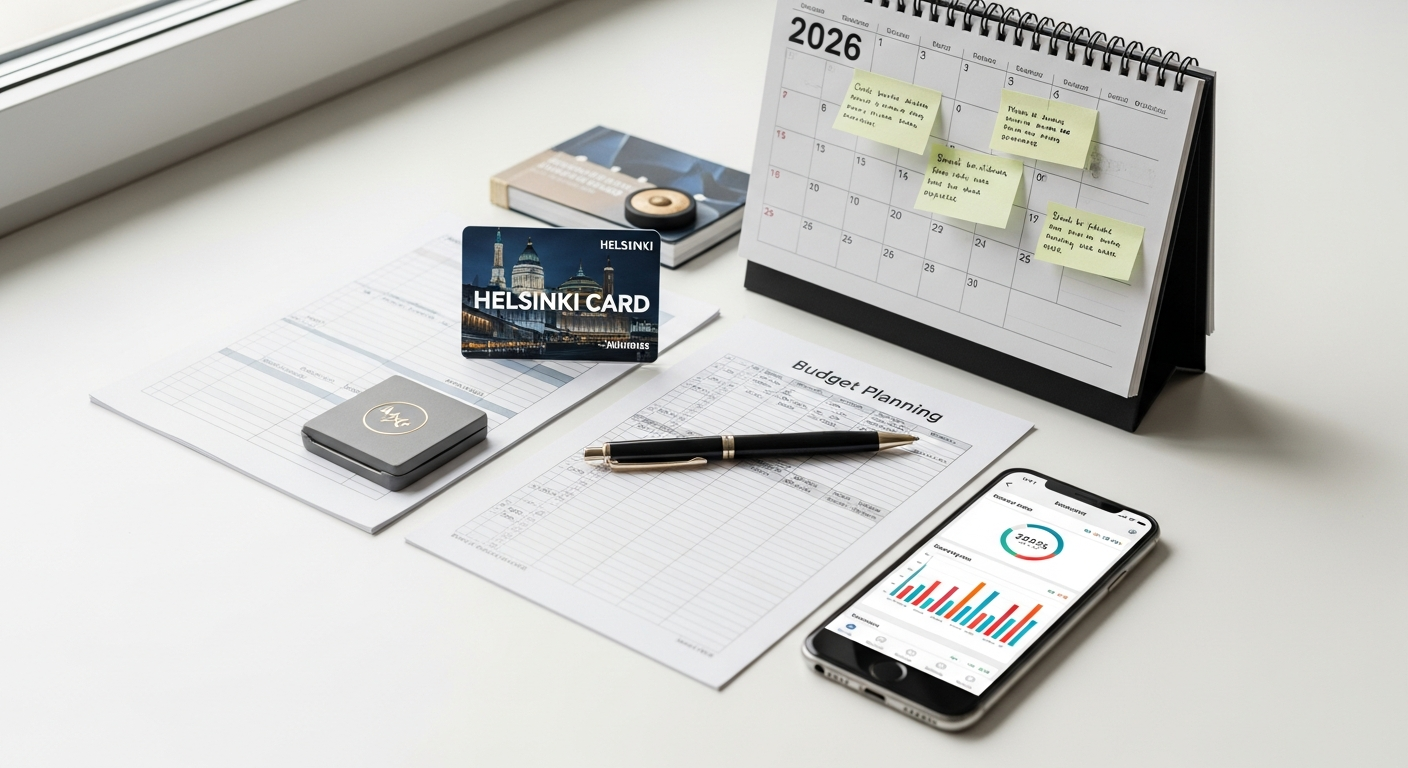
Imagine this: You've just arrived in Helsinki, excited to explore the Nordic capital's world-class museums, stunning architecture, and vibrant neighborhoods. Then you check ticket prices. A single museum entry runs €15-18. A day pass for public transport costs another €11. The Suomenlinna ferry adds more. By day two, you've already spent €40-80 on tickets that feel like they're eating into your travel budget faster than you expected. That's money you could've spent on authentic local restaurants, boutique shopping, or extending your trip by a full day.
The Helsinki Card City has become the go-to pass for travelers seeking convenience and value, but your actual savings potential depends entirely on how strategically you use it. This isn't a one-size-fits-all solution—it's a financial instrument that works brilliantly for some visitors and offers minimal benefit for others.
Discover if the Helsinki Card City is right for your Helsinki trip
This guide breaks down the real economics of the Helsinki Card City for 2026. You'll learn exactly which attractions deliver the highest ROI, how seasonal timing affects your savings, which pass duration actually makes sense for your trip length, and the insider tricks that separate savvy travelers from those who overpay. By the end, you'll know precisely whether this pass justifies its price for your specific Helsinki itinerary.
Calculating Your Real Savings: Which Attractions Actually Justify the Card
The first step in determining whether the Helsinki Card City makes sense for you is understanding the actual value proposition of included attractions. The card grants free entry to over 30 attractions, but not all carry equal weight in your decision-making.
Breaking down individual ticket prices versus included attractions
Suomenlinna Sea Fortress stands out as a standout inclusion. This UNESCO World Heritage site normally requires a €5 return ferry ticket plus a suggested €7 entry donation, totaling around €12. Amos Rex, one of Helsinki's most talked-about contemporary art museums, charges €18 for adult admission. The Design Museum runs €12 for general entry. The Kiasma contemporary art museum costs €13. Just these four attractions alone total €55 in individual tickets—nearly the cost of a full 24-hour card.
Other notable inclusions include the Museum of Contemporary Art, the Gallen-Kallela Museum, and the Finnish Museum of Natural History, each typically running €8-12 per visit. When you add cable car rides, boat tours, and sightseeing experiences to this list, the cumulative cost of individual purchases becomes strikingly apparent.
Identifying high-value museums that justify the pass investment
Not every included museum deserves equal priority in your itinerary. Your job is identifying which ones genuinely interest you and align with your travel style. Art enthusiasts will find tremendous value in Amos Rex and Kiasma alone. History buffs should prioritize the National Museum of Finland and Suomenlinna. Architecture lovers will appreciate the Saarinen House and various design-focused museums.
The key principle: If you plan to visit just two or three major attractions during your stay, the Helsinki Card City might not justify its cost. But if you're planning to see four or more, the numbers shift decisively in the card's favor.
Understanding which attractions offer the steepest discounts through the card
Beyond free admission, cardholders receive discounts at numerous restaurants, shops, and experiences throughout Helsinki. The Tallink ferry to Tallinn, Estonia—a popular day trip—offers a meaningful discount that can save €15-25 on round-trip passage. Several restaurants in the city center provide 10-20% reductions on dining, which can add up significantly if you enjoy a couple of nice meals during your stay.
These secondary discounts often go underutilized by travelers, yet they represent genuine savings opportunities that extend the card's value beyond museum entries.
Creating a personal attraction checklist to determine your break-even point
Start by listing every attraction that genuinely interests you during your Helsinki visit. Next to each, write the individual ticket price (available on attraction websites). Add them up. When your total approaches or exceeds the card price (€62 for 24 hours, €78 for 48 hours, or €94 for 72 hours), the card becomes financially sensible.
This checklist serves another purpose: it forces honest reflection about what you'll actually visit versus what you think you should visit. Many travelers overestimate their museum appetite. Be realistic about your pace and interests.
Comparing cost-per-attraction across different pass durations
A 24-hour card at €62 means you need roughly four major attractions to break even. A 48-hour card at €78 gives you more flexibility—three major attractions, plus transportation savings, creates a comfortable margin. A 72-hour card at €94 is most cost-effective when you plan leisurely days mixing attractions with neighborhood exploration and transportation-heavy days visiting distant sites.
The longer your stay, the more efficiently you use each euro of the pass investment.
Recognizing attractions worth skipping to optimize your budget
Some included attractions, while culturally significant, might not align with your interests. If contemporary art doesn't move you, skipping Kiasma in favor of a long neighborhood walk or café experience is perfectly rational. The card's value only materializes when you visit attractions you'll actually enjoy.
Factoring in ferry costs and how they shift your ROI calculation
The included Suomenlinna ferry access deserves special mention. The round-trip ferry alone costs €5-6 if purchased separately. For many visitors, Suomenlinna represents a half-day excursion, combining the ferry ride with fortress exploration and waterfront time. This single inclusion, paired with just three museum entries, creates substantial value.
Calculate your Helsinki Card City savings potential today
Transportation Economics: When Unlimited Public Transit Becomes Your Secret Weapon
For many travelers, the attraction savings represent only half the Helsinki Card City's value equation. The unlimited public transportation component often delivers the more substantial financial benefit, particularly for visitors who rely on Helsinki's efficient HSL system for daily movement.
Analyzing HSL zone AB coverage and daily transport costs without the card
Helsinki's public transport operates on a zone-based system, with HSL zones AB covering central Helsinki and most tourist attractions. A single journey ticket costs €3.20. A daily transport pass runs €11. Without the card, a visitor taking five or six journeys daily (entirely realistic when moving between neighborhoods, visiting attractions, and returning to accommodation) spends roughly €16-19 on transport alone.
Over a 48-hour period, that's €32-38 in transport costs—a significant portion of the 48-hour card price of €78.
Calculating tram, bus, metro, and train ride frequencies needed to offset pass cost
The math becomes compelling when you account for all transport modes. Suppose you take two tram journeys daily, one bus ride, one metro trip, and occasional train use. That's easily five journeys per day. Over 48 hours, you're looking at ten journeys—€32 in individual ticket purchases compared to the card's included unlimited transport.
For 72-hour stays with comparable travel patterns, unlimited transport accounts for nearly 40% of the card's total value.
Understanding how the included Suomenlinna ferry access amplifies savings
The Suomenlinna ferry isn't merely a sightseeing experience—it's practical transportation that factors into your cost calculation. The round-trip ferry normally costs €5-6. For visitors planning a Suomenlinna day (and you should—it's exceptional), this savings is particularly meaningful.
Comparing unlimited transport value for different visitor profiles
A museum-hopper moving between galleries across different neighborhoods will extract maximum value from unlimited transport. Someone staying in a central location and exploring primarily on foot derives less transportation benefit. Neighborhood explorers who take trams or buses to peripheral areas enjoy substantial transport savings.
Your visitor profile directly determines transportation economics.
Recognizing hidden transport savings (avoiding multiple single-journey tickets)
Beyond the per-journey cost, the card eliminates the friction and cognitive load of purchasing individual tickets. No fumbling for exact change. No confusion about zone boundaries. No regret about an extra €3.20 spent on a journey you could've walked. This convenience, while not quantifiable in spreadsheets, has genuine psychological and practical value.
Evaluating whether the card pays for itself through transport alone
For many visitors, the answer is yes. A visitor taking seven or more journeys daily—entirely realistic when combining attraction visits with neighborhood exploration—will have transport costs approach €22-24 daily. Over 48-72 hours, unlimited transport genuinely justifies a significant portion of the card's price.
Assessing the card's value for visitors with specific mobility needs or preferences
Travelers with limited mobility who rely heavily on public transport get exceptional value from unlimited passes. Families with children, where managing multiple ticket purchases becomes chaotic, benefit from the simplified system. Older travelers who appreciate not navigating ticket machines appreciate the convenience component that extends beyond pure economics.
Seasonal Timing Strategies: When Your Helsinki Card City Delivers Maximum Value
The Helsinki you experience in July looks and feels fundamentally different from the Helsinki of February. Seasonal timing dramatically affects both the card's value and your overall experience quality.
Summer advantage: Hop-on Hop-off bus tours and Canal Route Cruise inclusions
Summer transforms Helsinki's card value proposition. The seasonal Hop-on Hop-off bus tour (May through October) alone costs €25-30 if purchased separately. The Canal Route Cruise, operating during warmer months, provides a relaxing introduction to the city's waterfront neighborhoods and island communities. These experiences, included with the summer card, add considerable value unavailable during winter months.
A summer 48-hour card gives you access to attractions plus seasonal touring experiences that winter visitors simply cannot access. The value density is significantly higher.
Winter reality: Outdoor attractions and seasonal tours that close or limit operations
Winter fundamentally changes Helsinki's tourism landscape. The Canal Route Cruise closes for the season. The Hop-on Hop-off bus transitions to limited Panorama Sightseeing tours with far fewer daily departures. Suomenlinna becomes significantly more challenging to visit—not impossible, but less pleasant and less frequently served by ferries.
Winter card purchasers lose substantial value from seasonal inclusions. They're essentially paying for attraction access and transport without the experiential add-ons that justify the price for summer travelers.
Spring and autumn sweet spots for balanced pricing and attraction availability
April-May and September-October represent the Goldilocks seasons for Helsinki Card City value. Most attractions operate at full capacity. Some seasonal experiences (like early or late-season cruises) may operate on limited schedules, but transport and indoor attractions deliver full value. Weather supports neighborhood exploration without the peak-season crowds.
Shoulder-season travelers often get the best combination of experience quality and card value.
Understanding how seasonal closures affect your attraction options and savings potential
Research which attractions you plan to visit and their seasonal hours before purchasing your card. Some museums maintain year-round operations; others reduce hours or close entirely during off-season periods. A museum you planned to visit might operate only weekends during winter, or it might close for renovations entirely.
Misaligned seasonal planning can severely reduce your card's value.
Identifying which pass duration works best for different seasons
Summer visitors benefit from 48-72 hour cards that maximize access to seasonal experiences. Winter visitors might maximize value with 24-hour focused visits or skip the card entirely. Spring and autumn travelers have flexibility to choose based on their planned itinerary rather than seasonal constraints.
Planning around peak tourist seasons to maximize experience quality
July and early August represent peak season in Helsinki, bringing larger crowds to attractions and longer queues for popular experiences. May, June, September, and early October offer comparable weather with fewer tourists. September specifically provides beautiful light and comfortable temperatures without summer's crowding.
Your card delivers the same monetary value regardless of crowding, but your actual experience quality improves substantially during shoulder seasons.
Recognizing shoulder seasons where you get premium experiences at lower prices
This is the contrarian insight: You don't need to travel during peak season to experience Helsinki at its best. May's longer daylight hours, September's clarity and crisp air, and October's autumn colors each provide distinct advantages. The Helsinki Card City works equally well during these periods, but you'll move through attractions more comfortably.
Make Your Helsinki Card City Decision with Confidence
The Helsinki Card City isn't universally perfect—but for the right traveler on the right trip, it's genuinely transformative. If you're planning a 48-72 hour visit during spring through autumn, hitting multiple museums and attractions, and actually using that unlimited transport, the math overwhelmingly favors the card. You're looking at genuine savings of €30-60 compared to individual tickets, plus the priceless benefit of moving through Helsinki without constant transaction friction.
But if you're a mid-winter visitor seeing two attractions and staying in one neighborhood, you might genuinely save money skipping it entirely. The card's value is contextual, not automatic.
Here's my recommendation: Calculate your personal break-even point using the attraction checklist and transport analysis outlined above. Map your realistic daily itinerary—be honest about your pace and interests. Factor in seasonal closures and which experiences will actually be available during your visit. Then make your decision armed with actual numbers rather than marketing promises.
The Helsinki Card City has earned its popularity because it delivers real value—but only when you're intentional about how you use it. Travelers who purchase thoughtfully, plan strategically, and actually visit the included attractions find the card indispensable. Those who buy it as insurance against discovery or out of vague assumptions about its value often feel disappointed.
Your Helsinki experience will be exceptional either way. The card simply makes it more economical for visitors whose travel style aligns with what it offers. Take the time to determine whether you're that visitor.
Get your Helsinki Card City pass and start saving on your Helsinki adventure
Leave a Reply