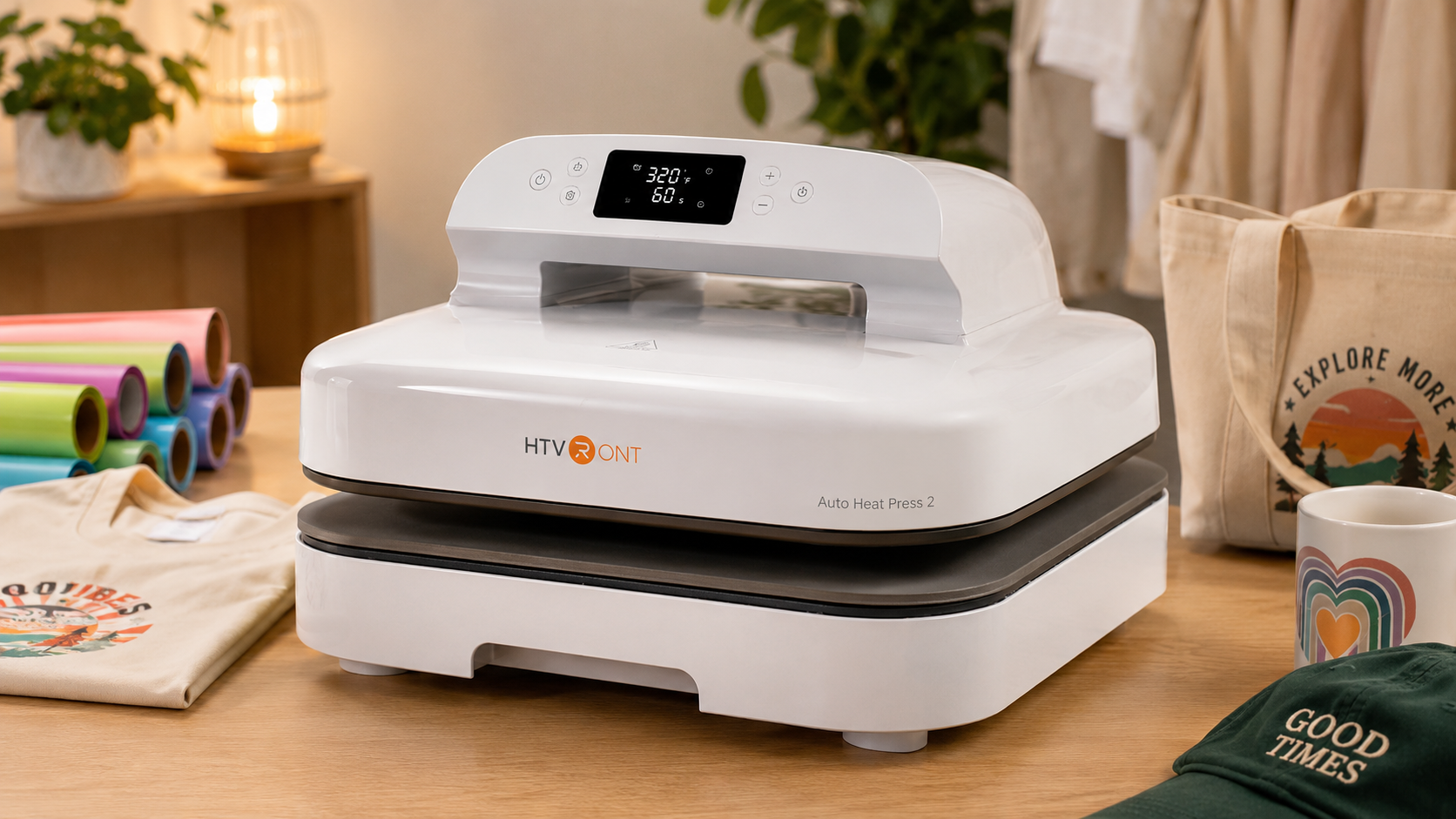
Small business owners in the custom apparel space are generating six-figure revenues—and many of them started with a single heat press machine in their garage. The difference between staying small and scaling comes down to equipment that works as hard as you do. When you’re pressing dozens of items daily, every minute counts, and manual processes become your biggest bottleneck.
The HTVRONT Auto Heat Press 2 isn’t just another heat transfer device—it’s engineered specifically for the sweet spot between hobbyist and professional-grade operations. At around $349.99, it delivers commercial-quality results without requiring commercial-level investment. This machine handles the technical heavy lifting so you can focus on what actually grows a business: customer acquisition, product innovation, and operational strategy.
Explore the HTVRONT Auto Heat Press 2 to see how it supports your business growth.
How the Auto-Open Function Transforms Production Efficiency
The auto-open feature is the quiet workhorse that changes everything about your daily workflow. Once the set time completes, the heat plate automatically lifts—meaning you’re no longer chained to the machine waiting for each cycle to finish. While the press does its job, you’re prepping the next batch of items, arranging transfers, or packing completed orders.
This automation prevents over-pressing damage that can reduce profit margins on high-value orders. A single ruined design on premium merchandise costs you not just the material but customer satisfaction and repeat business. The machine’s timing precision eliminates the guesswork that leads to inconsistent results.
Repetitive strain from manually opening and closing the platen throughout the day adds up quickly. Operators report noticeable fatigue reduction, which directly impacts productivity during high-volume seasons. When speed translates directly to revenue, fatigue-related slowdowns become expensive mistakes.
The throughput increase is substantial. One operator can now handle significantly more items per day without hiring additional staff during peak periods. This scalability becomes your competitive advantage during seasonal surges when other shops must turn away orders.
Pressure Control: Why 50-170 lbs Matters for Scaling
Equipment limitations often prevent business growth more than market demand does. With adjustable pressure ranging from 50 to 170 lbs, this machine accommodates far more than standard cotton T-shirts. Polyester blends, canvas, leather, and nylon all require different pressure profiles to avoid damage or incomplete transfers.
Consistency across different material types is where professional operations separate themselves from hobbyists. What works perfectly for basic apparel might damage specialty fabrics. This machine lets you explore premium product categories—canvas tote bags, leather patches, performance wear—without purchasing different equipment for each.
The memory mode stores your custom pressure profiles for specific products. Once you dial in the perfect settings for a supplier’s heat transfers, those parameters save automatically. Subsequent runs require one button press rather than manual adjustments, reducing both setup time and human error.
Gradual testing of new materials becomes feasible without major investment. As your business grows and product demand shifts, you’re not locked into your original offerings. The flexibility to experiment with premium materials that command higher margins is built directly into the machine’s capabilities.
Building a Customizable Workflow with Preset and Custom Modes
Four preset options provide quick access to common applications—basic cotton, performance fabrics, specialty transfers, and custom combinations. New operators can start productive immediately without extensive training on temperature and pressure variables. This onboarding efficiency becomes invaluable as your team grows.
Custom settings capability lets you dial in perfect parameters for your specific suppliers’ transfers. Different transfer manufacturers often require slightly different approaches. Rather than being locked into one preset, you’re building a library of documented settings that work for your exact materials and suppliers.
The digital display with clearly labeled controls ensures consistency when multiple team members operate the machine. One person’s interpretation of “medium pressure” shouldn’t differ from another’s. Standard operating procedures created around the presets protect quality as production scales across a growing team.
Preset memory prevents costly mistakes from manual setting adjustments. When new operators reset parameters mid-shift or experienced staff forget settings between days, the saved profiles eliminate guesswork. This reliability builds customer confidence in your delivery consistency.
Start configuring your custom workflow today with HTVRONT Auto Heat Press 2.
The 15×15 Platen: Why Size Matters for Product Diversification
The 15″x15″ platen accommodates larger items that command premium pricing. Oversized hoodies, tote bags, and canvas products represent margin opportunities that smaller platens simply can’t access. Full-size design placement without repositioning means professional results every time.
Your product catalog expands beyond basic T-shirts when equipment can handle larger items. Home décor items, accessories, and premium apparel all become viable offerings. This diversification reduces your dependence on any single product category and opens revenue streams that competitors using smaller equipment cannot serve.
Efficient layout of multiple smaller designs on larger substrates reduces waste. When you’re pressing many items daily, material waste directly impacts profitability. Smart planning around a larger platen means you’re maximizing usable space on each substrate.
Bulk orders for corporate clients become feasible when you can deliver professional-grade results on varied product types. Companies sourcing branded merchandise expect consistency across different item categories. A 15×15 platen demonstrates capability for these higher-value contracts.
The flexibility to pivot product offerings as market demand shifts is crucial for long-term sustainability. When one category saturates, you’re not forced to look for different equipment—you’re already set up to explore adjacent markets.
Fast Heat-Up Times and Operational Efficiency
Idle time between projects directly reduces daily output and profitability. Fast heat-up times mean less waiting and more pressing. When you’re running multiple orders daily, cumulative heat-up delays compound into lost revenue.
Quick turnaround capability becomes a premium service that customers will pay extra for. Rush orders are where margins expand because demand exceeds supply. Equipment that heats up fast enough to accommodate rush requests opens a pricing tier that others can’t serve.
Consistent heat distribution ensures first-pass success rates. Professional-looking results on the first attempt reduce material waste and rework cycles. Repeated pressing of failed items consumes time and materials without generating revenue.
Energy efficiency matters for operating costs, especially at scale. Lower power consumption compared to commercial-grade machines translates directly to reduced utility bills. Across hundreds of presses monthly, this efficiency adds meaningful savings to your bottom line.
Daily production cycles accelerate dramatically. One operator handling higher order volumes means better equipment utilization and improved revenue per square foot of workspace. Throughput improvements compound across the year into significant business impact.
Affordability Without Compromising Commercial Reliability
Direct-to-customer pricing eliminates retailer markups, keeping equipment costs competitive. This pricing model means you’re paying for manufacturing and distribution efficiency rather than middlemen markups. Starting equipment costs stay lower while maintaining commercial build quality.
Commercial-grade build quality means fewer breakdowns and maintenance costs over time. Professional equipment reliability costs more upfront but saves substantially in downtime and repairs. The math shifts dramatically when you calculate production losses during equipment failures.
Entry-level investment allows entrepreneurs to test the heat transfer market before massive financial commitment. You’re validating business model viability without betting the farm on equipment investment. For bootstrapped startups, this affordability is often the difference between launching and remaining an idea.
Competitive pricing compared to manual alternatives justifies the upgrade for serious business owners. The cost difference between manual and automatic heat presses pays back quickly through efficiency gains alone. Adding the quality improvements, this becomes an obvious investment for anyone treating heat transfer as actual business.
ROI potential within the first few months of active use is realistic for small businesses. Depending on order volume and pricing strategy, many operators report full equipment payback within 60-90 days. After that initial period, margins improve substantially through operational efficiency.
Real-World Applications for Growing Heat Transfer Businesses
Corporate merchandise programs represent steady revenue streams. Companies need branded apparel for events and employee gifts regularly. Serving this market requires reliability and quality consistency that this equipment provides.
E-commerce fulfillment handles custom orders from print-on-demand platforms without outsourcing. Rather than paying production fees to third parties, you’re keeping those margins in-house while serving customers faster.
Seasonal products create demand spikes for holiday-themed items and limited-edition collections. Quick turnaround capability means capturing seasonal revenue windows that require fast production timelines.
Promotional items serve local businesses needing branded merchandise for marketing campaigns. This local market often values convenience and customization over massive volume, creating profitable niches for equipped small operations.
Subscription boxes require producing unique, customized items consistently. The preset modes and memory function support reliable production batches for ongoing subscriber fulfillment.
Event merchandise partnerships with event organizers create on-demand custom apparel opportunities. Festivals, conferences, and sporting events all need fast merchandise production. Being the vendor who can deliver quickly becomes your competitive advantage.
Comparing the HTVRONT Auto Heat Press 2 to Manual Alternatives
Auto-open eliminates physical fatigue that manual heat press operators experience. By end-of-day, manual pressing causes noticeable hand and arm strain. This fatigue reduces output during peak periods when you need maximum productivity.
Preset modes provide consistency that manual operators struggle to achieve across high-volume runs. Human judgment varies throughout the day based on attention, fatigue, and experience. Automated presets deliver identical results regardless of operator state or shift timing.
Temperature and pressure precision reduces material waste compared to guesswork-based manual settings. When you’re pressing dozens of items daily, even small waste improvements compound into significant savings. Professional precision beats manual estimation every time.
Time savings translate directly to increased profit per hour of operation. If manual pressing takes 45 seconds per item and automatic pressing takes 20 seconds, the hourly throughput improvement is substantial. Across a full work year, this compounds into meaningful revenue differences.
Learning curve advantages mean faster productivity for new team members. Experienced operators can ramp up on preset modes quickly rather than requiring extensive manual training. Staff turnover becomes less disruptive to production.
Reliability reduces downtime that impacts business continuity. Manual presses have fewer components to fail, but consistent automation prevents operator errors that cause equipment stress and premature wear.
Setting Up Your Heat Transfer Business Infrastructure
Start by identifying target product categories based on the machine’s 15×15 capacity. Which items can you press efficiently? Which markets are underserved in your region? This analysis shapes your entire supply chain approach.
Source quality heat transfer suppliers compatible with the machine’s pressure and temperature range. Not all transfers work equally with all equipment. Building relationships with suppliers whose products perform optimally on this machine ensures consistent results.
Establish standard operating procedures using the preset and custom modes. Document exactly which settings apply to which products. This becomes your training manual for new staff and your quality control reference.
Create a workspace layout that accommodates material preparation, pressing, and cooling efficiently. Physical workspace organization directly impacts throughput. Bottlenecks in pre-pressing prep or post-pressing cooling reduce overall efficiency despite fast press cycles.
Develop a quality control checklist to maintain consistency as production scales. What defines acceptable results? How do you catch defects before shipping? Documented processes prevent quality drift as volume increases.
Plan for inventory management of blanks and transfer materials. Running out of stock mid-shift disrupts customer deliveries. Effective inventory systems ensure materials availability without excessive carrying costs.
Scaling Beyond One Machine: Growth Considerations
A single machine handles production for small businesses generating $20K-$50K monthly revenue comfortably. Understanding this capacity ceiling helps you plan when to add equipment. Most operators find this range represents the natural limit for one press.
Multiple units enable team-based operations and higher daily output without hiring complexity. Rather than managing multiple shifts, you’re running parallel operations. This approach scales more smoothly than trying to maximize single-machine capacity.
Consistent results across identical machines simplify training and quality control. When all operators work on the same equipment model, standard operating procedures transfer seamlessly. This consistency becomes your competitive advantage.
Expandable setup supports growth without major infrastructure changes. Adding a second machine requires minimal additional space or electrical work. The modular approach lets you scale aligned with actual revenue growth rather than predicting demand and overinvesting.
Affordable unit cost makes adding capacity financially accessible. Rather than one massive equipment investment, you’re spreading capital expenditure across multiple machines as growth justifies expansion. This staged approach reduces financial risk.
Maintenance and Long-Term Reliability for Business Operations
Regular maintenance schedules prevent costly downtime during peak business periods. Preventive maintenance costs far less than emergency repairs disrupting customer deliveries. Established care routines extend equipment lifespan substantially.
Durable construction reduces unexpected repairs that disrupt customer deliveries. Professional-grade components handle high-volume use without premature failure. This reliability is worth the equipment investment when production schedule disruptions threaten customer relationships.
Replacement parts availability ensures quick fixes without extended equipment downtime. When something does fail, knowing parts are available means repairs happen within days rather than weeks. This accessibility is crucial for production-dependent businesses.
Warranty coverage provides peace of mind during the critical first year of business. New operations have enough stress without worrying about equipment failures. Covered repairs remove one significant financial risk during the launch phase.
Proper care extends equipment lifespan, maximizing return on investment. Maintenance discipline pays back many times over through years of reliable service. A well-maintained machine can serve a growing business for years.
Reliable performance builds customer confidence in your delivery timelines. When equipment operates consistently, you’re never making excuses about delays. This reliability becomes part of your brand reputation.
Making the Business Case
The HTVRONT Auto Heat Press 2 represents a calculated investment for entrepreneurs serious about scaling their heat transfer operations. The auto-open function alone transforms how you manage production time, while the 50-170 lbs pressure range opens doors to premium product categories that command higher margins. Small business owners regularly recoup their equipment investment within 2-3 months of active operation, especially when they strategically diversify their product offerings beyond basic apparel.
What sets this machine apart isn’t flashy features—it’s the combination of reliability, speed, and affordability that allows you to focus on the actual business side of things: marketing, customer service, and product development. Those elements determine whether you’re still operating from a garage in two years or running a legitimate commercial operation. Equipment that handles the technical complexity reliably frees your attention for strategic decisions.
At this price point, the financial risk is manageable even if your market analysis proves wrong. Compare that to $5,000+ investments in industrial equipment where failure represents genuine financial hardship. This machine lets you test your business model with limited downside exposure while maintaining professional output quality.
If you’re at the point where manual heat pressing is limiting your growth or you’re considering your first professional-grade equipment investment, the HTVRONT Auto Heat Press 2 warrants serious consideration.
Invest in the HTVRONT Auto Heat Press 2 and start scaling your heat transfer business today.
Leave a Reply