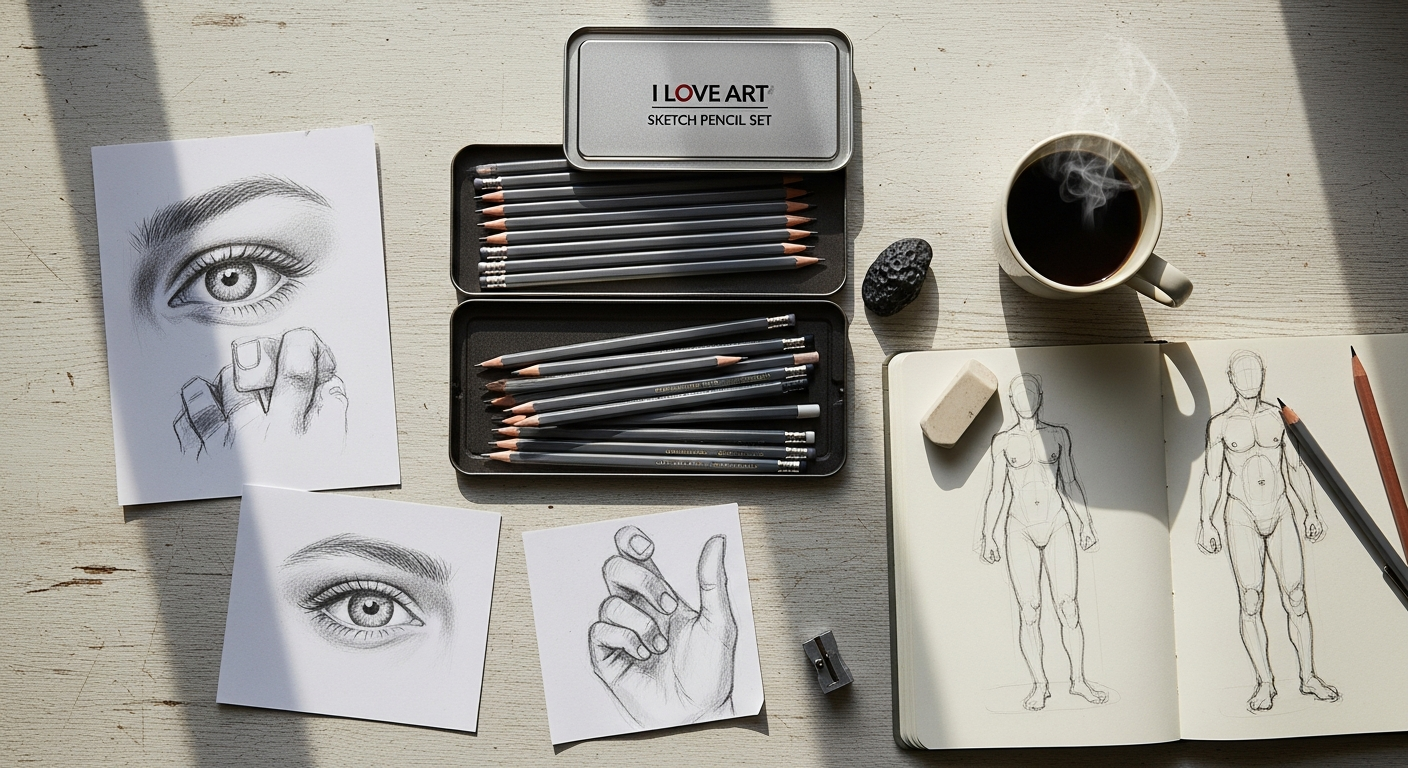
Over 80% of aspiring artists abandon their practice within the first six months—not because they lack talent, but because they’re using the wrong tools. The I Love Art Sketch Pencil Set from Mondo Artista IT has quietly become the go-to choice for students and emerging artists who refuse to compromise on quality without emptying their wallets.
At €15–€30, this set delivers what premium brands charge triple for—a complete ecosystem of graphite hardness grades, essential accessories, and smooth-performing pencils that actually respond to your touch. You’ll get everything needed to start sketching seriously without the financial anxiety that often paralyzes beginners.
In this guide, you’ll learn how to decode graphite hardness grades, master foundational shading techniques, understand what accessories actually matter, and discover why this set accelerates your artistic growth faster than piecing together random pencils. Explore the I Love Art Sketch Pencil Set at Mondo Artista IT today.
Understanding Graphite Hardness Grades for Student Sketching
Graphite pencils come in a spectrum of hardness levels, and understanding this range transforms your sketching capabilities. Each grade serves a specific purpose, and having access to the full spectrum is what separates casual doodling from intentional artistic development.
Hard grades (6H, 4H, 2H): Precision and Control
Hard grades create precise, light lines perfect for technical work and architectural sketches. These pencils excel at underdrawing—the foundation layer where you establish composition and proportions before committing to darker values. Hard grades require minimal pressure, which means your hand stays fresher during extended practice sessions. You’ll use these grades for mapping out your drawing with crisp, controllable lines that erase cleanly when adjustments are needed.
Medium grades (HB, B, 2B): The Versatile Center
This is where most everyday sketching happens. Medium grades balance control with expressiveness, making them ideal for general drawing practice and writing. They respond naturally to varying pressure, so as your hand strength and technique develop, these grades will show your improvement immediately. Many artists find themselves gravitating toward 2B for most of their practice work because it offers enough darkness for visible marks without the difficulty of controlling softer pencils.
Soft grades (4B, 6B, 8B): Drama and Depth
Soft grades produce rich, velvety blacks and dramatic tonal ranges. These pencils shine when you’re building shadows, creating atmospheric effects, and developing the visual weight that makes drawings pop off the page. Soft grades demand lighter pressure than beginners typically expect—pressing hard creates damage rather than darker lines. Learning this counterintuitive lesson with a complete set accelerates your understanding of pencil control.
Why students need the full spectrum
Working across all hardness grades develops true versatility. You’ll understand how different grades layer and blend, how pressure translates to tonal value, and where each pencil excels. This comprehensive experience creates muscle memory that transfers directly to more advanced techniques. A student who practices with only one grade learns only that grade’s limitations.
Common beginner mistakes
The most frequent error is relying on a single pencil grade, typically HB or 2B. This limits your tonal range and prevents you from understanding how layering creates depth. Without experiencing hard grades, beginners often press too hard with soft pencils, creating rough textures. Without soft grades, your shadows feel timid and unconvincing.
How hardness affects pressure and control
Harder pencils require less force to create visible marks, which means your hand tires less during long sessions. This is crucial for building sustainable practice habits. Softer pencils demand a lighter touch—pressing hard causes the graphite to grab the paper and create unintended texture. Understanding this relationship prevents frustration and accelerates skill development.
Complete Toolkit Breakdown—What’s Included & Why It Matters
The I Love Art Sketch Pencil Set is designed as a genuine all-in-one system, not a pencil set with mediocre add-ons. Each component serves a real purpose in your artistic practice.
Typical set configurations
Most configurations range from 12 to 24 pencils covering the complete hardness spectrum. The 24-pencil sets offer more granular control, with additional intermediate grades for smoother transitions. The 12-pencil sets provide essential coverage without overwhelming beginners with choices. Both configurations include the full range from hard to soft grades, ensuring you can handle any sketching scenario.
Charcoal pencils: Adding dimension
These pencils produce deeper blacks than graphite alone can achieve. They’re essential for creating dramatic shadows and unique textures that graphite struggles with. Charcoal pencils blend differently than graphite—they’re more forgiving and create softer transitions. Including them in the set means you can experiment with mixed-media approaches without separate purchases.
Kneaded eraser advantage
A kneaded eraser isn’t like traditional erasers. Its putty-like consistency allows you to lift highlights with precision, erase small areas without affecting surrounding marks, and clean up your paper without causing damage. For detail work and subtle corrections, this tool is irreplaceable. Many students buy kneaded erasers separately after realizing its value—having one included saves money and encourages experimentation.
Vinyl eraser: Reliable corrections
The vinyl eraser handles fast, general corrections across larger areas. It’s harder and more aggressive than kneaded erasers, making it ideal for clearing mistakes or removing entire sections during rework. The combination of both eraser types gives you flexibility for different correction scenarios.
Built-in sharpener: Consistency
A quality sharpener maintains consistent point sharpness across all your pencils. Dull pencils frustrate beginners who interpret poor results as personal failure rather than tool quality. A sharpener included in the set encourages regular maintenance and prevents the situation where students stop practicing because they can’t achieve sharp lines.
Why all-in-one packages save students money
Buying components separately costs significantly more. Art stores charge premium prices for individual accessories, and the total quickly exceeds the bundled set price. An all-in-one package eliminates decision paralysis about what accessories you actually need.
Quality of included accessories
The I Love Art brand maintains consistent quality throughout the set. The accessories aren’t afterthoughts—they’re functional tools that perform at the same level as the pencils. This cohesion matters because inferior erasers or sharpeners create frustrating experiences that discourage practice.
Blending and Layering Techniques You’ll Master First
The real power of a complete pencil set emerges when you understand how different grades interact through blending and layering.
Smooth application and blendability
I Love Art pencils respond beautifully to blending stumps, tissues, and even your fingers. This responsiveness is essential for creating the smooth transitions that characterize realistic drawing. Cheaper pencils often have inconsistent graphite quality that resists blending or creates streaking. A quality set like this produces uniform, blendable marks across every grade.
Creating tonal transitions
Build realistic gradients by layering from light to dark grades. Start with 2H or 4H to establish your lightest values, then layer B grades for mid-tones, and finish with 6B or 8B for deep shadows. This sequential approach creates smooth transitions that single-grade sketching cannot achieve. Each layer of graphite fills in microscopic paper texture, making the next layer blend more effectively.
Texture development
Different pencil grades create different textures. Horizontal strokes with hard grades suggest smooth surfaces, while hatching with soft grades builds rough textures. Combining grades—hard lines with soft shadows—suggests material quality. Learning these distinctions requires practice with the full spectrum.
Avoiding muddy marks
The common mistake is layering in the wrong sequence, creating dark, textured areas that look muddy rather than intentional. Always work light to dark. If you reverse the order, light layers won’t cover dark graphite, and your corrections become visible. Understanding this principle prevents hours of frustrating rework.
Speed sketching benefits
Having every grade available eliminates hesitation during sketching. You’re not wondering if a pencil is dark enough or worrying about damaging paper with excessive pressure. This freedom accelerates your practice and encourages experimentation.
Realistic shading exercises
Start with simple spheres. Use 2H for the highlight, 2B for mid-tone, and 6B for shadow. Practice smooth transitions without erasing—let each grade layer create the transition. Move to cubes, where hard edges require harder grades and soft shadows need soft grades. Progress to simple still life objects. These foundational exercises build muscle memory faster than any tutorial.
Price-to-Performance Value for Budget-Conscious Artists
The economics of the I Love Art Sketch Pencil Set are genuinely compelling for students and emerging artists.
Competitive pricing
At €15–€30, this set costs a fraction of premium alternatives from ultra-specialized brands. Those premium sets often charge €60–€150 for comparable graphite ranges. The difference isn’t always quality—it’s often brand positioning and packaging. The I Love Art brand competes on actual value rather than exclusivity.
Breaking down cost per pencil
A 24-pencil set at €30 costs €1.25 per pencil. Individual pencils from premium brands typically cost €2–€4 each. You’re not just buying pencils cheaper individually—you’re getting the accessories at a fraction of their standalone prices. A quality kneaded eraser alone costs €3–€5 purchased separately.
Quality consistency
I Love Art pencils use high-grade graphite that resists breakage during sharpening and maintains consistent performance throughout the pencil’s life. The leads don’t crack unexpectedly, and the hardness rating stays true across different pencils of the same grade. This reliability matters when you’re building practice habits—you want your tools performing predictably so you can focus on technique development.
Student budget reality
Many students operate with €50–€100 annual art supply budgets. This set represents a reasonable investment that covers core sketching needs without consuming half the annual budget. Purchasing premium individual pencils quickly exhausts student budgets while leaving gaps in hardness coverage.
Long-term value
A single pencil provides approximately 35–50 kilometers of continuous line, translating to dozens of hours of practice. Even heavy daily use means pencils last months. Calculating cost per hour of practice reveals exceptional value—often less than €0.01 per hour of sketching time.
When to upgrade
After 1–3 years of dedicated practice with this set, you’ll understand your personal preferences and specialized needs. At that point, strategic additions of premium single pencils make sense. You’ll know exactly which grades you use most and which you never touch. The foundation set becomes your reliable everyday tool while premium pencils handle specialized work.
Mondo Artista IT reputation
Mondo Artista IT maintains a catalog of over 75,000 art supplies, positioning itself as a comprehensive supplier rather than a boutique shop. This scale means quality control matters—they can’t sustain that volume with mediocre products. The I Love Art brand features prominently because it consistently delivers value and customer satisfaction. Browse Mondo Artista IT’s complete collection to see the full range of I Love Art products.
Real-World Applications Beyond Basic Sketching
The versatility of a complete pencil set becomes evident when you apply it to actual artistic projects.
Portrait drawing foundations
Capturing faces requires the full hardness spectrum. Hard grades establish subtle proportional guidelines, medium grades create form and structure, and soft grades build the rich shadows around eyes and under the chin that create dimensionality. The delicate skin tones demand smooth layering that only a varied set provides. Learning portraiture with a complete set prevents the frustration of “why doesn’t my face drawing look real?”
Still life composition
Setting up and sketching simple objects teaches form, shadow, and texture simultaneously. Rendering a ceramic bowl requires hard grades for highlight definition, medium grades for the form shadow, soft grades for the cast shadow, and potentially charcoal for the deepest darks. Completing still life studies with limited tools forces compromise; with a complete set, you focus on observation and technique rather than tool limitations.
Landscape sketching
Landscapes demand atmospheric perspective—distant elements rendered lighter and softer, foreground elements darker and more detailed. This requires moving between hard and soft grades within the same sketch. Trees, water, and terrain each benefit from specific grades. Working across a landscape teaches grade selection and when each pencil excels.
Technical drawing practice
Architectural sketches and mechanical drawings rely on hard grades for crisp, precise lines. While artists might assume technical drawing requires only one grade, the most compelling technical sketches combine precision with subtle shading. A complete set lets you add dimension to technical work without sacrificing accuracy.
Sketchbook journaling
Daily practice in a sketchbook builds momentum and consistency. Having a portable, complete set means you can sketch anything—quick gesture drawings with soft grades, detailed studies with hard grades, mixed approaches that combine both. Consistency matters more than perfection, and accessible tools encourage daily practice.
Classroom and workshop use
Art teachers recommend this set because it eliminates excuse-making. Students can’t claim they lack the right tools. The set is affordable enough that schools can recommend it without financial burden, and comprehensive enough that it works for various age groups and skill levels. Group learning environments benefit from everyone having comparable tools.
Transitioning to specialized work
As your skills develop, you’ll naturally gravitate toward specific grades and techniques. Perhaps you discover you love expressive mark-making and gravitate toward soft grades, or you develop a passion for technical precision. At that point, adding specialized pencils—ultra-premium 6B variants or limited-edition hard grades—enhances rather than replaces your foundation set. The complete set remains your reliable everyday tool.
Honest Limitations and When You’ll Outgrow This Set
Every product has boundaries, and understanding them prevents disappointment and unrealistic expectations.
Professional specialization
Ultra-niche professional work sometimes demands individual premium pencils with specific characteristics. Architectural firms might require pencils that deliver precise lines at specific hardness ratings. Fine art galleries expect work demonstrating mastery that sometimes benefits from specialized tools. However, these situations represent a tiny fraction of artistic practice. Most work—from student assignments to hobbyist sketching to professional illustration—thrives with this set.
Extreme detail requirements
Creating work at extreme magnification, where individual pencil strokes become the composition, sometimes demands premium single pencils with specific graphite consistency. Hyperrealistic work occasionally benefits from tools optimized for specific techniques. The threshold is high—most detailed work looks magnificent with this set once technique develops.
Personal preference evolution
As you develop a personal style, your preferences shift. You might discover you almost never use hard grades and always reach for 6B. Some artists prefer pencils with slightly different graphite feel or layering characteristics. After developing this self-knowledge, supplementing with premium alternatives makes sense. The foundation set brought you to this point of expertise.
Set size considerations
The 12-pencil versus 24-pencil choice matters. Twelve pencils covers the full range with less granular control. Twenty-four pencils offers intermediate grades for smoother progression. Consider your learning style—some students thrive with fewer options and clearer choices, while others appreciate additional control. Neither is wrong; your preference guides the selection.
Graphite feel variations
Premium brands sometimes offer subtly different tactile experiences. Some pencils feel slightly creamier, others more responsive to pressure variation. After extended practice, you might develop preferences for these nuances. However, chasing these differences early in your practice wastes money. Build fundamentals first, then explore premium options once you understand what you’re seeking.
Realistic timeline
This set genuinely supports 1–3 years of dedicated practice before specialization becomes relevant. Dedicated practice means sketching 30+ minutes daily. At this intensity, you’ll develop the knowledge and preferences to decide what upgrades actually serve your work. Many hobbyists use this set for 5+ years without feeling limited.
Upgrade pathways
Strategic upgrades enhance rather than replace. Perhaps you add ultra-premium 6B pencils for expressive work while keeping your foundation set for studies and sketches. Or you add specialized hard grades for technical work. The key is supplementing, not replacing. Your foundation set remains your reliable workhorse.
Building Your Artistic Foundation—The Student Advantage
The psychological and practical advantages of proper tools extend beyond technical performance.
Removing equipment anxiety
Many beginning artists hesitate because they worry about “wasting” expensive supplies on “bad” drawings. This anxiety paralyzes practice. Knowing you’re using reasonably priced, quality tools eliminates this barrier. You can sketch freely without guilt, and paradoxically, this freedom accelerates improvement.
Encouraging experimentation
A complete set invites trying different approaches. You’ll use hard grades for underdrawing without hesitation because they’re not “special.” You’ll layer soft grades liberally because you’re not rationing them. This experimental mindset builds intuition faster than cautious, conservative practice.
Developing personal style
Working across the full hardness spectrum reveals your natural preferences. Some artists gravitate toward soft, expressive marks; others prefer crisp, controlled lines. You won’t discover your tendencies by limiting yourself to a single grade. A complete set reveals who you are as an artist.
Muscle memory development
Consistent practice with quality tools that respond predictably builds reliable hand control. Your muscle memory learns the pressure required for different grades, the blending characteristics of each hardness, and the specific applications where each pencil excels. This knowledge transfers to other drawing tools and mediums.
Community validation
The I Love Art Sketch Pencil Set is popular among students and emerging artists specifically because it works. Seeing other students and artists succeed with this set builds confidence. You’re not using something obscure or questionable—you’re using what thousands of artists recommend and trust.
Accessibility factor
Making professional-quality sketching available without financial strain changes trajectories. Students who might have abandoned art due to supply costs instead find themselves with proper tools at affordable prices. This democratization of quality materials matters. Talent exists across all economic backgrounds, and proper tools shouldn’t determine who practices.
Confidence-building progression
Clear improvement happens when you have proper materials supporting your effort. You’ll see advancement that reflects genuine skill development rather than tool limitations. This measurable progress builds confidence and motivation for continuing practice.
Your Next Sketch Awaits
The I Love Art Sketch Pencil Set isn’t just a collection of pencils—it’s permission to practice seriously without the guilt of expensive mistakes. Your artistic foundation deserves better than whatever you’ve been using. The combination of complete hardness range, essential accessories, smooth performance, and genuinely affordable pricing makes this the rare product that lives up to the hype.
Stop waiting for the perfect supplies to arrive. The barrier to improvement isn’t the availability of better tools—it’s consistent practice with the tools you have. Commit to 30 days of daily practice with this set, and the difference will surprise you. Your hand will develop control, your eye will sharpen, and your confidence will grow.
Every accomplished artist began exactly where you are now—with basic pencils, a blank page, and the decision to start. The only difference between where you are today and where you’ll be next month is commitment and consistent practice. The I Love Art Sketch Pencil Set removes every excuse about tools or materials.
Get your I Love Art Sketch Pencil Set from Mondo Artista IT and begin your artistic journey today.

Leave a Reply