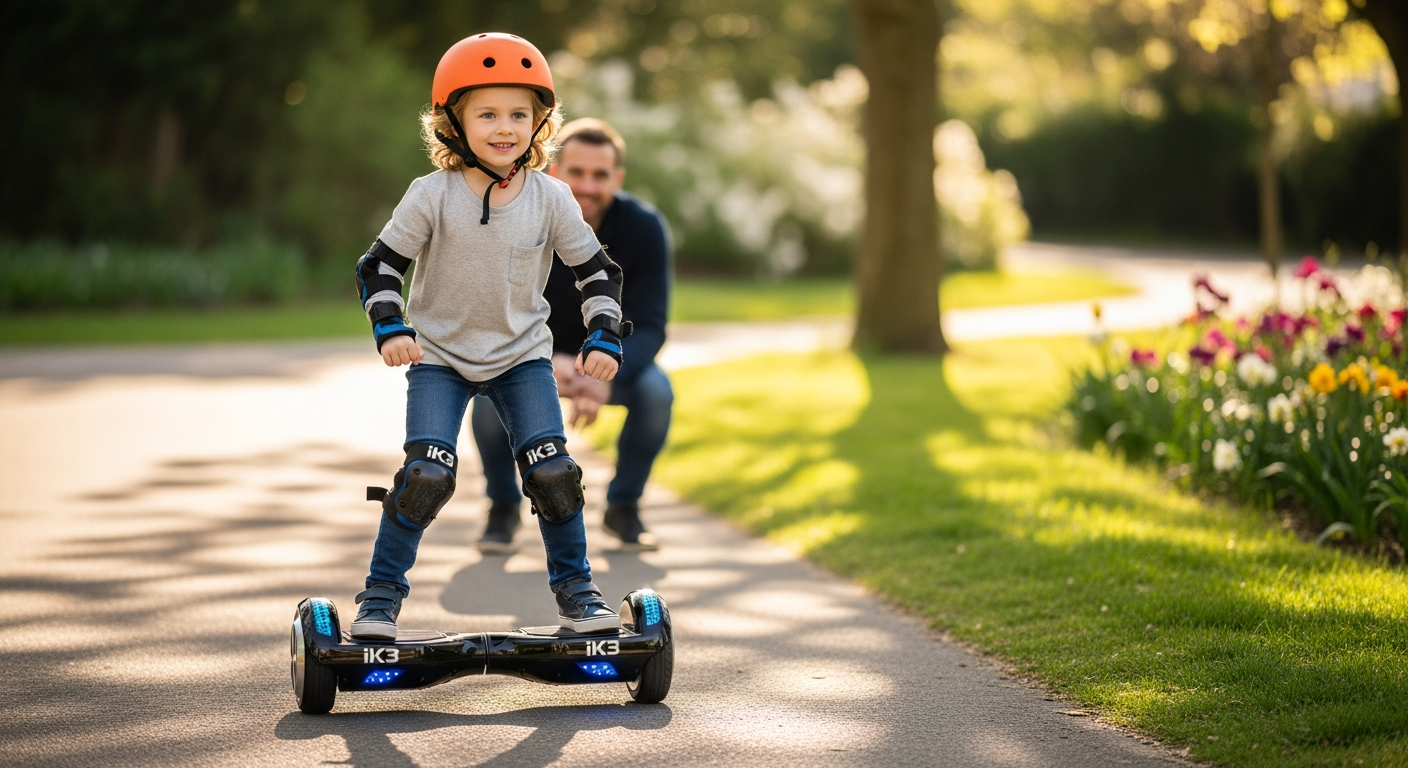
Nearly 40% of parents struggle to find the right balance between letting their kids have fun and keeping them safe outdoors. That tension between freedom and protection peaks when you're shopping for your child's first electric scooter. Speed control becomes everything—and that's where the iHoverboard iK3 stands out from the crowd.
The three adjustable speed settings aren't just a fancy feature; they're a game-changer for building confidence while preventing accidents. The iHoverboard iK3 Kids Electric Scooter has earned its reputation as a best-seller among families with children aged 6 to 14. What makes this scooter different is its thoughtful approach to progressive learning.
Instead of forcing young riders into one fixed speed, the iK3 lets you control the experience—starting slow at 3 mph, ramping up to 6 mph, and eventually unlocking the full 10 mph potential as your child develops their skills. Discover how to master each speed setting and build your child's confidence with the iHoverboard iK3 today. This guide helps you navigate those speed settings with confidence, showing which mode works best for different age groups, how to transition between speeds safely, and why this graduated approach transforms how quickly kids master their riding abilities.
Understanding the Three Speed Modes on the iK3
Mode 1 (3 mph): The Foundation Builder
Mode 1 represents the training ground where everything starts. At 3 mph, young riders focus entirely on balance, foot placement, and learning how the scooter responds to weight shifts. This speed works perfectly for first-time riders and children ages 6-7 in controlled environments like empty parking lots or quiet streets. Kids in this phase aren't ready for traffic decisions or complex terrain—they're building the muscle memory that everything else depends on.
Mode 2 (6 mph): The Confidence Booster
Once children master the fundamentals, Mode 2 opens up new possibilities. At 6 mph, intermediate riders aged 7-10 with basic scooter experience gain a genuine confidence boost. The speed feels noticeably faster than Mode 1, creating that "I'm really riding" sensation that keeps kids engaged and motivated. The scooter still remains responsive and manageable, allowing young riders to build on their foundation without overwhelming them.
Mode 3 (10 mph): The Full Experience
Mode 3 unleashes the iK3's complete potential. Designed for experienced young riders ages 10-14, this speed supports longer commutes and recreational riding across varied terrain. At 10 mph, the scooter becomes a genuine transportation tool, not just a toy. Riders at this level have developed the reaction time and judgment needed to handle faster speeds responsibly.
LED Digital Display Integration
The bright LED display shows real-time speed feedback, current mode, and battery level. This transparency helps riders understand exactly which mode they're in and their current speed, creating awareness that shapes behavior. When children can see they're in Mode 1 at 3 mph versus Mode 3 at 10 mph, they develop a stronger connection between the control setting and the riding experience.
Linear Acceleration Benefits
The iK3 delivers smooth power across all three modes, avoiding the sudden jerks that could throw off less experienced riders. This linear acceleration means children feel in control even when accelerating, building trust in the scooter's responsiveness and their own ability to manage it.
Matching Speed Settings to Your Child's Age and Skill Level
Ages 6-7 (Beginner Riders)
Children in this age range belong exclusively in Mode 1. Spend time focusing on balance, braking, and basic control before considering any speed increases. At this stage, the goal isn't covering distance—it's developing the foundational skills that everything else builds on. Many parents rush this phase, but those extra weeks of practice pay enormous dividends later.
Ages 7-9 (Developing Confidence)
After 2-3 weeks of consistent practice in Mode 1, introduce Mode 2. Most children in this range find the sweet spot between fun and safety at 6 mph. They've developed enough balance and control to handle the increase without feeling overwhelmed, yet the jump to Mode 2 remains exciting enough to maintain interest and motivation.
Ages 9-11 (Intermediate Progression)
As balance and reaction time improve, gradually transition toward Mode 3. This isn't an overnight switch—it's a gradual process where your child spends time in Mode 2 before advancing. Watch for overconfidence, which often appears as risky behavior or poor judgment rather than genuine readiness. Overconfidence and actual skill aren't the same thing.
Ages 12-14 (Advanced Riders)
Teenagers can access all three modes with your permission. The focus shifts from learning basic control to developing judgment, traffic awareness, and responsible riding in varied environments. These older riders need different guidance—less about physical skills and more about decision-making and situational awareness.
Individual Variation Matters
Age provides guidance, not prescription. Some children develop faster than others due to natural coordination, prior experience, or personality differences. Never rush progression based purely on age—watch for genuine signs of readiness instead.
Skill Assessment Checklist
Before moving up a mode, check these fundamentals: Can your child brake smoothly without jerking? Do they maintain balance on turns? Are they following safety rules consistently without reminders? Are they asking for permission before attempting new moves, or are they taking dangerous shortcuts? These observations matter more than any birthday.
Safety Features That Work Hand-in-Hand With Speed Control
Dual-Brake System Explained
The combination of an electronic brake and foot brake provides redundancy that matters at any speed. The electronic brake delivers primary stopping power through the handlebar lever, while the foot brake offers a backup mechanism. This dual approach means your child has multiple ways to stop safely, reducing the risk that a single failure point compromises their safety.
Regenerative Braking Advantage
When your child decelerates, the motor captures that energy and feeds it back into the battery. This extends battery range while providing smooth, controlled stops across all three modes. The result is a scooter that slows down predictably rather than suddenly, which builds confidence and prevents the abrupt stops that can cause riders to lose balance.
6-Inch Solid Tires and Stability
The puncture-resistant construction means fewer flat tires and unexpected breakdowns during rides. Solid tires provide excellent durability, though the rigid suspension does create a bumpier experience on rough or uneven surfaces. This trade-off means smooth pavement delivers a comfortable ride, but gravel or cracked concrete requires either slower speeds or route planning.
Lightweight Aluminum Frame (8kg)
At just 8kg, the iK3 remains easy for children to handle and maneuver. They won't experience fatigue during longer riding sessions, and carrying the scooter when needed isn't a struggle. This lightweight design also means if they need to dismount quickly or carry it up stairs, they can manage it independently.
Maximum Weight Capacity (70kg/154lbs)
Respecting the weight limit ensures the scooter maintains proper handling and braking performance. Exceeding this limit compromises the suspension geometry, brake modulation, and motor efficiency. It's not just a suggestion—it's the boundary of safe operation.
LED Ambient Lights on Pedal
The colored lights enhance visibility during dusk or indoor riding sessions. Other pedestrians and cyclists spot your child from greater distances, reducing the risk of collisions. These lights also add a visual element that kids genuinely enjoy, making the scooter feel more special.
Practical Strategies for Transitioning Between Speed Modes
The Two-Week Rule
Spend at least two weeks mastering each mode before attempting the next. This builds muscle memory and genuine confidence rather than surface-level familiarity. Two weeks allows dozens of riding sessions where your child internalizes how the scooter behaves at that speed. Rushing this timeline creates false confidence that evaporates when they encounter unexpected situations.
Practice Environment Progression
Start in empty parking lots where Mode 1 development happens without distractions. Move to quiet residential streets once Mode 2 work begins—places with minimal traffic and flat terrain. Introduce light traffic areas only when your child reaches Mode 3 and demonstrates consistent judgment.
Controlled Acceleration Drills
Have your child practice smooth starts and stops within each mode to develop feel for the scooter's responsiveness. These drills aren't boring exercises—they're the foundation of competent riding. A rider who practices acceleration control will handle unexpected situations far better than someone who's only cruised at constant speeds.
Brake Testing at Each Speed
Before moving up to the next mode, ensure your child can execute reliable stops from their current maximum speed. This isn't a one-time check—repeat it several times until the stopping distance becomes predictable and confident. Your child should stop smoothly without locking up the wheels or losing balance.
Weather and Surface Considerations
Wet pavement or uneven terrain demands staying in lower modes. Save higher speeds for ideal conditions with clear visibility and smooth, dry surfaces. Teaching children to adjust their speed based on conditions is one of the most valuable safety lessons they can learn, applicable to every vehicle they'll ever operate.
Communication Signals
Establish hand signals or verbal cues so your child knows when to shift modes or slow down based on environmental changes. A simple raised hand might mean "slow down" while a specific phrase could mean "you're cleared to use Mode 3 here." These signals create partnership in the riding experience rather than leaving your child to make decisions alone.
Your Roadmap to Confident Young Riders
The iHoverboard iK3 Kids Electric Scooter succeeds because it recognizes a fundamental truth: children don't learn at the same pace, and forcing them into one-size-fits-all speed is a recipe for frustration or danger. Those three adjustable modes—3 mph, 6 mph, and 10 mph—aren't marketing gimmicks; they're a structured pathway that transforms hesitant beginners into confident riders.
What this guide provides is the framework to make smart decisions about your child's progression. Start in Mode 1, master the fundamentals, and let your child's growing skills dictate when they're ready for the next level. Pair speed control with the dual-brake system, solid tires, and those helpful LED lights, and you've created an environment where safety and fun coexist beautifully.
The investment in the iK3 pays dividends far beyond the initial purchase price. You're buying years of outdoor activity, building your child's confidence, and establishing healthy habits around responsible riding. Begin with Mode 1, grab a helmet, and watch your child discover the joy of riding at their own pace. The full potential of that 10 mph top speed will come soon enough—and it'll mean so much more when they've earned it.
Leave a Reply