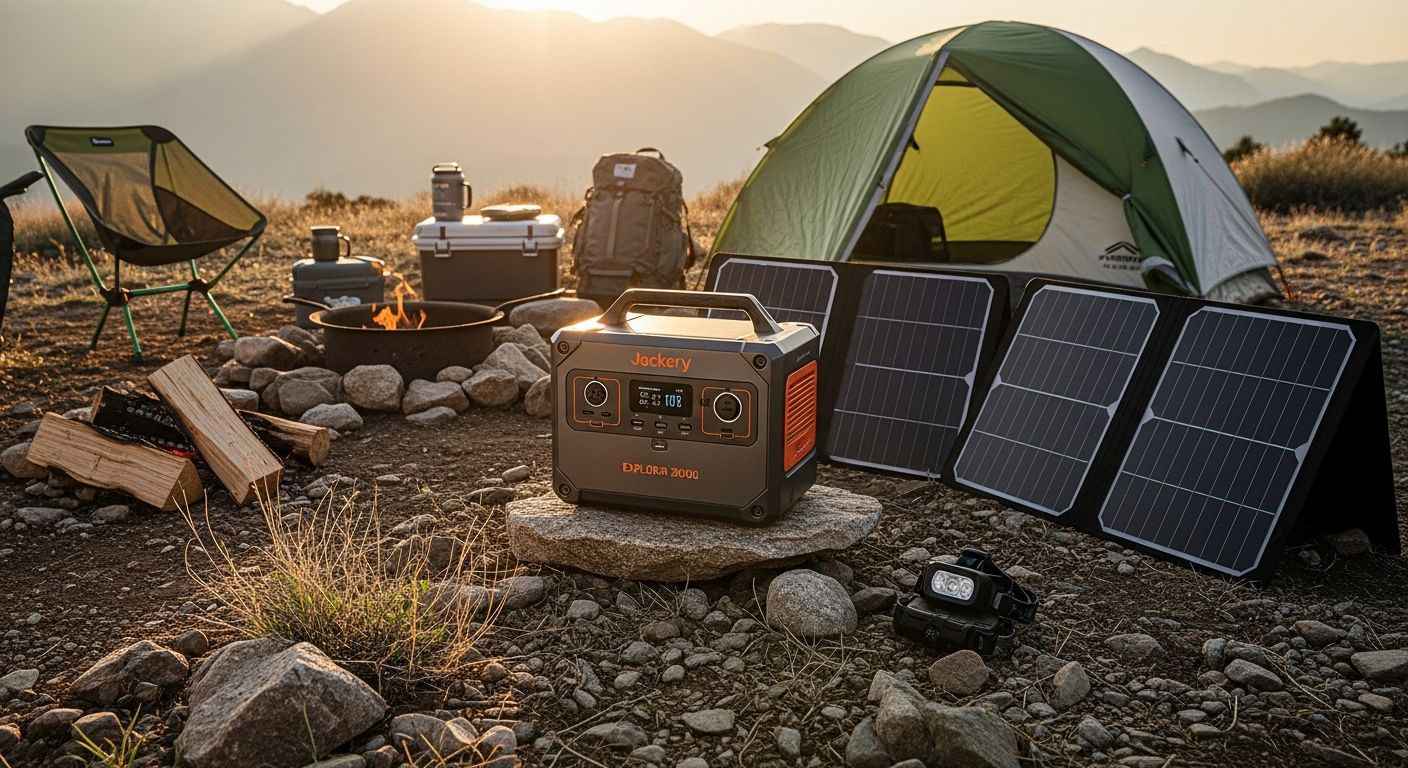
Over 40% of remote property owners cite unreliable grid access as their biggest challenge. For anyone committed to genuine energy autonomy, this reality cuts deeper than occasional inconvenience—it shapes daily life. Portable power stations have evolved from emergency backup devices into serious energy infrastructure, fundamentally changing what’s possible for off-grid living.
The Jackery Explorer 2000 Plus represents this new generation of power solutions. Unlike traditional backup systems designed merely for outages, this unit addresses the actual demands of energy-independent living: sustained daily power, expandable capacity, and genuine solar compatibility. It’s built for those ready to move beyond reliance on unstable grids.
Discover how the Jackery Explorer 2000 Plus enables true off-grid living at Hinnovation IT.
Beyond Emergency Backup—Off-Grid Living Redefined
How the Explorer 2000 Plus Shifts from Emergency Preparedness to Permanent Energy Independence
The conversation around portable power has fundamentally changed. Traditional backup systems sit dormant for months or years, waiting for grid failures. The Explorer 2000 Plus operates as primary infrastructure—powering daily life continuously in remote locations where grid connections don’t exist.
This shift requires a different mindset. Off-grid living demands reliable, consistent power delivery across months and seasons. The Explorer 2000 Plus handles this through its 2042Wh capacity and expandable architecture, transforming from a emergency reserve into the backbone of your energy system.
Real-World Off-Grid Scenarios: Remote Cabins, Tiny Homes, and Rural Properties Without Grid Access
Remote cabins represent perhaps the most straightforward application. A cabin used seasonally benefits immediately from the base 2042Wh capacity, powering essential appliances, heating systems, and communication devices without external grid dependency. The system’s reliability during extended stays becomes the deciding factor between comfortable living and survival mode.
Tiny homes on rural properties present different demands. These permanent residences require year-round energy availability for refrigeration, lighting, heating, and modern conveniences. The Explorer 2000 Plus, when paired with solar panels and expansion modules, provides the consistent output these homes demand.
Properties in genuinely remote areas—where grid extension costs exceed $50,000—make the financial case for portable power systems overwhelming. Rather than accepting grid limitation or spending fortunes on infrastructure, property owners increasingly choose systems that deliver independence upfront.
Daily Power Requirements for Off-Grid Living and How 2042Wh Capacity Handles Typical Consumption Patterns
Off-grid daily consumption patterns differ markedly from grid-connected living. A typical off-grid household might require 1,500-3,000Wh daily, depending on appliances and climate. The 2042Wh base capacity provides roughly one full day of moderate consumption.
The math becomes clearer with specifics: a refrigerator consumes roughly 150-200Wh daily, LED lighting systems use 100-150Wh, and a laptop or charging hub adds 50-100Wh. Basic cooking via electric kettle or induction cooktop runs 400-800Wh. This totals approximately 700-1,250Wh for essential modern living—leaving substantial capacity for seasonal variations or additional loads.
During high-sun seasons, daily solar recharging keeps the system topped up continuously. Winter months require either expanded battery capacity or reduced consumption. Understanding this seasonal rhythm guides decisions about whether the base unit alone suffices or expansion modules become necessary.
Scaling Your Power System—The Modular Expansion Strategy
Understanding the Battery Pack Expansion Ecosystem: From 2kWh to 12kWh with Five Additional Modules
The Explorer 2000 Plus distinguishes itself through architectural scalability. Rather than replacing the entire unit as energy demands grow, users add Battery Pack 2000 Plus modules—each adding 2048Wh capacity.
The expansion pathway runs: base unit (2.042kWh) → plus one module (4.09kWh) → plus two modules (6.14kWh) → expanding to five additional modules (12.29kWh total). This modular design accommodates growing energy needs without wholesale system replacement, distributing costs across multiple purchasing cycles.
Parallel Configuration Capabilities: Achieving 24kWh Capacity with Dual Units for Whole-Home Backup
For users requiring extended multi-day autonomy, parallel configuration doubles the entire system. Two complete Explorer 2000 Plus units can operate in parallel, achieving 24kWh total capacity. This configuration powers standard homes for several days during extended blackouts or provides sustained energy for permanent off-grid living without supplemental charging.
Parallel operation requires compatible cables and proper configuration through the system interface. The practical result: a household drawing 3,000Wh daily achieves eight days of autonomy from storage alone—enough to weather extended cloudy periods or severe weather events.
Phased Purchasing Approach: Starting with the Base Unit and Expanding as Budget Allows
Intelligent off-grid adoption follows financial reality. Rather than purchasing a complete 12kWh system upfront at roughly €7,000+, users can start with the base unit and add modules as circumstances change or budgets allow.
Year one: acquire the base 2kWh unit (€1,799), assess actual consumption patterns, and evaluate solar generation capacity. Year two: add modules based on proven requirements, not speculative needs. This approach reduces initial capital burden while gathering real-world data to inform expansion decisions.
Start your phased off-grid system at Hinnovation IT with flexible purchasing options.
Solar Synergy—Charging Your Independence
Ultra-Fast Solar Charging Capabilities with Jackery SolarSaga 200W Panel Configurations
Solar charging represents the true pathway to off-grid autonomy. The Explorer 2000 Plus accepts input from multiple Jackery SolarSaga 200W panels, configured in series or parallel depending on charging speed requirements and available space.
Six SolarSaga 200W panels (1,200W total capacity) recharge the base unit from empty to full in approximately 2 hours under optimal sunlight conditions. Four panels provide reasonable full-day charging in temperate climates, while tropical locations might reach full capacity in 1.5 hours. The system intelligently regulates input to protect battery health while maximizing charging speed.
Optimal Panel Placement and Seasonal Adjustments for Maximum Off-Grid Solar Efficiency
Panel placement determines real-world performance across seasons. South-facing mounting (in Northern Hemisphere) captures maximum sun during winter months when solar generation matters most. Seasonal angle adjustments—steeper in winter, flatter in summer—optimize total annual generation.
Shading analysis precedes installation. Trees, structures, and terrain features shadow panels during specific times of year, reducing effective generation. Off-grid living requires understanding these patterns and planning panel placement accordingly. East-west orientation provides even generation across morning and afternoon, while north-south positioning maximizes annual output.
Tropical and equatorial locations enjoy consistent sun angles year-round, simplifying panel configuration. Temperate and cold climates demand more sophisticated planning. The Explorer 2000 Plus’s acceptance of multiple panel configurations allows users to scale solar capacity matching their specific location’s seasonal patterns.
Charging Speed Comparison: Solar Versus AC Wall Charging Versus Vehicle Charging
AC wall charging dominates when grid connection exists. From empty to full in 1.7-2 hours, this proves fastest but requires access to standard household power—precisely what off-grid living avoids. AC charging serves primarily during system setup or emergency top-ups via generator.
Vehicle charging through a 12V car outlet operates at roughly 200-300W input—extremely slow for meaningful recharging but valuable for maintaining charge during extended RV adventures or mobile living scenarios.
Solar charging, despite slower peak speeds than AC power, delivers consistent daily replenishment across multiple hours. A 1,200W solar array averaging 800W over an 8-hour sun window provides 6.4kWh daily generation—sufficient to power 2-4 homes depending on consumption patterns. This consistency, combined with zero operational costs, explains why serious off-grid users prioritize solar capacity despite initial investment.
The LiFePO4 Advantage—Why Battery Chemistry Matters for Remote Living
LiFePO4 (Lithium Iron Phosphate) Chemistry Benefits: Safety, Longevity, and Performance Stability
LiFePO4 batteries transformed portable power systems. Unlike older lithium-ion chemistry, LiFePO4 delivers inherent thermal stability, eliminating many fire risks associated with traditional lithium batteries. For users living adjacent to their power systems, this safety difference proves genuinely meaningful.
Performance stability emerges across temperature ranges. LiFePO4 maintains usable capacity even in cold climates where traditional lithium weakens significantly. A LiFePO4 system operating in -10°C conditions retains roughly 85-90% capacity; older chemistries drop to 50% or lower, rendering them unreliable in winter off-grid scenarios.
Charging cycles increase dramatically with LiFePO4. The 4,000+ cycle rating means users can charge daily for 10+ years before reaching 80% capacity retention. This longevity transforms the financial calculus—paying €1,799 upfront for a battery system lasting a decade costs roughly €180 annually, comparing favorably to grid energy costs in many regions.
4,000+ Charge Cycle Lifespan: What This Means for 10+ Years of Reliable Off-Grid Power
The practical reality of 4,000 cycles unfolds differently for various users. An off-grid property drawing power from the system daily and recharging via solar undergoes one complete cycle daily. Over 10 years, this totals 3,650 cycles—comfortably within specification.
Seasonal usage patterns extend lifespan further. A cabin used only during summer months might accumulate merely 500-1,000 cycles over 10 years, retaining 95%+ capacity indefinitely. The battery outlasts user expectations substantially in part-time off-grid scenarios.
Battery replacement costs pale against grid extension expenses. Upgrading to a new LiFePO4 system after a decade remains dramatically cheaper than installing grid connections, digging trenches, and connecting utility infrastructure in remote locations.
Temperature Performance in Extreme Climates: Cold Winters and Hot Summers in Remote Areas
Cold climate operation presents traditional challenges for battery chemistry. The Explorer 2000 Plus’s LiFePO4 design handles temperatures down to -20°C with managed performance, though charging capacity reduces in extreme cold. Users operating in subarctic regions might limit charging below -10°C to preserve battery health—a manageable constraint for truly remote living.
Hot climate performance improves considerably. LiFePO4 chemistry excels at elevated temperatures, maintaining full capacity and charging speeds even in 50°C+ conditions common in desert or tropical regions. Ventilation becomes important rather than critical for these installations.
Seasonal management emerges as the practical strategy. Winter charging occurs during warmer daylight hours when temperature permits. Summer generation abundance offsets any winter capacity reductions. Understanding these patterns prevents disappointment and guides realistic system sizing.
Powering Demanding Applications—From Tools to Household Essentials
3000W Continuous Output and 6000W Surge Capacity: Which Appliances and Tools This Powers
The 3000W continuous output rating determines simultaneous load capacity. Most modern household appliances operate below 2000W: refrigerators (150-600W), LED lighting (10-100W), televisions (50-200W), laptops (50-100W), and electric kettles (1500-2000W). Running any combination simultaneously presents no challenge.
The 6000W surge capacity handles motor startup demands. Electric tools like circular saws, impact drills, or air compressors draw initial current spikes far exceeding running power—sometimes doubling their rated continuous consumption. The 6000W surge accommodates these momentary peaks without system shutdown.
High-demand scenarios emerge in specific applications. Running a window air conditioner (1000-1500W continuous, 2000W startup) alongside a refrigerator (200W) and lighting (100W) leaves comfortable headroom. Attempting simultaneous operation of two major appliances with high startup demands risks exceeding surge capacity—a constraint users understand and respect in off-grid living.
Simultaneous Operation: Running Multiple High-Draw Devices Without Power Reduction
The practical experience of 3000W continuous capacity reveals itself in daily patterns. Morning routines involving shower heating (1500W water heater), electric kettle (2000W), and lights (150W) total roughly 3500W momentarily—exceeding the system’s capacity. Real off-grid living spaces load-manage intuitively: heating water first, then the kettle, avoiding simultaneous high-demand operations.
This isn’t a flaw but rather a design reality reflecting available solar generation in most climates. Average solar generation of 800-1200W across daylight hours cannot simultaneously support multiple high-demand appliances indefinitely. Off-grid living adapts consumption patterns to generation availability.
Load management through intelligent scheduling proves remarkably effective. Charging batteries during peak sun hours, running high-demand operations mid-afternoon, and sequencing major appliances prevents surges while maximizing system efficiency. Users report this becomes automatic—similar to running dishwashers during off-peak hours in grid-connected homes.
Off-Grid Kitchen Setup: Refrigerators, Cooking Appliances, and Food Preservation Systems
Kitchen appliances present the most consistent energy demand in off-grid homes. A modern refrigerator consuming 150-200Wh daily operates reliably from the Explorer 2000 Plus base unit even with minimal solar input. Food preservation—the refrigerator’s primary function—represents non-negotiable energy expenditure for most off-grid residents.
Cooking strategies shift dramatically off-grid. Electric cooking—via induction cooktop, oven, or kettle—requires 1500-2000W sustained operation, consuming 500-2000Wh per meal depending on duration. Most successful off-grid kitchens combine efficient electric appliances with alternative heating: propane stoves, wood ovens, or solar ovens for daytime cooking.
Hybrid approaches prove most practical. Induction cooktops cook specific meals efficiently, while propane handles routine heating. This combination avoids excessive battery draw while maintaining modern convenience. Water heating shifts to dedicated solar thermal systems where possible, reserving battery power for lighting, refrigeration, and communication.
Portability Meets Capacity—The Weight and Mobility Reality Check
61.5 lbs (27.9 kg) Weight Assessment: What This Means for Different User Scenarios
The 61.5 lbs weight creates realistic constraints. This equals two standard car tires or approximately the weight of an average large dog—manageable for two people on level ground, genuinely challenging for solo transport across rough terrain.
RV users find this weight entirely practical. Loading into a truck bed or securing in a vehicle requires no special equipment. Static installation—placing the unit in a cabin or small home—presents no mobility concerns whatsoever.
Mobile property owners splitting time between locations face different considerations. Repeatedly loading and unloading from vehicles becomes tiring rather than impossible. Weekend cabin warriors—moving the unit only monthly—report minimal impact. Daily or weekly transport between properties, however, becomes genuinely tedious.
Suitcase Design with Wheels and Telescopic Handle: Real-World Usability in Various Terrains
The integrated wheels and telescopic handle transform practical usability. On level surfaces—driveways, cabin floors, truck beds—the unit rolls smoothly without manual lifting. The handle extends ergonomically, allowing comfortable transport without bending or strain.
Rough terrain changes the equation considerably. Grass, gravel, and unpaved paths challenge wheeled designs. Rocky or deeply rutted surfaces stop wheels entirely, reverting users to manual carrying—uncomfortable for the 61.5 lbs weight. Users at locations with consistent level access report high satisfaction; those requiring uphill transport or rough-ground movement acknowledge meaningful limitations.
Stairs present a genuine obstacle. The wheels don’t descend steps, and carrying 27.9 kg up flights repeatedly exhausts most users. Properties with multiple levels require strategic placement—ground-floor installation makes sense—or acceptance that transport difficulties limit flexibility.
Vehicle Transport Considerations: Truck Beds, Trailers, and RV Integration
RV owners report seamless integration. The Explorer 2000 Plus fits standard vehicle compartments, secures easily, and doesn’t consume excessive storage space. RV living—precisely the application Jackery designed this unit for—showcases the system’s practical advantages.
Truck owners find the weight manageable for bed placement. Combined with solar panels and expansion modules, total system weight (base unit plus two solar panels) reaches roughly 100-120 lbs—well within truck capacity. Securing the unit prevents movement during transport, and the telescopic handle allows easy deployment and storage.
Trailer-mounted systems work effectively. Dedicated trailer space accommodates multiple units with solar panels configured for extended off-grid duration. This approach, common among serious off-grid enthusiasts, converts mobility challenges into advantages through strategic system mounting.
Smart Monitoring and Control—Managing Your Power Remotely
Wi-Fi and Bluetooth App Control: Real-Time Monitoring from Anywhere on Your Property
The accompanying app transforms power management from guesswork to informed decision-making. Real-time monitoring displays battery percentage, remaining runtime estimates, current loads, and input/output wattage. Users check power status from anywhere on their property without approaching the unit physically.
Wi-Fi connectivity enables remote monitoring from greater distances—checking battery levels from the cabin’s interior while solar panels operate outside, or monitoring status while away on errands. The app sends notifications if the battery drops below user-defined thresholds, enabling proactive responses before power depletion becomes critical.
Bluetooth connectivity works within approximately 30-40 feet, sufficient for most property sizes. The dual connectivity approach accommodates different use patterns: Wi-Fi for extended monitoring, Bluetooth for quick checks without smartphone network requirements.
Battery Status Tracking: Voltage, Remaining Capacity, and Estimated Runtime Visibility
The app displays granular battery information historically unavailable in portable systems. Voltage tracking identifies potential battery health issues before performance degradation becomes apparent. Users comparing daily voltage readings notice trends—slight capacity reductions over years—well before reaching failure thresholds.
Remaining capacity percentages appear alongside estimated runtime at current loads. If the system powers 500W loads and displays 50% capacity remaining, the app calculates approximately 2 hours of continued operation. This information prevents surprise power losses and enables load management before depletion.
Historical data tracking reveals consumption patterns across days and seasons. Users analyzing monthly trends understand genuine power requirements versus perceived needs. This data-driven approach removes guesswork from expansion decisions—users recognize actual capacity gaps rather than making speculative purchases.
Load Management Through the App: Prioritizing Power Distribution During High-Demand Periods
Advanced app functionality allows users to prioritize loads. During periods when solar input falls below current consumption (typical winter afternoons), the app can reduce power allocation to non-essential outlets while maintaining critical systems—refrigeration, heating, communication.
This capability proves most valuable during extended cloudy periods or seasonal transitions. Rather than drawing battery reserves equally across all systems, users prioritize essential loads, extending autonomy without external charging input. The app guides load management decisions through real-time data rather than guesswork.
Investment Breakdown—Pricing Strategy for Off-Grid Adoption
Base Unit Pricing: €1,799.00 Starting Point and Regional Price Variations
The Explorer 2000 Plus base unit lists at €1,799.00 through Hinnovation IT in European markets. North American pricing hovers around $1,799 USD, with variations based on regional distributors, import duties, and local market conditions. Asian markets often feature lower pricing for identical specifications.
This base price establishes the entry point for genuine off-grid power. Compared against grid extension costs—frequently exceeding €30,000 for remote properties—the base unit costs represent a fraction of alternative infrastructure investments. For seasonal cabins, the payback period through avoided grid costs spans merely several years.
Currency fluctuations, bulk purchase discounts, and seasonal promotions create pricing variations. Users purchasing through established distributors like Hinnovation IT often access bundle pricing that reduces per-unit costs when acquiring systems for multiple properties or projects.
Bundle Options: Power Station with Solar Panels and Battery Pack Combinations
Strategic bundling reduces total system costs compared to purchasing components separately. A common bundle pairs the base unit with two Jackery SolarSaga 200W panels (approximately €400-600 each) at discounted rates. This combination—power station plus baseline solar generation—typically costs 10-15% less than individual component purchases.
Battery pack bundles pair the base unit with one or two additional 2048Wh modules. This accelerates expansion capability without requiring separate purchasing transactions. Users committing to expanded capacity upfront benefit from bundle pricing while securing their system specifications immediately.
Bundled pricing varies by supplier, season, and promotional timing. Hinnovation IT periodically offers seasonal bundles reflecting market demand—summer camping season bundles emphasizing portability, winter season bundles emphasizing home backup capacity.
Total System Cost Scenarios: From Basic 2kWh Setup to Fully Expanded 12kWh or 24kWh Configurations
A basic off-grid setup—base unit (2kWh) plus four SolarSaga 200W panels—totals approximately €2,400-2,800. This configuration powers most cabin operations and provides self-sufficient daily energy cycling via solar.
Mid-range expansion—base unit plus two expansion modules (6kWh total) with four solar panels—reaches €4,500-5,200. This configuration supports permanent part-time residency (weekends and seasonal use) without supplemental energy sources.
Fully expanded systems—base unit plus five modules (12kWh) with six solar panels and dual-unit parallel configuration (24kWh)—exceed €10,000-12,000. This investment delivers genuine whole-home backup capability or permanent off-grid living with minimal solar dependency. Annual per-kWh cost (calculated across 10-year system lifespan) compares favorably to grid electricity in high-cost regions.
Real-World Performance—What Off-Grid Users Actually Experience
Performance in Different Climate Zones: Tropical, Equatorial, and Cold Environments
Tropical installations report exceptional performance. Consistent year-round sun, minimal seasonal variation, and high solar irradiance enable even modest solar panel configurations to maintain system charge continuously. A 600W solar array (three panels) operates at full capacity most days, generating 3-4kWh daily in tropical regions.
Temperate climates present moderate variations. Spring and fall deliver excellent generation; summer provides abundance; winter requires careful load management or expanded solar capacity. A four-panel configuration (800W) generates 2-3kWh daily on average across the year—sufficient for modest household consumption with seasonal adjustments.
Cold climate operation demands respect and planning. Subarctic regions generate barely 1-1.5kWh daily from equivalent solar panels during winter months. Off-grid living in these zones requires either expanded battery capacity (12-24kWh systems) or generation alternatives. Some users combine solar with backup propane generation during winter darkness, maintaining energy independence while respecting climate realities.
Seasonal Variations: Summer Abundance Versus Winter Energy Scarcity Management
Summer abundance presents a different management challenge. A well-sized system in temperate or warm climates generates more power than users can consume during peak season. Rather than losing this excess, savvy off-grid operators shift consumption toward summer: pool filling, large-batch food preservation, water heating for storage, and equipment charging.
Winter energy scarcity requires different thinking. Users reduce non-essential loads, prioritize critical systems, and sometimes accept grid augmentation from diesel generators during extended cloudy periods. Communities of off-grid users in cold climates typically maintain 15-20kWh capacity for winter autonomy—far exceeding summer requirements.
Seasonal awareness permeates successful off-grid living. Rather than expecting uniform energy availability year-round, users adapt consumption and generation strategies to seasonal patterns. This flexibility eliminates frustration while maintaining genuine independence.
Reliability During Extended Outages: Multi-Day and Multi-Week Off-Grid Scenarios
The Explorer 2000 Plus excels during extended outages. A base unit (2kWh) plus four solar panels maintains household power indefinitely if daily consumption remains below solar generation—roughly 2-3kWh in temperate climates.
Multi-day outages without solar input require expanded capacity. A four-expansion-module configuration (10kWh total) powers average households for 3-4 days without supplemental charging. During winter blackouts lasting a week, expanded systems or backup generators become necessary.
Real-world reliability hinges on system sizing matching actual consumption. Users systematically underestimate power consumption—reality typically reveals 20-30% higher daily usage than initial estimates. Proper sizing accommodates this natural margin while ensuring reliability during extended scenarios.
Making the Off-Grid Decision—Is the Explorer 2000 Plus Right for You?
Assessing Your Energy Independence Goals: Part-Time Versus Permanent Off-Grid Living
The first genuine question distinguishes between part-time and permanent off-grid scenarios. Weekend cabin use demands far less capacity than year-round living. A base unit proves sufficient for many seasonal properties; permanent residency typically requires expansion modules and backup solar capacity.
Financial analysis differs between scenarios. Part-time use justifies smaller systems with longer payback periods. Permanent off-grid living—replacing 20+ years of grid electricity—demonstrates immediate financial advantage, especially in high-cost regions.
Energy independence also implies psychological factors. Some users seek complete autonomy from external energy sources; others prefer partial independence with occasional grid backup. Realistic assessment of genuine versus aspirational goals prevents purchasing excessive capacity or undersized systems that disappoint.
Property Characteristics That Influence Power Station Suitability
Property geography determines practical viability. South-facing roofs with minimal shading accommodate solar panels effectively. Properties surrounded by dense forest or in permanent shadow require alternative approaches—either accepting seasonal limitations or investing in large battery capacity for winter darkness.
Climate patterns shape system requirements directly. Desert properties with 300+ annual sunny days support minimal solar capacity (400-600W panels). Forest properties in temperate climates require 1000+ watt solar arrays. Cold climates demand the largest systems or backup generation.
Physical access influences installation and maintenance. Remote properties without vehicle roads but accessible via hiking present challenges for initial system delivery and future expansion. Planning phased expansion and establishing secure installation locations beforehand prevents complications.
Budget Considerations: Balancing Initial Investment with Long-Term Savings
The financial calculus depends entirely on individual circumstances. For properties where grid connection costs €20,000+, a €2,000 power station achieves immediate payback within 12-18 months through avoided grid infrastructure.
For already grid-connected properties seeking redundancy, the financial equation shifts. A €2,000 investment prevents perhaps €100-200 annual losses during occasional outages—a 5-10 year payback timeline. In this scenario, grid redundancy becomes a quality-of-life improvement rather than urgent financial necessity.
Long-term forecasting shapes decisions. Users expecting 15+ years of residence at a property benefit from system lifespan estimates exceeding 10 years with minimal degradation. Users planning relocation within 5 years might opt for smaller, portable systems over expanded capacity requiring permanent infrastructure.
Your Path to Genuine Energy Freedom Starts Here
The Jackery Explorer 2000 Plus stands apart as more than hardware—it represents genuine possibility for energy independence. With expandable architecture scaling from 2kWh to 24kWh, robust LiFePO4 chemistry delivering decade-spanning reliability, and authentic solar compatibility, this system bridges the gap between grid dependency and autonomous energy living.
Whether your vision involves a remote cabin retreat where grid connections prove financially impractical, permanent off-grid residency with full household autonomy, or simply rejecting external dependency entirely, the Explorer 2000 Plus provides the scalability and reliability to match your ambitions. Real users report genuine transformation—trading grid anxiety for predictable, manageable energy patterns tailored to their specific locations and consumption.
The 61.5 lbs weight represents a manageable constraint rather than limitation. The €1,799 base price delivers extraordinary value compared against alternative infrastructure investments. The phased expansion approach accommodates realistic budgets while solving immediate needs.
Leave a Reply