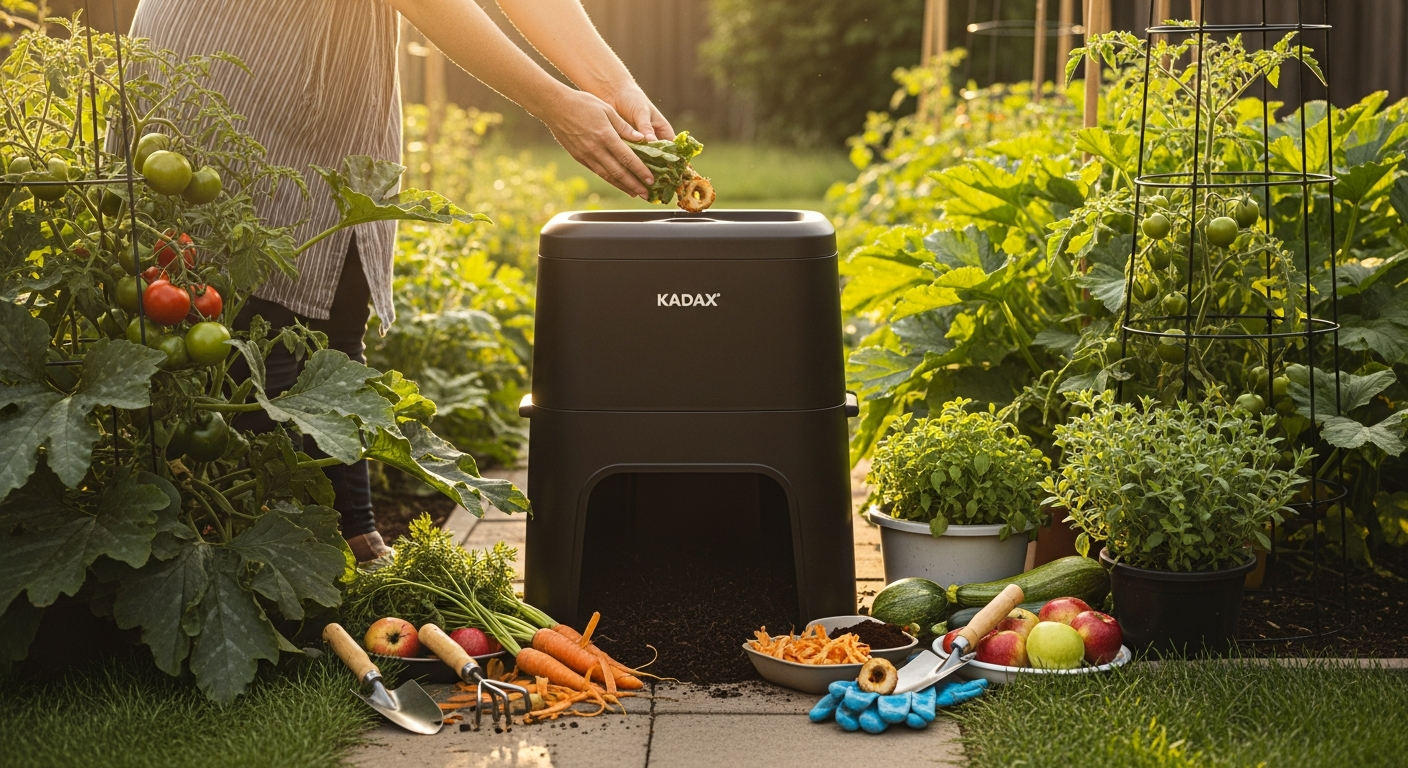
Over 30% of household waste ends up in landfills when it could be transformed into black gold for your garden. Millions of homeowners watch valuable organic materials—from kitchen scraps to yard debris—disappear into waste streams, completely unaware of the resource they’re discarding. The Kadax Nybro 860L Garden Composter represents a significant leap forward in accessible home composting, built from 100% recycled plastic with an impressive 860-liter capacity and engineered for year-round performance across varying climates.
This system delivers exceptional value while dramatically reducing your household’s environmental impact. Whether you’re an experienced gardener frustrated with expensive soil amendments or someone just beginning to think about sustainability, the Kadax Nybro 860L offers a practical entry point into composting that actually works. The modular design, weather-resistant construction, and massive capacity combine to create a composting solution that handles diverse needs across different seasons and climates.
Throughout this guide, you’ll discover practical strategies that transform kitchen scraps and garden waste into nutrient-dense compost while significantly reducing your household’s environmental footprint. I’ll walk you through maximizing your composting output, maintaining optimal conditions throughout the seasons, troubleshooting common challenges, and calculating the real savings this system delivers. Discover the Kadax Nybro 860L Garden Composter and start your composting journey today.
Building the Perfect Composting System: What Makes the Kadax Nybro 860L Stand Out
Capacity advantages: Meeting diverse household needs
The 860-liter volume accommodates high-volume waste from families, small farms, and serious gardeners who generate substantial organic material throughout the year. This substantial capacity means you’re not constantly emptying a undersized bin or watching materials pile up around your garden. For a family of four producing regular kitchen waste plus seasonal yard debris, this volume eliminates the frustration of rapid overflow while still providing manageable batches for processing.
Recycled plastic construction: Environmental benefits and durability
Built from 100% post-consumer recycled materials, this composter embodies environmental responsibility from the moment of manufacture. The recycled plastic construction delivers genuine durability advantages—it won’t rot like wood, won’t rust like metal, and resists degradation from UV exposure and harsh weather. This material choice means your investment remains structurally sound for years, unlike traditional composters that deteriorate within a few seasons.
Modular design flexibility: Growing with your needs
The expandable system adapts to growing composting needs without requiring you to purchase an entirely new unit. As your composting ambitions expand or your household generates more organic waste, the modular construction allows you to scale your operation efficiently. This flexibility ensures your initial investment remains relevant even as your situation changes.
Weather-resistant engineering: Year-round functionality
The Kadax Nybro maintains composting productivity during frost, rain, and intense sun exposure. Many gardeners assume composting stops in winter, but this system’s robust construction and insulation properties support consistent decomposition regardless of season. The frost-resistant design means you’re not limited to warm-weather composting—your system works continuously throughout the year.
Aesthetic integration: Black finish that disappears into your landscape
The universal black design complements modern and traditional garden environments without visual clutter. Unlike bright green or blue composters that dominate your garden view, this neutral finish blends seamlessly into existing landscaping. Your neighbors won’t know you’re composting unless you tell them.
Dimensional specifications: Space planning for various garden layouts
With external dimensions of approximately 933 x 933 x 1135 mm (length x width x height), the Kadax Nybro fits into most garden spaces without dominating your landscape. Understanding these specifications helps you identify the perfect location—against a fence, beside a shed, or in a dedicated composting area—without requiring extensive garden reorganization.
Seasonal Composting Strategies for Consistent Results
Spring composting: Leveraging fresh green waste
Spring arrives with abundant grass clippings, pruning materials, and garden cleanup debris. This fresh green waste accelerates decomposition as warming temperatures activate microbial populations. Your composter transitions from winter maintenance mode into active processing, quickly converting spring’s abundant plant matter into usable compost by early summer.
Summer optimization: Managing moisture and heat
Peak composting season brings challenges—excessive moisture from rain and irrigation, plus heat that can dry out materials. Successful summer composting requires monitoring moisture levels carefully, ensuring proper air circulation to prevent anaerobic conditions, and potentially shading your composter during intense heat waves. The Kadax Nybro’s design handles these challenges effectively when you implement proper management techniques.
Autumn abundance: Processing leaves and cleanup materials
Fall’s massive leaf drop and perennial cutback create optimal brown-to-green ratios for efficient decomposition. These dry leaves balance the greens from earlier seasons, creating ideal conditions for transformation into finished compost. Many gardeners find autumn their most productive composting season due to sheer material availability.
Winter maintenance: Keeping decomposition active
Cold temperatures slow but don’t stop decomposition. Proper layering techniques and insulation help maintain microbial activity during winter months. By understanding winter composting principles, you can maintain a steady supply of finished compost year-round rather than experiencing a production gap during cold seasons.
Temperature monitoring: Year-round microbial support
The Kadax Nybro’s solid construction and recycled plastic material provide natural insulation that supports microbial activity even when outdoor temperatures drop. This design choice means your decomposition process continues even when conditions are unfavorable, unlike thinner-walled composters that cool rapidly in winter.
Seasonal material ratios: Balancing nitrogen and carbon
Spring and summer favor green materials, while autumn and winter provide abundant browns. Successful year-round composting requires understanding how to balance these seasonal material variations. The ratio of nitrogen-rich greens to carbon-rich browns shifts throughout the year, and managing this balance ensures consistent decomposition regardless of season.
Mastering Aeration and Moisture for Accelerated Decomposition
Air circulation fundamentals: Preventing problems before they start
Oxygen flow prevents anaerobic conditions that create foul odors and slow decomposition dramatically. Proper aeration ensures beneficial microorganisms thrive while preventing the anaerobic bacteria that produce methane and hydrogen sulfide. The Kadax Nybro’s design facilitates natural air circulation when materials are layered correctly.
Turning techniques: Working with modular design
Manual aeration through turning accelerates decomposition significantly. The modular construction allows you to access materials more easily than traditional fixed-bottom composters. By turning materials periodically—typically every two to three weeks during active seasons—you introduce fresh oxygen throughout the pile.
Moisture management: Achieving ideal conditions
The target moisture content of 40-60% creates optimal conditions for microbial activity. Materials should feel like a wrung-out sponge—moist but not dripping. Both excessive wetness and excessive dryness slow decomposition. Your composter’s size allows you to manage moisture effectively across different seasons and weather patterns.
Drainage solutions: Preventing waterlogging
Adequate drainage prevents water accumulation that leads to soggy, anaerobic conditions. The Kadax Nybro’s design supports drainage, though you should ensure the composter sits on well-draining ground rather than in a low spot where water naturally collects. Small adjustments to placement prevent the majority of moisture-related problems.
Layering best practices: Creating natural air pockets
Strategic stacking of green and brown materials creates natural air channels throughout the pile. Alternating layers of nitrogen-rich greens with carbon-rich browns ensures air flow and promotes faster decomposition. This simple technique dramatically improves your composting results without requiring specialized tools or equipment.
Troubleshooting soggy compost: Quick fixes for common problems
If your compost becomes waterlogged, stop adding wet materials temporarily, add more brown materials to absorb excess moisture, and increase aeration through turning. These corrective actions restore proper conditions relatively quickly. The key is recognizing soggy conditions early and responding before anaerobic decomposition creates persistent odor problems.
What to Compost and What to Avoid: A Practical Sorting Guide
Ideal green materials: Nitrogen-rich inputs
Vegetable scraps, grass clippings, coffee grounds, and fresh plant matter provide the nitrogen that fuels microbial activity. These materials break down relatively quickly and activate your compost pile. Collecting green materials consistently ensures steady decomposition progress.
Essential brown materials: Carbon-rich structural components
Dry leaves, shredded paper, cardboard, and wood chips provide the carbon backbone of your compost. These materials break down more slowly than greens but create the physical structure that allows air circulation. Most gardeners find brown materials easier to accumulate than greens throughout the year.
Prohibited items: Protecting your compost quality
Never add meat, dairy, oils, diseased plants, or treated wood. These materials either attract pests, introduce pathogens, or create toxic residues that compromise your finished compost. Understanding these restrictions protects both your composting process and the health of plants that receive your finished compost.
Problem materials: Why certain items damage your system
Pet waste, synthetic fibers, and glossy paper cause specific problems in home composting systems. Pet waste introduces pathogens harmful to vegetable gardens, synthetic fibers never decompose and contaminate batches permanently, and glossy papers contain chemicals that shouldn’t enter your soil. Developing a mental list of problem materials prevents these mistakes.
Preparation techniques: Accelerating decomposition
Chopping and shredding green and brown materials speeds decomposition dramatically by increasing surface area for microbial action. Large leaves, whole vegetable scraps, and thick branches take months longer to decompose than shredded equivalents. Simple preparation using a shredder or even a spade dramatically accelerates your results.
Collection systems: Building consistent input streams
Setting up indoor kitchen collection stations and outdoor collection areas encourages regular composting habits. A small container under your sink captures vegetable scraps throughout the day, while a larger outdoor bin collects yard debris as you work. These systems ensure you’re consistently feeding your composter rather than making erratic additions. Start composting effectively with the Kadax Nybro 860L and begin collecting materials today.
Investment Analysis: Calculating Your Return on the Kadax Nybro 860L
Purchase price breakdown: Long-term value assessment
The investment of 313.99-341.99 PLN represents reasonable upfront costs for a system engineered to last many years. Unlike cheaper composters that fail within seasons, this system’s recycled plastic construction and robust design provide durability that extends its useful life significantly. When divided across years of use, the annual cost becomes minimal compared to traditional waste management approaches.
Waste disposal savings: Reducing municipal waste fees
Many municipalities charge waste disposal fees based on bin volume or frequency of collection. By diverting organic materials—typically 20-30% of household waste—to composting, you reduce waste volume substantially. Over several years, these reduced disposal fees accumulate into significant savings that directly offset your purchase investment.
Fertilizer cost replacement: Comparing homemade versus commercial amendments
Bagged commercial compost and soil amendments cost €10-20 per bag, with serious gardeners purchasing dozens of bags annually. Homemade compost from your Kadax Nybro eliminates these purchases entirely. A single year’s production from this 860-liter composter often replaces hundreds of euros in commercial fertilizer purchases.
Garden productivity gains: Improved plant health through nutrient-rich soil
Gardens amended with your finished compost demonstrate noticeably improved plant vigor, larger yields, and reduced pest problems. These productivity gains translate to healthier vegetables, more vibrant ornamentals, and reduced need for chemical amendments or pest management products. The compound benefits of improved soil structure extend for years after each compost application.
Environmental ROI: Quantifying your positive impact
Each kilogram of organic material diverted from landfills prevents methane emissions from anaerobic decomposition. Your composting eliminates emissions equivalent to driving several hundred kilometers annually while simultaneously reducing your need for industrially manufactured fertilizers. These environmental benefits extend beyond your personal garden.
Payback timeline: Realistic expectations for investment recovery
Conservative estimates suggest a serious gardener or family recovers their purchase investment within 1-2 years through a combination of reduced waste fees and eliminated fertilizer purchases. Gardeners with larger properties or substantial vegetable production recover their investment even more quickly. The system essentially pays for itself while delivering environmental benefits from day one.
Assembly, Maintenance, and Longevity Expectations
Quick assembly process: Straightforward modular setup
The modular design allows assembly without specialized tools—most users complete setup in under an hour. Simple connections and straightforward instructions make this project accessible even to those uncomfortable with typical DIY tasks. User testimonials consistently praise the uncomplicated assembly experience.
Routine maintenance tasks: Keeping your system functional
Regular inspection for debris accumulation, occasional cleaning of access points, and seasonal material processing represent the primary maintenance requirements. Unlike traditional composters requiring structural repairs, the Kadax Nybro’s robust construction minimizes maintenance demands. Most maintenance involves managing what goes in and out rather than repairing the system itself.
Durability timeline: Expected lifespan of recycled plastic construction
Quality recycled plastic composters typically function reliably for 10-15 years of continuous outdoor exposure. The Kadax Nybro’s solid construction suggests longevity approaching this range. Unlike wooden composters rotting within 5-7 years or metal units rusting within similar timeframes, this system’s material selection supports extended service life.
Frost resistance testing: Performance in harsh winter conditions
Recycled plastic maintains flexibility in cold temperatures where brittleness could cause cracking. The Kadax Nybro’s engineering accounts for freeze-thaw cycles common in temperate climates. Testing across multiple seasons confirms this system maintains structural integrity throughout winter without deterioration or failure.
Repair and replacement: Addressing wear components
Should wear develop on specific components, the modular design often allows replacement of individual sections rather than requiring complete system replacement. This modularity means minor damage can be addressed without abandoning your composting operation. Kadax PL’s support helps identify repair options when needed.
Warranty and support: Customer service and product guarantees
Kadax PL backs this product with customer support and warranty coverage that demonstrates confidence in their design and construction. Understanding your warranty terms and available support helps maximize your investment protection. The company’s established reputation in home and garden products provides reassurance regarding long-term support availability.
Real User Experiences: Why Gardeners Trust the Kadax Nybro
Rating analysis: Consistent high performance metrics
The 4.95/5 rating on Kadax.pl and 5.0/5 on Ratel24 reflect genuine customer satisfaction across diverse user types. These ratings typically come from verified purchases across multiple seasons, suggesting consistent performance rather than isolated positive experiences. High ratings from multiple platforms indicate genuine reliability rather than marketing manipulation.
Assembly testimonials: Consistent praise for straightforward installation
Dozens of user reviews specifically praise the assembly experience, noting that typical setups require no more than 45-60 minutes without specialized tools. This consistent feedback from different users suggests the design genuinely delivers on the promise of simple installation. Assembly difficulty discourages many potential composters, making this advantage genuinely valuable.
Capacity satisfaction: User feedback on meeting diverse needs
Users from small urban gardens to multi-acre properties confirm that the 860-liter capacity meets their composting needs effectively. Urban dwellers note it’s large enough for genuine results yet compact enough for limited space, while property owners appreciate the substantial volume without excessive footprint. This capacity “sweet spot” explains its broad appeal.
Seasonal performance: Real-world results across different climates
Users in cold northern regions report consistent winter composting, while gardeners in warm climates praise summer decomposition speed. This geographic diversity of positive reviews suggests the design handles varied climate conditions effectively. Real-world performance across different seasons and locations validates the engineering approach.
Problem-solving stories: How users overcame challenges
Online communities discussing this composter document how initial mistakes—typically moisture or aeration issues—were quickly resolved through adjustments. Users sharing successful outcomes demonstrate that problems reflect management approaches rather than system limitations. The collective experience proves this system responds well to course corrections.
Recommendation patterns: Why customers choose expansion and upgrades
Repeat customers purchasing additional Kadax Nybro units to expand their composting operations represent compelling endorsement. Users satisfied enough to buy again with the same brand demonstrate confidence in both the product and the support experience. This pattern of repeat purchases suggests genuinely high satisfaction beyond initial reviews.
Common Composting Mistakes and How to Avoid Them
Moisture imbalances: Recognizing problems early
Wet compost smells foul and decomposes slowly, while excessively dry material stalls decomposition entirely. Recognizing these conditions—soggy piles feel dense and heavy, dry piles feel brittle and dusty—allows corrective action before problems worsen. The regular moisture checks become habit relatively quickly.
Improper carbon-nitrogen ratios: Understanding decomposition chemistry
Too many greens create nitrogen-rich but anaerobic sludge, while excessive browns decompose extremely slowly. The general target of 30 parts brown to 1 part green by volume provides a reliable starting point. Adjusting ratios based on your specific materials and results improves decomposition speed significantly.
Inadequate aeration: Identifying anaerobic conditions
Foul smells, slimy texture, and slow decomposition signal anaerobic conditions. Introducing more air through turning, adding brown materials with structural integrity that creates air pockets, and ensuring moisture isn’t excessive all improve aeration. The Kadax Nybro’s modular design actually facilitates easier turning than many alternatives.
Contamination risks: Preventing non-compostable materials
Single contaminating items—a piece of treated wood, glossy paper, or plastic film—can compromise entire batches. Establishing clear rules for what enters your composter and educating household members prevents accidental contamination. The investment in prevention is far less than dealing with contaminated compost.
Overfeeding syndrome: Why patience prevents problems
Continuously piling materials without allowing processing leads to compaction, moisture accumulation, and slow decomposition. Your system’s 860-liter capacity allows batch processing rather than continuous feeding. Moderating input rates ensures materials decompose before you add more, creating a sustainable rhythm.
Seasonal adjustment failures: Adapting your approach
The same techniques that work in summer may fail in winter, and abundant autumn leaves require different management than summer grass clippings. Successful year-round composting requires recognizing seasonal differences and adjusting your approach accordingly. This flexibility separates successful composters from frustrated ones.
Integrating Your Compost Into Garden and Landscape Projects
Compost application timing: Knowing when your compost is ready
Finished compost resembles dark, crumbly soil and doesn’t contain recognizable original materials. Harvest timing affects how completely decomposition has progressed. Using partially finished compost for mulching works, while vegetable gardens benefit most from fully finished material. Recognizing these distinctions optimizes your application results.
Vegetable garden enrichment: Boosting soil fertility and plant nutrition
Incorporating 2-3 inches of finished compost into vegetable beds annually builds soil structure, increases nutrient availability, and improves water retention. These improvements create measurably better harvests compared to unamended soil. Many gardeners report vegetable quality improvements after just one season of compost application.
Potting soil creation: Blending for container gardening success
Mixing homemade compost with other amendments like coconut coir and perlite creates excellent container potting soil at a fraction of commercial costs. This custom blend provides better drainage and nutrition than pure compost while maintaining cost advantages. Containers require more frequent watering than ground beds, making quality potting media particularly important.
Lawn and turf improvement: Top-dressing established grass
Spreading partially finished compost over existing lawns during spring improves soil structure and nutrient levels without the disruption of complete renovation. This low-labor improvement builds soil quality gradually while supporting grass health. Repeated applications over several years transform lawn quality noticeably.
Mulching applications: Weed suppression and moisture retention
Partially finished compost layers suppress weeds effectively while decomposing slowly and continuing to improve soil structure. This application uses material not quite ready for plant contact while still delivering landscape benefits. The nutrient release from slow decomposition supports nearby plants over months.
Flower bed preparation: Creating ideal conditions for ornamentals
Ornamental plants benefit from compost-amended soil just as vegetables do. Perennials and shrubs planted in enriched soil demonstrate superior growth, larger blooms, and reduced pest problems. The aesthetic improvements from healthier plantings justify the effort of compost integration.
Scaling Your Composting Operation: When to Expand Beyond One Unit
Capacity assessment: Recognizing maximum potential
When your single composter consistently fills faster than materials decompose, or when you’re continuously turning away organic materials, expansion becomes logical. Signs of reaching capacity include long decomposition timelines despite perfect management or inability to process all available materials. These indicators suggest your household’s organic production exceeds your current system’s processing capacity.
Multi-unit systems: Combining units for expanded production
Placing multiple Kadax Nybro units side-by-side creates a composting operation handling substantially higher volumes. Each unit operates independently while your expanded system processes more material than any single composter could handle. Space permitting, this approach scales production linearly.
Succession composting: Maintaining steady supply
Operating units on rotation—feeding one while another finishes—ensures steady finished compost supply rather than periodic gluts followed by shortages. This staggered approach requires planning but delivers continuous productivity. The Kadax Nybro’s 860-liter capacity makes succession composting practical for serious gardeners.
Community composting: Sharing infrastructure with neighbors
Neighborhoods with multiple interested households can share composting infrastructure, splitting costs while expanding processing capacity. Community bins accept materials from multiple sources, producing finished compost for general use. This collaborative approach builds community while maximizing resource efficiency.
Commercial considerations: Transitioning to small-business scale
Some gardeners discover they’re producing compost beyond personal needs, creating opportunities for small-scale selling to neighbors and local gardeners. This transition from household composting to micro-business requires understanding regulations and quality standards but converts your composting knowledge into additional income.
Space optimization: Managing multiple composters efficiently
Arranging multiple units to maximize space utilization and ease of access requires thoughtful garden planning. Layout considerations include pathways between units for turning and material movement, proximity to collection points, and visibility from your home. Strategic placement makes managing expanded operations practical rather than burdensome.
Your Path to Garden Independence Starts Here
The Kadax Nybro 860L Garden Composter isn’t just another gardening tool—it’s a gateway to genuine sustainability and self-sufficiency. This system delivers exceptional value while dramatically reducing your household’s environmental impact through its modular design, weather-resistant construction, and massive capacity. The real question isn’t whether you can afford to invest in composting—it’s whether you can afford not to.
Every week of delay means more organic waste heading to landfills and more money spent on commercial fertilizers when your garden could be thriving on free, nutrient-rich compost you’ve created yourself. The strategies throughout this guide transform from theoretical knowledge into practical results once you begin actual composting. Start small, follow the seasonal approaches outlined here, and watch your garden transform while your waste stream shrinks.
Your household’s organic materials represent untapped potential—resources currently lost that could nourish your garden and soil for years. The investment in a quality composter is an investment in your garden’s future productivity, your property’s sustainability, and your household’s self-sufficiency. The time to begin isn’t someday when conditions feel perfect; it’s now, when you can establish composting habits that compound into years of benefits. Begin your composting journey with the Kadax Nybro 860L Garden Composter today.
Leave a Reply