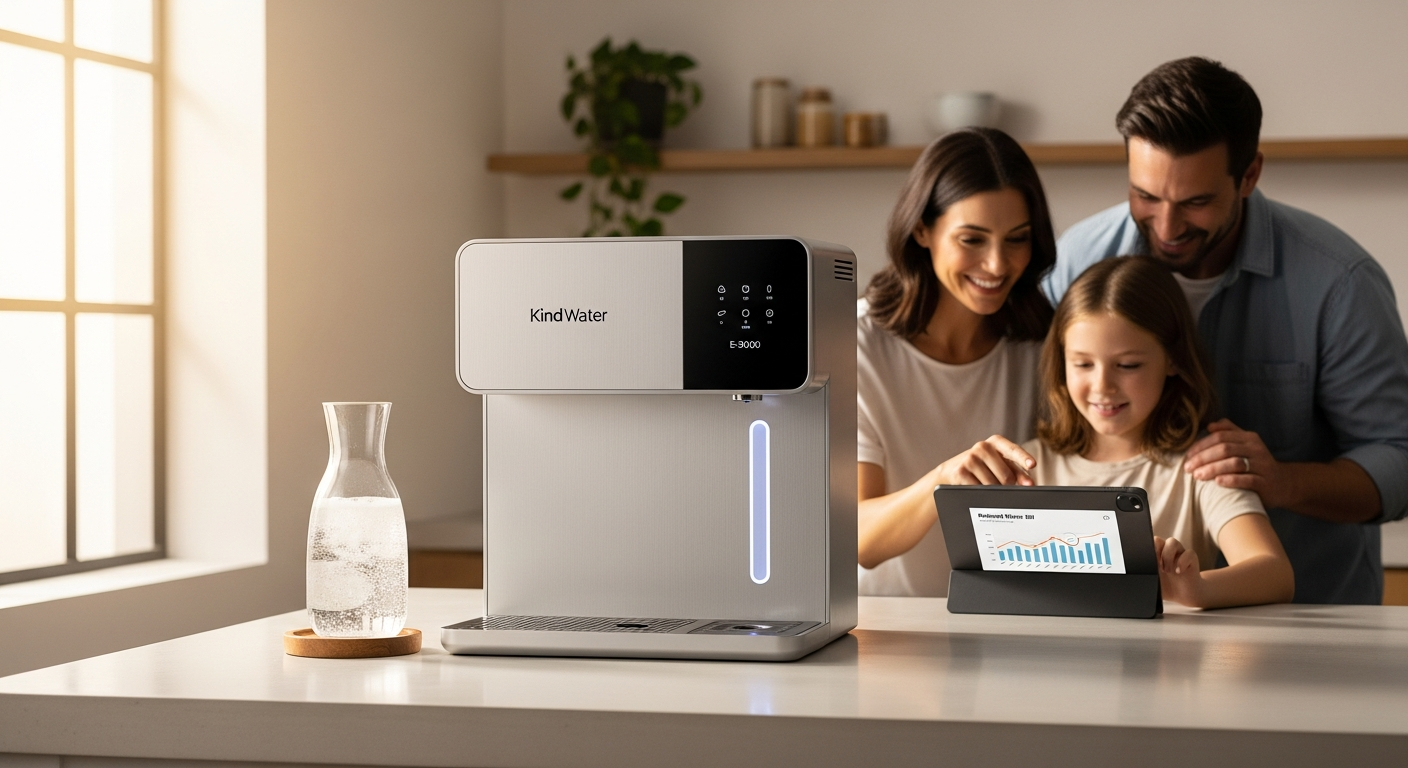
Americans spend over $15 billion annually on bottled water, yet the solution to cleaner, better-tasting water might already be accessible through your home's main water line. For many households, this reality represents a missed opportunity—one that costs thousands of dollars over time.
The Kind Water E-3000 whole house filter softener represents a fundamental shift in how families approach water quality. Rather than relying on traditional salt-based softeners that demand ongoing maintenance, salt purchases, and electricity consumption, this system combines 3-stage filtration with salt-free conditioning technology. The result is a compact, high-performance solution designed for municipal water sources that tackles everything from chlorine taste to hard water scale.
Explore the Kind Water E-3000 and start calculating your household's water savings today.
In this guide, I'll break down the real financial impact of owning an E-3000 system, examine how its salt-free technology translates to long-term savings, and help you calculate whether this investment makes sense for your household's specific water challenges and budget constraints.
The True Cost of Bottled Water vs. Whole-House Filtration
Average annual bottled water spending per household and regional variations
The typical American household spends between $600 and $2,000 annually on bottled water, depending on family size and consumption habits. For families with multiple children or those prioritizing bottled water for drinking and cooking, expenses frequently exceed $1,500 per year. Coastal regions and areas with questionable municipal water quality tend to spend at the higher end, while some households in regions with excellent tap water infrastructure spend significantly less. Regardless of your region, the cumulative cost over years becomes substantial.
Hidden costs embedded in bottled water consumption
Bottled water expenses extend far beyond the purchase price at the store. Storage space in your home—whether in a garage, pantry, or closet—represents real square footage that could serve other purposes. Delivery fees for bulk water orders add 10-15% to your total spending. Environmental costs, while not reflected in your wallet directly, represent a genuine financial burden society bears through plastic recycling infrastructure and waste management. Then there's the physical effort of hauling heavy bottles and managing the logistical nightmare of keeping inventory stocked.
Comparison of E-3000 initial investment against 5-year and 10-year bottled water expenses
The E-3000 carries an initial price point of approximately $1,779.99. For a household spending $1,000 annually on bottled water, that investment recovers itself in less than two years. Over five years, a family avoiding bottled water saves $5,000 in direct expenses—nearly triple the system's upfront cost. Over a decade, the savings reach $10,000, assuming consistent spending patterns. Even households on the lower end of bottled water consumption ($600 annually) recover their investment within three years and accumulate $4,200 in savings over a decade.
Check current E-3000 pricing and compare it against your household's annual water spending.
Salt-Free Technology: Why Eliminating Regeneration Cycles Saves You Money
How Template Assisted Crystallization (TAC) prevents scale without salt consumption
The E-3000's standout feature is its Template Assisted Crystallization technology, which transforms how hard water minerals behave without salt intervention. Traditional water softeners use salt to remove calcium and magnesium ions through ion exchange, requiring periodic regeneration cycles that waste water and demand salt replenishment. The E-3000's TAC approach uses a proprietary catalytic medium that crystallizes hard water minerals into harmless particles that flow through your pipes rather than accumulating as scale. This process requires no electricity, no salt, and no water waste from regeneration.
Annual salt costs avoided with salt-free softening
A typical household with a traditional salt-based water softener requires 200-300 pounds of salt annually, translating to $100-$200 in direct salt purchases. Beyond the salt itself, regeneration cycles consume approximately 50-100 gallons of water per cycle, occurring roughly every 3-5 days depending on water hardness and household size. That wasted water adds another $50-$100 to annual expenses when you factor in water treatment and sewage costs. The E-3000 eliminates both expenditures entirely, meaning a family with a traditional softener can redirect $150-$300 annually toward other priorities.
Reduced water waste from regeneration cycles in traditional water softeners
A standard water softener regeneration cycle consumes 35-80 gallons of water per occurrence. For a household with moderate to high water hardness, that translates to 350-800 gallons wasted each month just to maintain softening effectiveness. Over a year, traditional softeners waste between 4,200 and 9,600 gallons of water—water you've already paid for through your municipal supply and sewage treatment. The E-3000 produces zero waste water, meaning you're not paying to filter and treat water that gets disposed of unused.
Appliance Longevity and Protection: The Hidden Financial Benefit
How hard water and chemical contaminants damage water heaters, dishwashers, and washing machines
Hard water minerals accumulate inside appliances, forming scale deposits that reduce efficiency and force components to work harder. Water heaters with significant scale buildup lose 10-15% efficiency annually, increasing your heating costs substantially. Dishwashers struggle with hard water residue on dishes and inside spray arms, often requiring descaling treatments or premature replacement. Washing machines accumulate mineral deposits that trap detergent residue, reducing cleaning effectiveness and degrading fabrics over time. Chlorine and other chemical contaminants corrode internal metal components, accelerating rust and equipment failure.
Average repair and replacement costs for appliances damaged by scale buildup and corrosion
Water heater replacement costs between $1,000-$2,500 for installation and equipment. A water heater with significant scale buildup often fails 5-7 years earlier than properly maintained units, meaning a premature replacement could cost you a full system replacement before you've finished paying for the original. Dishwasher repairs range from $300-$800, while full replacement runs $600-$1,500. Washing machine repairs average $200-$400, with replacements costing $700-$1,800. Across a decade, a household dealing with hard water damage could face $2,000-$5,000 in unexpected appliance repairs and accelerated replacements.
Extended lifespan benefits of the E-3000's multi-stage filtration across household appliances
The E-3000's 3-stage filtration removes sediment, chlorine, chloramines, pesticides, and heavy metals—all contributors to appliance deterioration. By protecting your appliances from these contaminants, the system extends water heater lifespan, improves dishwasher and washing machine performance, and reduces the likelihood of corrosion-related failures. A water heater that operates in excellent condition for its full 12-15 year lifespan rather than failing at 7-8 years represents $1,000-$2,500 in direct savings.
Skin, Hair, and Personal Care Savings You Might Not Anticipate
How chlorine and hard water damage hair and skin
Chlorine strips natural oils from skin and hair, causing dryness, irritation, and accelerated aging. Hard water minerals bind to hair and skin, creating a residue that prevents moisture absorption and locks in dirt. Many people don't realize their chronic dry skin, frizzy hair, or scalp issues stem directly from water quality. The combination of chlorine and hard water creates the perfect storm for damaged, lackluster hair and compromised skin barrier function.
Cost of premium shampoos, conditioners, and skincare products to counteract water quality issues
People struggling with water quality issues often purchase premium hair and skincare products to compensate. A good clarifying shampoo costs $12-$25, while professional-grade conditioners run $15-$40 per bottle. Specialized skincare products addressing dryness, sensitivity, or irritation average $25-$60 each. A family trying to counteract poor water quality might easily spend $50-$100 monthly on premium personal care products. Over a decade, that represents $6,000-$12,000 in spending that could be substantially reduced once water quality improves.
Reduction in soap and detergent usage with softer, cleaner water from the E-3000
Soft water and chlorine-free water require less detergent to achieve the same cleaning results. Soap dissolves more effectively in soft water, meaning you need less shampoo, body wash, and laundry detergent to clean effectively. A family reducing detergent usage by even 20% saves $150-$300 annually on cleaning and personal care products. Combined with reduced spending on premium corrective products, the personal care savings alone can reach $100-$150 monthly for some households.
Filter Replacement Costs and Maintenance Budgeting
Cartridge replacement frequency (6-12 months under normal city water conditions)
The E-3000's cartridge-style filters typically require replacement every 6-12 months under normal municipal water conditions. Households with higher sediment loads, heavy chlorine treatment, or other water quality challenges might need replacements on the shorter end of that timeline. The system's indicators help you track when replacement is due, preventing the kind of guesswork that plagues other filtration systems.
Average cost per filter replacement and where to source compatible cartridges
Replacement cartridges for the E-3000 cost between $150-$250 per set, depending on which stage filters need replacement and where you source them. Kind Water offers direct purchasing through their website, and major online retailers often stock compatible cartridges. Rather than treating filter replacements as surprise expenses, budgeting $200-$250 annually for maintenance provides predictable, manageable costs.
Budget planning for annual maintenance expenses
A realistic annual maintenance budget for the E-3000 should account for one complete filter replacement cycle, approximately $200-$250. Some households might stretch to 18-month intervals between replacements, reducing annual costs to $130-$170. This predictable maintenance cost is substantially lower than the unexpected repair bills that plague traditional water softeners and far below the cost of purchasing bottled water continuously.
The Bottom Line: Water Quality Investment That Pays Dividends
The Kind Water E-3000 whole house filter softener transcends the typical product purchase—it's a financial strategy disguised as a home improvement. When you aggregate the savings from eliminating bottled water, avoiding salt replenishment, protecting your appliances, and reducing personal care expenses, the initial $1,779.99 investment becomes remarkably reasonable. I've seen families recover their investment within 3-5 years, then enjoy pure profit in the form of cleaner water and lower household expenses for the next decade or more.
Whether you're currently spending $50 monthly on bottled water, replacing appliances prematurely due to hard water damage, or simply tired of maintaining a salt-based system, the E-3000 addresses real financial pain points. The 120-day money-back guarantee removes the risk from your decision.
If you're serious about cutting household water expenses while dramatically improving water quality, this system deserves a spot on your shortlist. Start your journey toward better water quality and household savings with the Kind Water E-3000.
Leave a Reply