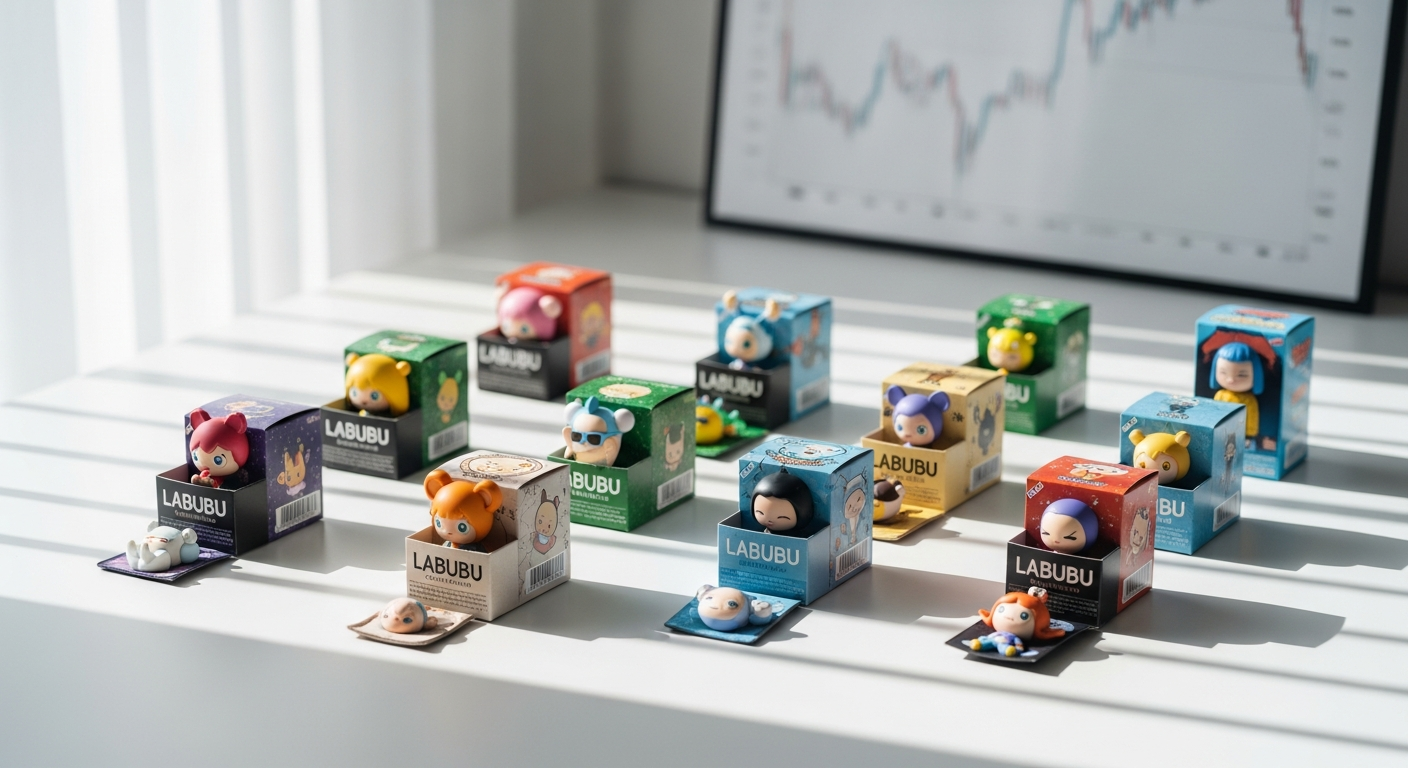
Labubu & The Monsters Blind Box Figures: From Collectible Hobby to Secondary Market Asset
Labubu figures are selling for 10 times their retail price on secondary markets—and that's just for mid-tier chase editions. The blind box collectible phenomenon has exploded beyond casual fandom into legitimate investment territory, with The Monsters IP generating $419 million in 2024 alone. This market has evolved from niche hobby to mainstream cultural moment, and the financial implications are impossible to ignore.
What makes Labubu different from typical collectibles is the deliberate scarcity engineered into every release. Pop Mart's surprise economy model creates artificial demand through blind box mechanics, limited production runs, and strategically hidden secret variants. The artist-driven character design by Kasing Lung—combined with celebrity endorsements and social media amplification—has transformed these $10–$20 figures into assets that serious collectors actively track and trade.
Start building your Labubu investment portfolio today with authentic figures from trusted retailers.
The Secondary Market Economics Behind Labubu's Skyrocketing Resale Prices
How Blind Box Scarcity Mechanics Artificially Inflate Secondary Market Demand
The blind box format is Pop Mart's psychological masterpiece. Collectors pay their $10–$20 without knowing what figure they'll receive, creating an inherent element of unpredictability that drives repeat purchases. This uncertainty doesn't diminish demand—it amplifies it. When someone pulls a common variant from their first box, the natural instinct is to buy another, then another, chasing that elusive secret edition.
The scarcity isn't accidental. Pop Mart controls production runs with precision, ensuring that certain variants appear in only a small percentage of boxes. This engineered rarity creates genuine scarcity that the secondary market hungrily pursues.
Price Multipliers: Retail Versus Resale
A standard Labubu figure retails for $10–$20 depending on the series and region. On secondary markets, common variants might sell for $25–$40, representing a modest markup. But rare chase editions? Those command $100–$500+, sometimes even higher for ultra-rare secret variants or regional exclusives. The most sought-after figures have fetched hundreds of dollars from determined collectors willing to pay premiums to complete their sets.
This pricing disparity reflects the brutal mathematics of blind boxes—if a figure has a 1-in-144 pull rate in a sealed case, collectors face significant financial barriers to acquiring it through retail channels alone.
The Psychology of FOMO That Drives Repeat Purchases
Fear of missing out is the engine behind this market. Limited-edition releases, timed collaborations, and finite production windows create urgency that transcends rational spending. A collector might purchase an entire sealed case (containing 12 blind boxes) hoping to land a specific variant, knowing that waiting risks the figure becoming unavailable entirely.
This psychology extends beyond individual purchases. The completion set mentality—acquiring every variant within a series—becomes an obsession for serious collectors. The figures they're missing represent psychological gaps that secondary market prices exploit ruthlessly.
Market Data Showing Explosive IP Revenue Growth
The Monsters IP demonstrated a 726.6% year-on-year growth in 2024, generating $419 million in revenue. This isn't just consumer spending on blind boxes—it reflects the entire ecosystem: secondary market transactions, trading volume, and the sustained attention from investors and collectors treating these figures as appreciating assets.
This growth trajectory places The Monsters alongside established collectible categories that have historically retained or appreciated in value over time.
Why Limited-Edition Collaborations Command Premium Markups
Collaborations like the Coca-Cola Series or Big into Energy releases create artificial scarcity at the brand level. These aren't just limited editions—they're brand partnerships that signal exclusivity and cultural moment. A Coca-Cola collaboration Labubu carries narrative weight beyond the figure itself; it represents a specific moment in Pop Mart's history and the broader collectible toy market.
Secondary market prices for collaboration variants typically exceed standard releases by 30–100% or more, reflecting their perceived collectibility and the smaller production runs allocated to partner releases.
Seasonal Price Fluctuations and Release Timing Impact
Release timing directly influences secondary market pricing. Figures released during peak shopping seasons (holidays, back-to-school) experience different demand patterns than off-season releases. Early secondary market prices tend to spike immediately after announcement, stabilize during the retail window, then shift based on actual pull rates and collector sentiment.
Savvy investors monitor these cycles, recognizing that prices often soften slightly after a series' retail window closes, then appreciate again as figures become harder to source and news of the next release cycle builds anticipation.
Secure your rarest Labubu variants before they disappear from the market.
Identifying Chase Variants & Secret Editions Worth Hunting
What Makes Secret or Chase Figures Different From Standard Blind Box Pulls
Standard variants appear with predictable frequency in sealed cases. Secret editions—marked with special designations in collector communities—carry significantly lower pull rates, sometimes appearing in fewer than 1% of boxes. These figures usually feature unique designs, alternative colorways, or special markings that distinguish them from the standard lineup.
Chase variants occupy the middle ground: rarer than standards but more accessible than true secrets. The distinction matters financially. A secret Labubu might be worth $300 while a similar-looking standard variant sells for $15.
Rarity Tiers: Common, Uncommon, Rare, and Ultra-Rare Classification Systems
The collector community has developed standardized rarity classifications based on pull rates and market availability. Common variants represent the standard lineup with expected frequency. Uncommon variants appear less regularly but aren't particularly challenging to acquire. Rare variants require either significant purchasing volume or secondary market acquisition. Ultra-rare figures—including secrets and exclusive variants—represent the pinnacle of collectibility.
Understanding these tiers helps collectors calibrate expectations and investment decisions. A rare figure today might become uncommon as the secondary market stabilizes, but ultra-rare figures from early series have historically maintained or appreciated in value.
How to Authenticate Genuine Labubu Figures Versus Counterfeits
Counterfeit Labubu figures flood online marketplaces, particularly on platforms with minimal verification. Genuine figures exhibit specific quality standards: clean manufacturing, precise paint application on details like teeth and eyes, and properly aligned features. Counterfeits often display sloppy paint work, misaligned components, or noticeably inferior materials.
The blind box packaging itself serves as an authentication checkpoint. Genuine Pop Mart boxes feature specific printing quality, accurate font rendering, and correct holographic elements. Counterfeits typically show printing inconsistencies, blurry text, or missing security features.
Serial Numbers, Packaging Details, and QR Code Verification Methods
Each genuine Pop Mart blind box includes a serial number corresponding to its production batch. These numbers follow specific formatting conventions and can be cross-referenced against Pop Mart's official databases. Packaging details like label placement, color accuracy, and material quality vary distinctly between authentic and counterfeit products.
Modern Pop Mart figures include QR codes linking to authentication databases. Scanning these codes reveals production information, serial verification, and anti-counterfeiting metadata. If a QR code doesn't work or returns invalid information, the figure is almost certainly counterfeit.
Regional Exclusives and Their Impact on Global Resale Value
Certain Labubu variants are released exclusively in specific regions—Asia, North America, Europe, or specific countries. These regional exclusives command global secondary market premiums because collectors worldwide pursue complete collections. A figure available only in Japan automatically attracts international buyers, inflating prices beyond what domestic availability would support.
Understanding regional release patterns helps identify undervalued figures poised for appreciation as awareness of their exclusivity spreads globally.
Building a Strategic Labubu Collection for Long-Term Value Retention
Diversification Strategy: Balancing Popular Characters With Underrated Variants
Sophisticated collectors don't chase every hyped release indiscriminately. Instead, they diversify: acquiring popular figures that maintain baseline demand (the core of collection value), while strategically pursuing underrated variants that others overlook. This approach protects against total loss if the market suddenly shifts while positioning the collector to capitalize if underappreciated figures gain recognition.
Popular characters like Labubu himself retain steady demand across market cycles. Less celebrated variants from the same series sometimes appreciate more aggressively because fewer collectors pursued them initially.
Investment-Grade Figures Versus Display-Only Collectibles
Not all Labubu figures are created equal for investment purposes. Investment-grade figures possess rarity, historical significance (early series commands premiums over recent releases), condition, and demonstrated market demand. Display-only collectibles lack these characteristics—they're acquired purely for personal enjoyment without expectation of financial appreciation.
Understanding this distinction prevents emotional purchasing that undermines investment returns. A beautiful variant you adore might not appreciate, but that's fine if you're buying it for display rather than investment.
Storage and Preservation Techniques That Maintain Resale Value
Condition dramatically impacts secondary market pricing. Mint-condition figures in pristine boxes command 30–50% premiums over opened or damaged versions. Proper storage requires climate control (avoiding temperature and humidity extremes), protection from sunlight (which fades paint), and careful handling to prevent accidental damage.
Serious collectors maintain collections in sealed boxes rather than displayed, prioritizing financial value over visual appreciation. Those seeking compromise solutions use display cases that protect figures from dust and UV exposure while allowing visual enjoyment.
Packaging Preservation: Why Keeping Original Boxes Increases Value
The original blind box packaging is integral to resale value. A figure without its box might be worth $30; the same figure with original packaging could fetch $75+. The packaging provides authentication, originality verification, and the complete collector experience that secondary market buyers expect.
This reality forces a strategic decision: figures intended for long-term value retention must remain boxed, while display figures are typically removed from packaging.
Tracking Your Collection With Spreadsheets and Valuation Apps
Serious collectors maintain detailed tracking systems documenting purchase price, acquisition date, current estimated value, condition status, and rarity tier. Spreadsheets allow historical price analysis, identifying which figures have appreciated and which haven't. This data informs future purchasing decisions and helps determine optimal liquidation timing.
Several apps now specialize in collectible toy tracking, automatically updating prices based on secondary market sales data and providing portfolio valuation snapshots.
When to Hold Versus When to Sell Based on Market Trends
The most profitable secondary market participants understand holding periods. Figures typically appreciate most in the 6–18 months following their retail window, as scarcity becomes apparent and late collectors scramble to acquire variants they missed. After this window, appreciation slows unless the figure becomes historically significant or new demand drivers emerge.
Liquidating during peak appreciation—when market sentiment is strongest but the figure hasn't yet become common knowledge among non-collectors—typically maximizes returns. Holding indefinitely assumes perpetual appreciation, which isn't guaranteed for collectibles.
The Kidult Market Phenomenon & Demographic Expansion
Why Adult Collectors (Kidults) Are the Primary Driver of Labubu Demand
The "kidult" phenomenon—adults collecting toys traditionally associated with children—drives Labubu's market. These aren't nostalgic millennials chasing childhood interests; they're professionals with disposable income treating collectibles as hobby investments and artistic purchases. Adults comprise the vast majority of serious Labubu collectors, with average annual spending reaching $500–$5,000+ for dedicated enthusiasts.
This demographic shift fundamentally changed toy collecting from a niche children's activity into a mainstream adult passion with serious financial implications.
The Ugly-Cute Aesthetic Appeal Across Age Groups and Cultural Backgrounds
Labubu's design—the furry body, pointed ears, serrated grin, and mischievous expression—occupies a unique aesthetic space. It's deliberately not traditionally cute; instead, it embraces "ugly-cute" principles that appeal across demographics. The character is simultaneously endearing and unsettling, innocent yet impish. This tonal ambiguity resonates universally in ways that conventionally cute characters sometimes don't.
The aesthetic transcends cultural boundaries. Asian collectors appreciate Kasing Lung's Hong Kong artistic perspective, while Western collectors connect with the character's irreverent personality and distinct design philosophy.
Psychological Comfort and Nostalgia Factors in Adult Toy Collecting
Collecting serves psychological functions beyond investment. The unboxing experience, the tactile pleasure of handling well-crafted figures, and the community of fellow collectors provide comfort and belonging. For many adults, Labubu collecting represents accessible luxury—premium hobby experiences at price points that don't require extreme wealth.
The nostalgia factor, while present, is less about childhood memories than about recapturing the simple joy of collecting. Adults spent years suppressing toy interest; Labubu's cultural legitimacy as a collectible art form enables them to embrace this interest openly.
Instagram and TikTok Culture Amplifying Labubu Visibility Among Younger Demographics
Social media transformed Labubu from niche collectible into cultural phenomenon. Unboxing videos, collection showcases, and trading content generate millions of views. Younger demographics discover Labubu through social platforms, creating a second wave of collectors who approach the hobby with smartphone-native enthusiasm.
This amplification creates self-reinforcing cycles: visibility drives demand, demand creates more content, content drives further visibility. Early adopters benefit enormously from this mechanism, as their early purchases gain cultural significance.
How Streaming Culture and Celebrity Unboxing Videos Influence Purchasing Behavior
Celebrity participation legitimized Labubu collecting in mainstream culture. When celebrities with massive followings unbox Labubu figures, it signals cultural relevance to audiences who might otherwise dismiss toy collecting as niche. These unboxing videos don't just entertain—they actively drive purchasing behavior by showcasing the surprise mechanics and celebratory moments associated with chase variants.
Streaming culture has also created professional unboxers who influence collector behavior through product reviews, investment guidance, and market analysis streamed to dedicated audiences.
Navigating Counterfeit Markets & Protecting Your Investment
The Scale of Fake Labubu Figures Flooding Online Marketplaces
Counterfeit Labubu figures represent a significant portion of secondary market listings, particularly on platforms with minimal seller verification. These counterfeits range from obviously crude knockoffs to sophisticated reproductions that fool casual buyers. The profit margins on counterfeits are substantial—a $2 manufacturing cost selling for $15 creates powerful incentive for counterfeiters to flood markets.
Estimates suggest that 20–30% of Labubu figures listed on unvetted platforms are counterfeit, making authentication skills essential for secondary market buyers.
How to Spot Counterfeit Blind Boxes Through Packaging Analysis
Genuine Pop Mart blind boxes feature specific printing quality, exact color matching, and precise label placement. Counterfeiters struggle with consistency; their boxes often exhibit color variations, printing misalignment, or font inconsistencies compared to genuine samples. The material quality differs subtly—genuine boxes use specific cardstock that feels distinct from counterfeit alternatives.
High-resolution comparison photos of your figure's packaging against verified authentic examples reveal counterfeit indicators: blurry printing, incorrect holographic elements, or missing security features.
QR Code Scanning and Authentication Databases for Verification
Legitimate Pop Mart figures include functional QR codes linking to brand verification systems. When scanned, these codes reveal production batch information, manufacturing dates, and authenticity confirmation. Counterfeit figures either lack QR codes entirely or include non-functional codes. Scanning QR codes from trusted databases confirms legitimacy; non-functional codes indicate counterfeits.
Pop Mart and authorized retailers maintain public-facing databases allowing consumers to verify QR codes before purchase.
Trusted Retailers Versus High-Risk Secondary Market Sellers
Purchasing directly from Pop Mart's official website or authorized retailers eliminates counterfeit risk but also removes secondary market discounts. High-risk secondary market sellers—unknown accounts on open platforms—require extreme authentication diligence. Medium-risk sellers include established resellers with reputation systems but no physical verification infrastructure.
Low-risk secondary market sources include certified resellers, Pop Mart authorized retailers selling secondary inventory, and established collector communities with reputation systems.
Red Flags: Pricing That Seems Too Good to Be True
Secondary market premiums for rare Labubu figures are substantial but predictable based on historical sales data. A figure normally selling for $200 doesn't suddenly appear for $80 without explanation. Extreme discounts signal either counterfeits, damaged goods, or unreliable sellers. If pricing seems too good to be true, it almost certainly is.
Experienced collectors maintain price reference databases, immediately recognizing listings that deviate from market norms. Trust these instincts—they protect investment.
Pop Mart's Release Calendar & Strategic Launch Timing
How Pop Mart Staggers Releases to Maintain Perpetual Demand Cycles
Pop Mart engineers perpetual demand through carefully timed release cycles. New Labubu series launch before previous series fully saturate the market, creating continuous urgency. Announcement timing generates anticipation; retail windows maintain excitement; secondary market appreciation follows retail conclusion. Before this cycle completes, announcements for the next series begin the cycle again.
This orchestration isn't accidental—it's strategic business psychology designed to maintain active collector engagement and purchasing behavior across years rather than months.
Upcoming Labubu Series Predictions for 2026 Based on Historical Patterns
Historical release patterns suggest Pop Mart will introduce 3–4 major Labubu series annually, likely featuring artist collaborations and thematic variations. Early 2026 predictions include seasonal releases (likely winter/spring themes), regional exclusive variants, and possible partnerships with major brands building on 2024's Coca-Cola collaboration success.
These predictions help collectors anticipate release timing and allocate budgets strategically rather than reactively purchasing every announcement.
Collaboration Announcements and Their Immediate Market Impact
Collaboration announcements immediately influence secondary market pricing for related figures. When Pop Mart announces a new partnership, collectors reassess their holdings of figures from similar collaborations, either acquiring them before price spikes or liquidating to capitalize on renewed attention.
Announcement timing is so impactful that serious collectors maintain alerts for Pop Mart announcements, monitoring social media and official channels for breaking news before broader market awareness.
Pre-Order Strategies and How Early Access Affects Secondary Market Prices
Pop Mart often offers early pre-order access to loyal customers and app users. These early purchases reduce secondary market scarcity during the initial retail period, moderating prices. However, figures purchased through pre-orders often arrive in early waves, allowing early secondary market listing before full retail window completion. Early listers often command premium pricing by establishing market baseline before supply normalizes.
Strategic collectors balance pre-order participation (ensuring acquisition of desired variants) against secondary market entry timing (when peak pricing occurs).
Seasonal Collections and Holiday-Themed Variants
Seasonal releases—particularly winter/holiday themes and spring collections—drive concentrated purchasing enthusiasm. These limited seasonal windows create genuine time-based scarcity; collectors know they won't reappear for 12 months. Holiday-themed Labubu figures consistently appreciate more aggressively than non-seasonal releases, reflecting the compressed purchasing window.
Identifying seasonal variants likely to have long-term collector demand provides reliable appreciation vectors.
From Hobby to Portfolio: Treating Labubu as Alternative Asset Class
Comparing Labubu Collectibles to Traditional Investments (Stocks, Real Estate, Art)
Labubu figures function similarly to alternative asset classes like fine art or vintage collectibles. Returns depend on scarcity, demand, and market sentiment rather than fundamental business metrics. Like art investments, Labubu appreciation requires identifying undervalued figures before broader market recognition. Like real estate, condition and location (rarity tier) directly impact value. Like stocks, secondary market liquidity varies depending on current demand and market sentiment.
The advantage over traditional alternatives: lower entry cost and higher potential appreciation percentages from purchase to sale. The disadvantage: less predictable long-term returns and higher volatility.
Portfolio Allocation: What Percentage of Net Worth Serious Collectors Dedicate to Figures
Financial advisors treating collectibles as portfolio components typically recommend 3–10% of net worth allocation for serious hobbyists, scaling to 20%+ for dedicated investors who can afford losses. Annual spending for serious Labubu collectors ranges from $500–$5,000+, representing significant recurring investment. Professional collectors maintain organized portfolios tracking acquisition costs, current valuations, and realized gains/losses across multiple figures.
This allocation framework prevents emotional over-investing while enabling meaningful participation in the market.
Tax Implications of Buying and Selling Collectibles for Profit
Selling collectibles for profit creates capital gains tax obligations. The rate depends on holding period (long-term: over 1 year; short-term: under 1 year) and jurisdiction. Long-term capital gains receive preferential tax treatment in many locations. Serious collectors consult tax professionals to understand obligations, track basis costs, and potentially leverage loss harvesting strategies to offset gains.
Treating Labubu as investment rather than pure hobby triggers tax implications that casual collectors should understand before engaging in regular resale activity.
Liquidity Concerns: How Quickly You Can Convert Figures to Cash
Unlike stocks or bonds, Labubu figures aren't instantly liquid. Converting figures to cash requires finding buyers, negotiating prices, and completing transactions through secondary market platforms. Popular figures might sell within days; niche variants might take weeks or months. Sudden liquidation needs force below-market pricing as collectors accept lower offers to access cash quickly.
Serious investors maintain reserve positions of more liquid figures to ensure they can access cash without forced liquidation of slower-moving inventory.
Long-Term Appreciation Potential Based on Historical Data
Historical data from early Labubu releases shows consistent appreciation for rare variants. Figures that could be acquired for $10–$20 at retail now sell for $100–$300+ depending on rarity tier. However, not all figures appreciate equally; common variants from well-produced series often remain relatively flat. The best appreciation has occurred with limited-edition collaborations, regional exclusives, and variants from early series releases.
This historical pattern suggests that careful variant selection focusing on rarity and early access provides legitimate long-term appreciation potential.
Community Insights: What Serious Collectors Actually Spend & Pursue
Average Annual Spending Among Dedicated Labubu Collectors ($500–$5,000+)
Surveys of serious Labubu communities reveal substantial annual spending commitments. Casual collectors spend $100–$300 annually on scattered purchases. Hobbyist collectors dedicate $500–$1,500 annually to systematic acquisition. Serious investors commit $2,000–$5,000+, with the most dedicated collectors exceeding these numbers substantially. These figures include retail purchases, secondary market acquisitions, and trading value exchanges.
This spending reflects both the emotional investment in collecting and the increasingly legitimate treatment of figures as financial assets.
Completion Set Goals and the Financial Commitment Required
Completing a full series—acquiring every standard variant and secret edition—requires substantial financial commitment. A series with 12 standard variants and 2 secret editions could cost $30–$50 for retail acquisition of standards, then $200–$800 for secondary market secret editions, totaling $250–$1,000+ per complete series. Serious collectors maintain 3–5 simultaneous completion projects, significantly escalating annual spending.
The completion set mentality drives much secondary market volume, as collectors aggressively pursue final variants to complete collections.
Trading Culture: How Collectors Exchange Duplicates and Negotiate Value
Sophisticated collector communities organize trading networks where individuals exchange duplicate figures based on negotiated values. A collector with duplicates of a popular variant might trade two copies for one rare variant they're seeking. These trades reflect estimated secondary market values but include community goodwill elements that pure cash sales don't.
Trading culture reduces cash spending while increasing collecting velocity—members acquire more figures through strategic exchanges than they could through pure retail purchasing.
Online Forums, Discord Communities, and Collector Networks
Dedicated collector communities organize around Discord servers, subreddits, Facebook groups, and specialized forums. These spaces function as information exchanges (authentication guidance, market analysis, release announcements), trading marketplaces (members post duplicates and seek figures), and social communities (collectors share photography, celebrate acquisitions, and discuss trends).
Participating in these communities provides access to market intelligence unavailable to casual observers and enables direct trading with motivated collectors.
Collector Testimonials: Why People Justify Premium Spending on Figures
Serious collectors justify premium spending through multiple lenses: artistic appreciation of Kasing Lung's design work, community belonging and friendship, investment return potential, and the psychological satisfaction of completing collections. Testimonials consistently emphasize that figures represent more than material objects—they're touchstones for collecting identity and community connection.
This multi-dimensional justification framework explains why financial analysis alone doesn't capture why collectors allocate such substantial resources to this hobby.
The Artist's Vision: Kasing Lung's Design Philosophy & Character Narrative
Background on Hong Kong Artist Kasing Lung and Creative Process
Kasing Lung, a Hong Kong-based artist, created Labubu as part of "The Monsters" series, establishing a unique design philosophy that blends Eastern artistic traditions with contemporary aesthetic sensibilities. Lung's background in illustration and character design informed Labubu's distinctive visual language. The character emerged from artistic exploration of "ugly-cute" aesthetics—deliberately subverting conventional cuteness standards to create something more psychologically compelling.
Lung's artistic legitimacy significantly enhances Labubu's perceived value; collectors appreciate owning figures created by an established artist rather than generic corporate design.
The Mischief-Meets-Cute Concept and Its Cultural Resonance
Labubu embodies the "mischief-meets-cute" philosophy—simultaneously innocent and impish, kind-hearted yet mischievous. This tonal balance creates psychological complexity that conventional cute characters lack. The character has narrative depth: it's not just a pleasant figure, but an entity with personality and agency. This complexity resonates across cultures; the mischievous personality appeals to collectors who appreciate characters with attitude.
Cultural resonance extends globally: Western collectors connect with the irreverent personality, while Asian collectors appreciate the artistic and cultural perspective embedded in the design.
Character Design Elements: Furry Body, Pointed Ears, Serrated Teeth Symbolism
Labubu's physical design employs specific symbolism. The furry body suggests a wild, untamed creature; the pointed ears signal supernatural or fantastical nature; the serrated teeth represent danger and unpredictability. Yet the wide eyes and body proportions communicate innocence and vulnerability. These contradictory elements—danger and innocence, wildness and cuteness—create the distinctive "ugly-cute" tension that defines the character.
Understanding design symbolism deepens appreciation and collector attachment, transforming figures from toys into meaningful artistic objects.
How Labubu's Personality Narrative Drives Emotional Collector Attachment
Beyond visual design, Labubu possesses a developed personality narrative. Pop Mart and Kasing Lung cultivate character story arcs, releasing figures that represent different emotional states and moments in Labubu's fictional life. This narrative structure enables collectors to build personal relationships with the character, viewing collection completion as participating in an unfolding story rather than simply acquiring objects.
Emotional attachment translates to sustained collecting commitment and premium willingness—collectors justify higher spending because they're investing in ongoing narrative participation, not just accumulating possessions.
Evolution of the Character Across Different Series and Collaborations
Labubu has evolved significantly across different series releases. The "Big into Energy" series portrayed the character at high-energy moments; "Have a Seat" showed relaxed, introspective variations; collaborations with brands like Coca-Cola placed the character in thematic contexts. This evolution prevents stagnation, maintaining collector interest across years of releases.
Series-specific variants acquire historical significance—early series represent character origins, while later series show artistic growth and experimentation. This historical progression enhances long-term collecting appeal.
The Bottom Line for Labubu Collectors & Investors
Labubu & The Monsters blind box figures have transcended typical collectible status—they've become a legitimate secondary market asset class with demonstrable appreciation potential. The combination of artist-driven design, engineered scarcity, celebrity amplification, and psychological FOMO mechanics creates a perfect storm for sustained demand. The numbers are clear: early adopters of specific chase variants have seen returns that rival traditional investments.
But here's what matters most: success in this market requires strategy, patience, and authentic passion for the figures themselves. The collectors who profit aren't chasing every release blindly—they're studying pull rates, tracking artist collaborations, preserving condition meticulously, and understanding when to hold versus when to liquidate. The kidult market isn't slowing down, and The Monsters IP's 726.6% growth trajectory suggests we're still in the early innings of this phenomenon.
Start by identifying which series genuinely resonate with you, research authentication methods to avoid counterfeits, and build your collection with intention. Whether you're collecting for the art, the community, or the investment potential, the Labubu market rewards informed decision-making. Track your purchases, connect with other serious collectors, and stay alert to Pop Mart's release calendar. The figures that seem ordinary today could be the chase variants everyone's hunting tomorrow.
Begin your strategic Labubu investment journey with verified authentic figures from trusted sources.
Leave a Reply