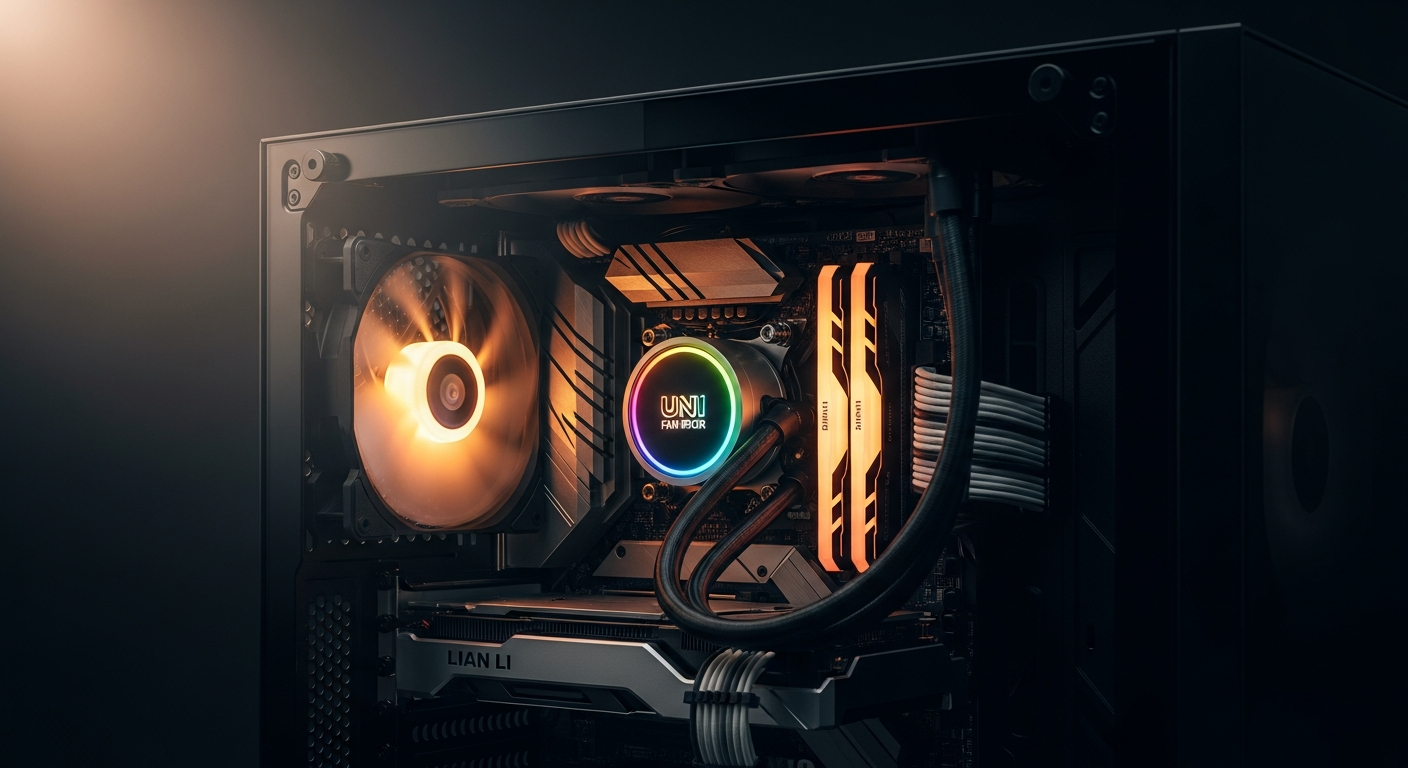
Cable clutter is killing your PC build's aesthetic—and I'm willing to bet you've spent hours wrestling with fan connectors, only to realize you've created a tangled mess behind your motherboard. The frustration is real, especially when you're investing in premium components that deserve a clean, professional look.
The Lian Li UNI FAN SL-INF 120 ARGB is rewriting the rules for how 120mm fans integrate into modern systems. This reverse blade PWM fan combines innovative daisy-chaining technology with addressable RGB lighting and serious cooling credentials, making it a favorite among builders who refuse to compromise on either performance or appearance.
Explore the Lian Li UNI FAN SL-INF 120 ARGB and transform your PC's cable management today.
The Cable Management Game-Changer: How the Daisy-Chain System Works
The proprietary plug-and-play system stands out immediately. Traditional fans demand individual connections to motherboard headers—a single 3-pin or 4-pin PWM connector for each unit. The Lian Li changes this equation with a single connector that handles power distribution to multiple fans simultaneously. This approach cuts motherboard header congestion dramatically, freeing up space for other components and simplifying your build's electrical architecture.
Daisy-chaining capability allows you to stack multiple fans together with minimal additional cabling. Instead of routing separate power runs throughout your case, you connect one fan to the motherboard and link additional units in sequence. The result is a visually clean case interior where cables disappear instead of becoming a prominent fixture behind your tempered glass panel.
Installation Advantages for Different Case Types
Compact cases and ITX builds particularly benefit from this system. Space-constrained environments demand strategic cable management—every inch matters when you're working with limited real estate. The reduced cable routing complexity eliminates the frustration of cramming multiple individual connectors into tight spaces. This translates to faster installation times and fewer headaches when you're trying to close your case panels without pinching wires.
Backward Compatibility and Connector Concerns
Understanding your motherboard's capabilities matters here. The proprietary connector system isn't universal—you need to verify that your board supports the daisy-chain technology before purchase. Some older motherboards or budget models may lack this specific header type. Researching your particular motherboard's manual beforehand prevents compatibility surprises after the fans arrive.
Reverse Blade Design Explained: Airflow Performance for Intake Configurations
The reverse blade geometry isn't just aesthetic posturing—it optimizes intake airflow by pushing air into the case more efficiently than conventional fan blade designs. Standard blade configurations often sacrifice visual appeal when used as intake fans. The Lian Li solves this dilemma through thoughtful engineering that maintains beauty without compromising thermal capacity.
Performance metrics substantiate this claim. The fan reaches a static pressure of up to 2.02 mmH2O, sufficient for handling radiators and restricted airflow scenarios. Maximum airflow capacity hits 108.05 m³/h at 2,100 RPM, delivering effective thermal management for demanding components including high-end processors and graphics cards.
PWM Control and Speed Precision
The PWM control system enables fine-tuning fan speed to balance cooling performance and noise output. You're not locked into a single operating curve—instead, you adjust the fan to match your actual workload. During idle periods, the fan runs slowly and quietly. When your CPU hits thermal load during gaming or rendering tasks, speed increases proportionally to maintain safe temperatures.
Optimal Mounting Positions
Strategic placement determines maximum effectiveness. This fan truly shines in intake positions where the reverse blade design delivers superior performance. Front intake configuration typically works best, leveraging the blade geometry for optimal air movement. Rear exhaust and radiator mounting are possible, though intake configurations showcase the fan's distinctive advantages most clearly.
RGB Lighting and Aesthetics: The Infinity Mirror Effect
Addressable RGB LED technology grants full customization of lighting colors and effects across your entire fan ecosystem. The infinity mirror design creates distinctive visual depth on both the side and front surfaces, producing an effect that photographs beautifully and commands attention inside any case.
RGB ecosystem integration ensures seamless compatibility with popular motherboard RGB software from ASUS, MSI, Gigabyte, and other major manufacturers. Daisy-chaining RGB connections allows linking multiple fans together for synchronized lighting effects, creating a unified visual presentation rather than individual, disconnected light sources.
Software Compatibility and Control Options
Lian Li's ecosystem works smoothly with their proprietary software, and the fan plays nicely with third-party RGB controllers as well. Animation options range from static colors to pulsing effects, rainbow cycles, and reactive modes that respond to system temperatures. Manual control possibilities let you dial in exactly the look you want, whether that's a subtle ambient glow or a bombastic RGB showcase.
Visual Impact Across Case Types
The mirror effect translates beautifully across tempered glass, mesh, and solid panels. Tempered glass cases showcase the effect most dramatically, with light reflecting off the mirror surface creating depth that standard RGB fans simply can't match. Even in mesh cases, the visual impact remains impressive—the infinity mirror effect adds sophistication beyond typical RGB implementations.
Specifications and Performance Metrics: What the Numbers Tell You
The 120mm form factor ensures standard sizing for compatibility with most modern cases and cooling solutions. This universality matters—you're not locked into proprietary case designs or mounting solutions that limit your options for future upgrades or case swaps.
Operating specifications place this fan firmly in the premium segment. Maximum RPM reaches 2,100 with noise levels climbing as speed increases. The bearing type supports extended operational life, with expectations for thousands of hours before bearing wear becomes noticeable. Power consumption remains efficient through PWM control, benefiting builders conscious of energy usage and system heat generation.
Thermal Performance in Real-World Scenarios
Thermal performance benchmarks demonstrate cooling capacity suitable for both air and liquid cooling solutions. The fan handles demanding configurations including high-end AIO coolers and custom water loops without thermal bottlenecking. Static pressure specifications mean it won't struggle against radiator resistance.
Durability and Warranty Coverage
The fan's construction quality establishes durability expectations that justify premium positioning. Warranty coverage provides peace of mind, typically spanning multiple years depending on your retailer and region. This backing reflects Lian Li's confidence in the product's longevity.
Installation Process and Compatibility Considerations
Mounting orientation depends on your chosen airflow configuration. Front intake positioning represents the most common application, taking advantage of the reverse blade design. Securing mechanisms are straightforward—standard mounting brackets work with the 120mm form factor without complications.
Motherboard compatibility verification is the essential first step. Your board needs to support either the daisy-chain connector or have sufficient regular PWM headers if you're not daisy-chaining. RGB header requirements follow similar logic—you need either a dedicated RGB controller or motherboard support for addressable RGB synchronization.
Cable Routing Strategies
Best practices involve routing the single power connector directly to your motherboard header, minimizing cable visibility. If daisy-chaining multiple fans, sequence them logically to simplify power distribution. RGB cables deserve similar attention—hide them along the case's interior edges where tempered glass won't reveal the wire runs.
Troubleshooting Common Issues
Connector fitment occasionally requires gentle pressure to achieve full seating. Software recognition issues typically resolve through BIOS updates or RGB software reinstalls. PWM control problems usually stem from incompatible headers or driver issues rather than hardware faults.
Value Proposition: Is the €29.90 Price Tag Justified?
Premium positioning in the 120mm fan market places this unit at the higher end of the spectrum. Budget alternatives exist at €15-20 price points, but they typically sacrifice cable management simplicity, RGB sophistication, or thermal performance.
Cost-per-performance analysis measures thermal output relative to price. The cooling capacity rivals fans costing significantly more, while the daisy-chain system provides efficiency that standard RGB fans can't match. The cable management savings calculate the time and frustration eliminated—hours of routing, crimping, and problem-solving suddenly become minutes of straightforward installation.
Aesthetic Investment and Visual Upgrade
Aesthetic investment quantifies the visual upgrade for RGB-focused builds. The infinity mirror effect represents a significant aesthetic step above standard LED implementations. For builders where appearance matters as much as performance, this distinction carries real value.
Long-Term Durability Benefits
Build quality and longevity justify premium pricing through extended operational life. This fan won't require replacement after a single system rebuild. The investment compounds across multiple builds as you reuse the fan in new configurations.
Target Audience Alignment
Who benefits most from this fan's feature set? High-end gaming enthusiasts, content creators with demanding thermal loads, and aesthetic-focused builders get the most value. Budget-conscious builders prioritizing raw cooling per dollar might find better value elsewhere, though they sacrifice the cable management advantages and visual sophistication.
Real-World Use Cases: Where This Fan Truly Shines
High-end gaming rigs benefit from the cooling demands of demanding AAA titles and streaming setups. Sustained thermal management during marathon gaming sessions keeps temperatures in check while the low-noise operation preserves the gaming experience.
Content creation workstations require sustained thermal management for rendering, video editing, and 3D work. The fan's robust airflow capacity handles the continuous heat output of processors and GPUs pushed to their limits. RGB-heavy aesthetic builds integrate seamlessly into coordinated lighting ecosystems, where synchronized effects across multiple components create visual cohesion that uncoordinated fans simply can't achieve.
Specialized Build Scenarios
Compact and ITX builds prioritize cable management where space is premium. Every saved cable run means more room for components and improved airflow. Silent PC projects use PWM control to maintain quiet operation during low-demand periods, ramping up only when necessary. Radiator configurations deliver performance in AIO and custom loop setups where traditional fans might bottleneck cooling capacity.
Potential Drawbacks and Honest Trade-Offs
Premium pricing creates a higher cost per unit compared to budget-friendly alternatives. If your primary concern is raw cooling performance per euro spent, this fan might be overkill.
The proprietary connector ecosystem raises potential future compatibility concerns if you switch platforms. While Lian Li maintains broad software support, proprietary systems always carry a degree of lock-in risk. RGB dependency requires compatible motherboard or controller investment—you can't skip this aspect if you want the full experience.
Noise Considerations at Maximum Performance
Noise levels at maximum RPM balance performance ceiling versus acoustics. The fan isn't silent at full speed, though noise remains acceptable for most users. Limited color options at purchase restrict available finishes—you get the standard design without custom variants.
The fan represents overkill for basic builds prioritizing budget over aesthetics. Learning curve for RGB software presents initial setup complexity for users unfamiliar with RGB ecosystems, though most find the software intuitive after initial configuration.
Comparing the Lian Li UNI FAN SL-INF 120 ARGB to Competing Options
Direct competitors in the premium 120mm segment include Corsair ML120 Pro RGB, NZXT Aer RGB 2, and Fractal Design Aspect RGB models. Feature-by-feature breakdown reveals that while competitors match thermal performance, few offer equivalent cable management solutions.
Price-to-performance comparisons measure value proposition against similarly-priced alternatives. The Lian Li typically delivers superior thermal capacity and notably better cable management, justifying its positioning within the premium segment.
Ecosystem Considerations and Brand Reputation
Ecosystem lock-in considerations weigh proprietary systems versus open-standard compatibility. The Lian Li's broader software support mitigates lock-in concerns compared to some competitors. Brand reputation establishes Lian Li's standing in the PC enthusiast community as a reliable innovator focused on solving real builder problems.
Availability varies by region, with European pricing typically around €29.90 while North American pricing adjusts accordingly. User reviews across forums and review sites consistently praise the cable management revolution and RGB execution, with primary criticism focusing on price positioning.
Maximizing Performance: Setup Tips and Optimization Strategies
Optimal fan curve configuration balances thermals and noise through PWM settings. Start with conservative curves that maintain safe temperatures without aggressive cooling during idle periods. Most motherboard BIOS options allow custom fan curves based on CPU or system temperature—experiment until you find the sweet spot between acoustics and thermal headroom.
Intake versus exhaust positioning strategically places fans for case airflow optimization. The reverse blade design shines in intake positions, so prioritize front intake mounting. Reserve exhaust positions for standard blade designs if you're combining different fan types.
Advanced Configuration Techniques
Daisy-chain ordering sequences multiple fans for balanced power distribution. Connect the fan nearest to airflow source to the motherboard header, then chain additional units in sequence away from the power source. This approach distributes electrical load evenly.
RGB synchronization techniques create cohesive lighting effects across your entire system. Use your motherboard's RGB software to sync the fan with other RGB components, creating unified animations rather than individual light shows.
Maintenance and Long-Term Performance
Cable routing best practices hide connectors while maintaining airflow. Avoid routing cables in front of fan intakes where they might obstruct airflow. Monitoring software integration tracks fan performance, enabling on-the-fly adjustments as your system ages. Maintenance and cleaning schedules keep the fan operating at peak efficiency—quarterly cleaning prevents dust accumulation that reduces airflow.
Thermal paste compatibility with your CPU cooler ensures the fan works optimally with your cooling solution. Some cooler designs benefit from strategic fan positioning relative to heatsink fins—experiment during initial setup to confirm optimal thermal transfer.
The Verdict: Premium Cooling Meets Next-Level Cable Management
The Lian Li UNI FAN SL-INF 120 ARGB isn't just another RGB fan—it's a thoughtful solution to a problem that's plagued PC builders for years. That daisy-chain cable system genuinely transforms how you approach interior organization, while the reverse blade design delivers thermal performance that rivals and often exceeds conventional alternatives. The infinity mirror RGB effect adds visual sophistication that photographs beautifully and integrates seamlessly into coordinated builds.
Yes, €29.90 per unit sits at the premium end of the 120mm spectrum. But when you factor in the cable management advantages, robust cooling capacity, and aesthetic impact, the investment pays dividends—especially if you're building a system where appearance matters as much as performance. This fan resonates with builders who've grown tired of compromising between form and function. Whether you're designing a high-end gaming rig, a content creation powerhouse, or a meticulously coordinated RGB showcase, the Lian Li UNI FAN SL-INF 120 ARGB deserves serious consideration. It's the kind of component that makes you appreciate thoughtful engineering every time you open your case.
Leave a Reply