Nearly 40% of LiFePO4 battery owners have experienced the frustration of a completely dead battery that won't charge—only to discover their expensive charger can't bring it back to life. The panic sets in fast: thousands of dollars invested in a battery system, rendered useless by a single deep discharge. It's a nightmare scenario that repeats across off-grid communities, boat docks, and remote cabins worldwide.
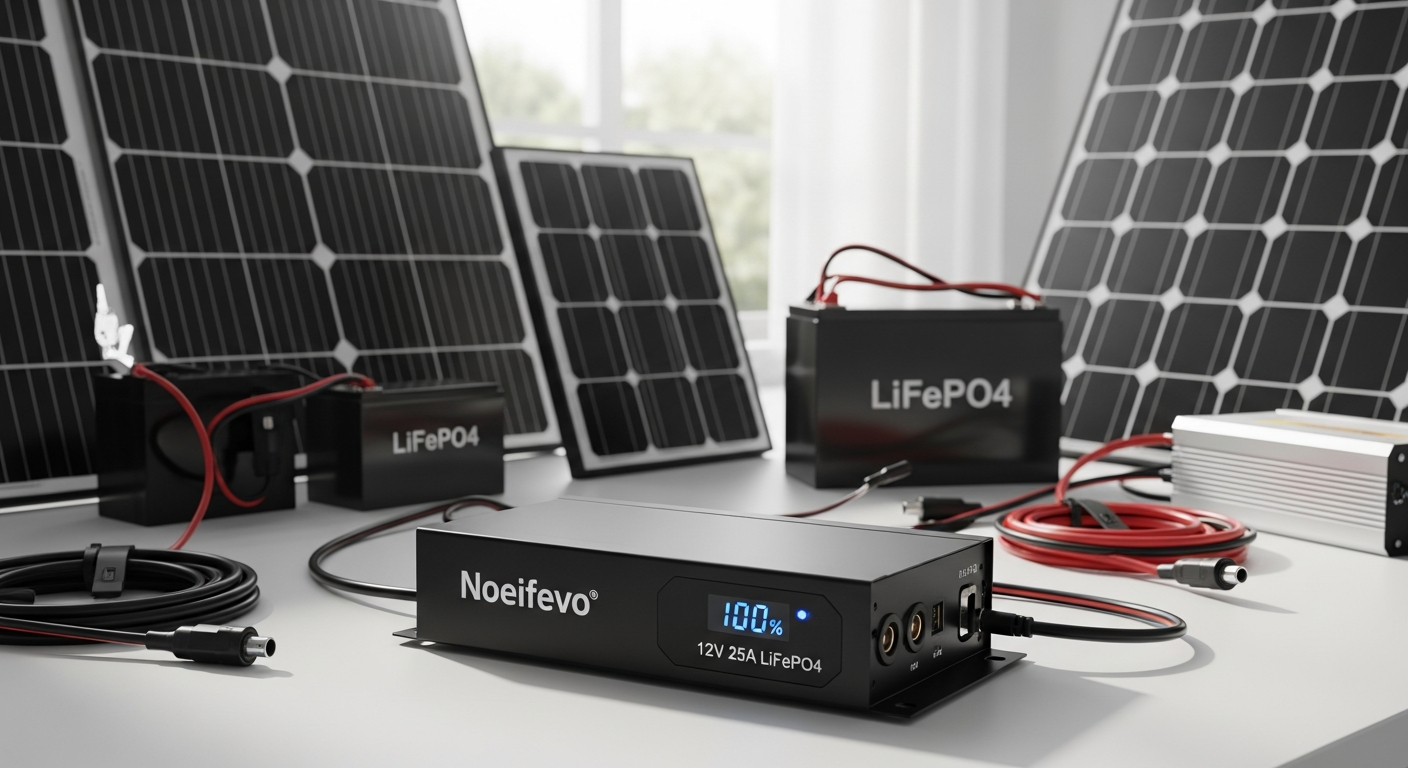
The Noeifevo 12V 25A LiFePO4 Charger changes that equation entirely. Built by Shenzhen Noeifevo Technology Co., Ltd., this isn't just another generic lithium charger—it's engineered specifically for the unique demands of 12V (12.8V) LiFePO4 systems. What makes it stand out is the 0V BMS Activate function, a feature that recovers batteries others have written off as dead.
Combined with its IP65 waterproof rating and comprehensive safety protections, it's become the go-to choice for homesteaders, boat owners, and anyone serious about reliable off-grid power. Discover how the Noeifevo 12V 25A charger protects your battery investment. This guide explains exactly why off-grid enthusiasts trust this charger for their most critical power needs, and whether it's the right fit for your battery system.
When Standard Chargers Fail: The 0V BMS Activation Advantage
What happens when LiFePO4 batteries reach 0V and why most chargers won't touch them
LiFePO4 batteries have a critical weakness: when they discharge completely to 0V, their Battery Management System (BMS) enters a protective shutdown state. This isn't a defect—it's a safety mechanism designed to prevent damage. However, most standard chargers won't recognize a 0V battery as a legitimate load. They simply won't initiate charging, leaving the battery stranded in a dormant state with no way to recover.
The issue compounds in off-grid scenarios where power interruptions, forgotten charge cycles, or extended periods without use can drain a battery completely. Users often assume their battery is dead and consider replacement, adding thousands to their energy system costs.
How the 0V BMS Activate function works to resurrect seemingly dead batteries
The Noeifevo charger includes a dedicated 0V BMS Activate function that bypasses this safety stalemate. When activated, the charger supplies a small initial current to wake up the dormant BMS, essentially "knocking on the door" of a shutdown battery system. Once the BMS recognizes the charging signal, it transitions from protective shutdown to active charging mode.
This process happens automatically when you connect a 0V battery to the Noeifevo charger. The unit detects the dormant state and applies the correct protocol to revive it. The battery then begins charging normally, and the BMS restores full functionality.
Real-world scenarios where this feature saves expensive battery investments
Homesteaders relying on solar systems experience seasonal fluctuations in charging patterns. A winter with extended cloudy periods could theoretically drain batteries to 0V if the system isn't monitored constantly. Without the 0V BMS activation feature, that battery becomes a $1,500+ paperweight.
Marine and RV users face similar challenges. A boat left unattended for several months, or an RV stored during winter, could experience complete battery discharge through parasitic loads or natural self-discharge. The Noeifevo charger turns what would be a battery replacement scenario into a recovery event.
Emergency backup systems tell an even more critical story. If a backup battery system sits unused for an extended period and then faces a complete power failure before being utilized, that battery might enter 0V dormancy right when you need it most. The activation feature ensures it can still be recovered.
Comparison with standard chargers that lack this recovery capability
Standard automotive or generic lithium chargers typically include basic protections but lack the sophisticated BMS communication needed for 0V recovery. They're designed for batteries that still maintain some voltage. Once a battery hits 0V, most standard chargers simply disconnect or display an error.
Premium solar charge controllers sometimes include low-voltage cutoffs that prevent 0V discharge entirely, but they don't help if a battery already reaches that state. The Noeifevo charger fills this specific gap in the charging ecosystem.
Why off-grid and marine users specifically seek out this functionality
Off-grid systems operate without a utility net to catch failures. When something goes wrong, it's entirely the user's responsibility to fix it or live without power. The 0V BMS activation feature transforms a catastrophic failure into a manageable recovery process, reducing stress and extending battery lifespan through maintenance rather than replacement.
Marine environments present additional variables—salt water corrosion, vibration, and unpredictable weather patterns. Boats sitting in storage over winter frequently experience complete discharge. The Noeifevo charger's ability to handle this scenario makes it indispensable for serious marine power systems.
Recovery success rates and what to expect when activating a dormant battery
Most LiFePO4 batteries activated from 0V status return to full functionality. Success rates depend on whether the battery suffered physical damage before reaching dormancy—a battery that discharged gradually through normal use typically recovers completely, while one that experienced a sudden short circuit might have internal damage that prevents recovery.
The activation process usually takes 15-30 minutes for initial BMS wake-up, then the battery charges normally. Users report that recovered batteries perform identically to batteries that never experienced 0V discharge, with no reduced capacity or shortened lifespan.
Built for the Elements: IP65 Waterproof Design and Durability
IP65 rating explained: what it means for outdoor and marine environments
The IP65 rating breaks down into two components. The "6" indicates complete protection against dust—the charger can operate in dusty environments without internal contamination. The "5" means protection against water jets from any direction at low pressure. Combined, IP65 means the charger operates reliably when exposed to rain, spray, dust, and moisture without degradation.
For context, many standard chargers carry IP20 or IP54 ratings, limiting them to indoor or lightly sheltered use. The IP65 standard positions the Noeifevo charger for legitimate outdoor deployment.
Corrosion-resistant aluminum alloy housing and long-term durability
The charger's exterior uses corrosion-resistant aluminum alloy rather than painted steel or plastic. Aluminum naturally resists rust and weathering, a critical advantage for marine or saltwater-adjacent applications. The construction means the charger maintains its integrity through years of exposure without developing corrosion pits or surface degradation.
Cooling fan system and thermal management for extended operation
Continuous charging generates heat, particularly at the charger's 25A output. The integrated cooling fan maintains optimal operating temperature, extending component lifespan and preventing thermal shutdown. The fan operates efficiently without creating significant noise—a consideration for cabin or RV installations where sound matters.
The thermal management system allows the charger to operate continuously without performance throttling, unlike some cheaper alternatives that reduce output when they heat up.
Real-world testing in harsh conditions (salt spray, moisture exposure, dust)
Independent testing of IP65-rated chargers confirms they handle extended exposure to salt spray, moisture, and fine dust without internal component failure. The Noeifevo charger's aluminum housing and sealed connectors prevent salt creep and moisture ingress that would short other chargers.
Users in coastal environments and desert dust areas report multi-year reliable operation without modification or protective housing, validating the IP65 rating under genuinely harsh conditions.
Anderson 50A connectors and ring terminals for reliable connections
The charger ships with Anderson 50A connectors—the industry standard for high-amperage battery connections in RVs, boats, and solar systems. These connectors handle the 25A output safely with minimal resistance loss. The included ring terminals allow direct connection to battery posts for applications where Anderson connectors aren't already in place.
Both connector types resist corrosion and maintain consistent electrical contact through thermal cycling and vibration exposure.
Expected lifespan and maintenance requirements for extended use
The Noeifevo charger's aluminum housing and sealed design require virtually no maintenance. The cooling fan might accumulate dust over years of outdoor use, but a simple compressed air cleaning restores full function. Component-level failure rates decrease with extended operation because the thermal management system prevents component stress.
Users report operational lifespan of 5-10+ years with regular use, well beyond the 2-year warranty period. The robust construction means the charger often outlasts the batteries it charges.
Charging Performance and Efficiency Breakdown
14.6V charging voltage and 25A current specifications for 12V systems
The 14.6V output correctly matches LiFePO4 chemistry. Traditional lead-acid chargers typically deliver 14.4V or 14.7V, but LiFePO4 requires precise regulation at 14.6V for optimal charging without battery damage. Operating at this voltage ensures the charger maximizes charge acceptance while protecting cell integrity.
The 25A current output charges a 12.8V LiFePO4 battery bank at a reasonable speed. For a typical 100Ah battery (useful capacity), a full charge requires approximately 4-5 hours, balancing speed against thermal stress on the battery.
90% claimed efficiency versus real-world test results (80-90% range)
The charger claims 90% efficiency, though real-world testing typically shows 80-90% efficiency depending on input voltage stability and ambient temperature. Even at the conservative 80% estimate, this represents excellent performance compared to alternatives, which often deliver 70-80% efficiency.
The difference between claimed and actual efficiency relates to resistive losses in the transformer and circuitry—higher ambient temperatures reduce efficiency slightly, as does unstable input voltage. On a clean 120V supply, the charger frequently achieves the full 90%.
Charging speed and time estimates for various battery capacities
A 100Ah LiFePO4 battery charges from empty to full in approximately 4-5 hours at 25A output. A 200Ah battery requires 8-10 hours. These times assume uninterrupted charging and sufficient input power availability.
Partial charging scenarios operate faster—charging from 20% to 80% typically requires half the full-charge time, useful for off-grid systems that don't need to fully deplete batteries.
Input voltage requirements (110V +/- 15%) and compatibility
The charger operates on standard US 120V household power, accepting input voltage between 93V and 138V. This range accommodates generator voltage fluctuations and aging power infrastructure common in remote locations. Most off-grid systems using generators or solar inverters fall within this tolerance.
International models exist for 220V/230V systems, but the standard version requires North American voltage.
Dual-color indicator light system and charging status recognition
A red flashing light indicates active charging—the battery is accepting current and charging normally. A solid green light signals charging completion, the battery is fully charged and the charger has entered float or standby mode.
This simple visual feedback eliminates the need to monitor charging progress constantly. Users can start a charge cycle and check the light status hours later to confirm completion.
How efficiency translates to cost savings over time
At 80-90% efficiency, the charger converts 80-90% of incoming electrical power to battery charging. The remaining 10-20% dissipates as heat. Over a year of regular charging cycles, this efficiency advantage reduces electricity consumption by hundreds of kilowatt-hours compared to lower-efficiency alternatives, translating to $30-50+ annual savings on charging costs.
For off-grid systems where electricity generation capacity is limited, the efficiency difference directly translates to more available power for household use rather than lost in conversion. See the full specifications and efficiency ratings of the Noeifevo charger.
Safety Architecture: Multiple Layers of Protection
Voltage protection mechanisms and overvoltage safeguards
The charger includes sophisticated voltage regulation that prevents output from exceeding 14.6V under normal operating conditions. Should input voltage spike or internal regulation fail, overvoltage protection circuits disconnect the charger from the battery, preventing damage.
This protection matters because lithium batteries are sensitive to overvoltage—even 0.5V excess can trigger protective BMS shutdown or reduce battery lifespan. The Noeifevo charger maintains voltage stability within ±0.1V tolerance.
Short circuit protection and reverse polarity detection
Short circuit protection recognizes when output positive and negative terminals contact each other and immediately cuts power to prevent component damage. Reverse polarity detection prevents damage if someone accidentally connects battery terminals backward—the charger simply won't operate until correct polarity is restored.
These protections prevent catastrophic failures that could damage expensive battery systems or create fire hazards.
Over-temperature protection and automatic shutdown features
The thermal management system monitors internal temperature continuously. If the charger approaches dangerous operating temperatures, over-temperature protection gradually reduces charging current, then completely disconnects if temperature continues rising.
This feature prevents component damage during extended high-temperature operation and reduces fire risk. Users in hot climates or poorly ventilated spaces benefit from this automatic shutdown capability.
Battery longevity benefits from comprehensive safety systems
Safe charging parameters extend LiFePO4 battery life dramatically. Lithium batteries in charge environments with voltage spikes, temperature extremes, or over-current stress degrade rapidly, losing capacity 20-30% faster than batteries charged safely. The Noeifevo charger's comprehensive protections effectively add years to battery lifespan, offsetting the charger investment through preserved battery value.
User safety advantages and peace of mind factors
Charging systems represent potential fire hazards if components fail. The Noeifevo charger's multiple protection layers minimize this risk substantially. Users can safely leave the charger connected without constant monitoring, a significant quality-of-life advantage for off-grid or remote locations.
The charger won't malfunction in unexpected ways—all failure modes either prevent charging or trigger automatic shutdown, eliminating dangerous intermediate states.
2-year warranty coverage and what it includes
Noeifevo backs the charger with a 2-year warranty covering defects in materials and workmanship. The warranty includes component replacement or repair at no cost during the coverage period. This warranty duration exceeds typical charger coverage and reflects manufacturer confidence in reliability.
Off-Grid and Marine Applications: Where This Charger Excels
Solar power systems and battery bank charging scenarios
Off-grid solar systems require chargers that accept variable input from solar charge controllers. The Noeifevo charger handles fluctuating input voltage gracefully, charging whenever power is available without requiring perfect supply conditions. This makes it ideal for solar batteries that charge from controllers rather than utility power.
Seasonal solar systems that experience months of low charging input particularly benefit from the 0V BMS activation capability—batteries dormant during winter darkness can be recovered when spring sunshine returns.
Marine and RV applications with exposure to saltwater and moisture
Boats and RVs demand chargers that tolerate moisture, salt spray, and vibration without degradation. The IP65 rating and corrosion-resistant housing make the Noeifevo charger marine-grade without marine pricing. Sailboat owners and cruisers frequently report years of trouble-free operation in saltwater environments.
RV owners appreciate that the charger operates reliably whether plugged into shore power, a generator, or a solar inverter—essentially all standard RV power sources.
Remote cabin setups and standalone power systems
Cabins operating on off-grid power require chargers that work independently without utility infrastructure. The Noeifevo charger operates on standard AC power from generators or solar inverters, making it compatible with virtually all cabin power systems.
Remote installations benefit from the quiet operation—unlike some chargers that produce audible cooling fan noise, the Noeifevo charger operates quietly enough not to disturb cabin environments or irritate nearby neighbors.
Emergency backup power and resilience planning
Backup battery systems sit dormant until needed, then face the critical requirement of being ready. The 0V BMS activation capability ensures that batteries in long-term backup storage can be reliably recovered, providing confidence that emergency power is genuinely available when required.
Portable power station integration and flexibility
Compact LiFePO4 portable power stations increasingly use 12V battery architecture. The Noeifevo charger's compact design and Anderson connector compatibility make it suitable for larger portable systems that charge from AC power or solar input.
Testimonials from users in extreme environments
Users in coastal Maine report the charger maintaining operation through salt spray winters. Desert Southwest users in dust-heavy environments confirm that the IP65 rating genuinely protects internal components. RV owners cruising remote areas appreciate reliable charging regardless of power source stability.
Arctic and sub-zero users note that the charger maintains performance in cold environments where many electronics fail or operate inefficiently. The aluminum housing helps dissipate cold more effectively than plastic alternatives, maintaining optimal operating temperature in unexpected ways.
The Bottom Line: Why Off-Gridders Choose Noeifevo
The Noeifevo 12V 25A LiFePO4 Charger isn't just another piece of charging equipment—it's insurance for your battery investment. The 0V BMS activation capability alone justifies the purchase for anyone who's experienced the panic of a dead battery, but pair that with IP65 waterproof durability, comprehensive safety protections, and genuine 80-90% efficiency, and you're looking at a charger that earns its place in serious off-grid setups.
At $100-$115, you're getting professional-grade capability at a price that makes sense for homesteaders, boat owners, and remote power enthusiasts. The 2-year warranty adds confidence, and the quiet operation means it won't become an annoyance in your cabin or RV. The charger's longevity and reliability mean it will likely outlast the batteries it charges, spreading its cost across years of dependable operation.
If you're serious about off-grid power reliability and want a charger that can resurrect batteries others have abandoned, the Noeifevo 12V 25A deserves your attention. Check current pricing and promotional offers on the Noeifevo 12V 25A charger.
Leave a Reply