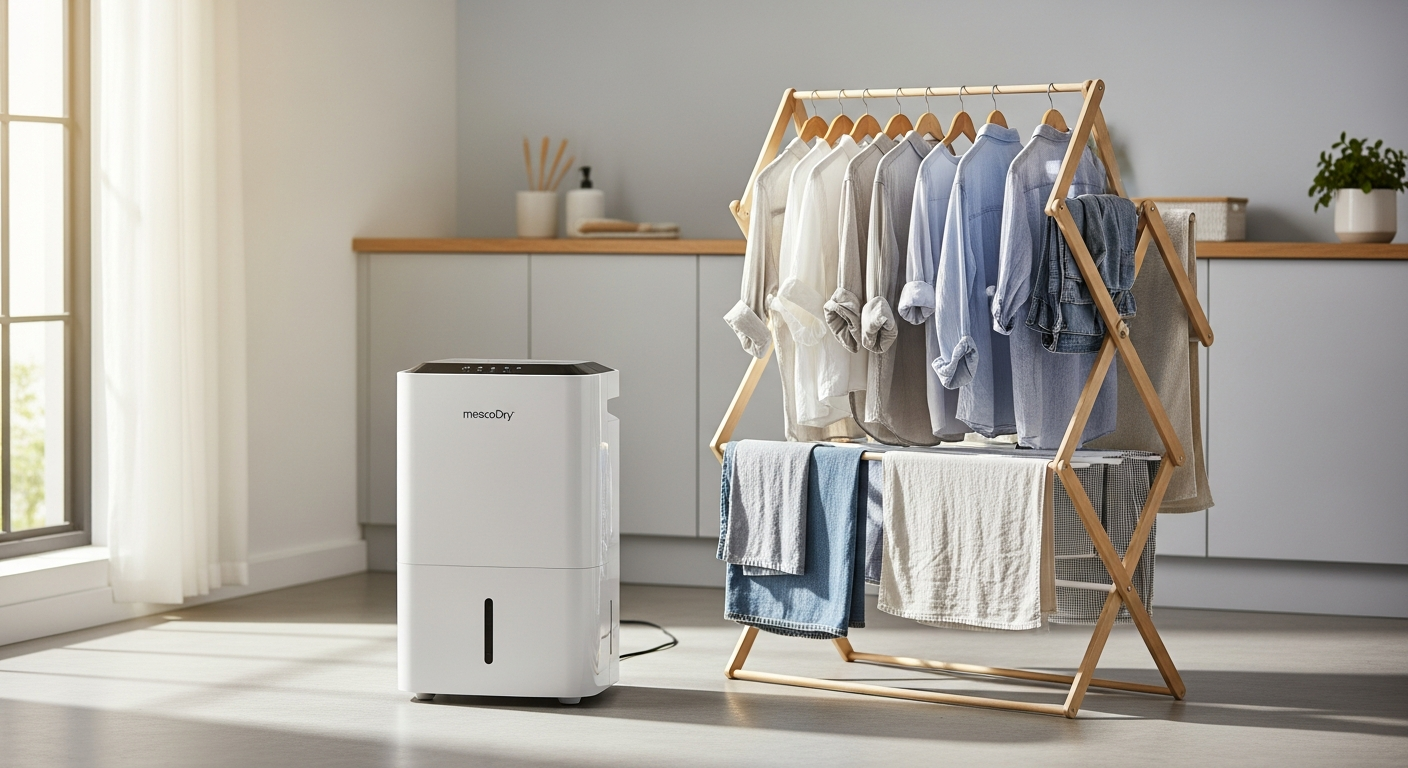
Wet laundry piled in corners, mould blooming on windowsills, and that stubborn musty smell that won't disappear—these are the hallmarks of indoor drying in UK homes. Winter months make it worse, and even homes without obvious damp problems struggle when wet clothes need to dry indoors. The frustration builds quickly: clothes take days to dry, humidity spikes, and you're left wondering if there's a better way.
Enter the MeacoDry Arete One 20L Dehumidifier & Air Purifier, a device engineered specifically for this exact problem. Rather than managing dampness after it becomes an issue, the Arete One tackles both dehumidification and laundry drying simultaneously through intelligent automation and precise engineering. Its Smart Laundry Mode cuts drying times dramatically while keeping humidity levels in check, preventing the secondary problems that plague homes relying on traditional drying methods.
This guide examines how the Arete One's specialized drying features work, why its 20-litre daily moisture removal capacity transforms indoor laundry routines, and whether the investment genuinely outperforms conventional drying approaches. Discover how the MeacoDry Arete One can revolutionize your household's approach to indoor laundry.
Smart Laundry Mode Explained—How the Arete One Accelerates Drying Cycles
How Smart Laundry Mode automatically sets humidity to 35% for optimal drying conditions
The Arete One's Smart Laundry Mode operates with surgical precision. When activated, the unit automatically lowers humidity to 35% and maintains this level for up to six hours—the exact conditions needed for rapid moisture evaporation from fabrics. This isn't arbitrary; 35% humidity represents the sweet spot where water molecules leave clothing efficiently without damaging fibres or creating the damp environment that encourages mould growth.
The automation removes guesswork. Rather than manually adjusting settings throughout the day or hoping conditions stay favourable, the mode handles everything. Set it, leave it, and return to dry clothes without the dampness problem that typically follows indoor drying.
The science behind why lower humidity speeds up moisture evaporation from fabrics
Moisture evaporation depends on the difference between humidity levels in fabric and humidity in the surrounding air. When indoor air is saturated (typical in homes with wet laundry), evaporation stalls. Clothes remain damp for days because the air can't absorb more moisture. By dropping humidity to 35%, the Arete One creates a steep moisture gradient—the air becomes hungry for water molecules, pulling them from fabric fibres much faster than passive air-drying or radiator methods allow.
This principle applies regardless of fabric type, load size, or room temperature. The lower the ambient humidity, the quicker evaporation occurs. The Arete One weaponizes this physics principle, transforming it into practical drying speed.
Typical drying timeframes for different load sizes
Most everyday clothing loads—t-shirts, underwear, socks—dry within 3–4 hours under Smart Laundry Mode. Heavier items require more time. Bath towels typically dry in 5–6 hours, while bed sheets (a particularly challenging category) can take the full six-hour window. Smaller loads of lightweight fabrics may dry in under three hours, while dense items like denim or sweatshirts benefit from the full drying duration.
These timeframes contrast sharply with traditional methods. Hang-drying indoors often takes 24–48 hours during winter, while radiators create uneven drying and fabric damage over time.
Comparison: Smart Laundry Mode versus hang-drying and radiator methods
Hang-drying in standard indoor conditions (40–60% humidity) stretches drying times to two or three days, during which mould risk escalates and odours develop. Radiator drying works faster but creates problems: heat concentrates on small areas of fabric, causing shrinkage and damage to delicate items, while the radiator itself becomes less effective for room heating. Additionally, the moisture released back into the room can actually increase overall household humidity, creating the very problem you're trying to solve.
The Arete One's Smart Laundry Mode outperforms both methods. It dries clothes in hours rather than days, maintains consistent conditions across all fabrics, prevents secondary moisture problems, and doesn't compromise room heating or appliance function.
Energy consumption during laundry mode and cost implications per cycle
The Arete One consumes approximately 216W of power during standard operation. Running Smart Laundry Mode for a full six-hour cycle costs roughly 26–30 pence in electricity, assuming UK rates around 24p per kWh. For a household doing laundry three times weekly, annual laundry-drying costs reach approximately £40–50—a fraction of tumble dryer expenses.
This efficiency matters at scale. Over ten years, the cost differential between the Arete One and an electric tumble dryer exceeds £3,000, not accounting for reduced fabric wear or avoided mould remediation.
Year-Round Indoor Drying Without the Dampness Problem
Why indoor laundry drying typically creates mould, mildew, and condensation
Hanging wet clothes indoors releases moisture directly into the air. A typical washing machine cycle removes roughly 50% of water from fabrics; the remaining moisture must evaporate somewhere. In low-humidity environments, evaporation proceeds smoothly. In UK homes—particularly during winter when windows remain closed and heating systems dry air inconsistently—moisture accumulates. Relative humidity climbs above 60%, the threshold where mould spores activate and begin colonizing walls, ceilings, and window frames.
The problem compounds over hours and days. Each load of laundry adds moisture; if drying is slow, subsequent loads amplify the effect. Within a week, many homes develop visible mould, especially in bedrooms, bathrooms, and poorly ventilated areas.
How the Arete One's 20-litre daily moisture removal prevents secondary damp issues
Twenty litres represents substantial moisture extraction capacity. During a single Smart Laundry Mode cycle, the unit removes significant water from both the clothing and the surrounding air. This dual action prevents humidity from climbing into mould-friendly territory.
The cumulative effect matters more than single-cycle performance. A household running two or three laundry cycles weekly with the Arete One extracts 40–60 litres of moisture per week—equivalent to preventing the moisture problem from developing in the first place. Walls stay dry, window frames remain mould-free, and the musty smell associated with damp never takes hold.
The relationship between humidity control and preventing mould growth on walls and ceilings
Mould requires three conditions: moisture, organic matter (found in dust and building materials), and temperature above freezing. Most UK homes satisfy the temperature and organic matter requirements year-round. Controlling humidity—keeping it below 55% consistently—removes the moisture component, breaking the mould equation.
The Arete One's Smart Humidity Mode maintains optimal levels automatically even outside laundry-drying cycles. This continuous control means mould doesn't simply pause during laundry activities; it stops growing entirely, preventing the accelerated decay of walls, ceilings, and the structural issues that follow.
Multi-season usage: laundry drying in winter, general dehumidification in spring
Winter demands Smart Laundry Mode—wet clothes accumulate, heating systems create dry pockets, and condensation becomes problematic. The Arete One handles multiple daily loads without humidity spiking. Spring transitions the unit toward general dehumidification; Smart Humidity Mode kicks in, maintaining 55% humidity automatically as weather warms and seasonal dampness peaks. Summer sees the integrated H13 HEPA filter shine, functioning as a standalone air purifier when dehumidification needs decrease. Autumn brings humidity management back into focus as windows close and heating systems activate.
Experience year-round air quality and drying efficiency with the MeacoDry Arete One.
Cost Analysis—Investment Versus Traditional Drying Methods
Upfront cost versus ongoing tumble dryer expenses
The Arete One carries an upfront investment of £239.99–£293.07. A basic electric tumble dryer costs less initially (typically £150–250), but operational expenses quickly accumulate. Running a tumble dryer costs approximately 50–70 pence per load, depending on model efficiency and local electricity rates. A household completing four laundry loads weekly faces annual tumble dryer costs of £100–150, compared to the Arete One's £40–50 annually.
Over five years, the Arete One costs £239.99 plus £200–250 in electricity, totalling roughly £490–540. A tumble dryer accumulates £150–250 upfront plus £500–750 in five-year running costs, totalling £650–1,000. The financial case for the Arete One strengthens further when accounting for equipment lifespan; tumble dryers typically require replacement within 8–10 years, while the Arete One's five-year warranty and durable construction support longer service life.
Annual electricity costs for running the Arete One
At 216W power consumption and roughly 300 operating hours annually (accounting for laundry drying and general dehumidification across seasons), the Arete One uses approximately 65 kWh per year. At 24p per kWh, annual electricity costs reach around £15.60 for pure dehumidification and laundry drying. Adding occasional air purification mode might raise this to £20–25 annually.
These figures assume typical household usage patterns. Homes in particularly damp regions or those with high laundry volumes might see slightly higher consumption, but the device remains remarkably cost-effective compared to alternative drying methods.
Comparison: Cost per load using Smart Laundry Mode versus electric tumble dryers
A single Smart Laundry Mode cycle lasting six hours consumes 1.3 kWh, costing approximately 31 pence. For lighter loads lasting three hours, costs drop to 15 pence per load. Tumble dryers typically consume 2.5–4 kWh per cycle, costing 60–96 pence per load using identical electricity rates.
Over 200 laundry loads annually (roughly 4 per week), the Arete One costs £31–62 in electricity, while a tumble dryer costs £120–192. The savings accumulate to £60–130 per year, or £300–650 over a five-year period—sufficient to offset the Arete One's upfront cost premium and then deliver genuine savings.
Hidden benefits—reduced mould remediation costs and extended fabric lifespan
Treating mould damage to walls, ceilings, and window frames costs £500–2,000+ per incident. Preventing mould entirely saves these remediation expenses entirely. The Arete One's humidity control effectively insures against costly damp problems.
Fabric lifespan extends significantly without tumble dryer exposure. Dryer heat damages elastic fibres, shrinks fabrics, and accelerates wear; items dried via the Arete One's low-humidity method maintain their structure and fit considerably longer. A typical wardrobe might last 20–30% longer with gentle drying, translating to hundreds of pounds in avoided replacement purchases over a decade.
Quiet Operation for Family-Friendly Drying
Night Mode functionality—dimmed lights and reduced fan speed for overnight drying
Night Mode transforms the Arete One into a bedroom-friendly appliance. The display dims, reducing light pollution, while the fan operates at reduced speed, maintaining dehumidification capability without creating noise disturbance. Many households run the Arete One overnight in bedrooms during Smart Laundry Mode, positioning it to both dry clothes and improve overnight air quality without disrupting sleep.
The feature acknowledges reality: drying laundry often happens on schedules divorced from waking hours. Overnight operation consolidates multiple benefits—clothes dry while occupants sleep, humidity decreases during hours when ventilation isn't possible, and morning routines begin with dry clothing ready and fresher air to breathe.
Noise levels across different modes
The Arete One produces as little as 38dB at its quietest setting—equivalent to a whispered conversation or a quiet library. Standard dehumidification mode operates around 42–45dB, still quieter than most household appliances. Smart Laundry Mode runs slightly louder at approximately 48–50dB, comparable to a normal conversation or background music.
Even these higher figures remain well below tumble dryer noise, which typically reaches 65–80dB—loud enough to disrupt conversation or sleep. The Arete One's whisper-quiet operation means it can run in living spaces, bedrooms, or open-plan homes without creating the acoustic disruption that forces tumble dryer users to isolate the appliance.
Why whisper-quiet operation matters for bedrooms, living spaces, and open-plan homes
Modern homes increasingly favour open-plan layouts where laundry drying can't be isolated to utility rooms. Tumble dryers create acoustic and thermal problems in these spaces; they're noisy, hot, and generally unwelcome. The Arete One, operating quietly and producing minimal heat, integrates seamlessly into living environments.
Bedrooms present another challenge; hanging wet laundry overnight often isn't practical, and tumble dryers aren't acceptable in bedrooms due to noise and heat. The Arete One's quiet operation permits overnight laundry drying in bedrooms, meaning families can manage laundry loads without compromising sleep quality.
Quiet Mark accreditation and what this certification guarantees
Quiet Mark accreditation, awarded by the Noise Abatement Society, certifies products as genuinely quiet compared to category peers. The Arete One carries this certification, meaning independent testing confirms its noise performance against strict standards. This isn't manufacturer marketing; it's third-party validation that the device performs as quietly as advertised.
For consumers exhausted by tumble dryer noise or hesitant about bedroom dehumidifiers, Quiet Mark accreditation provides assurance. The certification doesn't guarantee inaudible operation, but it confirms the Arete One minimizes acoustic impact within the constraints of its function.
The Smart Choice for Households Battling Indoor Laundry Challenges
The MeacoDry Arete One 20L Dehumidifier transforms indoor laundry from a frustrating, damp-creating burden into an efficient, controlled process. Its Smart Laundry Mode doesn't simply dry clothes faster—it systematically eliminates the secondary problems that plague homes managing wet washing indoors: mould growth, musty odours, humidity spikes, and heating inefficiency.
At £239.99–£293.07, the investment pays dividends through multiple channels. Lower electricity costs accumulate to meaningful savings, extended fabric lifespan reduces replacement expenditure, and avoided mould remediation costs provide insurance against far more expensive problems. For families in larger homes, those handling frequent laundry loads, or households already dealing with damp and allergy issues, the Arete One represents far more than a dehumidifier—it's a comprehensive solution addressing several interconnected household problems simultaneously.
The device's engineering reflects five years of development incorporating feedback from over 2,000 customers. Awards including the Red Dot Design Award, Quiet Mark accreditation, and Which? Best Buy status cement its reputation. The combination of powerful dehumidification, energy efficiency, whisper-quiet operation, and integrated air purification—all packaged in a design that sits flush against walls and won't dominate rooms—creates something genuinely different from conventional laundry solutions.
If indoor laundry drying has represented your household's weak point, causing days of damp clothes, compromised air quality, and persistent mould concerns, the Arete One genuinely deserves serious consideration. Invest in the MeacoDry Arete One and end indoor laundry frustration today.
Leave a Reply