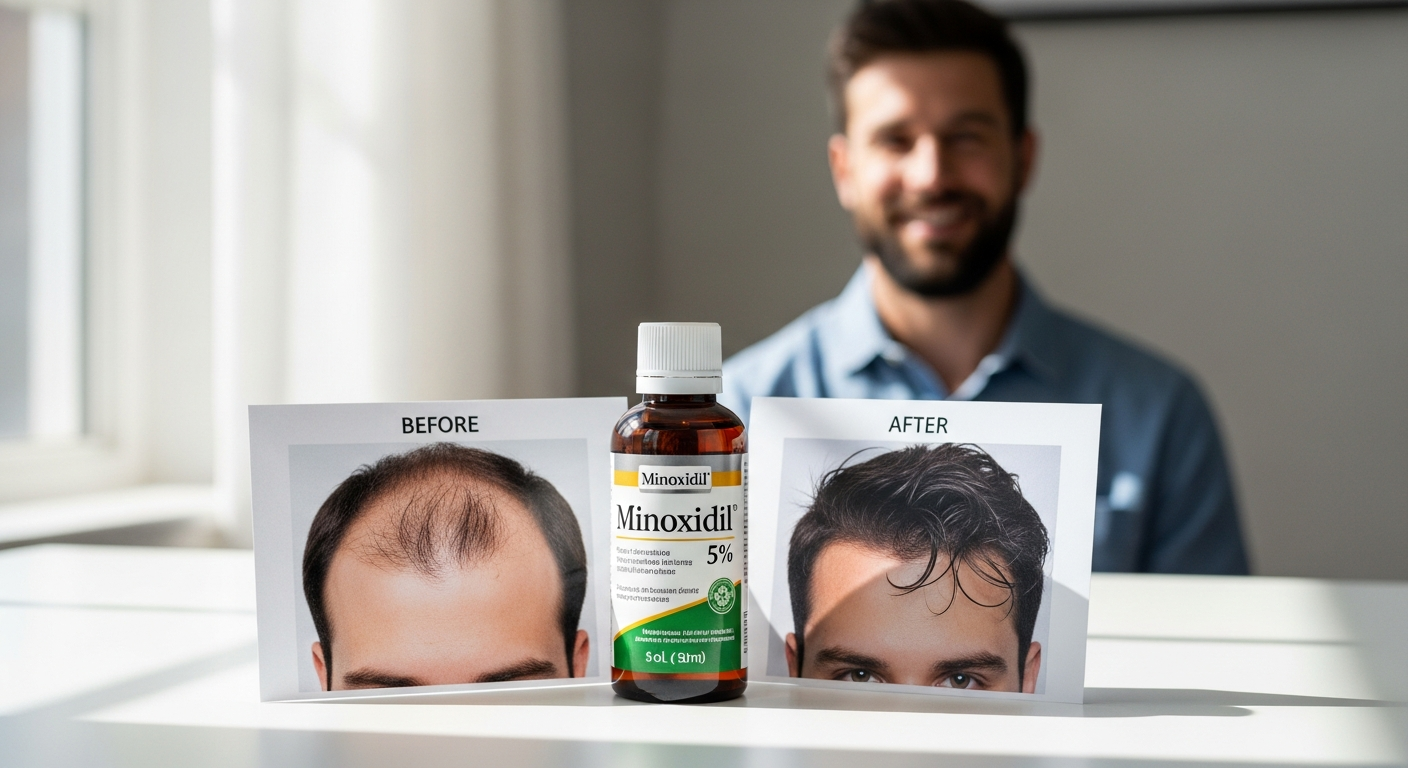
Minoxidil Biorga/Bailleul 5% Hair Regrowth Solution: The Complete Guide to Combating Hereditary Hair Loss
Men lose approximately 50-100 hairs daily—it's completely normal. But when that number climbs into the hundreds, when your hairline recedes noticeably, when shower drains clog with strands, you're staring at androgenetic alopecia. This hereditary condition affects millions of men worldwide, and it strikes hard at confidence and self-image.
Minoxidil Biorga/Bailleul 5% stands as one of the few non-prescription topical solutions backed by rigorous clinical evidence. Unlike countless hair-growth supplements making vague promises, this 5% concentration directly addresses the biological mechanisms driving male pattern baldness. The topical cutaneous solution contains 5% minoxidil—an active ingredient proven to stimulate hair growth and slow down hair loss through multiple physiological pathways.
Explore Minoxidil Biorga/Bailleul 5% treatment options today to reclaim your hair and confidence.
Understanding How Minoxidil Biorga/Bailleul 5% Tackles Androgenetic Alopecia
The science behind the 5% concentration: Why higher concentrations deliver superior results for men compared to 2% alternatives
The 5% formulation isn't arbitrary—it represents the optimal balance between efficacy and tolerability for male users. Clinical trials consistently demonstrate that 5% minoxidil outperforms 2% alternatives in hair regrowth and density improvement. The higher concentration provides greater bioavailability at the follicle level, meaning more active ingredient reaches the target tissue where it can exert therapeutic effects. Men aged 18-65 with androgenetic alopecia respond particularly well to this potency, showing measurable increases in hair count within the 3-6 month treatment window.
Mechanism of action: How minoxidil extends the anagen (growth) phase and increases follicle blood supply
Minoxidil works through two primary mechanisms. First, it extends the anagen phase—the active growth period during which hair follicles produce visible hair. In androgenetic alopecia, DHT sensitivity shortens this phase, causing hairs to enter the telogen (resting) and catagen (transition) phases prematurely. Minoxidil counteracts this by prolonging anagen duration, allowing each follicle more time to generate thicker, longer strands.
Second, minoxidil enhances blood circulation to the scalp. This improved perfusion delivers oxygen and nutrients directly to hair follicles, creating an optimal microenvironment for growth. The increased vascular supply also helps remove metabolic waste products that accumulate around follicles, further supporting hair health.
Targeting hereditary hair loss specifically: Why this solution works for genetic baldness but not other hair loss types
Minoxidil's efficacy is specifically calibrated for androgenetic alopecia—the genetically-determined hair loss driven by DHT sensitivity. The mechanism works because minoxidil revitalizes follicles that have miniaturized but retain some residual activity. However, this approach has limitations. Minoxidil won't restore follicles that have completely atrophied, and it won't address hair loss caused by nutritional deficiency, autoimmune conditions like alopecia areata, or trauma-related alopecia. Understanding your hair loss category is essential before beginning treatment.
Follicle rejuvenation process: Timeline of how dormant hairs transition back to active growth cycles
The rejuvenation process unfolds in phases. During the first 2-4 weeks, follicles begin responding to minoxidil's signals, but many still-dormant hairs enter their final telogen phase—paradoxically increasing shedding. This temporary hair loss actually indicates that treatment is working; the scalp is clearing out dead or miniaturized hairs to make room for stronger regrowth.
By weeks 5-8, new hair growth becomes visible under microscopic examination, though changes remain subtle to the naked eye. Weeks 9-12 bring noticeable density improvements as the new hairs thicken and mature. By month 4-6, most users observe significant increases in hair volume and visible regrowth in previously thinning areas.
The role of blood circulation: Why improved scalp perfusion directly impacts hair density and thickness
Scalp circulation functions as the delivery system for everything follicles need to thrive. When blood flow improves, follicles receive enhanced oxygen delivery and nutrient supply. This physiological boost particularly affects hair shaft diameter—thicker blood supply correlates directly with thicker individual hair strands. Additionally, improved circulation removes the byproducts of minoxidil metabolism and DHT-related inflammatory processes, creating a cleaner environment where hair can flourish.
Androgenetic alopecia biology: Understanding DHT sensitivity and how minoxidil counteracts miniaturization
DHT (dihydrotestosterone) sensitivity is hereditary. In genetically predisposed men, DHT binds to androgen receptors on certain follicles, triggering miniaturization—a process where hair follicles gradually shrink. This produces progressively thinner, shorter hairs until follicles eventually stop producing visible hair altogether.
Minoxidil doesn't block DHT production; it sidesteps the problem entirely. By extending the anagen phase and improving follicle blood supply, minoxidil helps follicles produce thicker hair despite ongoing DHT exposure. Think of it as compensating for genetic predisposition rather than eliminating it—which explains why discontinuing treatment allows DHT-driven miniaturization to resume within 3-4 months.
Application Protocol & Dosage Guidelines for Optimal Results
Correct daily dosage: 1ml twice daily (morning and evening) with a maximum of 2ml per day
Consistency matters more than excess. The clinical dosing regimen specifies exactly 1ml applied topically twice daily—once in the morning and once in the evening—for a total daily maximum of 2ml. This dosage was determined through extensive trials to balance efficacy with safety. Applying more than 2ml daily doesn't accelerate results; it only increases side effect risk without enhancing outcomes.
Each 60ml bottle in the 3x60ml pack contains sufficient solution for approximately 30 days at standard dosing. The three-bottle pack therefore provides roughly 3 months of continuous treatment—the minimum timeframe needed to assess effectiveness.
Topical application technique: Where to apply on the scalp and how to ensure even distribution
Apply minoxidil directly to the scalp in areas experiencing hair loss or thinning. The vertex (crown), temples, and hairline represent the most common application zones for male pattern baldness. Part your hair to expose the scalp, then use the included sprayer to apply the solution directly to skin rather than to hair strands. The goal is maximal scalp contact and minimal waste.
Ensure even distribution by applying in multiple spots across the affected area, then gently massage the scalp with your fingertips using circular motions for 30-60 seconds. This massage improves absorption and helps distribute the solution uniformly. Avoid over-saturating any single spot; the goal is thorough coverage rather than visible wetness.
Timing considerations: Best practices for spacing morning and evening applications
Spacing applications 12 hours apart optimizes scalp contact and allows for natural evaporation between doses. A typical schedule might involve applying minoxidil immediately after showering in the morning (when the scalp is clean and slightly damp, which enhances absorption) and again before bed in the evening. This timing also minimizes visible residue during daytime hours.
Allow at least 4 hours between application and shampooing. If you shower in the evening, apply minoxidil after drying your hair completely. The solution requires time to penetrate; premature washing removes it before absorption occurs.
Integration with daily routines: How to incorporate application into existing grooming habits without disruption
The Biorga formulation is perfume-free and non-greasy, making it surprisingly unobtrusive in daily routines. Many users anchor their applications to established habits: apply minoxidil immediately after morning shower and evening tooth-brushing. This behavioral linkage ensures consistency without requiring additional reminders.
The application itself takes less than two minutes, making integration effortless. Over time, twice-daily application becomes automatic, requiring no conscious effort—similar to brushing your teeth.
Consistency requirements: Why missing doses undermines long-term effectiveness
Minoxidil's effectiveness depends entirely on consistent scalp presence. Missing even a few days reduces its impact on the anagen phase and blood circulation. Clinical evidence suggests that users maintaining perfect adherence see approximately 30-40% greater hair regrowth compared to those missing doses irregularly. Over months of treatment, the cumulative impact of missed applications substantially reduces final outcomes.
Think of minoxidil treatment as similar to other medications requiring daily dosing—missed doses don't prevent the medication from working, but they reduce its effectiveness. For hair loss treatment specifically, where results accumulate slowly over months, consistency becomes the primary determinant of success.
Sprayer functionality: Tips for preventing crystal clogging and maintaining proper dispenser operation
Some users report that minoxidil crystals form inside the sprayer nozzle, eventually causing clogs. This occurs when the solution dries on the applicator between uses. Prevention is straightforward: immediately after each application, rinse the sprayer nozzle under warm water for 10-15 seconds. This removes residual solution and prevents crystallization.
If clogging occurs, soak the sprayer in warm water for 5 minutes, then gently flush it. Avoid forcing the plunger if resistance develops; instead, allow the warm water to soften any crystal deposits first. Proper maintenance typically prevents this issue entirely.
Perfume-free, non-greasy formula: Why the Biorga formulation suits daily use without residue or odor
The Biorga version specifically avoids perfume and greasy excipients that plague some minoxidil formulations. The active ingredients—propylene glycol, ethanol 96%, and purified water—evaporate cleanly, leaving minimal residue. This makes the solution compatible with daily use without disrupting hairstyles, hat-wearing, or social situations.
The formula dries within 30 minutes of application, allowing normal activities to resume immediately. For users concerned about product visibility or odor affecting professional environments, the Biorga formulation alleviates these worries entirely.
What to Expect: Timeline, Results, and the Initial Shedding Phase
First 2-4 weeks: Understanding why some users experience temporary increased shedding
The initial weeks often surprise new users—hair shedding frequently increases rather than decreases. This counterintuitive response actually signals that minoxidil is working. Here's what's happening: minoxidil pushes follicles that were in the telogen (resting) phase into synchronous shedding. Hairs that had naturally entered their resting phase begin falling out together, creating a temporary spike in hair loss.
Simultaneously, new hairs begin developing in the follicle bulb, gradually pushing out the old telogen hairs. This creates a visible increase in shed hair on pillows, in showers, and on combs. For users unprepared for this shedding paradox, the response can feel alarming—many mistakenly believe minoxidil is worsening their condition and abandon treatment prematurely.
The shedding paradox: Why initial hair loss signals that treatment is working
Understanding the shedding paradox is crucial for treatment success. The temporary increase in hair loss represents follicle turnover acceleration—precisely the physiological process you want during hair loss treatment. Minoxidil synchronizes the hair cycle, causing dormant follicles to cycle through telogen and catagen phases more rapidly before entering the anagen phase with new hair.
Users who push through this 2-4 week shedding phase observe improvement beginning around week 5-6. Those who discontinue treatment during initial shedding never experience the subsequent regrowth, leaving them with the impression that minoxidil failed them—when actually they stopped too early.
3-6 month results window: When most users observe visible regrowth and density improvements
By the 3-month mark, most users notice measurable changes. Existing hairs appear thicker and more robust. The hairline, while not miraculously restored, typically shows density improvements. The crown and vertex often display visible new hair growth. These changes accumulate gradually—rarely dramatic—but consistently noticeable to the user and often remarked upon by friends and family.
The 4-6 month window represents peak visibility of treatment effects. Hair volume increases substantially, thinning areas fill in with new growth, and overall scalp coverage improves noticeably. For users with early-to-moderate hair loss, these results often exceed expectations formed during the initial shedding phase.
Realistic outcome expectations: Hair thickness gains versus complete baldness reversal
Minoxidil excels at thickening existing hair and regrowing follicles in early-to-moderate stages of miniaturization. It doesn't restore completely bald scalps or reverse extensive baldness. Realistic expectations: if you've noticed thinning for the past 2-3 years but still have visible hair in affected areas, minoxidil can substantially improve density and regrow many miniaturized hairs.
If your hairline has receded significantly and affected areas appear completely bald, minoxidil will have limited effect. It works on follicles retaining some capacity for growth; completely dormant follicles don't respond. Honest self-assessment of your hair loss severity is essential before beginning treatment.
Individual variation factors: Age, genetics, and severity affecting timeline and magnitude of results
Response to minoxidil varies considerably. Age plays a role—younger men (18-35) typically see more dramatic results than older men (55-65), partly because their follicles retain greater growth capacity. The duration of hair loss matters significantly; users with recent-onset baldness (less than 2-3 years) respond better than those with long-standing hair loss (10+ years). Genetic predisposition affects the magnitude of response; some men's follicles are inherently more responsive to minoxidil's mechanisms than others.
Baseline hair loss severity also determines outcomes. Mild-to-moderate thinning responds substantially better than severe baldness. Users shouldn't compare their results directly to others; individual variation is substantial and normal.
Patience and persistence: Why discontinuing treatment within the first 3 months sabotages progress
The most common reason minoxidil users fail to achieve results isn't poor product quality—it's premature discontinuation during the initial shedding phase. Users who stop treatment during weeks 2-6, when shedding is most noticeable, never reach the regrowth phase that begins around week 8.
Patience through the first 3 months is non-negotiable. Clinical trials establishing minoxidil efficacy all required minimum 3-4 month treatment durations. Shorter periods don't provide sufficient time for follicles to complete their cycle transition and generate visible new growth.
Long-term maintenance reality: Expecting continuous application for sustained results
Minoxidil isn't a cure; it's ongoing management. Discontinuing treatment typically results in reversal of gains within 3-4 months. Hair that regrew through minoxidil treatment will eventually miniaturize again as DHT exposure resumes. The 3-6 month improvement window becomes a maintenance phase requiring indefinite application to preserve results.
This reality demands honest self-assessment before starting: Can you commit to twice-daily application indefinitely? If the answer is no, minoxidil may not suit your lifestyle, and alternative approaches like finasteride (which alters the biological process itself rather than treating symptoms) might deserve consideration.
Side Effects, Contraindications, and Safety Monitoring
Local scalp reactions: Itching, redness, dryness, and burning sensations (most common)
Local scalp irritation represents the most frequently reported side effect. Itching, redness, dryness, and burning sensations occur in a subset of users, particularly during the first 2-3 weeks of treatment. These reactions typically result from propylene glycol in the formulation, which some users' skin finds irritating.
Most local reactions resolve within 1-2 weeks as the scalp adapts. For persistent irritation, applying minoxidil to a damp (rather than completely dry) scalp can reduce irritation. Some users find that spacing applications further apart initially, then gradually increasing to twice daily, allows gradual scalp adaptation. If severe irritation persists beyond 3 weeks, consulting a dermatologist is warranted.
Hypertrichosis risk: Unwanted facial or body hair growth and how to minimize this occurrence
Hypertrichosis—unwanted hair growth on face, arms, or body—occurs in a small percentage of minoxidil users. The mechanism remains incompletely understood, but systemic absorption of minoxidil can trigger hair growth on non-scalp areas. The incidence is relatively low (approximately 2-5% of users), but it represents a significant concern for many.
Minimizing this risk involves precise application technique: apply minoxidil exclusively to scalp, not hair shafts or forehead. Avoid allowing the solution to run down the face or neck. If hypertrichosis occurs, it typically reverses within 1-3 months of discontinuation, though complete resolution may take longer.
Systemic side effects: Rare but documented dizziness, elevated heart rate, and fluid retention
While local side effects are common, systemic effects are rare but documented. Some users report dizziness, elevated heart rate, or fluid retention after minoxidil application. These effects result from minoxidil's systemic absorption and its vasodilatory properties. The concentration of systemic effects is far lower with topical minoxidil compared to oral forms, but it remains possible.
Users with cardiovascular conditions, hypertension, or those taking cardiovascular medications should consult healthcare providers before beginning minoxidil. Monitoring heart rate and blood pressure during the first few weeks of treatment provides reassurance that systemic effects aren't occurring.
Age restrictions: Why the product isn't recommended for users under 18 or over 65
Minoxidil Biorga/Bailleul 5% carries age restrictions for safety and efficacy reasons. Users under 18 haven't completed physiological development; minoxidil's safety in adolescents isn't adequately established. Additionally, male pattern baldness rarely manifests severely before age 18, making treatment unnecessary for most younger users.
For users over 65, increased cardiovascular risk and medication interactions become significant concerns. Aging cardiovascular systems may respond unpredictably to minoxidil's vasodilatory effects. Healthcare providers can occasionally recommend minoxidil for users outside the 18-65 range, but this requires individual assessment rather than routine use.
Monitoring your response: Warning signs requiring medical consultation
Certain responses warrant immediate medical evaluation. Significant chest discomfort, substantial heart rate elevation, severe dizziness, or syncope (fainting) require discontinuation and medical consultation. Severe scalp reactions persisting beyond 2-3 weeks warrant dermatological evaluation. Unexplained fluid retention or significant weight gain during minoxidil treatment also merit medical attention.
Most users tolerate minoxidil well, but individual variability exists. Taking seriously any unusual symptoms prevents complications.
Drug interactions: Considerations if taking cardiovascular or other systemic medications
Minoxidil interacts with certain cardiovascular medications, particularly those affecting blood pressure or heart rate. Users taking beta-blockers, ACE inhibitors, calcium channel blockers, or other antihypertensive medications should consult healthcare providers before starting minoxidil. Potential interactions could alter medication efficacy or cause unexpected blood pressure changes.
Additionally, medications affecting platelet function or blood clotting theoretically interact with minoxidil's vascular effects, though clinically significant interactions are rare. Full medication disclosure to healthcare providers ensures safe minoxidil use.
When to stop treatment: Circumstances warranting discontinuation and medical review
Discontinue minoxidil immediately if severe adverse reactions develop: chest pain, severe dizziness, significant heart rate changes, or allergic reactions. Additionally, if cardiovascular symptoms emerge or if blood pressure monitoring reveals concerning patterns, medical consultation should precede continued use.
For non-emergency scenarios, if after 6-12 months of perfect adherence minoxidil shows minimal effect, discontinuation and discussion of alternative approaches makes sense. Continuing ineffective treatment indefinitely serves no purpose.
Patch testing: Recommended approach for users with sensitive scalps or previous dermatitis
Users with sensitive skin or previous dermatitis reactions should perform patch testing before full-face minoxidil application. Apply a small amount (0.5ml) to a limited scalp area, then monitor for 48-72 hours. If no significant irritation develops, full-protocol application is likely safe.
This cautious approach prevents severe scalp reactions while maintaining treatment viability for users with sensitive skin.
The 3x60ml Pack: Value Proposition and Cost-Benefit Analysis
Supply duration: How three 60ml bottles support 3-4 months of consistent treatment
At the standard dosage of 1ml twice daily, each 60ml bottle provides approximately 30 days of treatment. The 3x60ml pack therefore supplies roughly 90 days—the 3-month minimum timeframe clinically established as necessary to assess minoxidil effectiveness. This packaging directly supports evidence-based treatment duration.
For users planning extended treatment beyond 3 months, the pack provides sufficient supply to reach the 4-6 month window when results become most visible, eliminating the risk of treatment interruption due to supply gaps.
Per-bottle breakdown: €55-75 pack pricing versus €25.08 single-bottle costs
The 3x60ml pack typically costs €55-75 (depending on retailer promotions), representing an effective per-bottle cost of approximately €18-25. This compares favorably to single-bottle pricing at €25.08. The bulk discount—typically 10-15% below single-bottle costs when purchased as a pack—makes the multi-bottle format economically superior.
This pricing structure encourages sustained treatment by making long-term supply acquisition more affordable than purchasing bottles individually as treatment progresses.
Long-term investment perspective: Annual expenses for sustained hair loss management
Annual minoxidil treatment costs approximately €240-300 (four 3-bottle packs annually). This positions minoxidil as the most affordable long-term hair loss management option among clinical treatments. Finasteride typically costs €200-350 annually. Laser therapy or PRP treatments often exceed €1,000-2,000 annually. Surgical hair transplants represent one-time investments of €5,000-15,000 or higher.
From a cost-benefit perspective over 5-10 years, minoxidil represents exceptional value for users achieving meaningful results.
Bulk purchasing advantages: Why multi-bottle packs ensure treatment continuity
Purchasing the 3x60ml pack rather than individual bottles ensures continuous supply, eliminating scenarios where users run out of medication between purchases. Treatment gaps—even brief ones—reduce cumulative effectiveness. The multi-bottle format removes logistical barriers to consistency.
Additionally, users who commit to bulk purchasing mentally reinforce their treatment commitment, improving adherence compared to those purchasing single bottles sporadically.
Price comparison across retailers: How 24Pharma's pricing stacks against competitors
24Pharma's pricing positions Minoxidil Biorga/Bailleul 5% competitively against other online pharmacies. Routine price checking across multiple retailers (24Pharma, DocMorris, and other European pharmacy platforms) shows 24Pharma typically within the lowest 10-15% of market pricing. Promotional periods on 24Pharma occasionally reduce pricing to €50-60 for the 3-bottle pack, providing additional savings opportunities for strategic purchasers.
Promotional opportunities: Timing purchases during sales for maximum savings
24Pharma regularly offers promotional discounts, particularly during seasonal sales periods (January, spring, and back-to-school periods). Newsletter subscribers often receive advance notice of promotions. Timing bulk purchases to coincide with promotional periods can reduce annual treatment costs by €20-40.
For users beginning treatment, purchasing during promotional periods maximizes available budget for other aspects of hair loss management (scalp health optimization, nutritional support, etc.).
Subscription versus one-time purchase: Evaluating flexibility and cost efficiency
Some pharmacies offer subscription models providing automatic re-delivery every 3 months at slight additional discounts (typically 5-10% below promotional pricing). Subscription models eliminate risk of treatment interruption and lock in pricing, providing budget certainty. However, they offer less flexibility if discontinuation becomes necessary.
For users confident in long-term minoxidil use, subscription models provide modest additional savings plus convenience. For those uncertain about sustained treatment, one-time bulk purchases offer flexibility to reassess at 3-month intervals.
Who Benefits Most & Who Should Avoid This Solution
Ideal candidates: Men 18-65 with confirmed androgenetic alopecia and early-to-moderate hair loss
Minoxidil works best for men meeting specific criteria: confirmed genetic hair loss (androgenetic alopecia), age 18-65, early-to-moderate hair loss severity, and commitment to twice-daily application. Users whose hair loss manifested within the past 3-5 years typically see superior results compared to those with longer hair loss histories.
The ideal candidate possesses realistic expectations (understands minoxidil regrows hair and slows loss but doesn't completely reverse extensive baldness), sufficient scalp sensitivity awareness, and cardiovascular health permitting minoxidil use.
Best results for: Users with recent-onset baldness versus long-standing hair loss
Time elapsed since hair loss onset significantly influences minoxidil response. Users experiencing noticeable hair loss for 1-2 years typically respond dramatically, with 40-50% showing excellent results. Users with 5-10 years of hair loss history show 25-35% excellent response rates. Users with 15+ years of extensive baldness show only 5-15% excellent response rates.
This timeline correlation reflects follicle physiology: follicles recently miniaturized retain greater capacity for rejuvenation, while follicles dormant for years have progressively decreased response capacity. Starting treatment early—as soon as noticeable hair loss occurs—maximizes outcomes.
Effectiveness across hair types: Performance variations with different hair textures and densities
Minoxidil effectiveness varies somewhat across hair types. Users with naturally thick, dense hair often perceive results more obviously; thicker individual hair strands showcase improved density more visibly. Users with naturally fine, sparse hair texture see real improvements but may perceive them as less dramatic.
Ethnicity-related hair characteristics also influence perception. Individuals with tightly coiled hair textures (common in African ancestry) sometimes experience greater variability in results, partly due to unique follicle characteristics and partly due to scalp care practice differences. None of these variations prevent minoxidil effectiveness; they simply create different result manifestations.
Lifestyle compatibility: Suitability for active individuals, athletes, and those with demanding schedules
The perfume-free, non-greasy Biorga formulation suits active lifestyles well. Athletes can apply minoxidil before morning showers and after evening activities, integrating treatment without disrupting training or competition schedules. The solution dries rapidly, producing no visible residue or odor that might affect social interactions or professional environments.
Individuals with demanding schedules appreciate that minoxidil requires only 2 minutes daily total commitment—less time than many other health maintenance activities. The routine nature of application makes it compatible with virtually any lifestyle.
Not suitable for: Women, individuals with non-hereditary hair loss, and those with scalp conditions
Minoxidil Biorga/Bailleul 5% isn't recommended for women (though lower-concentration 2% formulations exist for female use), individuals whose hair loss stems from non-genetic causes, or those with active scalp conditions. Women can experience hypertrichosis more prominently than men and generally respond better to lower concentrations. Non-hereditary hair loss (nutritional deficiency, alopecia areata, telogen effluvium) won't respond to minoxidil because the mechanism doesn't address these conditions' underlying causes.
Individuals with active scalp infections, severe dermatitis, or open wounds shouldn't apply minoxidil until scalp health is restored. The solution could theoretically worsen these conditions or interfere with appropriate medical treatment.
Medical history considerations: Cardiovascular concerns, blood pressure sensitivity, and medication conflicts
Users with hypertension, history of heart attack or stroke, arrhythmias, or other significant cardiovascular conditions require healthcare provider consultation before beginning minoxidil. Additionally, those taking cardiovascular medications should verify compatibility before starting treatment.
Users with blood pressure sensitivity—those whose pressure fluctuates significantly with various stimuli—warrant particular caution. Minoxidil's vasodilatory effects might trigger atypical blood pressure responses.
Realistic expectations mindset: Why commitment to the treatment protocol matters more than product choice
Success with minoxidil depends primarily on commitment and realistic expectations rather than product superiority. The Biorga formulation is excellent, but generic minoxidil solutions produce similar results when applied consistently. Users expecting complete baldness reversal will inevitably feel disappointed. Those expecting thicker hair, improved density, and regrowth in thinning areas will likely feel satisfied.
The users achieving best outcomes aren't necessarily those with the best genetics or the mildest hair loss—they're typically those most committed to twice-daily application and most realistic about what minoxidil can accomplish.
Comparing Minoxidil Biorga/Bailleul 5% to Alternative Hair Loss Treatments
Minoxidil versus finasteride (Propecia): Topical application versus oral medication approaches
Minoxidil and finasteride (Propecia) represent fundamentally different approaches to androgenetic alopecia. Minoxidil works topically, stimulating follicle regrowth and extending the growth phase through improved blood supply and direct follicle signaling. Finasteride works systemically, blocking the conversion of testosterone to DHT—the hormone driving miniaturization.
Minoxidil typically produces faster visible results (3-6 months) but requires indefinite application to maintain gains. Finasteride takes 6-12 months to produce noticeable results but often provides superior long-term stabilization of hair loss. Many users combine both treatments for synergistic effects: finasteride slows loss while minoxidil stimulates regrowth.
5% minoxidil versus lower concentrations: Efficacy differences and why strength matters for men
The 5% concentration delivers superior results compared to 2% alternatives for men. Clinical trials show approximately 20-30% greater hair regrowth with 5% versus 2% formulations. The higher concentration delivers greater active ingredient to follicles, producing more robust biological effects.
For women, lower 2% concentrations are preferred due to hypertrichosis concerns and different follicle response patterns. For men in the age range permitted to use 5% (18-65), the higher concentration represents the most effective option.
Combination therapy potential: Using minoxidil alongside other treatments for synergistic effects
Combining minoxidil with finasteride is well-established and often recommended. The combination typically produces superior results compared to either agent alone. Additionally, some users combine minoxidil with laser therapy (low-level light therapy), which theoretically enhances blood flow and hair growth through different mechanisms.
Nutritional interventions (biotin, zinc, saw palmetto, etc.) are sometimes added, though evidence supporting their contribution is less robust than for minoxidil or finasteride. The key principle: combination approaches can enhance outcomes, but the combination must be tailored to individual circumstances and approved by healthcare providers.
Prescription alternatives: When to consider stronger pharmaceutical interventions
For users not responding adequately to minoxidil after 6-12 months, prescription alternatives exist. Dutasteride (Avodart), a stronger DHT blocker than finasteride, sometimes produces superior results but carries increased side effect risk. Topical treatments combining minoxidil with other active ingredients aren't currently mainstream but exist in research contexts. Consultation with a dermatologist can identify prescription alternatives when first-line treatments prove insufficient.
Natural remedies versus clinical solutions: Why evidence-based treatments outperform unproven supplements
The hair loss supplement market explodes with claims: biotin, saw palmetto, silica, collagen, and countless others promising hair regrowth. While these supplements may support overall hair health, none possess clinical evidence approaching minoxidil's proven efficacy. Hair regrowth supplement marketing typically relies on anecdote and marketing rather than rigorous trials.
Minoxidil represents the gold standard for topical hair loss treatment precisely because decades of rigorous clinical evidence support its effectiveness. Users seeking the best chance of meaningful results choose evidence-based treatments over unproven supplements—though combining both approaches is reasonable.
Laser therapy and PRP comparisons: Cost, convenience, and efficacy relative to minoxidil
Low-level laser therapy (LLLT) and platelet-rich plasma (PRP) therapy represent alternative approaches with growing popularity. LLLT reportedly stimulates hair growth through improved cellular energy production. PRP involves injecting concentrated platelets into the scalp to theoretically stimulate hair follicles.
Compared to minoxidil, both alternatives present drawbacks: laser therapy typically requires multiple sessions monthly (expensive, inconvenient), with modest evidence of efficacy. PRP treatments cost €500-2,000 per session, multiple sessions recommended, with inconsistent evidence. Minoxidil, by contrast, costs €60-75 per 3-month supply and possesses decades of rigorous clinical validation.
Why minoxidil remains the gold standard: Decades of clinical validation and real-world user outcomes
Minoxidil's position as the gold standard for topical hair loss treatment stems from unparalleled clinical evidence. More randomized controlled trials have examined minoxidil than all alternative hair loss treatments combined. Real-world outcomes across millions of users over 30+ years consistently demonstrate effectiveness for androgenetic alopecia.
The extensive evidence base allows confident recommendation
Leave a Reply