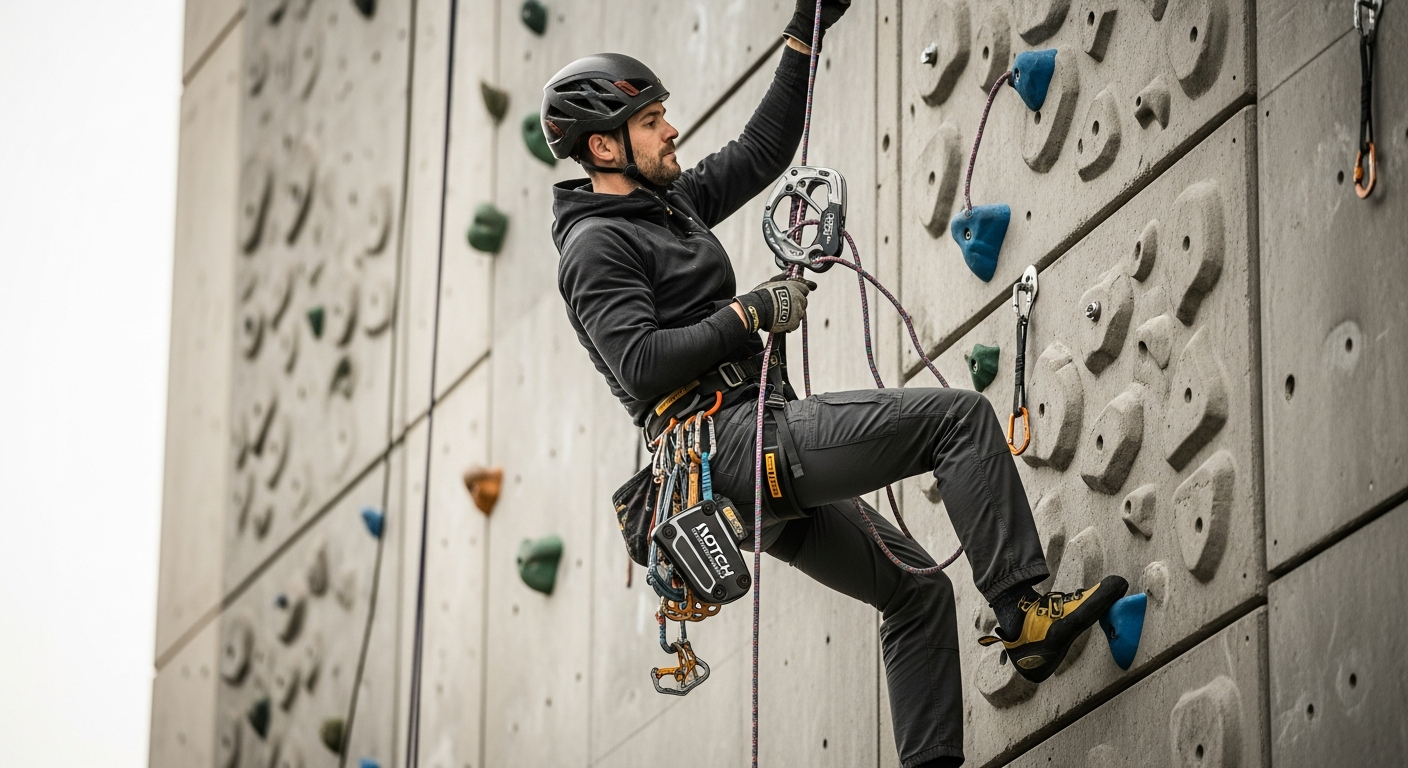
Professional arborists spend over 60% of their workday managing rope friction and positioning, yet most climbing devices force them to fumble with tools and complicated adjustments while suspended in the canopy. Every second spent adjusting friction settings or wrestling with attachment pins is a second not spent cutting, rigging, or moving through the canopy efficiently. These small delays compound throughout a climbing day, stealing hours from production schedules and adding unnecessary physical and mental fatigue.
The Notch Rope Runner Vertec represents a fundamental shift in how arborists approach vertical positioning, built on decades of innovation and refined through collaboration with experienced professionals like Kevin Bingham. This next-generation tool addresses specific pain points that production climbers face daily through tool-free friction adjustments, seven customizable settings, and pin-free attachment design.
From Rope Runner Pro to Vertec—What Changed and Why It Matters
Evolution from the best-selling Rope Runner Pro to the next-generation Vertec model
The Rope Runner Pro earned its reputation as one of the best-selling climbing devices ever created, establishing Notch as a trusted name in arborist equipment. However, success bred opportunity. Rather than rest on proven designs, Notch recognized that real-world arborists were finding workarounds, adjusting their techniques, and sometimes compromising efficiency to work within the Pro's limitations. The Vertec builds on this legacy while systematically addressing the feedback collected from thousands of production climbers.
Real-world feedback from professional arborists that drove design improvements
Every significant change in the Vertec emerged directly from what working arborists told Notch they needed. Production climbers highlighted recurring friction points—literally and figuratively—where the climbing device itself became the bottleneck rather than the solution. Whether managing fast removals in heavy timber or executing precision work on delicate ornamentals, arborists needed a device that could adapt without creating new problems. This feedback loop shaped every engineering decision.
Key pain points addressed: slic pin removal, tending behavior refinement, and on-the-fly adjustability
The slic pin system, while functional, required management and carried the risk of dropping or losing pins during high-canopy work. The Vertec eliminated this entirely through midline attachability that requires no pins at all. Tending behavior—how the device handles rope movement during controlled descents—received significant refinement based on feedback about inconsistent performance across different rope diameters and carabiner setups. Most importantly, the tool-free friction adjustment means climbers can now modify their settings instantly while positioned in the tree, responding to changing conditions without descending or reaching for tools.
Mastering the Seven Friction Settings—Finding Your Perfect Rope Match
Overview of the seven distinct friction settings and their purpose
The Vertec's seven friction settings represent genuine precision rather than cosmetic differentiation. Each setting adjusts the mechanical resistance between the rope and the device's friction body, allowing climbers to achieve the exact feel they need for their specific rope and climbing style. Rather than forcing climbers to adapt to the device, this seven-level system acknowledges that different arborists, different ropes, and different work scenarios demand different friction profiles.
How friction settings correlate to rope diameter (11mm to 12.9mm compatibility)
Rope diameter directly influences friction behavior. The Vertec accommodates the full range from 11mm to 12.9mm diameter ropes, and the seven settings account for how friction changes across this spectrum. A climber using an 11mm rope on a tight setting needs a different configuration than someone running 12.9mm rope. The seven options ensure that regardless of your rope choice, you have settings available that provide smooth, controlled movement without the sluggishness of over-friction or the skittishness of under-friction.
Matching friction levels to Single Rope System (SRS) and Moving Rope System (MRS) applications
SRS and MRS systems behave differently mechanistically, and the Vertec's versatility extends to both. Single Rope climbers benefit from friction settings that provide predictable, linear control during ascent and descent. Moving Rope practitioners work with systems where the rope mechanics differ significantly, and the Vertec's flexibility means you're not forced to compromise your preferred climbing system to use the device. The seven settings give both climbing approaches room to find their optimal configuration.
Tool-Free Adjustability and Pin-Free Attachment—The Efficiency Revolution
Mechanics of the tool-free friction adjustment system
The Vertec's friction adjustment mechanism operates through an intuitive design that doesn't require wrenches, pliers, or hex keys. Arborists can modify their friction setting using the device itself—no supplementary tools needed. This might sound like a minor convenience, but consider the reality of production climbing: you're suspended 60 feet in the canopy, you've identified that your current friction setting isn't quite right for the rope temperature or the work you're doing next, and you need to make an adjustment. Tool-free modification means you handle this in seconds rather than descending to your equipment bag.
How midline attachability eliminates the need for slic pins
Previous climbing devices required slic pins for midline attachment, creating a point of friction (non-mechanical) in your workflow. These pins needed to be positioned correctly, managed during transitions, and monitored to prevent loss. The Vertec's redesigned attachment point accepts midline attachment directly without any pins. This simplification doesn't sound revolutionary until you factor in the dozens of times per day a production climber might make this attachment. Each instance becomes faster and more reliable.
Time savings during setup and removal in the canopy
Over a full climbing day, the cumulative effect of tool-free adjustments and pin-free attachment amounts to significant time recovery. Setup moves faster. Friction modifications take seconds instead of minutes. Removal and transition to new rigging points become smoother. None of these individual savings is dramatic, but production climbing work consists almost entirely of incremental optimizations. When you reclaim 30 minutes across a 8-hour day through efficiency gains, that's productivity that flows directly to your bottom line.
Optimize your climbing workflow by investing in the tool-free efficiency of the Rope Runner Vertec.
Technical Specifications and Safety Certifications You Should Know
Working Load Limit (WLL) of 130 kg (286 lbs) and rope diameter compatibility (11mm to 12.9mm)
The Vertec carries a Working Load Limit of 130 kg (286 lbs), providing substantial safety margin for typical arborist applications. Its compatibility extends from 11mm to 12.9mm diameter ropes, covering the vast majority of professional climbing rope options currently in use. This range represents real flexibility—you're not locked into a specific rope choice or forced to carry multiple devices for different rope diameters.
Compact dimensions (9.3 cm L × 4.8 cm W × 15.5 cm H) and weight (454 g / 1 lb)
At just 454 grams (approximately 1 pound), the Vertec adds minimal weight to your climbing system. The compact dimensions—9.3 cm long, 4.8 cm wide, and 15.5 cm tall—mean it doesn't create bulk or awkwardness when positioned on your harness or climbing system. Physical dimensions matter in tree work where every ounce and every centimeter influences your agility and comfort during full-day climbing sessions.
CE certification and EU 2016/425 regulation compliance with track and trace capabilities
Safety certification isn't negotiable in professional climbing equipment. The Vertec holds CE certification and meets all requirements under regulation (EU) 2016/425, confirming that it meets rigorous European safety standards. The device includes a scannable data matrix for track and trace capabilities, providing traceability and facilitating any necessary recalls or service communications. This infrastructure reflects Notch's commitment to both safety and professional accountability.
Real-World Production Climbing—Where the Vertec Excels
Everyday production work scenarios and climbing efficiency gains
Production climbing demands speed without sacrificing control. Consider a typical day: high-volume removals where you're ascending and descending dozens of times, establishing work positions, and managing efficient rope handling. The Vertec's tool-free friction adjustments and simplified attachment system reduce friction points in your workflow. Climbers consistently report noticeable productivity gains during high-volume work, particularly when managing multiple trees or complex cutting sequences.
Performance advantages in high-volume cutting operations and various tree species
Different tree species present different climbing characteristics. Dense hardwoods create different rope dynamics than soft woods. Broad-canopied shade trees present different positioning challenges than tight conifers. The Vertec's seven friction settings and responsive attachment design adapt to these varying conditions. Arborists working across diverse tree species appreciate equipment that doesn't force them to compromise—they can optimize their device for the work at hand.
Reliability for full-day climbing sessions and adaptability across arborist specializations
Whether you specialize in large removals, precision ornamental work, utility line clearance, or emergency response climbing, the Vertec's versatility supports your specific discipline. The device maintains reliable performance throughout extended climbing sessions, constructed from durable aluminum alloy and stainless steel that resist fatigue and corrosion. Replacement parts like the Friction Body Kit and Upper Bollard remain available, supporting long-term use and maintenance.
Investment Breakdown—Pricing, Value, and Long-Term ROI
Price range overview ($514.99 to $700.00) with bundle options and included accessories
The Notch Rope Runner Vertec typically ranges from approximately $514.99 to $700.00 depending on the retailer, bundled accessories, and any promotional offerings. While this represents a meaningful investment in climbing equipment, the range reflects different configuration options and bundling scenarios rather than significant quality variation.
Cost-per-use analysis over the device's lifespan and durability considerations
Climbing devices represent capital investments in your professional operations. A Vertec used regularly over multiple seasons quickly demonstrates its value through productivity gains and reliability. Professional-grade equipment typically justifies higher upfront cost through reduced replacement frequency and consistent performance. The Vertec's construction from aluminum alloy and stainless steel suggests longevity that extends well beyond casual use, making the cost-per-use calculation favorable for production climbers.
Return on investment through improved productivity and manufacturer warranty coverage
The actual ROI emerges through multiple channels. Direct productivity gains—more efficient positioning, less time spent on adjustments, smoother workflow transitions—translate to more billable climbing hours per day. Equipment reliability reduces unplanned downtime and the stress of working with devices that feel marginal. Knowing that your climbing device will function consistently across varying conditions builds confidence that lets you focus on the work itself rather than your equipment. While Notch's specific warranty terms should be confirmed with retailers, the manufacturer stands behind its equipment, providing protection on your investment.
Why the Notch Rope Runner Vertec Deserves a Place in Your Climbing Kit
The Notch Rope Runner Vertec isn't just another climbing device—it's a carefully engineered solution that respects your time, safety, and need for precision in the canopy. The tool-free friction adjustments eliminate frustrating delays, the seven settings give you genuine control across rope types, and the pin-free attachment simplifies your workflow. Small inefficiencies compound throughout a climbing day, stealing hours from production and adding unnecessary fatigue, but the Vertec addresses these friction points in ways that previous generations couldn't.
Whether managing high-volume removals, precision trimming work, or complex rigging, this device adapts to your demands without compromising control or safety. The investment at $515 to $700 pays for itself through improved efficiency and the peace of mind that comes with genuinely reliable equipment. Professional arborists who've made the switch consistently report that the Vertec delivers productivity gains and reduced frustration over multiple seasons of use.
If you're serious about your climbing work and tired of workarounds that slow you down, it's time to experience what next-generation rope positioning feels like. Get your Notch Rope Runner Vertec and elevate your climbing performance today.
Leave a Reply