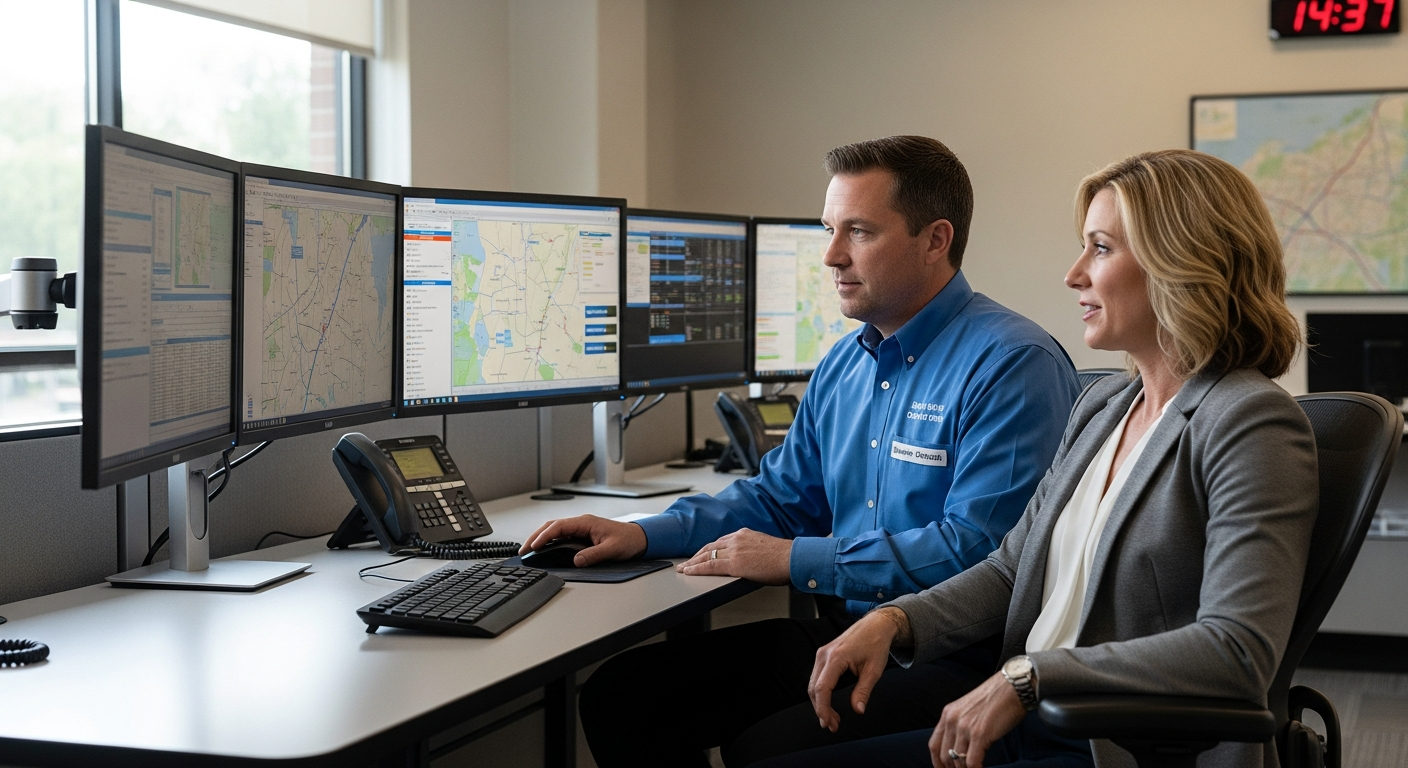
Did you know that 911 dispatch operators spend an average of 8–12 hours per shift sitting in the same chair? For healthcare staff, law enforcement personnel, and emergency services workers, finding a chair that can handle constant use without sacrificing comfort isn't a luxury—it's a necessity. The physical and mental demands of these roles are extraordinary, yet they're often overlooked when facilities make seating decisions.
The OFM 247 Big & Tall 24/7 Ergonomic Office Chair was engineered specifically for these high-demand, continuous-operation environments. Unlike standard office chairs designed for occasional use, the OFM 247 is built to withstand relentless, multi-shift operations while supporting users up to 400 pounds. It represents the difference between a chair that merely occupies space and one that actively supports mission-critical work.
Explore the OFM 247 and discover why it's the preferred choice for high-demand environments.
The Case for Heavy-Duty Seating in Mission-Critical Environments
How continuous-shift work demands exceed standard office chair specifications
Continuous-shift operations create demands that typical office furniture simply cannot meet. A dispatcher working a 12-hour shift doesn't have the luxury of periodic breaks or position changes like someone in a standard office environment. The chair must maintain structural integrity, comfort, and support throughout extended periods without degradation. Standard office chairs are typically rated for 8-hour workdays with multiple users rotating throughout. When one person occupies a chair for 12 hours straight—or when multiple operators use the same chair across shift changes—the wear patterns accelerate dramatically.
The physical toll of prolonged sitting on emergency services personnel
Sitting for 8–12 hours without proper support creates cumulative physical damage. Emergency services workers experience lower back pain, poor circulation, shoulder tension, and reduced spinal alignment. These aren't minor discomforts—they translate into reduced alertness during critical moments, higher injury rates, and accelerated burnout. The relationship between seating quality and operator performance is direct: when a dispatcher is in pain or discomfort, their cognitive function suffers, their reaction time slows, and their ability to manage high-stress situations deteriorates. For 911 centers and emergency rooms, this directly impacts response quality and potentially lives.
Why commercial-grade furniture is non-negotiable for healthcare and dispatch operations
Healthcare facilities and dispatch centers operate under strict compliance requirements. The environments are inherently more contaminated—exposure to bodily fluids, biohazards, and infection vectors is constant. Standard office chairs with fabric upholstery and unsealed components become contamination vectors themselves. Commercial-grade furniture with antimicrobial materials, sealed construction, and cleanable surfaces isn't an upgrade—it's a regulatory necessity. The difference between compliance and non-compliance can mean audit failures, operational shutdowns, or worse, disease transmission incidents.
Cost-benefit analysis: durability over time versus frequent chair replacements
A facility manager purchasing cheap chairs at $100–$150 per unit might feel they're saving money upfront. However, those chairs typically survive 2–3 years under continuous use before requiring replacement. An OFM 247 at $250–$450 lasts 5–10 years. Over a decade, equipping 20 dispatch stations with budget chairs means purchasing replacements multiple times, investing in labor for removal and installation, managing downtime, and dealing with inconsistent comfort across the facility. The OFM 247's durability means fewer disruptions, more consistent operational standards, and significantly lower per-year cost of ownership.
Industry standards and compliance requirements for intensive-use facilities
The OFM 247 meets or exceeds ANSI/BIFMA performance standards for safety and durability. These standards aren't arbitrary—they're developed by facility safety experts and industry professionals specifically for high-use environments. Certification means the chair has been tested for structural integrity under stress, material safety, chemical resistance, and performance consistency. For facility directors, this certification simplifies compliance documentation and risk management.
The connection between proper seating and employee retention in high-stress roles
Emergency services experience notoriously high turnover. Employees cite poor working conditions as a primary reason for leaving. While salary matters, the daily experience of pain, discomfort, and poor ergonomics compounds psychological stress. Operators who spend 12 hours in an uncomfortable chair develop resentment about their work environment—it becomes a visible symbol of how the organization values them. Conversely, facilities that invest in proper seating demonstrate commitment to employee wellbeing. This investment directly correlates with improved retention rates and reduced recruitment costs.
Industrial-Grade Materials Built for Sanitation-Critical Spaces
Anti-microbial and anti-bacterial vinyl upholstery options for healthcare compliance
The OFM 247 offers anti-microbial and anti-bacterial vinyl as an upholstery option—not a luxury feature, but a necessity in healthcare settings. This material actively inhibits bacterial and microbial growth on the surface, reducing cross-contamination risks between patients and staff. In hospitals and clinics where MRSA, C. difficile, and other resistant pathogens present ongoing challenges, every touch surface matters. The vinyl option provides a barrier that standard fabric cannot.
Commercial-grade, stain-resistant fabric for easy decontamination protocols
For facilities preferring fabric, the OFM 247 includes commercial-grade, stain-resistant options. These materials resist absorption of blood, bodily fluids, and chemical disinfectants—critical in emergency departments and trauma centers. The stain resistance isn't merely aesthetic; it prevents contamination from penetrating into the chair's structure, where it could harbor pathogens and compromise sanitation protocols.
Why material selection matters in hospitals, clinics, and law enforcement facilities
In these environments, the chair isn't just furniture—it's part of the infection control infrastructure. Law enforcement facilities host contaminated individuals; hospitals manage biohazard exposure; clinics operate under strict sanitation protocols. A chair that absorbs body fluids or harbors bacteria becomes a liability. Material selection directly impacts facility safety, compliance audits, and operational credibility.
Cleaning and maintenance procedures for infection control environments
The OFM 247's materials support aggressive cleaning protocols. Vinyl upholstery can withstand harsh disinfectants, high-temperature steam cleaning, and chemical decontamination procedures that would damage standard office chair fabrics. The sealed construction prevents liquids from entering the chair's frame, and the heavy-duty components resist corrosion from sanitizing agents. Facility staff can decontaminate chairs between operators without concern about material degradation.
ANSI/BIFMA certification: what it means for facility safety standards
ANSI/BIFMA standards establish performance benchmarks for office furniture in professional environments. Certification means the OFM 247 has undergone rigorous testing for structural stability, material safety, flammability resistance, and ergonomic performance. For facility directors, this certification reduces liability concerns and simplifies compliance documentation. It signals that the chair meets recognized industry safety standards rather than relying on manufacturer claims alone.
Heavy-duty steel 5-star base construction for reliability under constant use
The OFM 247 features a heavy-duty steel 5-star wheeled base designed for the aggressive movement patterns in dispatch centers and emergency rooms. Operators frequently shift position, lean back, roll between workstations, and subject the base to repeated stress. A flimsy base would wobble, crack, or fail within months. The reinforced steel base maintains stability and structural integrity across years of continuous operation. This seemingly simple component significantly impacts operator confidence and safety.
Caster options: standard, soft-wheel for hard floors, and glide alternatives
The OFM 247 recognizes that different facilities have different flooring—tile in hospitals, concrete in dispatch centers, vinyl in clinical spaces. Standard casters work for carpeted areas; soft-wheel casters protect hard floors from damage while maintaining smooth rolling; glides prevent rolling entirely for stationary positioning. This flexibility means the OFM 247 adapts to the facility rather than forcing the facility to adapt to the chair.
Check out the OFM 247's customization options and see how it fits your facility's specific needs.
Customization Features That Support Diverse Operator Body Types
400-pound weight capacity: accommodating a broader range of users
Not all operators fit standard chair specifications. The OFM 247's 400-pound weight capacity accommodates a far broader range of body types than typical office chairs. This means the same chair works for diverse teams—taller operators, broader builds, and heavier-framed individuals all receive proper support. Facilities don't need multiple chair models; one OFM 247 configuration works across a diverse workforce.
Pneumatic seat height adjustment for quick position changes between operators
In multi-operator environments, chairs transition between people across shift changes. Pneumatic adjustment allows rapid height changes without tools or complicated procedures. An outgoing operator can easily lower the seat for their replacement, ensuring quick transitions and consistent comfort across the shift change. This efficiency matters in dispatch centers where every minute of operational readiness counts.
One-touch sliding seat depth adjustment for personalized comfort without tools
Seat depth significantly impacts thigh support and circulation during extended sitting. The OFM 247's one-touch sliding depth adjustment allows operators to customize this dimension without removing tools or calling maintenance. A taller operator can extend the seat depth; a shorter operator can reduce it. This quick customization ensures maximum comfort without friction or delay.
T-shaped adjustable arms (height and width) for varied upper body support
Arm height and width dramatically affect shoulder, neck, and arm comfort during 12-hour shifts. Fixed arms create problems—too high, and they force shoulders into an elevated position; too low, and they provide insufficient support. The OFM 247's adjustable T-shaped arms accommodate different arm lengths, shoulder widths, and working styles. Operators can position arms to support forearms during typing or retract them when reaching across the console.
Back height, depth, and pitch adjustments for spinal alignment
Spinal alignment directly impacts long-term back health and comfort. The OFM 247 allows operators to adjust back height to support their specific thoracic curve, back depth to control lumbar positioning, and pitch to control forward/backward angle. These adjustments accommodate different spinal curvatures and postural preferences, reducing strain on discs and supporting structures.
Synchronized seat and back adjustments for coordinated ergonomic positioning
Advanced ergonomic design means seat and back adjustments work in coordination rather than independently. Synchronized adjustments maintain proper relationships between seat angle, back angle, and lumbar support, preventing the awkward positioning that results from independent adjustment. This coordinated approach ensures that customization improvements in one dimension don't create problems in another.
Built-in lumbar support and 3-inch padded seat and back cushioning
Lumbar support specifically addresses lower back strain during extended sitting. The OFM 247 includes integrated lumbar support that maintains natural spinal curvature without requiring a separate pillow. The 3-inch padding provides substantial cushioning—not just surface softness, but deep support that distributes weight effectively and reduces pressure points. This thickness ensures the padding maintains effectiveness even after years of use, unlike thinner cushions that compress and harden over time.
360-degree swivel and smooth tilting action with tension control
Operators need fluid movement—reaching across the console, turning toward phones or monitors, and adjusting their position throughout the shift. The 360-degree swivel provides unrestricted rotational movement, and the smooth tilting action with tension control allows recline adjustment without sudden movements or instability. Operators can lean back briefly without sliding or wobbling, maintaining stability while reducing spinal compression.
Why Dispatch Centers Specifically Demand This Chair Model
Multi-operator environments: quick adjustability between shifts and personnel
Dispatch centers operate 24/7 with overlapping shifts and rapid personnel changes. The same console might be staffed by three different operators across a single day. Standard chairs with complicated adjustment mechanisms create bottlenecks—incoming operators waste time adjusting the chair, or they simply work in an uncomfortable position inherited from the previous shift. The OFM 247's quick-adjust features mean operators customize their seating in minutes, not half an hour.
Extended sitting sessions without fatigue or discomfort
A dispatcher handling incoming emergency calls cannot take frequent breaks. Eight to twelve hours of sitting in poor seating creates progressive fatigue, reduced alertness, and physical discomfort that degrades performance exactly when it matters most. The OFM 247's comprehensive support system, padding, and adjustability minimize this fatigue. Operators remain comfortable and alert throughout extended shifts, maintaining the high cognitive performance that emergency dispatch demands.
Reliability during peak call volumes and high-stress situations
When call volumes spike during emergencies or natural disasters, dispatchers work at maximum intensity. A failing chair—one that wobbles, squeaks, or becomes unstable—creates additional stress and distraction. The OFM 247's robust construction eliminates these failure points. Operators can focus entirely on the emergency situation rather than managing an unreliable work surface.
Integration with dispatch console setups and workstation configurations
Dispatch consoles have specific spatial requirements and aesthetic standards. The OFM 247's functional design integrates seamlessly into professional dispatch environments. Its proportions work with standard console dimensions, and its appearance communicates professionalism and reliability rather than appearing out of place in a sophisticated operational center.
Reduced worker compensation claims related to ergonomic injuries
Poor seating directly increases ergonomic injury rates—back strains, carpal tunnel, shoulder injuries, and repetitive stress injuries. These injuries drive worker compensation claims, increase insurance premiums, and remove experienced operators from duty. The OFM 247's ergonomic design measurably reduces injury incidence, lowering workers' compensation costs and keeping experienced staff operational.
Operator feedback: comfort during 12+ hour shifts
The OFM 247 has earned its reputation through actual operator experience. Dispatchers and emergency services workers—notoriously critical about their working conditions—consistently report that this chair enables comfortable extended shifts. This feedback from users in the most demanding environments carries significant weight.
Real-world performance in 24/7 emergency services operations
The OFM 247 isn't a theoretically optimized chair tested in a lab—it's proven in actual 24/7 emergency services environments. Dispatch centers, hospitals, law enforcement facilities, and emergency rooms across North America have deployed thousands of these chairs. Their continued use and replacement orders demonstrate genuine performance validation in the harshest real-world conditions.
Budget-Conscious Investment for Facility-Wide Deployments
Price range ($250–$450) relative to total cost of ownership
The OFM 247's $250–$450 price point appears moderate compared to premium office chairs, but it's significantly higher than budget alternatives at $100–$150. However, total cost of ownership—the financial reality across multiple years—tells a different story. A $150 budget chair might require replacement every 2–3 years; an OFM 247 lasts 5–10 years. Across a decade, the budget chair requires multiple purchases and installation labor, while the OFM 247 requires only one purchase.
Durability justification: fewer replacements over 5–10 years
The industrial-grade construction, reinforced components, and commercial-grade materials mean the OFM 247 maintains performance across extended timelines. Facilities don't face the degradation and failure patterns that plague budget seating. This durability directly translates to operational stability and reduced equipment management burden.
Bulk purchasing considerations for dispatch centers and hospital departments
Facilities deploying the OFM 247 across multiple workstations benefit from volume purchasing discounts and standardization advantages. A dispatch center with 20 operators can standardize on the OFM 247, ensuring consistent ergonomic support, simplifying training on adjustment procedures, and maintaining unified spare parts inventory. This standardization reduces overall operational complexity and cost.
Comparison to cheaper alternatives that fail under continuous-use conditions
Budget chairs purchased for $100–$150 typically exhibit failures within 2–3 years of continuous use: pneumatic cylinders fail, bases crack, padding compresses, and adjustments become loose or inoperable. These failures don't occur during normal office hours—they occur during the demanding continuous-use conditions where the OFM 247 was specifically designed to perform. The true cost of budget seating includes these premature failures and the operational disruptions they create.
ROI calculation: reduced sick leave and injury-related downtime
Proper seating reduces ergonomic injuries, lower back pain, and fatigue-related performance issues. Facilities deploying the OFM 247 report reduced sick leave among operational staff, fewer injury claims, and improved performance metrics. These improvements directly contribute to ROI, as they represent retained productivity and reduced operational costs. An operator who remains healthy and alert because of quality seating delivers substantially more value than one managing chronic discomfort.
Warranty and support options for commercial fleet purchases
OFM provides warranty coverage and commercial support for bulk deployments. Facilities purchasing multiple units gain access to streamlined replacement procedures, priority support, and predictable maintenance protocols. This support structure further reduces operational friction and ensures consistent performance across the facility.
Long-term value for facilities managing multiple workstations
For a dispatch center with 30 workstations or a hospital with 50 chairs across multiple departments, the OFM 247's durability and standardization create substantial long-term value. One standardized model across the facility simplifies training, spare parts management, and maintenance procedures. The consistent performance across all workstations ensures uniform operator experience and ergonomic support.
Beyond the Chair: Creating Ergonomic Workstations for High-Demand Roles
Complementary ergonomic furniture and accessories for dispatch consoles
The OFM 247 performs optimally within a comprehensive ergonomic workstation design. Monitor arms that position screens at proper viewing angles, keyboard trays that support proper wrist alignment, and footrests that address circulation during extended sitting all contribute to overall ergonomic effectiveness. The chair is the foundation, but complete workstations include supporting elements.
Monitor positioning and keyboard/mouse setup for extended shifts
Screen height, viewing distance, and angle significantly impact neck and shoulder strain. Proper keyboard and mouse positioning reduces wrist strain and carpal tunnel risk. These ergonomic factors work in concert with the chair's support system. A properly adjusted OFM 247 works best with monitors positioned at eye level and keyboards positioned to support neutral wrist alignment.
Footrest and lumbar pillow integration with the OFM 247
While the OFM 247 includes integrated lumbar support, additional lumbar pillows can customize support for specific operators. Footrests address circulation and pressure relief for taller operators or those with specific anatomical needs. These accessories extend the OFM 247's adaptability to individual differences.
Workstation layout optimization for emergency services environments
Dispatch consoles and emergency room workstations benefit from thoughtful layout optimization. Equipment placement, cable management, and spatial organization reduce unnecessary movement and repetitive reaching. The ergonomic chair supports the operator's body; intelligent workstation layout minimizes additional strain from poorly positioned equipment.
Training operators on proper adjustment and usage techniques
The OFM 247's numerous adjustments provide flexibility, but only if operators understand how to use them. Facilities deploying the chair should provide brief training on adjustment procedures, proper sitting posture, and customization techniques. Operators who understand the chair's capabilities achieve maximum benefit and comfort.
Regular maintenance schedules to ensure continued performance
Preventive maintenance extends the OFM 247's lifespan and ensures consistent performance. Periodic inspection of casters, adjustment mechanisms, cushioning integrity, and base stability identifies potential issues before they develop into failures. A simple maintenance schedule—perhaps quarterly inspections and annual deep cleaning—maintains optimal performance across years of use.
Ergonomic assessment programs for staff in intensive-use roles
Facilities can implement periodic ergonomic assessments that evaluate workstation setup, operator posture, and any emerging discomfort patterns. These assessments ensure that adjustments remain optimized as operators' needs change and that the workstation continues supporting their physical wellbeing throughout their tenure.
The Bottom Line for Operations Managers and Facility Directors
The OFM 247 Big & Tall 24/7 Ergonomic Office Chair represents far more than a seating purchase—it's a strategic investment in operational efficiency, employee health, and facility compliance. When your team works around the clock in high-stakes environments, cutting corners on seating means risking productivity, employee retention, and worker safety. The 400-pound weight capacity, antimicrobial materials, extensive adjustability, and industrial-grade construction make this chair the clear choice for dispatch centers, healthcare facilities, and emergency services operations that demand uncompromising reliability.
At $250–$450 per unit, the OFM 247 delivers exceptional value for organizations that understand the true cost of inadequate furniture. Budget chairs might appear cheaper initially, but they fail under continuous-use conditions, require frequent replacement, and create operational disruptions that far exceed their initial savings. The OFM 247's durability, comfort, and compliance features ensure years of reliable performance with minimal maintenance intervention.
Employee retention, reduced injury claims, improved alertness during extended shifts, and facility compliance all flow from quality seating decisions. Your team members spend a significant portion of their careers in their chairs; investing in their physical comfort and ergonomic support demonstrates organizational commitment and yields measurable operational benefits.
If you're managing a facility where continuous operations and employee wellbeing are non-negotiable, the OFM 247 deserves serious consideration in your next equipment procurement cycle.
Start your OFM 247 investment today and transform your facility's ergonomic standards.
Leave a Reply