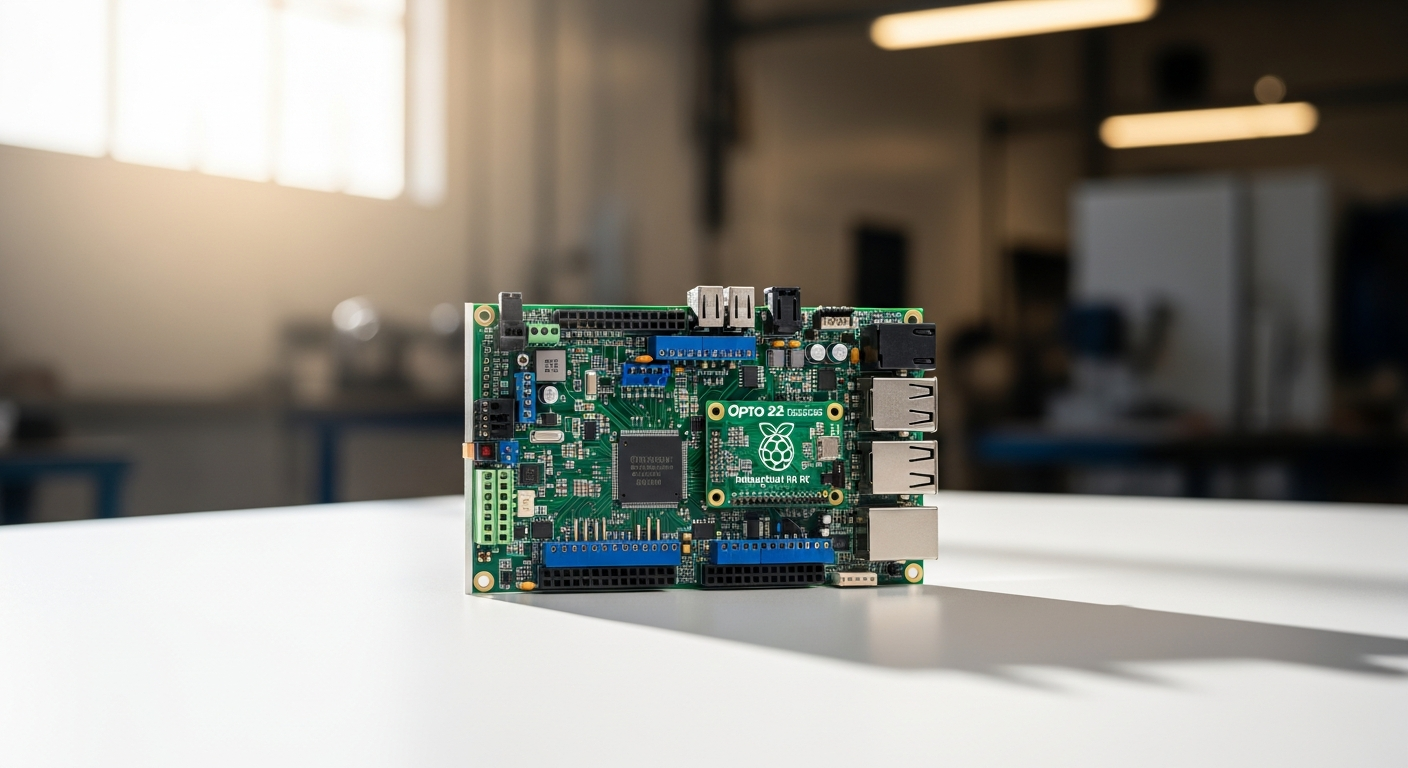
Hobby projects have their place—blinking LEDs, temperature sensors, basic automation tasks. But most Raspberry Pi builders hit a ceiling quickly. The moment you need to control an industrial motor, switch a high-voltage pump, or manage mission-critical equipment, the Pi's native GPIO pins become a liability. Operating at just 3.3 VDC, they're fundamentally incompatible with the real-world electrical loads that industrial applications demand.
The Opto 22 Digital I/O for Raspberry Pi Starter Kit solved this problem elegantly. It pairs the affordable, flexible Raspberry Pi with industrial-grade I/O modules that have spent decades powering automation systems worldwide. This kit doesn't just extend your Pi's capabilities—it transforms it into a legitimate industrial control platform.
What Makes This Kit Different From Standard Raspberry Pi Accessories
Standard Raspberry Pi accessories handle basic logic-level signals. The Opto 22 kit operates in a completely different category. Its core advantage lies in deploying the same industrial-grade components found in professional automation systems—components tested across thousands of installations over decades.
The kit handles voltage ranges from 2.5 VDC all the way to 280 VAC, a spectrum far beyond what Raspberry Pi's native GPIO pins can manage. Beyond raw voltage handling, the system provides crucial isolation and protection features. Voltage spikes, electrical faults, and transient surges that would destroy a standard Pi board are contained and managed safely by industrial-grade circuitry.
Another critical difference: expandability. The included 8-module mounting rack accepts up to 12 total Opto 22 G4 modules, allowing you to scale from simple 4-module starter configurations to complex multi-input, multi-output systems. Each module operates independently, so a fault in one doesn't cascade through the entire system. For $129, you're accessing professional control capabilities that would cost thousands in dedicated industrial controllers.
Understanding the Four Core I/O Modules Included
The starter kit ships with four specialized modules, each handling specific voltage domains and signal types.
G4IAC5 Input Module: AC/DC Sensing
This module monitors high-voltage AC and DC signals between 90-140 VAC/VDC. It's designed to sense industrial sensors, equipment status signals, and control feedback from machinery. When your pump reports its running state or a motor indicates load conditions, this module captures that information reliably.
G4IDC5MA Input Module: DC Logic With Manual Override
Operating in the 10-32 VDC range, this module adds a practical feature: integrated manual/auto switching. Technicians can manually control connected equipment or allow the Raspberry Pi to take over—essential for maintenance scenarios where manual intervention outranks automation.
G4OAC5 Output Module: AC Load Control
Switches AC loads between 12-140 VAC, enabling control of motors, solenoids, AC-powered industrial equipment, and HVAC systems. Each output carries industrial-grade protection and fusing, ensuring your control logic safely commands real-world equipment.
G4ODC5 Output Module: DC Load Control
Manages 5-60 VDC equipment including relays, LED arrays, pneumatic valve solenoids, and DC motors. The modular design means you can mix and match these four module types based on your specific application—two inputs and two outputs, or any other combination your project demands.
Each module operates independently with pre-configured fusing and surge protection appropriate for industrial environments. This distributed architecture reduces failure cascading and simplifies troubleshooting.
Start building your industrial automation foundation with the Opto 22 Raspberry Pi kit.
Hardware Components and Physical Setup
The system architecture centers on the OPTO-P1-40P Carrier Board, which interfaces directly with your Raspberry Pi's 40-pin GPIO header. This carrier board serves as the intelligence bridge, translating GPIO signals from the Pi into commands for the industrial I/O modules.
The included 8-module mounting rack (G4PB8H) provides secure mechanical housing for your I/O modules. This isn't just a convenience—the rack organizes wiring, ensures proper spacing between modules, and allows field technicians to quickly identify each module's function and status. The design accommodates up to 12 total modules, supporting expansion as your application grows.
Compatibility spans the Raspberry Pi ecosystem: models 1 A+ and B+, Pi 2 Model B, Pi 3 Model B, Pi 4 Model B, and even the Pi Zero. The included interface cable provides secure connections between the carrier board and I/O modules, while mounting standoffs stabilize the Pi board within the rack assembly.
Field wiring uses terminal block connectors—no soldering required. Technicians simply insert bare wire or crimp terminals and tighten set screws. A spare fuse is included, enabling quick replacement if overcurrent conditions occur.
Programming and Integration With Raspberry Pi
The kit integrates seamlessly with standard Raspberry Pi development environments. Native support exists for Python and C, the primary languages used in Pi projects. If you're comfortable with GPIO libraries from standard Raspberry Pi projects, this kit's integration feels natural and intuitive.
Node-RED deserves special mention for non-programmers. This visual programming interface lets you create automation logic by dragging blocks and connecting them—no syntax knowledge required. Input modules trigger actions, outputs execute commands, and complex automation sequences emerge from visual workflows.
Opto 22 provides code samples and documentation designed specifically for Raspberry Pi developers. This accelerates development from initial prototype to working implementation. Event-driven programming capabilities enable real-time responses to industrial conditions—when a sensor triggers, your Pi responds immediately, not on a polling cycle.
Network connectivity built into Raspberry Pi enables remote monitoring and control. Connect to your system from anywhere, adjust parameters, trigger emergency stops, or collect sensor data for analytics. Integration with MQTT, REST APIs, and other industrial communication protocols means this kit plays well with larger automation ecosystems.
Real-World Applications and Use Cases
Factory automation benefits immediately. Conveyor belts, sorting systems, and assembly line equipment all depend on reliable switching and sensing. The kit handles the complexity while Raspberry Pi runs your control logic.
HVAC systems require monitoring temperature sensors and switching heating/cooling equipment. The multi-voltage support ensures compatibility with existing building systems. Water management applications—pump operations, valve controls for irrigation or industrial processing—all fall within the kit's capabilities.
Building automation consolidates lighting, security, and environmental monitoring. Predictive maintenance becomes possible when you collect sensor data about equipment health, enabling you to anticipate failures rather than react to them.
Educational applications teach industrial automation principles in engineering programs. Students work with real industrial components, understanding concepts that transfer directly to professional environments.
Taking Your Raspberry Pi Into Industrial Territory
The Opto 22 Digital I/O for Raspberry Pi Starter Kit represents a genuine breakthrough for makers, engineers, and automation enthusiasts ready to move beyond hobby projects. Combining Raspberry Pi's affordability and flexibility with industrial-grade Opto 22 modules delivers professional-level control capabilities at a fraction of traditional automation costs.
The expandable architecture accommodates growth. Start with the included four modules and add up to eight more as your application demands. Multi-voltage support—from 2.5 VDC to 280 VAC—eliminates compatibility headaches. Proven reliability across decades of industrial deployments means you're building on a foundation that won't disappoint.
Whether you're automating a small manufacturing process, controlling HVAC systems, managing water pumps, or teaching industrial automation principles, this starter kit provides the platform you need. At $129, this investment scales with your ambitions. Start with basic I/O control today and expand to complex multi-module systems tomorrow. Your Raspberry Pi is finally ready for serious work.
Transform your Raspberry Pi into an industrial automation platform with the Opto 22 starter kit now.
Leave a Reply