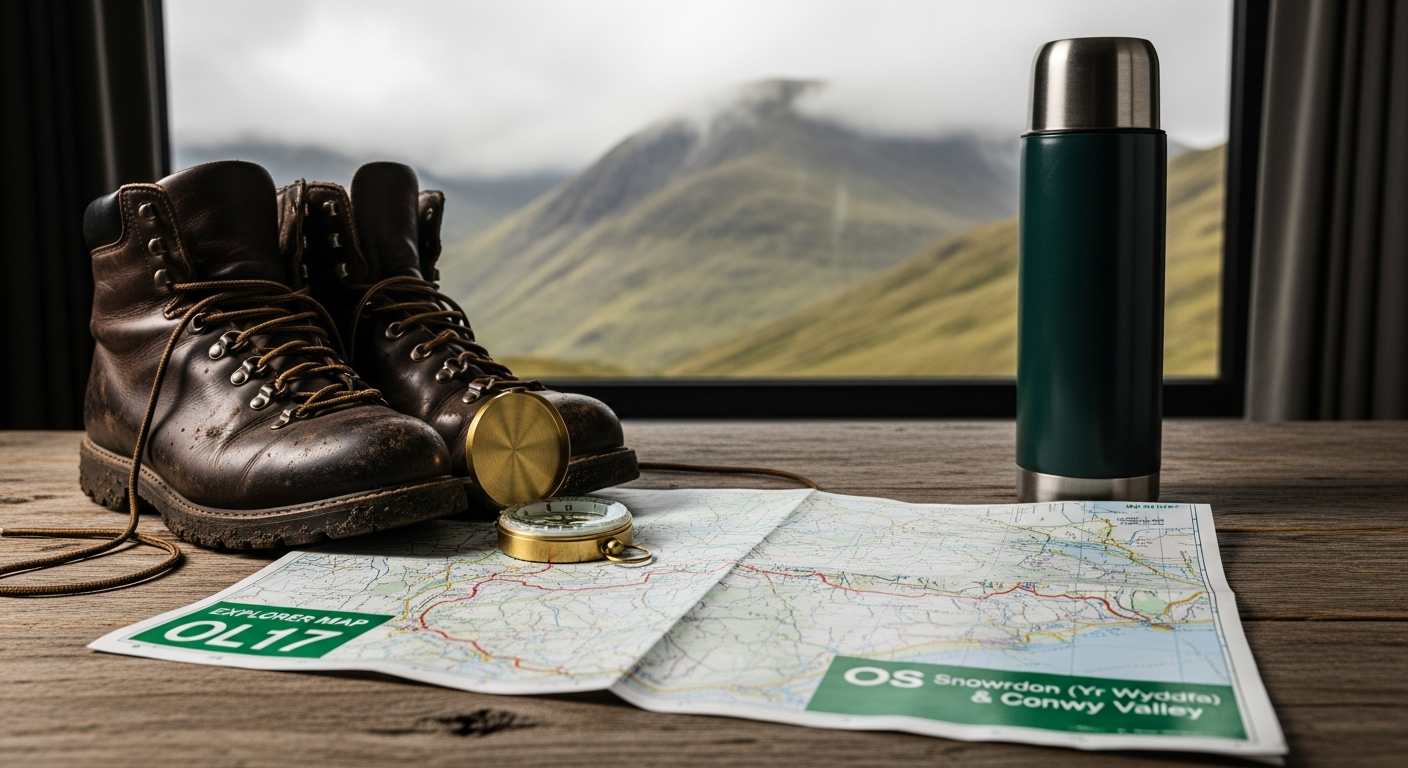
Over 100,000 hikers tackle Snowdon annually, yet many arrive unprepared with inadequate navigation tools. The mountain's reputation for stunning views often overshadows its reputation for rapid weather changes and complex terrain—a combination that catches unprepared adventurers off guard every season. Without proper navigation, even experienced walkers can find themselves disoriented on exposed ridges or trapped in cloud cover with no clear descent route.
The Ordnance Survey Explorer Map OL17 stands as Britain's most detailed cartographic representation of Northern Snowdonia, created by the nation's official mapping authority. This isn't just another folded piece of paper gathering dust in a rucksack—it's a precision instrument developed through decades of systematic surveying and field verification. The 1:25,000 scale delivers exceptional granularity, revealing individual footpaths, subtle terrain features, and critical navigation waypoints that smartphone GPS simply cannot match.
Discover why the OS Explorer Map OL17 has become the gold standard for serious Snowdon adventurers.
Why Snowdon Demands Precision Navigation
Snowdon's terrain presents a uniquely challenging navigation problem. Steep ascents give way to exposed ridges where a single navigational error can force hikers into cliff-edge situations. Multiple converging paths create decision points that appear deceptively similar in poor visibility, and the mountain's weather systems can transition from clear sunshine to thick cloud in minutes.
Poor navigation directly correlates with extended exposure times in harsh conditions. When hikers lose the path, they don't simply turn back—they often continue searching for trail markers, burning energy and time while weather conditions deteriorate. Detailed topographic mapping identifies safe descent routes long before emergencies occur, revealing alternative paths and emergency shelter locations marked on the map.
Smartphone GPS fails spectacularly in these environments. The steep valley walls surrounding Snowdon create signal blackouts, battery drain accelerates in cold temperatures, and screen glare makes digital navigation impossible in bright mountain sunlight. Meanwhile, physical map reading strengthens spatial reasoning and builds the psychological confidence that comes from holding a proven, reliable navigation tool in your hand.
Real-world rescue statistics demonstrate the value of detailed maps. Hikers carrying quality navigation tools experience significantly lower rates of disorientation and dangerous detours. The map serves not just as a navigation aid, but as a constant reference point that prevents the mental spiraling that occurs when walkers question whether they're on the correct route.
Decoding the 1:25,000 Scale: What You Actually Get
Understanding the OL17's scale requires translating a simple ratio into practical terrain knowledge. Four centimeters on the map represent one kilometer on the ground—or in imperial terms, 2.5 inches equals one mile. This means a standard folded map section shows approximately four square miles of terrain, balancing detailed visibility with reasonable physical size.
Lower-resolution alternatives, typically printed at 1:50,000 scale, cover twice the ground but sacrifice critical detail. At 1:50,000, individual footpaths merge together, walls disappear from the representation, and subtle terrain features that prevent navigation errors simply don't appear. The OL17's higher resolution reveals the landscape's actual complexity.
Contour lines tell the story of gradient severity and climbing difficulty. Tightly spaced contours indicate steep sections where hikers should prepare for physical exertion, while widely separated contours suggest gentler terrain suitable for maintaining faster pace. The OL17 uses five-meter contour intervals, allowing walkers to distinguish between steep scrambles and moderate hillsides at a glance.
Micro-features become visible at 1:25,000 that disappear at lower resolutions: individual buildings, wall alignments, stream crossings, and subtle path deviations. In featureless moorland or during whiteout conditions, these seemingly minor details prevent navigation errors that could result in dangerous detours. The scale specifically optimizes for walking and mountain biking activities, providing exactly the right balance between coverage area and ground-level precision.
The Six Routes to Snowdon's Summit: Mapped & Analyzed
Llanberis Path
The longest approach from Llanberis covers nearly eight miles but maintains the most gradual ascent profile. The OL17 clearly shows the path's consistent switchback pattern, making it popular with families and those seeking a steady, sustained climb rather than extreme gradients. Water sources appear marked at regular intervals along this well-developed route.
Miners' Track
Combining historical interest with moderate difficulty, the Miners' Track follows the route where Victorians extracted slate and copper from Snowdon's flanks. The path offers excellent views while maintaining reasonable gradient. The OL17 identifies several stream crossings and old mining infrastructure that add character to the ascent.
Snowdon Ranger Path
From Rhyd Ddu, the Snowdon Ranger Path provides perhaps the quietest and most scenic alternative. The OL17 reveals this route's isolation—fewer path converging points and less crowding than the more popular approaches. Contour lines show a series of gentle ascents rather than relentless climbing.
Rhyd Ddu Path
The least crowded western approach, Rhyd Ddu offers genuine solitude for those willing to start further west. The OL17 shows this path's advantages: straightforward navigation without confusing junctions, dramatic views across Snowdon's western faces, and substantially fewer human traffic signs.
Watkin Path
The most challenging southern route delivers dramatic scenery through steep ascents and technical terrain. The OL17 uses dense contour spacing to communicate this path's severity, helping hikers prepare mentally and physically for the most demanding approach to the summit.
Crib Goch Ridge
For experienced mountaineers, Crib Goch provides a technical scramble combining all of Snowdon's challenges: exposure, scrambling sections, and weather-dependent safety conditions. The OL17 shows precisely where the scramble intensifies and identifies bailout routes for those who reconsider their abilities mid-route.
Each route's difficulty, terrain characteristics, and estimated walking times appear clearly, with water source locations and shelter points marked for emergency reference. The summit elevation data and walking time estimates help hikers match their fitness levels and daylight hours to appropriate routes.
Order the OS Explorer Map OL17 now and master all six summit routes with confidence.
Beyond Snowdon: Exploring the Wider Conwy Valley Network
Snowdon represents only the beginning of Northern Snowdonia's adventure possibilities. Secondary peaks clearly marked on the OL17 include Carnedd Llewelyn, Carnedd Dafydd, Glyder Fawr, Glyder Fach, Tryfan, and Tal y Fan—each offering distinct character and navigation challenges. The map reveals how these peaks connect through ridge walks and valley passes, enabling multi-day hiking itineraries across the entire Northern Snowdonia range.
The North Wales Path integration transforms the OL17 from a local hill-walking map into a long-distance trekking tool. Connections to the Wales Coast Path enable coastal-to-mountain expeditions that combine seaside walking with alpine elevation gain. Valley floor walking routes through Betws-y-Coed and Beddgelert provide accessible alternatives for those seeking lower-impact exploration.
Mountain biking trails and bridgeway networks appear distinguished from footpath-only routes, allowing cyclists to identify legal riding opportunities. Horse riding routes and permissive paths serve equestrian enthusiasts seeking legitimate access across private land. Youth hostels, bothy locations, and emergency shelter points dot the map, enabling multi-day expedition planning with confidence in overnight accommodation options.
Standard vs. Active: Choosing Your Map Format
Standard Folded Paper Version
Traditional 1:25,000 scale printed on standard cartographic paper offers lightweight compactness ideal for daypack carrying. Entry-level pricing between £8.44 and £12.99 makes the OL17 accessible to budget-conscious hikers. However, the standard version remains susceptible to water damage and tearing in harsh conditions, requiring careful handling during rain or stream crossings.
Weatherproof Active Version
The durable synthetic material resists water, mud, and tearing while enhancing legibility in bright sunlight. Premium pricing around £17.00 is justified by substantially extended durability—this version survives multiple expeditions and maintains readability across seasons. For exposed mountain environments with unpredictable weather, the Active version delivers insurance against weather-related damage.
Decision Framework
Occasional hikers tackling Snowdon once or twice yearly benefit from the standard version's affordability and lightweight character. Frequent mountaineers, multi-day expedition planners, and those regularly exposed to harsh conditions justify the Active version's premium cost through extended lifespan and reduced replacement frequency. Winter mountaineers conducting ice-climbing expeditions or scrambling in wet conditions should strongly consider the Active version's superior durability.
Maintenance extends map longevity for both versions. Storing maps flat rather than crumpled prevents permanent fold damage. Protection in dedicated map cases prevents rain damage during active hiking while maintaining readability in the field.
The Digital Advantage: Free OS Maps App Integration
The OL17's physical map becomes exponentially more powerful when paired with the free digital download accessible via the OS Maps app on smartphones and tablets. Real-time location tracking without excessive battery drain provides constant position confirmation, especially valuable during complex navigation or poor visibility conditions.
Zooming capabilities match or exceed the physical map's detail level, with the screen potentially revealing features that require close examination on paper. Offline functionality proves invaluable—downloading map tiles before entering signal-dead zones ensures navigation capability even when carrier coverage vanishes. The hybrid approach creates redundancy: if the physical map becomes damaged, the digital version provides complete backup navigation. If the smartphone dies, the physical map remains functional indefinitely.
Layering features enable terrain, satellite imagery, and historical map overlays, providing context that pure topography cannot convey. Marking waypoints, saving routes, and sharing navigation data with hiking partners transforms individual navigation into collaborative group planning. Accessibility features including larger text, voice guidance, and high-contrast modes serve hikers with visual limitations or preference for audio-based direction.
Route Planning Strategies Using the OL17
Pre-expedition map study conducted at home, well before departure, identifies potential hazards, water sources, and shelter locations when adequate time exists for considered planning. This preparation prevents rushing decisions during the expedition when weather deteriorates or fatigue clouds judgment.
Contour reading techniques develop through practice, transforming squiggly lines into intuitive gradient understanding. Hikers learn to identify steep sections that demand energy conservation, recognize ridge walks offering efficient high-altitude travel, and spot valleys providing protected descent options during emergencies.
Waypoint selection marks decision points and turnaround locations before departure, preventing the mental confusion that occurs when multiple path options converge in poor visibility. Walking time estimates improve when hikers incorporate the OL17's gradient data with Tobler's hiking function—a calculation method that adjusts pace for elevation gain and descent.
Weather contingency planning identifies alternative routes visible on the map, enabling rapid pivots when conditions deteriorate. Group coordination becomes more effective when multiple hikers reference shared map locations during navigation briefings. Photography planning uses the OL17 to identify vantage points and photogenic terrain features, enabling pre-positioned shooting locations for optimal light conditions.
Navigation drills conducted in low-risk environments build map-and-compass skills before they're genuinely required in challenging terrain. Recording actual routes walked on the map provides personal data for future trip planning and fitness tracking, creating an accumulating knowledge base of personal mountain experience.
Who Benefits Most from the OL17
Serious hikers and fell walkers seeking detailed terrain data for challenging mountain navigation represent the core user base. Mountain bikers requiring clear distinction between bridleways, footpaths, and open terrain appreciate the OL17's comprehensive path classification. Outdoor educators and group leaders managing navigation training and group safety protocols depend on the map's accuracy for liability and participant competency development.
Trail runners planning routes and identifying elevation profiles for training use the OL17 to design repeatable, documented training loops. Photography enthusiasts locate vantage points and plan golden-hour expeditions using terrain knowledge the map provides. Equestrian riders finding bridleways and permissive paths discover legitimate access opportunities across private land.
Adventure racers and orienteers use detailed contour data for competitive navigation training. Travel writers and journalists researching authentic outdoor experiences in Snowdonia move beyond guidebook clichés to genuine exploration through comprehensive mapping. Local residents discovering lesser-known trails explore their region systematically, often making personal discoveries invisible to casual tourists.
Tourists seeking authentic experiences beyond conventional guidebook routes access the OL17 as a portal to genuine Snowdonian adventure.
Comparing the OL17 to Digital-Only Navigation Solutions
Reliability differences between physical and digital navigation remain substantial. When a smartphone's screen cracks, battery dies, or software crashes, navigation capability evaporates instantly. A physical map requires no technology, accepting only the user's ability to read contour lines and compare terrain features.
Battery life considerations eliminate power concerns entirely when carrying a map. Winter mountaineers, particularly those operating in extreme conditions, experience smartphone battery drain at rates that render digital navigation unreliable. Meanwhile, physical maps perform identically in freezing conditions whether it's the first minute or the eighth hour of navigation.
Signal coverage gaps plague digital navigation in mountainous terrain. The steep valley walls surrounding Snowdon create systematic signal blackouts where smartphones provide zero location verification. Accuracy comparison reveals that OS mapping authority credentials and decades of systematic surveying trump crowd-sourced applications with user-generated data quality variability.
User interface differences separate tactile map reading from screen navigation. Maps engage multiple cognitive processes simultaneously, allowing walkers to develop spatial memory and terrain comprehension. Screen navigation provides turn-by-turn directions but undermines the spatial reasoning that builds genuine navigation competency.
Cost analysis comparing one-time OL17 purchase to ongoing app subscriptions increasingly favors physical ownership. Data privacy concerns avoid location tracking through physical navigation—an increasingly important consideration for those valuing privacy. The hybrid approach combining both methods creates optimal safety through redundancy and complementary strengths.
Practical Tips for Maximizing Your OL17 Experience
Map case selection protects investment while maintaining readability during active hiking. Transparent map cases allow reference without removal, protecting from rain while preserving usability. Lamination options—both professional and DIY methods—extend the standard version's lifespan dramatically.
Annotation techniques mark personal discoveries without damaging the original map. Using pencil rather than permanent markers allows erasure and updating as new information emerges. Scale reference through a ruler or hand-span measurement enables distance estimation when precise measurements matter.
Compass pairing with a baseplate compass that aligns with the map grid enables triangulation and bearing calculation. Storage methods preventing creases and deterioration between expeditions maintain map integrity across years of use. Sharing knowledge by documenting new routes and trail conditions contributes to community understanding.
Updating awareness regarding new edition releases and what changes ensures map currency for expanded networks or new access routes. Resale value maintenance through map care enables potential secondary market sales for those upgrading to newer editions. Creating a map collection by building a comprehensive library for broader exploration transforms the OL17 into one component of a larger navigation system.
The Resurgence of Physical Maps in the Digital Age
Growing recognition of smartphone navigation limitations in outdoor settings has sparked renewed appreciation for physical maps. Mental health benefits of disconnecting from digital devices during outdoor pursuits extend beyond navigation to provide genuine respite from constant connectivity demands. Navigation skill retention strengthens through physical maps—spatial reasoning develops through the cognitive work required to translate paper representations into terrain understanding.
Community building around shared map experiences and group navigation traditions creates social cohesion that digital-only approaches don't facilitate. Environmental consciousness increasingly values reducing battery waste and electronic dependency. Historical appreciation of landscape evolution through map editions connects present journeys to past expeditions.
Risk mitigation through redundancy in navigation systems prevents catastrophic failures when single-source technologies fail. Sensory engagement from the tactile, visual, and cognitive richness of paper maps offers richness that screens cannot replicate. Educational value emerges through teaching children navigation skills using tangible tools they can manipulate and understand. Cultural preservation maintains traditional outdoor skills and knowledge threatened by technology dependency.
Investment Value: Is the OL17 Worth Your Money?
Cost-per-use calculation reveals excellent value for regular mountain users. A single rescue operation prevented through proper navigation justifies the entire map cost through insurance value—avoiding expensive rescue operations through proper navigation represents perhaps the strongest financial argument. Longevity assessment shows a standard map surviving five to ten years of active use, while the Active version extends to fifteen or more years.
Comparison to annual app subscription costs reveals that maps represent genuine ownership rather than perpetual rental arrangements. Resale potential maintains value in the secondary-hand map market, particularly for unused editions. Bundling opportunities through purchasing multiple OS maps for regional coverage distribute costs across broader exploration areas.
Gift-giving appeal makes the OL17 a meaningful present for outdoor enthusiasts, offering practical utility alongside symbolic gesture toward authentic adventure. Skill development ROI—investing in navigation competency for lifetime benefits—compounds across decades of outdoor pursuits. Seasonal discounts and bulk purchasing strategies reduce effective costs further.
The value proposition separating premium OS mapping from budget alternatives lies in the national mapping authority's systematic surveying, decades of accuracy refinement, and commitment to maintaining updated information.
Real-World Testimonials: Why Hikers Trust the OL17
Experienced mountaineers who've relied on this map for decades consistently rank it among their most essential equipment. Safety outcomes demonstrate how detailed navigation prevented dangerous situations—hikers credit the map's clarity for averting potential rescues when other navigation methods would have failed.
Discovery narratives reveal how the OL17's detail enables finding hidden valleys and lesser-known peaks invisible on lower-resolution alternatives. Community endorsements show why outdoor clubs and hiking groups recommend the OL17 across their membership. Comparison experiences from hikers switching from digital-only to hybrid approaches consistently report improved confidence and navigation speed.
Seasonal reliability across winter conditions and extreme weather demonstrates the map's consistent performance regardless of environmental severity. Group expedition accounts document successful multi-day trek navigation coordination across experienced hiking parties. Beginner success stories reveal how the OL17 builds confidence in new hikers, making mountains feel navigable rather than intimidating.
Professional guide perspectives explain why commercial operators stock this specific map. International visitor feedback shows why overseas adventurers seek out the OL17 specifically when planning Snowdonian expeditions.
Navigate Snowdon with Confidence: Your OL17 Adventure Awaits
The OS Explorer Map OL17 Snowdon represents far more than a practical navigation tool—it's your gateway to authentic exploration of Wales' most iconic mountain landscape. The 1:25,000 scale masterpiece consistently outperforms digital alternatives through reliability, precision, and the confidence that comes from understanding terrain through tangible detail rather than relying on wireless signals and battery life.
Whether you're a seasoned fell walker seeking precision navigation for complex ridges, a photographer hunting for perfect vantage points at sunrise, or a weekend adventurer hungry for authentic mountain experiences beyond tourist trails, the OL17 delivers uncompromising detail and reliability. The hybrid approach combining the physical map with the free OS Maps app download creates a navigation system that's virtually bulletproof against the unpredictable challenges of mountain terrain.
Snowdon demands respect, preparation, and proven navigation tools. The OL17 has earned its reputation as Britain's best-selling topographic map through decades of reliable performance in conditions that expose the weaknesses of digital-only approaches. Your next summit success, safe descent, and genuine Snowdonian memory depend on tools you can trust absolutely.
Leave a Reply