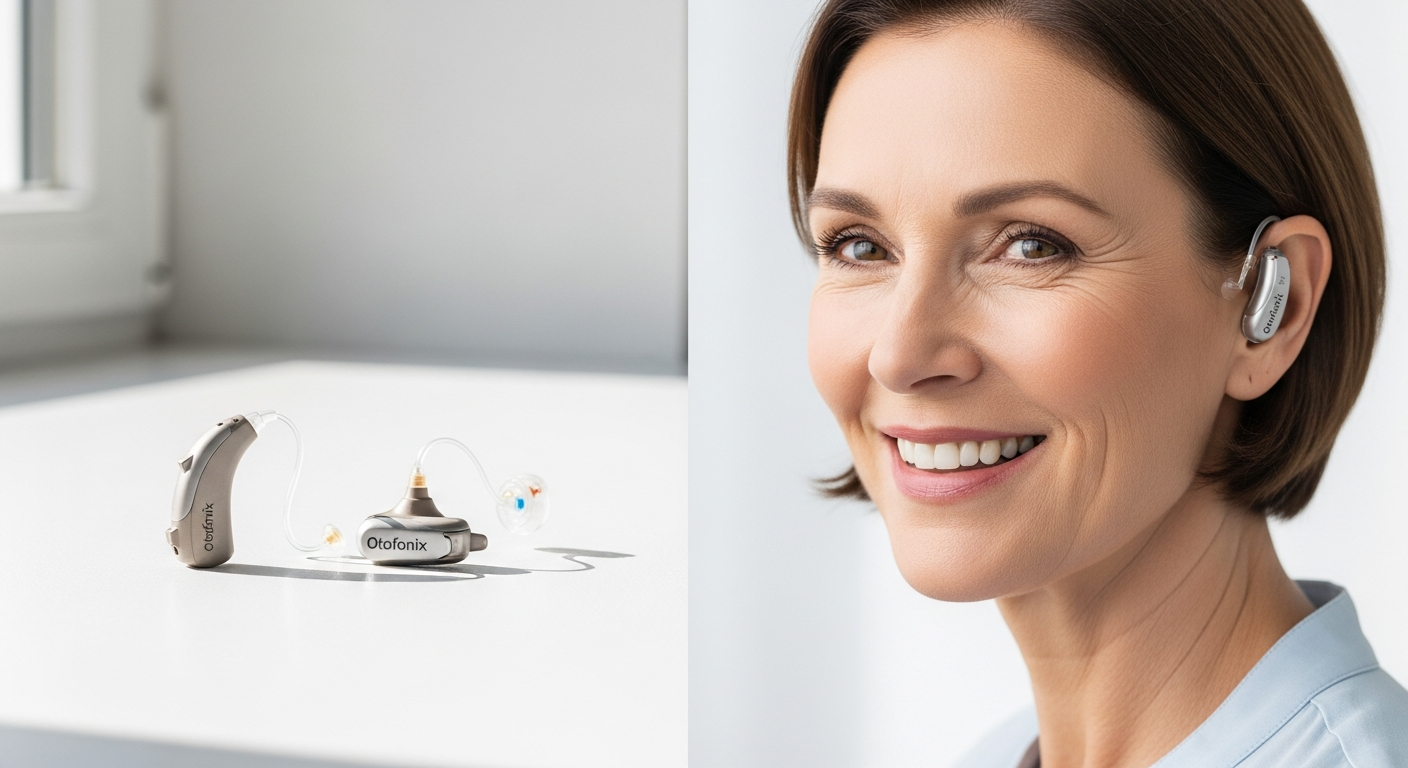
Nearly 48 million Americans experience some degree of hearing loss, yet only about 30% actually seek treatment. The barrier isn't awareness—it's cost. Most prescription hearing aids run $4,000 to $6,000 per pair, leaving millions to suffer through muffled conversations and social isolation in silence.
The Otofonix Helix rechargeable hearing aids challenge that narrative entirely. These behind-the-ear devices prove you don't need to drain your savings account to reclaim clear, vibrant hearing. Built for real people with real budgets, the Helix combines cutting-edge noise-cancellation technology with rechargeable convenience, delivering professional-grade features at a fraction of what you'd pay at a traditional audiologist's office.
Explore the Otofonix Helix rechargeable hearing aids and discover affordable clarity today.
Why Rechargeable Hearing Aids Are Changing the Game for Busy Professionals
How rechargeable technology eliminates daily battery swaps and reduces ongoing costs
Traditional hearing aids demand constant attention. You're always stocking up on tiny batteries, fumbling with replacement packs, and worrying about running out at the worst moment. The Helix rechargeable system eliminates that friction entirely. Instead of managing disposable batteries, you simply dock your hearing aids into their charging case each night. One simple habit replaces dozens of battery changes throughout the year.
Beyond convenience, this translates to real savings. Disposable hearing aid batteries cost between $150 to $300 annually per person, depending on usage. Over five years, that's substantial money saved—funds you could redirect toward other health priorities or simply pocket.
The 18-hour battery life advantage: what you can accomplish without recharging mid-day
An 18-hour battery charge covers a full day of typical use without interruption. Wake up, insert your charged hearing aids, and forget about power management until bedtime. This span accommodates working professionals, active retirees, social butterflies, and anyone who simply wants hearing aids that don't demand midday attention.
Real-world scenarios benefit enormously. A full workday, evening dinner with friends, or weekend outing proceeds uninterrupted. You're not calculating whether you'll need to recharge before an important meeting or social event.
Charging logistics: the 2-hour recharge cycle and when it fits best into your routine
Two hours represents a manageable recharge window that fits seamlessly into most daily routines. Charge them while you shower in the morning, work at your desk during lunch, or place them in their case during your evening wind-down. The compact charging case fits easily on a nightstand, office shelf, or travel bag.
Travel presents particular advantage. Unlike disposable battery users who must carry backup supplies, rechargeable users simply need their charging case. Hotels, airplanes, and road trips become simpler when you're not dependent on purchasing specific battery models in unfamiliar locations.
Comparison of rechargeable vs. traditional disposable battery hearing aids
Disposable battery hearing aids require ongoing purchasing, storage, and environmental responsibility. Rechargeable devices shift this equation entirely—lower lifetime costs, zero battery shopping, and consistent power management. The upfront investment in rechargeable technology pays dividends across years of use.
Environmental impact shouldn't be overlooked either. Traditional hearing aid batteries accumulate in landfills at an astounding rate. By switching to rechargeable technology, individual users contribute to reducing battery waste while extending their device lifespan through simpler maintenance.
Navigating Noise: How Dual Directional Microphones Improve Speech Clarity
Understanding directional microphone technology and how it isolates speech from background noise
Dual directional microphones function as intelligent audio filters. Rather than amplifying everything equally, they prioritize sound coming from in front of you while reducing noise from behind and sides. This selective processing allows conversation to emerge from otherwise chaotic acoustic environments.
The technology works by comparing sound signals arriving at each microphone. When the same sound reaches both microphones at slightly different times, the system recognizes it as directional background noise and suppresses it. Sounds arriving simultaneously—like a person speaking directly to you—are amplified and prioritized. This computational approach transforms noisy situations into manageable listening experiences.
Real-world scenarios where dual microphones excel: restaurants, offices, social gatherings
Restaurant environments present one of hearing loss's greatest challenges. Multiple conversations, kitchen noise, and background music create overwhelming acoustic complexity. Dual directional microphones allow you to focus on your dining companion while the system naturally reduces surrounding chatter.
Office settings benefit similarly. Conference calls, open-plan environments, and hallway conversations become less exhausting. Your brain receives clearer speech signals, reducing the cognitive fatigue that often accompanies hearing loss.
Social gatherings—parties, family dinners, community events—shift from isolating experiences to genuine participation. You follow conversations more naturally, respond appropriately, and remain engaged rather than constantly struggling to catch fragments.
The four listening programs: customizing your hearing experience for different environments
Four distinct listening programs allow optimization for specific situations. A "restaurant mode" emphasizes speech while suppressing ambient noise. An "outdoor mode" handles wind and distance differently than indoor scenarios. A "conversation mode" might prioritize close-range directional microphones, while a "quiet mode" works when background noise is minimal.
Users switch between programs based on environment, much like adjusting camera settings for different lighting. This customization means the Helix adapts to your life rather than forcing you to adapt to fixed hearing parameters.
Ten volume levels explained: finding your personal comfort zone
Ten distinct volume levels provide granular control. Rather than choosing between "too quiet" and "too loud," you access incremental adjustments matching your precise comfort threshold. Some users prefer subtle amplification, while others need significant volume boost—the Helix accommodates both preferences and everything between.
This range becomes particularly valuable across changing situations. A lower volume might suit quiet office work, while moderate levels fit social settings, and higher levels address noisy environments or outdoor scenarios.
Discover how the Helix's customizable programs and volume controls enhance your hearing clarity.
Telecoil Connectivity: Access Public Hearing Loop Systems Like Never Before
What is a telecoil (T-coil) and how it streams audio directly to your hearing aids
A telecoil—or T-coil—is an electromagnetic receiver built into compatible hearing aids. When activated, it picks up magnetic signals broadcasted by hearing loop systems installed in public venues. Rather than relying on microphones to capture audio from a room's speakers or speakers themselves, the telecoil receives a direct audio stream.
This direct connection eliminates background noise interference. Audio travels directly from the source to your hearing aids without passing through the room's acoustic environment. A speaker at a microphone sends signal directly to your device, resulting in crystal-clear transmission regardless of room size or ambient noise.
Public venues with hearing loop systems: theaters, airports, houses of worship, and conference halls
Theaters increasingly install hearing loop systems, allowing patrons with compatible hearing aids to hear performances with pristine clarity. Actors' dialogue and musical accompaniment stream directly to your ears at your preferred volume level.
Airports feature hearing loop systems at information desks and gate announcements. Critical travel information reaches you clearly without the ambient noise chaos of busy terminals.
Houses of worship commonly use hearing loops, enabling congregation members to hear sermons and music with full clarity. Conference halls and lecture venues similarly implement these systems, ensuring attendees with hearing aids receive equal access to presentations.
How telecoil reduces background noise while enhancing speaker clarity
The electromagnetic signal carrying telecoil audio bypasses environmental acoustics entirely. Your hearing aids receive a clean, uncolored signal directly from the source microphone. This approach differs fundamentally from microphone-based amplification, which captures everything a microphone "hears," including background noise.
Result: speaker clarity rivals one-on-one conversation quality despite potentially occupying a massive auditorium. The technology prioritizes the intended audio source exclusively.
Activation and switching between telecoil and standard microphone modes
Switching between telecoil and standard microphone operation occurs through your hearing aid's program selector. Most devices feature a simple button or remote control. When you enter a venue with hearing loop systems, activate the telecoil program. When you leave, return to standard microphone operation.
Some advanced Helix models even allow manual or automatic switching, detecting hearing loop presence and adjusting accordingly.
Behind-the-Ear Design: Balancing Discretion with Power and Comfort
Why BTE (behind-the-ear) style offers superior amplification for mild to moderate hearing loss
Behind-the-ear design houses amplification components in a compact device resting behind your ear. This configuration allows for more powerful speakers, larger battery capacity, and superior sound processing compared to tiny in-the-ear alternatives. For mild to moderate hearing loss—the Helix's target application—this design delivers necessary amplification without compromising portability.
The architecture also simplifies handling. Larger devices are easier to insert, remove, and manipulate for users with dexterity challenges or visual impairment. Maintenance and battery replacement (or in the Helix's case, charging) becomes more straightforward.
The lightweight, discreet profile: wearing them all day without fatigue
Despite housing powerful components, the Helix maintains a lightweight, streamlined profile. Many users report forgetting they're wearing hearing aids after initial adjustment periods. The discreet design means you're not advertising your hearing loss to everyone you encounter unless you choose to.
All-day wear becomes comfortable. Unlike bulkier devices or poorly-fitting models, the Helix supports full-day usage without soreness, skin irritation, or fatigue. You focus on hearing, conversations, and living—not on uncomfortable equipment.
Gain specifications: 42-53dB amplification and what these numbers mean for you
Gain refers to how much amplification the hearing aid provides. The Helix's 42-53dB gain range addresses mild to moderate hearing loss effectively. For context, normal conversation occurs around 60dB. A 45dB gain boost brings quiet sounds into comfortable listening range without over-amplifying already-adequate sound levels.
This specification aligns precisely with the condition the Helix was engineered to address. Higher-gain devices exist for severe hearing loss, but they introduce greater complexity and higher cost. The Helix's gain range represents optimal power for its target user population.
Durability and build quality for active lifestyles and outdoor use
Behind-the-ear positioning keeps hearing aids away from most moisture sources—ears themselves don't sweat significantly compared to other body areas. The design proves more durable than in-the-ear alternatives during physical activity, outdoor work, or variable climates.
Build quality throughout the Helix emphasizes reliability. Components withstand daily insertion and removal cycles, environmental exposure, and the general wear of active lives. This durability extends product lifespan, further justifying the initial investment.
Breaking Down the $399 Price Tag: Value Proposition vs. Premium Alternatives
How Otofonix Helix pricing compares to traditional prescription hearing aids ($4,000–$6,000+)
The typical prescription hearing aid costs $4,000 to $6,000 per pair—sometimes exceeding $8,000 with premium features. The Helix enters at approximately $399 per pair. This represents roughly 90% savings compared to traditional options.
That disparity isn't accidental. The Helix achieves affordability through direct-to-consumer sales, eliminating middleman markups and dispensing fees. You purchase directly from Otofonix rather than through medical professionals charging for consultation, fitting, and ongoing adjustments.
What features you're getting for under $400
Within that $399 price point, you receive genuine cutting-edge technology: rechargeable battery with 18-hour longevity, dual directional microphones, noise cancellation, four customizable listening programs, ten volume levels, telecoil connectivity, and behind-the-ear amplification suited for mild to moderate hearing loss.
Premium hearing aids priced five to ten times higher sometimes offer additional features like smartphone connectivity or artificial intelligence adjustment. However, the core hearing amplification technology differs surprisingly little. Many high-priced devices primarily offer brand prestige and professional service components rather than dramatically superior amplification quality.
Hidden costs to consider: accessories, replacement parts, and ongoing maintenance
The $399 investment covers only the hearing aids themselves. Realistic ownership considers additional expenses. Replacement earpieces might cost $30-$50 per pair. Cleaning supplies and maintenance kits run $10-$20 annually. Optional accessories like spare charging cables or protective cases add modest expenses.
Otofonix's free lifetime phone support eliminates consultation fees that traditional dispensers charge. One-year warranty coverage addresses defects without additional cost. These support inclusions actually reduce your total ownership cost compared to prescription hearing aid models requiring ongoing professional management.
Cost-per-year analysis: calculating long-term affordability
A five-year lifespan produces a per-year cost of approximately $80. Add modest maintenance and accessory costs—perhaps $20 annually—yielding roughly $100 per year. Compare this to prescription alternatives costing $800-$1,200 annually, and the Helix's affordability becomes starkly apparent.
Even accounting for occasional repairs or replacements, the Helix's cost-per-year remains dramatically lower than traditional options. This economic advantage becomes particularly meaningful for individuals managing multiple health expenses or operating on limited hearing healthcare budgets.
Your Hearing, Your Choice: Making the Helix Decision
The Otofonix Helix rechargeable hearing aids represent a genuine shift in accessibility—proving that quality hearing enhancement no longer requires a premium price tag. Whether you're tired of struggling through conversations, missing out on meetings, or feeling isolated in social settings, the Helix offers a tangible solution that's both practical and affordable.
The 18-hour rechargeable battery eliminates the frustration of constant battery replacements. The dual directional microphones and four listening programs let you customize your hearing to match your life. The telecoil connectivity opens access to hearing loop systems in theaters, airports, and places of worship. The real question isn't whether the Helix is good—it's whether it's right for you.
If you have mild to moderate hearing loss, appreciate modern convenience features, and refuse to let budget constraints keep you from hearing clearly, this device deserves serious consideration. The 45-day money-back guarantee removes the risk entirely, and the free lifetime phone support means you're never navigating this journey alone.
Reclaiming the sounds you've been missing starts with a single decision. You've waited long enough for affordable, quality hearing enhancement.
Take the first step toward better hearing with the Otofonix Helix today.
Leave a Reply