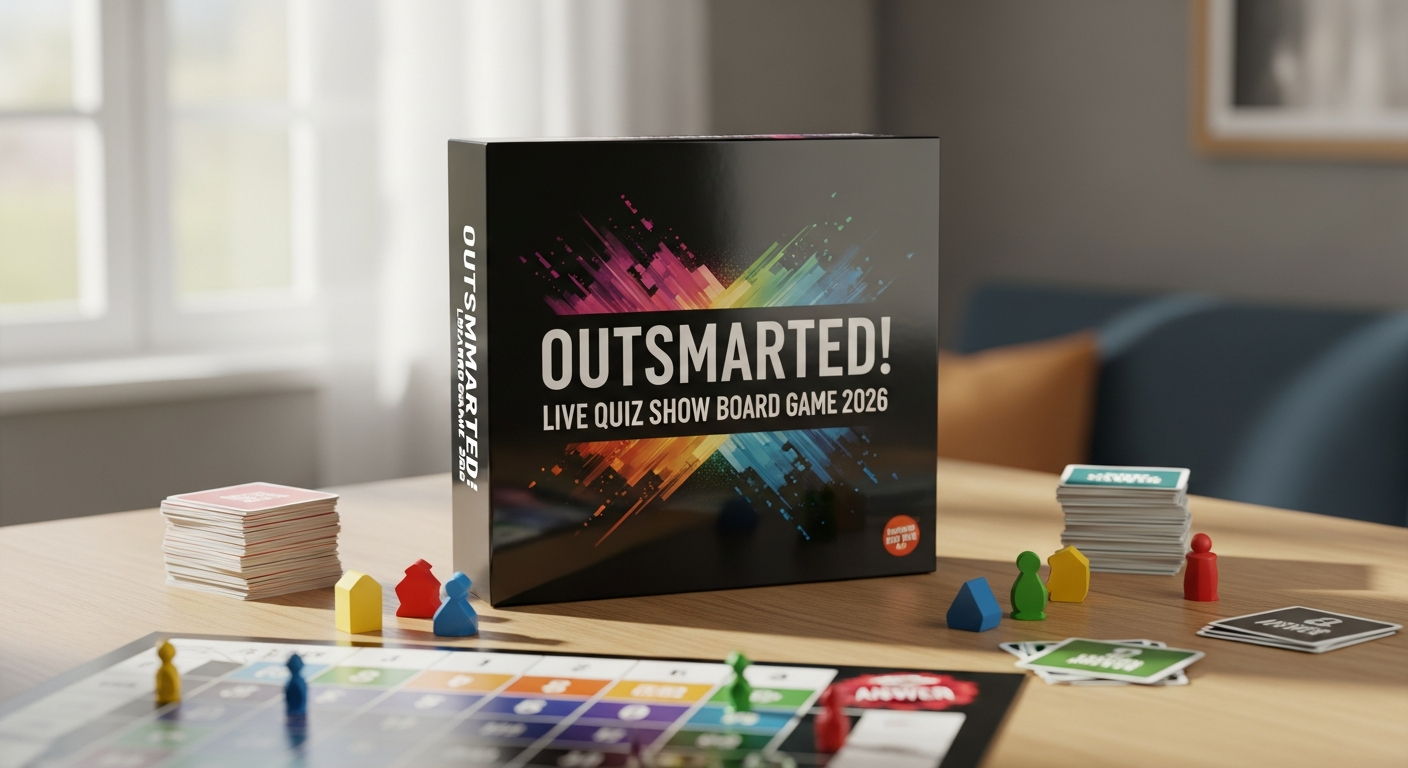
Imagine a trivia night where nobody has to read questions aloud, manage timers, or keep score manually. Outsmarted! transforms your living room into a professional-grade quiz show studio through its companion app, which acts as the intelligent host. The app runs on smartphones, tablets, or laptops and delivers questions with the polish and energy you’d expect from television. This means players can focus entirely on competing rather than administering the game.
The multimedia dimension separates Outsmarted! from every trivia board game that came before it. Over 10,000 questions aren’t simply text—they include photographs, audio clips of songs, video clips, and dynamic visual content that create genuine immersion. When you’re identifying a famous painting from a cropped detail or recognizing a melody from three seconds of audio, the experience feels exponentially more engaging than reading “Who painted Starry Night?” on a card.
The app eliminates the traditional game master role entirely. Real-time scoring appears instantly on every player’s screen, team performance updates dynamically, and the app manages all logistics while you focus on strategy and friendly competition. The physical board and player pawns still matter—they provide tangible connection and visual progress—but the digital interface handles everything that typically slows down a trivia night.
Start your Outsmarted! experience today and transform game night forever.
How the companion app transforms the game board into an interactive live quiz show
The app serves as the central nervous system of the entire experience. When you launch it, you’re not just loading a question database—you’re accessing a fully realized quiz show platform. The interface mimics television quiz formats, with dramatic reveals, sound effects, and visual animations that build anticipation between questions. Categories appear with vibrant graphics, timers count down visibly, and correct answers trigger satisfying confirmations.
The role of multimedia questions in creating immersion
Traditional trivia cards feel flat because they rely on text alone. Outsmarted!’s multimedia approach engages multiple senses simultaneously. A question might display a famous photograph and ask you to identify the location, or play a ten-second video clip and require you to name the film. Song clips make music identification immediate and authentic—you’re hearing actual audio rather than reading descriptions of music. This sensory richness transforms trivia from an intellectual exercise into entertainment that genuinely captivates players.
Why the app-hosted format eliminates the need for a traditional game master
In conventional board games, someone always plays referee. They read questions, interpret rules, settle disputes, and track scores. This role exhausts whoever takes it on and prevents them from playing competitively. Outsmarted! removes this burden by automating everything through the app. The system is impartial, consistent, and tireless. Players trust the mechanics because they’re not subject to human interpretation or bias.
Integration between physical board movement and digital question delivery
The game maintains balance between digital and physical elements. Players roll the D6 die and move their pawns around the four-panel board just like in traditional games, but landing on spaces triggers questions through the app rather than drawing cards. This integration keeps the tactile experience alive while channeling everything through the digital system. You get the best of both worlds—the satisfying physicality of board games combined with the flexibility and richness of digital content.
How the “live quiz show” atmosphere differs from standard trivia board games
Standard trivia games feel static and procedural. Players sit quietly while someone reads a question, answers come quickly, and the game continues. Outsmarted! creates theater. The app builds anticipation before revealing questions, celebrates correct answers with animations and sounds, and displays dramatic score updates. Teams feel the pressure of real-time competition. The momentum builds the same way it does during actual television quiz shows, making every question feel momentous rather than routine.
Real-time scoring and team performance tracking through the app interface
Every player sees live scoring on their individual devices. This transparency eliminates disputes and keeps everyone engaged because the current standings are always visible. The app tracks individual performance, team totals, question categories you’re strong or weak in, and historical statistics if you play multiple rounds. This data transforms a casual game night into something measurable and motivating—players naturally want to improve their categories or beat their previous scores.
Playing Across Distances—Remote Gaming Capabilities That Connect Families
Outsmarted!’s remote play feature addresses one of modern life’s great challenges: maintaining connection with loved ones who live far away. The game supports up to six connected devices simultaneously, meaning your college student, your parents three states away, and your sibling on the opposite coast can all compete in the same game as if they were sitting around the same table. Internet connectivity is the only requirement—geography becomes irrelevant.
How remote play works with up to six connected devices simultaneously
Each player or team needs access to a device with the Outsmarted! app installed and active internet connection. When you create a game session, you receive a unique code or link to share with remote players. They enter this code into their app, and everyone synchronizes to the same game instance. The app manages all coordination in the background. Questions appear simultaneously across all devices, timers sync perfectly, and scores update in real-time regardless of physical location. The experience feels native and seamless—the technology disappears entirely.
Setting up virtual game nights with players in different locations
Setup requires minimal coordination. The game organizer downloads the app, creates a player profile, and starts a new game session. They then share the session code via text, email, or messaging app. Remote players install the app on their devices (if they haven’t already), enter the shared code, and they’re immediately part of the game. No complicated video conferencing setup, no technical troubleshooting—just instant connection. The barrier to entry is genuinely low, making it feasible even for non-technical family members.
Internet requirements and device compatibility
The app functions on iOS and Android smartphones and tablets, as well as through web browsers on laptops and desktops. Minimum internet speed requirements are modest—a stable broadband connection suffices, and the app functions acceptably even on moderate mobile data connections. Older devices might experience slower performance, but the app supports a wide range of hardware from the last several years. Compatibility extends across major operating systems, ensuring nearly anyone with a connected device can participate.
Managing team assignments and player rotations in remote settings
The app’s team management system handles assignments automatically. When players join, you assign them to teams or designate them as individual competitors. The system tracks which team each player belongs to and aggregates scores accordingly. If someone needs to rotate out mid-game, you can pause and reassign without disrupting the overall match. This flexibility proves essential for remote play, where scheduling quirks might mean players joining partway through or needing to leave early.
Audio and video communication features integrated into the app
While Outsmarted! focuses primarily on the game itself, the app integrates voice communication so players can hear each other without requiring a separate video conferencing tool. This direct audio channel creates presence and allows real-time reactions, celebrations, and friendly trash talk. For groups preferring full video, most players run a simultaneous Zoom or similar service for face-to-face connection while the Outsmarted! app handles all game mechanics.
Advantages of remote play for long-distance families and friend groups
The psychological impact of remote play cannot be overstated. Families separated by distance suddenly have a structured, engaging activity to share weekly or monthly. Friends who moved apart maintain meaningful connection through competitive gameplay. Work colleagues building remote team cohesion find Outsmarted! more engaging than typical virtual happy hours. The game creates common ground and friendly competition that transcends the limitations of physical distance, making long-distance relationships feel less isolating.
Age-Adjusted Difficulty—Why Everyone Wins in Mixed-Age Households
The single most frustrating aspect of traditional family trivia games is the inevitable dominance of one player or age group. Teenagers crush questions about modern pop culture while their grandparents excel at historical trivia, and younger children feel left behind entirely. Outsmarted! solves this through intelligent difficulty adjustment across three tiers: Juniors (ages 8+), Teens, and Adults. Each player receives questions calibrated to their knowledge level, ensuring competition remains genuinely competitive regardless of age gaps.
How the three-tier difficulty system works
When you set up a game, each player indicates their age category. The app then filters questions from its vast library to match that difficulty level. Junior questions focus on accessible knowledge—recognizing famous cartoon characters, identifying basic historical events, naming common animals. Teen questions raise the complexity—more sophisticated historical context, deeper pop culture knowledge, challenging current events. Adult questions demand expertise—obscure historical details, nuanced current affairs, sophisticated cultural references. Everyone answers questions of appropriate difficulty, creating equal pressure and equal opportunity to succeed.
Preventing dominant players from overshadowing younger or less knowledgeable participants
In games where everyone answers the same questions, knowledgeable players build insurmountable leads and less knowledgeable players disengage. With age-adjusted difficulty, an eight-year-old can win an entire game against three teenagers and two adults because they’re all competing on level ground. A grandparent suddenly feels intellectually challenged again rather than like a spectator watching younger family members dominate. This fundamental fairness transforms game night from frustrating to genuinely fun for everyone.
Fair competition mechanics that level the playing field across age groups
Beyond difficulty adjustment, the scoring system recognizes that some questions inherently prove harder than others. Correctly answering a challenging question might award more points than answering an easy question. This weighted scoring further levels the field—an eight-year-old who nails a difficult Junior question gains real momentum. A teenager who stumbles on a Teen-level question doesn’t suffer catastrophic point loss. The mechanics acknowledge that difficulty varies and adjust rewards accordingly.
Question complexity and vocabulary adjustments for different age brackets
It’s not just about difficulty level—it’s about presentation. Junior questions use age-appropriate vocabulary, reference materials children know, and avoid abstract concepts. A Teen-level question might reference social media trends or contemporary musicians that adults wouldn’t recognize. Adult questions assume sophisticated knowledge and use complex language. This calibration extends beyond raw knowledge to ensure the questions themselves feel accessible and fair to each age group.
How age-adjusted difficulty encourages participation from reluctant players
Younger players who might otherwise feel intimidated suddenly find themselves answering questions they can actually answer. Success breeds confidence and engagement. An older player who worried they’d be left behind discovers they can compete effectively. Even players with knowledge gaps in certain categories find other categories where they excel. This achievement-based engagement transforms hesitant participants into active competitors who genuinely want to play again.
Customizing difficulty settings mid-game to match player skill levels
The app allows difficulty adjustments between rounds if your assessment of a player’s capability proves inaccurate. If a Junior player consistently dominates their difficulty level, you can shift them to Teen questions mid-game. If an Adult struggles, you can dial back difficulty. This flexibility acknowledges that age doesn’t perfectly predict knowledge and allows customization based on actual performance.
Content That Never Gets Stale—10,000+ Questions and Daily Refreshes
The graveyard of abandoned board games is filled with trivia sets where players have memorized all questions or grown bored seeing the same twenty-four cards repeatedly. Outsmarted! addresses this fundamental problem through sheer scale and continuous updates. The base library contains over 10,000 multimedia questions. Beyond this, six core categories ship with the game, plus over 100 optional add-on question packs covering specialized topics. Most remarkably, the “Breaking News” category refreshes daily with questions about current events, ensuring your game night always includes today’s relevant topics.
Discover how fresh daily content keeps your Outsmarted! games engaging every single time.
The massive question library spanning over 10,000 multimedia questions
The sheer volume of available questions makes repetition virtually impossible in casual play. Even if your group played multiple times weekly, you’d encounter the same question only after many months of gameplay. This abundance directly addresses a core frustration with traditional trivia games, where limited card decks make repeating questions inevitable. The digital format makes housing 10,000+ questions economically feasible in ways physical cards never could be.
Six core categories available in the base game with over 100 optional add-on packs
The base game ships with six primary categories covering broad knowledge areas. Additional question packs available as in-app purchases (typically $2.49 to $3.49 each) specialize in niches: movie franchises, specific historical eras, specific sports leagues, celebrity culture, technology, world capitals, or virtually any topic you can imagine. This modular approach lets each household customize their question library to match their group’s interests and knowledge bases.
The “Breaking News” category that updates daily with current events
This feature represents genuine innovation in trivia gaming. Each day, new questions appear covering that day’s news events. If a significant political development occurred, expect questions about it. If a major cultural event happened, it becomes trivia material. This daily refresh means your game night incorporates genuinely current information rather than static knowledge. It also means players who follow current events have an advantage in this specific category, which feels fair and rewarding.
How frequently new questions are added to prevent repetition and maintain engagement
Beyond the daily Breaking News category, the core library expands periodically with new question batches. Seasonal collections appear during holidays or around major events. These additions ensure that even players who’ve completed all original questions find fresh material regularly. The content strategy prioritizes preventing the stale feeling that plagues traditional games, making replayability feel infinite rather than merely adequate.
In-app purchase options for expanding your question library
Question pack purchases range from $2.49 to $3.49 for individual packs, with discounted bundle options available. This monetization approach differs from traditional games where you’re locked into whatever questions came in the box. You can start with the base game and expand only the categories your household cares about. Families obsessed with music trivia might purchase every music-related pack, while sports-focused groups gravitate toward sports expansions. This flexibility ensures everyone creates their ideal question library.
Seasonal and themed question collections throughout the year
Around major holidays or anticipated cultural events, Outsmarted! releases themed collections. Halloween-focused questions appear in October, Christmas questions in December, Olympics questions during Olympic years, and so on. These seasonal offerings give you reasons to explore new content beyond the core library and create timely relevance. They also serve as natural gift ideas—a new question pack collection makes an easy gift for players who already own the base game.
Flexible Gameplay Modes—From Quick Sessions to Marathon Nights
Some nights you have thirty minutes while kids finish homework. Other nights you’ve cleared the entire evening for dedicated game time. Outsmarted! accommodates both scenarios through adjustable game formats that adapt to your schedule and preferences. The game offers multiple winning conditions—you can play for points like traditional games or collect “Rings of Knowledge” in the style of Trivial Pursuit. Game length is completely flexible, from express rounds lasting thirty minutes to full campaigns spanning hours.
Playing for points versus collecting “Rings of Knowledge” (Trivial Pursuit-style)
The points system offers straightforward competition—answer questions correctly, earn points, highest score wins. This format rewards consistency and breadth of knowledge across all categories. Rings of Knowledge mode operates differently: correctly answering questions in a particular category earns you a ring for that category. Your goal is collecting one ring in each category before opponents do the same. This Trivial Pursuit-style format changes strategy significantly—you might focus on your weak categories first to prevent opponents from dominating them, or build on strengths strategically. Both modes create compelling gameplay with different psychological dynamics.
Quick 30-minute games for busy schedules and full-length games for dedicated nights
The app lets you preset game length before starting. A quick game might include just three questions per category and one full rotation around the board. A full game might extend to five or six rotations with bonus questions, allowing deeper strategy and more chances for momentum shifts. This flexibility makes Outsmarted! feasible for weeknight family time when everyone’s exhausted and just wants an hour of connection, as well as for weekend marathons where you block out three hours for serious competition.
Customizable game lengths based on player availability and preferences
Beyond preset options, you can adjust almost every game parameter manually. Add more rounds if you’re having fun and want to keep playing. Skip the final round if someone needs to leave early. Increase or decrease the number of questions per category. These granular controls acknowledge that game nights rarely follow perfect schedules—someone arrives late, someone else needs to leave early, or you simply want to keep playing because the energy is great. The flexibility ensures the game adapts to your reality rather than forcing you into rigid structures.
Team play options supporting up to six teams with solo challenge modes available
Outsmarted! supports competitive formats ranging from free-for-all competition (individuals battling individually) to team-based play (up to six teams competing together). Team formats allow stronger and weaker players to balance out, create natural groupings when you have even numbers, or force strategic team composition challenges. Solo modes work perfectly for two-player matches or when players prefer direct head-to-head competition without team dynamics.
Practice modes for learning questions before playing with others competitively
Want to warm up before a serious game? Practice mode lets you answer questions without competitive pressure. This serves multiple purposes: new players learn game mechanics, players unfamiliar with certain categories build confidence, or dedicated competitors study advanced material. Practice mode feels less intimidating for younger or less confident players, giving them opportunity to succeed privately before competing publicly.
Tournament-style brackets for larger groups or recurring game nights
If your friend group plays Outsmarted! regularly, you can organize tournament brackets tracking wins across multiple nights. The app manages bracket mechanics, tracks advancing players, and maintains historical records. This formalized structure appeals to competitive groups wanting to build narrative across multiple game sessions. A champion emerges from a season of play. Players track their head-to-head records against each other. The stakes feel meaningful rather than casual.
Technical Setup and Device Requirements—What You Actually Need
Outsmarted! requires far less technical infrastructure than you might expect. The fundamental requirement is a stable internet connection and at least one compatible device to run the app. That’s genuinely the baseline. Beyond that, having devices for each player provides the optimal experience, but the game accommodates various configurations.
Minimum internet connection specifications for stable gameplay and performance
A standard broadband connection of 10 Mbps or faster provides completely stable gameplay. The app compresses data efficiently, so even moderate mobile data connections function adequately, though WiFi proves more reliable for uninterrupted play. Poor connections cause occasional lag or syncing delays, but the game tolerates imperfect networks better than many apps because the actual data being transmitted is modest—questions display quickly, and answer submissions transfer instantly.
Compatible devices and OS requirements for all players
The app runs on iOS 12 or later for Apple devices and Android 6.0 or later for Android devices. It’s also accessible through web browsers on laptops and desktops, making it truly cross-platform. This broad compatibility means almost anyone with a modern smartphone, tablet, or computer can participate. The only real limitation affects people with devices manufactured before roughly 2015 or those running heavily outdated operating systems.
The physical board components
The physical components remain modest: a four-panel board, an oversized D6 die, and player pawns representing historical figures. These pieces aren’t essential to gameplay—they’re entirely cosmetic and psychological. The game functions perfectly through the app alone if you prefer not using physical pieces. However, the board and pawns add tactile satisfaction and visual progress that many players appreciate. Moving your pawn around the board after answering correctly creates real-world feedback that purely digital games can’t replicate.
Setting up the app on multiple devices for simultaneous play across locations
Each player needs the app installed on their personal device. Installation takes minutes from the iOS App Store or Google Play. Creating an account requires basic information and an email address. Once accounts exist, joining a game session is as simple as entering a shared code. The synchronization happens automatically—everyone’s devices stay perfectly in sync despite being geographically dispersed. Initial setup proves straightforward even for non-technical users.
Device storage requirements for the app and question libraries
The app itself occupies approximately 500 MB of storage space. Question libraries download gradually as needed rather than requiring all 10,000+ questions stored locally. This approach minimizes storage burden on personal devices. Even phones with modest storage capacity accommodate Outsmarted! without difficulty. Optional question pack purchases download individually, allowing you to delete packs you’ve grown tired of and reinstall them later without re-purchasing.
Recommended device specifications for optimal performance and smooth gameplay
While the app functions acceptably on basic devices, newer smartphones and tablets (from the past three to four years) provide the smoothest experience with minimal lag. Devices with at least 4 GB of RAM and dual-core processors handle everything without stuttering. These specifications are modest and describe virtually all modern devices. Only older or budget-tier hardware shows notable performance limitations. For most household devices already in circulation, optimal performance is the default.
Pricing Breakdown—Understanding the Investment Beyond the Base Game
Outsmarted! positions itself as a premium board game, with base game pricing at £28.89 to £34.99 in the UK and $29.99 in the US. This price point places it in the upper middle range of contemporary board games—more expensive than mass-market options but cheaper than luxury specialty games. Understanding the full investment picture requires looking beyond the base game price.
Base game cost with optional question pack pricing
Your initial investment covers the physical components and access to the core 10,000-question library with six primary categories. This foundation supports unlimited gameplay with no additional spending required. However, optional question packs priced at $2.49 to $3.49 each let you expand into specialized topics. Multiplayer bundles offering five to ten packs at discounted rates typically cost $9.99 to $14.99. One household might spend $30 on the base game and never spend another dime. Another might invest $80 over a year gradually adding packs reflecting their evolving interests.
One-time purchase versus subscription model comparison and value analysis
Outsmarted! uses a one-time purchase model for the base game plus optional à la carte pack purchases. No subscription is required. This differs favorably from other entertainment platforms requiring ongoing monthly fees. You buy the game once and retain access permanently. While question packs cost money, you purchase only the expansions you actually want. This model appeals to families preferring predictable costs and long-term ownership rather than recurring fees.
Value proposition compared to other premium board games and entertainment options
A premium modern board game typically costs $30 to $50 and offers perhaps one hundred hours of total entertainment before players exhaust the content or grow bored. Outsmarted! delivers thousands of hours of potential gameplay through its vast question library and daily updates. That means cost per hour of entertainment drops significantly over time. After just three months of weekly game nights, you’ve amortized the base game cost over substantial usage, making long-term value exceptional. Compared to monthly streaming subscriptions or regular dining out, Outsmarted! represents an efficient entertainment investment.
Seasonal sales and promotional pricing opportunities throughout the year
Retailers discount Outsmarted! during major holiday shopping periods and seasonal events. Black Friday, Cyber Monday, Christmas, and back-to-school sales typically offer 15% to 30% discounts from the base price. Early adopters who purchased at launch often qualify for early access to new features. Following social media channels and signing up for the publisher’s email list ensures you catch promotions before they sell out. These discounts meaningfully reduce the effective base game cost.
Bundle deals combining base game with popular question packs at discounted rates
Periodically, the publisher releases bundles pairing the base game with two to four question pack collections at bundled pricing. These bundles provide better value than purchasing everything individually. A bundle including the game plus four themed pack collections might cost $49 to $59 compared to $50+ for the base game alone plus individual pack purchases. These tiered bundle options acknowledge that different households want different content volumes and price accordingly.
Cost per play hour over extended ownership and long-term value considerations
This metric matters most for long-term evaluation. If your family plays weekly, the base game becomes incredibly cost-effective within a year. You’d accumulate roughly fifty game nights of entertainment from a $30 investment—just sixty cents per hour. Even accounting for optional pack purchases, cost per hour remains negligible compared to other entertainment. Casual players enjoying monthly games accumulate entertainment more slowly, but still achieve reasonable value within eighteen months of ownership. Only households that purchase and never play represent genuinely poor value.
Where Outsmarted! Shines—Real-World Advantages for Modern Gamers
Beyond the mechanics and features, Outsmarted! addresses genuine needs in contemporary entertainment and family dynamics. It succeeds because it solves real problems that traditional games fail to address.
Modernizing trivia for audiences fatigued by traditional formats and static questions
Many adults abandoned board games because traditional offerings feel stale and dated. Card-based trivia games haven’t fundamentally evolved in decades. Outsmarted! brings board gaming into the 21st century through multimedia elements, app-driven delivery, and content that reflects current culture. Players who’d dismissed board games as antiquated find themselves genuinely engaged by this format. The “live quiz show” presentation transforms trivia from an academic exercise into entertainment comparable to television programming.
Accessibility for players with varying knowledge bases and diverse interests
Traditional games often favor one knowledge domain—pop culture experts dominate pop culture trivia, sports enthusiasts dominate sports games, and history buffs dominate history games. Outsmarted!’s breadth across hundreds of categories and question types means nearly everyone excels somewhere. A player weak in music might devastate competitors on geography questions. Another player weak at current events might shine on classic cinema. The game rewards diverse knowledge rather than specialist expertise, making everyone feel capable of winning.
Social connection benefits during remote or hybrid work environments and schedules
Modern life frequently separates people despite technology’s promises of constant connectivity. Outsmarted! provides structured, engaging interaction that superficial video calls can’t replicate. Families separated by distance create weekly game night traditions. Remote teams building cohesion find this more meaningful than generic team-building exercises. The synchronous, competitive nature creates genuine presence and connection despite physical distance.
Educational value through current events and diverse question categories
The “Breaking News” category means players stay informed about current events through game engagement. Children exposed to diverse questions across hundreds of categories naturally expand their knowledge. Adults discovering knowledge gaps become motivated to learn more. The game rewards curiosity—questions about unfamiliar topics create learning opportunities. Unlike passive education, the competitive framework makes learning feel rewarding rather than obligatory.
Engagement levels compared to passive entertainment alternatives and screen time
Streaming services offer infinite passive entertainment requiring no engagement. Outsmarted! demands active participation, strategic thinking, and interpersonal interaction. Players leave game nights mentally stimulated and socially connected rather than glazed from passively consuming content. For families and friend groups concerned about screen time quality, active screen use through competitive gaming proves more valuable than passive viewing.
Inclusivity that makes competitive gaming enjoyable for all skill levels and ages
Traditional games often feature dominant players who win predictably. Outsmarted!’s age adjustment, diverse question types, and multiple winning formats create genuine competition where anyone can win. This inclusivity transforms game night from frustrating for weaker players into genuinely fun for everyone. That shift—from someone playing because they feel obligated to someone playing because they genuinely want to—represents the game’s greatest achievement.
Honest Limitations—When Outsmarted! Might Not Be Your Game
No product suits everyone, and Outsmarted! has legitimate constraints worth understanding before purchasing. Being transparent about limitations helps ensure you make informed decisions.
Internet dependency as a barrier for unreliable connections or offline play
If your household features unreliable internet or you want to play offline during trips without connectivity, Outsmarted!’s app-based architecture becomes problematic. Unlike traditional board games that function anywhere, this game requires stable internet throughout play. Vacation homes with spotty WiFi, remote locations without reliable service, or countries with limited infrastructure present genuine barriers. For households with solid internet connectivity, this limitation barely registers. For others, it proves dealbreaking.
Reported occasional glitches in team mode setup and player assignment systems
While generally stable, some users report sporadic issues with team formation, particularly when managing many simultaneous players. Questions might appear out of sync across devices occasionally, or team assignments might reset unexpectedly. These glitches prove frustrating but rare. They typically resolve by restarting the app or adjusting team assignments. Players accustomed to flawless performance from other apps might find occasional technical hiccups annoying, though frequency decreases as the software matures.
The tactile experience trade-off when most interaction occurs through the app
Despite physical board components, the primary interaction happens through the digital app. Questions appear on screens, answers submit through screens, and scoring displays on screens. The board and pieces become almost ceremonial—pleasant but not essential. Players preferring the full tactile experience of traditional board games, where shuffling cards and moving pieces forms core interaction, might feel the physicality proves underwhelming. The app-centric design appeals to digital-native players but potentially disappoints traditionalists.
Timer speed concerns for older players or those needing more response time
The default answer timer moves quickly—typically allowing 30 to 45 seconds per question. For older players, those with processing delays, or people who simply think carefully before answering, this pace feels rushed. The app allows adjustment to slower timers, but players unfamiliar with the settings might not realize customization is possible. Players who prefer leisurely, thoughtful gameplay might prefer traditional trivia where no timer pressure exists.
Learning curve for players unfamiliar with app-based gaming and digital interfaces
Despite intuitive app design, genuinely non-technical players might struggle initially with installation, account creation, joining shared games, or adjusting settings. The learning curve is modest and quickly conquered, but during first games, technical confusion might distract from enjoyment. Family members resistant to technology might grumble about app navigation even after you explain it clearly. This proves temporary—after one or two games, mechanics become automatic—but the friction point exists.
Device compatibility issues with older smartphones or tablets and legacy systems
Devices manufactured before 2015 or those running ancient operating system versions might not support the app. This affects only small percentages of households with modernish devices, but relevant for anyone still using legacy hardware. Windows Phone users (rare but extant) cannot participate natively, though web browser access might work. For almost all contemporary device owners, compatibility proves irrelevant, but edge cases exist.
Outsmarted! Versus Traditional Trivia Games—A Head-to-Head Breakdown
Comparing Outsmarted! to classic trivia board games reveals precisely where innovation creates advantages and where traditionalists might prefer established formats.
Dynamic multimedia questions versus static text-based trivia cards and formats
Traditional trivia relies on written questions read aloud. Outsmarted! questions appear visually with images, videos, and audio. A question about a song plays the actual song rather than describing it. A question about a painting displays the actual artwork. This multimedia approach creates dramatically higher engagement and more authentic competition. You’re identifying paintings from visual appearance rather than reading descriptions. The immersion advantage belongs entirely to Outsmarted!.
Automated scoring and timer management versus manual gameplay and scorekeeping
Traditional games require someone tracking scores on paper or memory. Players dispute scoring, debate timer accuracy, and sometimes lose track entirely. Outsmarted! automates everything perfectly. Scores appear instantly and transparently on every device. Timers remain impartial. No player can claim they were unfairly timed or scored. This automation eliminates friction and disagreements, creating smoother gameplay. However, some players enjoy the slightly slower pace and personal interaction of manual scorekeeping.
Content freshness and daily updates versus static question banks and limited decks
Traditional games feature finite question sets. After enough plays, you’re repeating questions. Outsmarted!’s library of 10,000+ questions makes repetition unlikely in casual play. The daily Breaking News category ensures content stays current. Traditional games with printed cards cannot refresh like digital content, making content staleness inevitable over time. This advantage belongs decisively to Outsmarted!.
Age-adjusted difficulty versus one-size-fits-all question difficulty levels
Traditional trivia games typically offer one difficulty level. Everyone answers the same questions regardless of age or knowledge. This creates inevitable unfairness when age gaps exist. Outsmarted!’s age-adjusted system levels the playing field dramatically. Mixed-age households find traditional games frustrating precisely because fairness becomes impossible. Outsmarted! solves this through intelligent calibration.
Remote play capabilities versus local-only gaming and distance limitations
Traditional board games require physical presence. Outsmarted! enables remote play across any distance. For families separated geographically, this capability proves revolutionary. Traditional games cannot compete because the feature simply doesn’t exist. For co-located groups, both function equally, but Outsmarted!’s remote capability removes a significant limitation.
Replayability factor with 10,000+ questions versus limited card decks and repetition
A traditional trivia game might include three hundred questions. After thirty games, you’re repeating questions extensively. Outsmarted!’s vast library virtually guarantees fresh questions for hundreds of plays. Even casual weekly players encounter repetition only after six months or longer. This replayability advantage transforms Outsmarted! into a long-term investment whereas traditional games inevitably become stale.
Setting Up Your First Game—A Practical Getting Started Guide
Getting started with Outsmarted! is straightforward, but a guided approach prevents common mistakes and ensures smooth first experiences.
Downloading and installing the app on your primary device and all player devices
Visit the iOS App Store or Google Play Store depending on your device type. Search for “Outsmarted!” and download the official app. Installation takes approximately three minutes. Ask all players to download the app before your first game—having everyone prepared prevents delays. The app works immediately upon download, though account creation comes next.
Creating an account and setting up player profiles with difficulty preferences
Launch the app and follow the account creation prompt. You’ll provide an email address and password. Create a player profile with your name and select your age category (Junior, Teen, Adult). Each player should create their own profile with appropriate age selection—this drives the difficulty customization that makes the game fair. Once profiles exist, they’re ready to use for any future games.
Selecting your first game mode and categories
Start with “Points” mode if you want straightforward scoring, or “Rings of Knowledge” if you prefer Trivial Pursuit-style collection. For your first game, stick with the core categories rather than adding optional packs. This keeps things simple and prevents overwhelming new players with options. You can explore optional packs in subsequent games after you understand
Leave a Reply