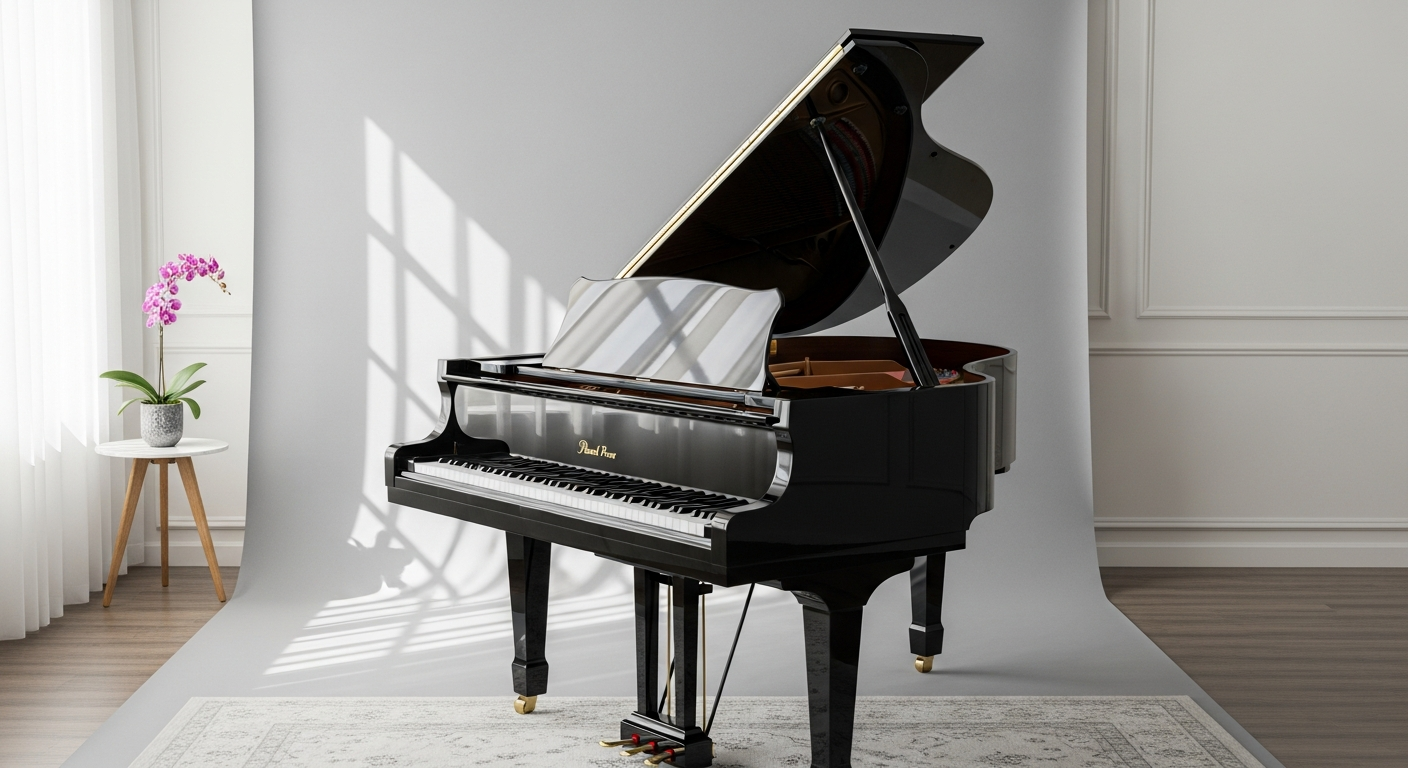
When competitors costing twice as much struggle to match its resonance and responsiveness, you know something extraordinary is happening in the piano market. The Pearl River GP150 Baby Grand Piano represents a watershed moment where the world's largest piano manufacturer has engineered a 4'11" instrument that delivers a unique voice rivaling grands significantly larger and considerably more expensive.
Pearl River Piano Group has synthesized centuries of European piano-building tradition with cutting-edge manufacturing precision to create an instrument that bridges the gap between aspiring pianists and seasoned professionals. This baby grand doesn't force you to compromise between budget constraints and sonic excellence—it simply delivers both.
Explore the Pearl River GP150 and experience its award-winning performance firsthand.
The Engineering Behind Pearl River's Signature Sound Quality
The GP150's sonic character stems from deliberate engineering choices that maximize tonal projection and expressive capability. Vertically laminated bridges with solid maple caps create the foundation for resonance that fills a room without becoming harsh or overwhelming.
German hammer felt specifications are engineered to precise tolerances, contributing to a dynamic range that responsive players can exploit across soft, intimate passages and powerful, brilliant sections. This isn't generic felt—it's specified to support the particular touch characteristics Pearl River has cultivated across decades of refinement.
German Scale design implementation ensures a full-bodied tone with clarity across all registers. Whether you're playing in the lowest octaves or the highest treble, the instrument maintains tonal coherence without any register sounding thin or disconnected from the whole.
Solid brass hardware and components aren't merely aesthetic choices. They support consistent performance over decades by resisting oxidation and mechanical degradation that can compromise responsiveness and tonal integrity.
Evaluating the Touch Weight and Action Response for Different Pianists
Action Consistency Across the Keyboard
A light, responsive touch mechanism is the GP150's calling card, and it appeals to both classical and contemporary players because it doesn't impose a particular stylistic viewpoint. The action feels immediate without being twitchy, allowing technique-focused players to develop precision without fighting resistance.
Action consistency across the keyboard ensures uniform feel from the lowest notes to the highest treble. This matters more than casual listeners realize—an inconsistent action creates frustration and actually limits musical expression because you're constantly compensating for mechanical variation rather than focusing on interpretation.
Customization and Professional Readiness
Adjustment capabilities for personal preference allow technician-guided customization post-purchase. If you prefer slightly heavier touch weight for classical repertoire, or need the action regulation adjusted for your particular technique, skilled technicians can make these refinements without compromising the instrument's core character.
This responsiveness supports complex repertoire and dynamic expression that separates the GP150 from budget-category instruments. Players attempting Rachmaninoff, Prokofiev, or contemporary classical works have the mechanical responsiveness their interpretations demand.
Dimensions and Placement: Is the 4'11" Size Right for Your Space?
Baby grand classification delivers sound projection and tonal depth suitable for most venues without occupying the footprint of a 6-foot concert grand. The GP150's proportions make it practical for real-world spaces where full concert grands simply don't fit.
Home studio requirements typically need 200+ square feet with adequate ceiling height—roughly a 14' × 14' space—to allow sound to develop naturally without excessive reflections that muddy the tone. Smaller rooms still benefit from the GP150, though you'll want to consider acoustic treatment if walls are overly reflective.
Smaller venue compatibility makes the GP150 ideal for recital halls and intimate performance spaces where a concert grand would overwhelm the acoustic environment. Many teaching professionals and performing musicians choose the GP150 specifically because it suits the spaces where they actually perform.
Acoustic considerations vary significantly between living rooms and dedicated music rooms. A living room with carpet and soft furnishings naturally dampens high frequencies, while a dedicated music room with harder surfaces and higher ceilings allows fuller tonal projection. Both scenarios work with the GP150—you're simply adjusting for the space itself, not compensating for instrument limitations.
Affordability Without Compromise: Understanding the Value Proposition
Discover why the Pearl River GP150 offers unmatched value in the luxury piano market.
Price positioning at $14,500–$17,780 undercuts European competitors priced at $25,000 and beyond. That price differential isn't incidental—it reflects genuine manufacturing advantages that Pearl River has developed as the world's largest piano producer.
Manufacturing efficiency advantages allow Pearl River to reduce costs without compromising quality. Vertical integration, scale economies, and precision machinery mean fewer defects, less waste, and faster production timelines. These savings transfer directly to buyers rather than being absorbed as corporate margins.
Financing options and payment plans improve accessibility for serious buyers. Many dealers offer structured financing that makes the investment manageable across 24–60 month periods, effectively spreading the cost without dramatic increases from interest.
Resale market strength means Pearl River instruments hold value better than budget alternatives. A GP150 purchased today will retain 60–70% of its value in five years, whereas budget-category pianos depreciate to 40–50%. This durability of value matters if life circumstances eventually force a sale.
Real-World Performance: From Home Practice to Concert Venues
Tonal projection in residential settings fills a room with rich, articulate sound without overwhelming listeners or fatiguing ears during extended practice sessions. The balance between projection and restraint makes the GP150 equally suitable for intimate performances and daily practice routines.
Suitability for recording sessions captures acoustic characteristics that translate exceptionally well to microphone. Engineers consistently praise Pearl River instruments for recording qualities—they don't require excessive microphone technique to capture authentic piano tone.
Professional recital hall performance demonstrates why musicians confidently perform on this model in front audiences and adjudicators. The GP150 commands respect in formal performance contexts despite its mid-range price point.
Dynamic range capabilities provide expressive potential across soft and powerful playing styles. You can play ppp passages with clarity and control, then shift seamlessly to fff passages with brilliant projection—without the instrument ever feeling unstable or compromised.
How the GP150 Compares to Competitors in the $15,000–$20,000 Range
Pearl River Versus Yamaha Baby Grands
Pearl River and Yamaha baby grands occupy similar price territory but present distinct tonal characteristics and touch weight differences. Yamaha pianos tend toward brightness and clarity, while Pearl River emphasizes warmth and resonance. Both approaches have merit—your preference depends on whether you're drawn to a more brilliant or darker tonal palette.
Touch weight in Yamaha models often feels slightly heavier, appealing to pianists trained on traditional action specifications. The GP150's lighter touch appeals to players who prioritize responsiveness and speed of repetition.
Pearl River Versus Kawai Models
Pearl River versus Kawai models reveals different construction philosophies. Kawai instruments utilize advanced synthetic materials and modern innovations, while Pearl River emphasizes traditional construction methods with contemporary precision manufacturing. Sonically, Kawai pianos often sound more uniformly refined across registers, while Pearl River instruments develop a more distinctive character.
Build quality improvements over previous generations address historical concerns with modern innovations. Earlier Pearl River models occasionally generated comments about action consistency or voicing variability. Contemporary production standards have essentially eliminated these issues, with build quality now matching or exceeding competitors in the same price bracket.
Customer preference data explains why musicians increasingly choose Pearl River in this price bracket. Hands-on comparisons consistently show players gravitating toward the GP150's tonal character and touch responsiveness, even when comparing directly against established European brands costing $5,000–$10,000 more.
Maintenance, Care, and Long-Term Investment Protection
Regular tuning requirements typically occur 2–4 times yearly depending on usage and environment. A piano used several hours daily in a climate-controlled home might need quarterly tuning, while occasional-use instruments in stable environments might sustain pitch stability with biannual tuning.
Seasonal humidity management protects performance and longevity through environmental control. Pianos are fundamentally wooden instruments sensitive to moisture fluctuations. A room humidifier in winter and dehumidifier in summer maintain the 40–50% relative humidity range where pianos perform optimally.
Preventative maintenance schedule recommended by technicians keeps the piano responsive and reliable. Annual inspections catching minor issues before they become significant problems cost far less than ignoring maintenance and facing major action work later.
Action regulation and voicing services maintain the instrument's touch and tonal characteristics over time. After several years of use, the action mechanism gradually settles and adjusts, and hammer felt gradually compacts. Professional regulation and voicing restore the original responsiveness and tone that attracted you to the instrument initially.
Making Your Decision: Is the Pearl River GP150 Your Next Piano?
The Pearl River GP150 represents a genuine inflection point in the luxury piano market. You're no longer forced to choose between affordability and exceptional sound—this instrument delivers both without compromise.
The combination of German engineering, vertically laminated bridges, responsive touch weight, and stunning aesthetic options creates a package that performs well above its price point. Whether you're a dedicated home musician, a teaching professional, or a performer seeking a reliable companion for smaller venues, the GP150 addresses real needs without forcing you to accept limitations.
The investment typically ranges from $14,500 to $17,780—significant money certainly, but positioned strategically below the $20,000 threshold where European competitors operate. When you factor in durability, resale value strength, and the sheer satisfaction of playing an instrument this responsive and resonant, the value proposition becomes undeniable.
Your next step involves scheduling a hands-on session with a Pearl River dealer in your area. Playing the GP150 yourself—feeling the action, hearing how it sounds in the space where you'll perform—transforms abstract comparisons into direct experience. That moment when you sit at the keyboard and realize you're playing something genuinely exceptional at a price that makes financial sense is when this decision moves from intellectual to personal.
Visit Pearl River's official site and connect with authorized dealers offering the GP150 today.
Leave a Reply