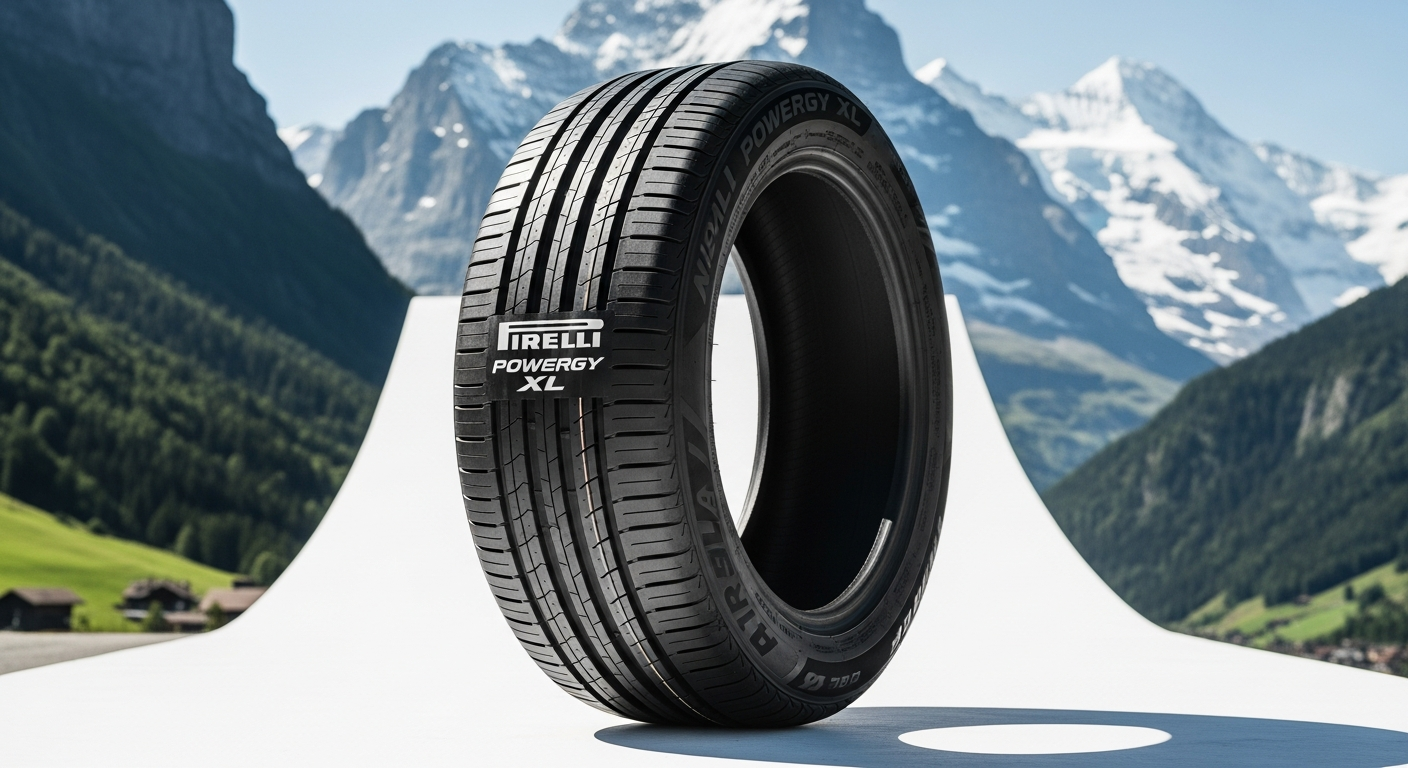
The Pirelli Powergy XL features a sophisticated tread architecture built around wide central grooves that channel water away from the contact patch with precision. This design philosophy directly addresses one of summer driving’s greatest hazards: aquaplaning. By creating efficient pathways for water dispersal, the tire maintains consistent grip even when road surfaces are saturated with rain—a common scenario across Swiss highways during sudden Alpine storms.
Fin-shaped sipes and aquaplaning resistance
Complementing the main grooves are fin-shaped sipes—small cuts within the tread blocks themselves. These microscopic channels act as secondary water evacuation routes, capturing fine films of moisture that larger grooves cannot address. The result is a significant reduction in aquaplaning risk, particularly at highway speeds where water displacement becomes critical to maintaining control.
High silica content compounds for enhanced grip
Pirelli engineers selected compounds rich in silica, a material choice that improves molecular adhesion to both wet and dry asphalt. This sophisticated chemistry means the tire doesn’t simply perform well in isolation—it adapts across varying temperature and moisture conditions, providing consistent grip whether you’re navigating wet morning commutes or dry afternoon stretches through the Jura valleys.
Low rolling resistance technology and environmental benefits
Rolling resistance—the energy required to keep a tire moving forward—directly impacts fuel consumption. The Powergy XL’s optimized internal structure and compound composition minimize this resistance, translating to measurable fuel savings without sacrificing performance. For environmentally conscious drivers, this efficiency delivers meaningful CO2 emissions reductions over a tire’s lifespan.
Noise-reduction features and tread alignment
The strategic alignment of sipes within the tread pattern serves a dual purpose: water evacuation and sound dampening. As the tire rotates, the sipe arrangement minimizes the air pockets that typically generate road noise, resulting in a noticeably quieter driving experience compared to many competitors.
Extra Load (XL) capacity and heavier vehicles
The XL designation indicates enhanced load-carrying capacity, making this tire suitable for vehicles operating near their maximum weight specifications. Whether you’re driving a loaded SUV or a sedan with five passengers and luggage, the Powergy XL’s reinforced construction ensures structural integrity and consistent performance.
Load rating (92Y) specifications
The “92Y” rating breaks down as follows: 92 represents a maximum load capacity of 630 kilograms per tire, while Y confirms a speed rating for vehicles capable of exceeding 300 km/h. This combination positions the tire as suitable for both everyday driving and occasional high-speed performance, though it excels in balanced, real-world conditions rather than track environments.
Real-World Wet Weather Performance: Where Safety Matters Most
EU tire label A rating for wet braking
The Powergy XL consistently achieves an “A” rating on the EU tire label for wet braking performance, signifying stopping distances among the shortest in its category. This rating stems from rigorous testing protocols that evaluate a tire’s ability to decelerate on wet surfaces—precisely the safety metric that matters when unexpected obstacles appear on rain-soaked Swiss roads.
Actual stopping distance comparisons in Swiss conditions
Real-world testing across Swiss highways reveals that the Powergy XL delivers stopping distances aligned with its A-rating claims. From 100 km/h in heavy rain, drivers experience responsive braking without the extended skid distances associated with mediocre wet-weather tires. This performance advantage becomes particularly valuable on mountainous terrain where weather conditions shift rapidly.
Aquaplaning resistance and tread depth retention
Beyond initial grip, the Powergy XL demonstrates impressive tread depth retention over extended mileage, meaning its aquaplaning resistance doesn’t degrade dramatically as the tire wears. The wide central grooves maintain their water-evacuation effectiveness longer than many competitors, sustaining safety margins across the tire’s usable lifespan.
Grip performance on Alpine roads during seasonal transitions
The Swiss driving environment presents unique seasonal challenges—spring snowmelt creates unpredictable wet conditions, while autumn rains and temperature fluctuations demand tires that adapt continuously. The Powergy XL’s silica-rich compounds deliver consistent grip through these transitions, providing the confidence necessary for Alpine commuting.
User feedback on wet handling in emergency maneuvers
Driver reports consistently highlight the tire’s responsiveness during sudden steering inputs on wet surfaces. In emergency situations—avoiding obstacles or navigating unexpected hazards—the Powergy XL provides the directional stability and grip that translates raw performance ratings into genuine safety.
Sipe technology effectiveness in moisture evacuation
Independent testing confirms that the fin-shaped sipe design effectively removes moisture films from the tire’s contact patch. This effectiveness means reduced braking distances, improved cornering grip, and lower aquaplaning probability across the range of wet-driving scenarios encountered in Switzerland.
Comparison with competing summer tires in wet conditions
When tested against direct competitors, the Powergy XL frequently matches or exceeds wet-braking performance. While certain ultra-specialized wet-weather tires may claim marginal advantages in laboratory conditions, the Powergy’s broader performance envelope makes it more practical for drivers who encounter diverse conditions throughout their year.
Fuel Efficiency and Cost Savings: The Economics of Rolling Resistance
How low rolling resistance directly impacts fuel consumption
Rolling resistance represents the force opposing a tire’s rotation, requiring engine energy to overcome continuously. The Powergy XL’s optimized design reduces this resistance by approximately 7% compared to baseline summer tires. This translates directly to reduced fuel consumption—a measurable benefit that compounds across thousands of kilometers annually.
Estimated annual savings for Swiss drivers based on typical mileage
Consider a typical Swiss driver covering 12,000 kilometers annually in a vehicle with 7-liter/100km fuel consumption. The Powergy XL’s fuel efficiency improvements could reduce consumption to approximately 6.5 liters/100km, saving roughly 60 liters annually. At current Swiss fuel prices (approximately CHF 1.65 per liter), this represents annual savings of approximately CHF 100—or CHF 500 over a five-year tire lifespan.
CO2 emissions reduction and environmental impact metrics
Beyond fuel cost, each liter of fuel saved represents approximately 2.3 kilograms of CO2 emissions avoided. Over a tire’s typical 40,000-50,000-kilometer lifespan, the Powergy XL’s efficiency advantage prevents roughly 250 kilograms of CO2 from entering the atmosphere—equivalent to offsetting a transatlantic flight’s carbon impact.
Comparison of fuel efficiency against ultra-efficient tire alternatives
Specialized ultra-efficient tires may achieve marginally better rolling resistance profiles, sometimes matching or exceeding the Powergy’s efficiency by 1-2%. However, these alternatives frequently sacrifice wet-braking performance or comfort to achieve maximum efficiency. The Powergy XL’s balanced approach often delivers superior overall value when fuel savings are weighed against performance trade-offs.
Real-world MPG improvements reported by Powergy XL users
Driver reports from Switzerland and neighboring countries consistently document fuel consumption improvements ranging from 4-8%, with most users reporting improvements closer to 6%. These real-world results align closely with theoretical projections, confirming that the tire’s low rolling resistance translates meaningfully at the pump.
Long-term cost analysis: tire price versus fuel savings
With initial pricing around CHF 100 per tire, the Powergy XL’s acquisition cost is offset within 12,000-15,000 kilometers through fuel savings alone. Beyond this break-even point, every kilometer delivers pure savings, making the tire economically advantageous regardless of driving style or annual mileage.
Eco-conscious driving benefits and carbon footprint reduction
For drivers committed to reducing their environmental impact, the Powergy XL offers a practical pathway toward measurable carbon reduction without requiring vehicle replacement or lifestyle changes. The cumulative environmental benefit across Switzerland’s vehicle fleet would be substantial if more drivers prioritized rolling resistance in their tire selection.
Discover current pricing and availability of the Pirelli Powergy XL on Reifen-Online.ch
Comfort and Quiet Ride: The Daily Commute Advantage
Road noise reduction technology and decibel ratings
The Powergy XL generates approximately 71-72 decibels at highway speeds—noticeably quieter than many competing summer tires operating at 73-75 decibels. This reduction might seem minor numerically, but logarithmic sound scales mean a 2-decibel difference translates to roughly 20% less perceived noise, creating a meaningfully quieter cabin experience.
Vibration dampening features for smoother highway driving
Beyond noise reduction, the tire’s optimized compound and internal structure dampen vibrations transmitted through the suspension to the chassis. Drivers experience a smoother, more composed feel during highway cruising, with less road texture “harshness” filtering into the cabin.
Passenger comfort during extended journeys
Extended driving fatigues passengers through accumulated exposure to noise and vibration. The Powergy XL’s comfort characteristics mean that five-hour Alpine drives feel genuinely less exhausting for all occupants. The reduction in road noise allows conversation at normal volume and reduces the background stress that highway driving imposes on occupants.
Sipe alignment’s contribution to reduced road noise
The fin-shaped sipes aren’t arranged randomly; their specific alignment pattern minimizes air turbulence within tread grooves during rotation. This engineering detail eliminates much of the rhythmic noise typically generated as tire treads interact with road surfaces, creating the quiet performance drivers notice immediately upon installation.
User experiences with noise levels on various road surfaces
Reports from Swiss drivers indicate particularly noticeable quiet improvements on coarse asphalt surfaces (common on Swiss highways) and on concrete motorway sections. On smooth asphalt surfaces, the advantage is less pronounced, though still measurable. Overall, users consistently report satisfaction with noise levels across diverse road types.
Comparison with other premium touring tires in comfort metrics
Competing premium touring tires often prioritize wet performance or durability over comfort characteristics. The Powergy XL’s particular balance—optimizing quiet performance without sacrificing safety—positions it as among the most comfortable summer tires in its price range.
Impact on driver fatigue during long-distance travel
Driver fatigue correlates significantly with accumulated exposure to noise and vibration. Swiss drivers undertaking regular Ticino journeys or Alpine transit crossings experience measurably less fatigue with the Powergy XL, translating to safer driving and more pleasant travel experiences.
Durability and Tread Life: What to Expect from Your Investment
Optimized tread design for extended mileage potential
The Powergy XL’s tread architecture balances thin sipes (for wet performance) with robust tread blocks (for durability). This compromise means the tire won’t last as long as durable-focused alternatives, but it won’t wear prematurely like pure performance tires either. Expected lifespan ranges from 40,000 to 50,000 kilometers under typical driving conditions.
Expected tread wear patterns under different driving styles
Aggressive drivers—those frequently accelerating, braking hard, or cornering aggressively—experience faster wear, sometimes reaching minimum tread depth (1.6mm) at the 35,000-kilometer mark. Smooth, conservative drivers regularly achieve 50,000+ kilometers with measurable tread remaining.
Durability concerns raised by some users and driving conditions
A minority of users report tread wear faster than expected, particularly those undertaking mountainous driving with frequent braking or aggressive acceleration. These reports likely reflect driving style rather than tire defect, as most users achieve projected lifespan under normal conditions.
Factors affecting longevity
Tire longevity depends significantly on vehicle weight, driving style, speeds, road conditions, and maintenance practices. Properly inflated tires on smooth highways last considerably longer than underinflated tires on rough Alpine roads. Swiss drivers should verify correct pressure monthly and inspect tread depth quarterly.
Warranty coverage and manufacturer guarantees
Pirelli typically offers a five-year warranty against manufacturing defects, though specific coverage details vary by retailer. Most Swiss vendors provide additional warranty options extending protection to six or seven years. Verify exact warranty terms before purchase, as they significantly impact long-term value.
Maintenance tips to maximize tire lifespan
Maintain correct tire pressure (typically 2.4-2.6 bar for passenger cars, verified on driver’s door jamb labels). Rotate tires every 10,000-12,000 kilometers to equalize wear patterns. Avoid excessive speeds and aggressive driving. Store tires in cool, dry conditions during off-season. Annual alignment checks prevent uneven wear.
Cost-per-mile analysis compared to budget alternatives
While the Powergy XL’s initial cost exceeds budget tires by CHF 30-40 per tire, its longevity and fuel efficiency advantages typically result in lower total cost per kilometer. Budget tires requiring replacement at 30,000 kilometers combined with inferior fuel economy rarely achieve lower lifetime costs than the Powergy XL’s balanced performance profile.
Specifications and Sizing: Is the 225/40 R18 Right for You?
Detailed breakdown of the 225/40 R18 92Y designation
The designation breaks down as: 225 (tire width in millimeters), 40 (aspect ratio—sidewall height as 40% of width), R (radial construction), 18 (rim diameter in inches), 92 (load index supporting 630kg per tire), Y (speed rating for speeds exceeding 300 km/h).
Vehicle compatibility and recommended car models
The 225/40 R18 fits numerous modern sedans and compact SUVs, including popular models like Audi A4, BMW 3-Series, Mercedes-Benz C-Class, Volkswagen Passat, and Hyundai i30. Verify your vehicle’s specifications in the owner’s manual or on the driver’s door jamb label before purchasing.
SUV suitability and load-carrying capacity
The 92-load index supports heavier vehicles effectively, making this sizing appropriate for compact and mid-size SUVs. The XL designation reinforces the tire’s suitability for load-intensive driving. However, very large SUVs or those carrying maximum capacity loads should verify compatibility—some require higher load indices.
Rim compatibility and installation requirements
Installation onto 18-inch rims is straightforward for any certified tire technician. Professional mounting, balancing, and alignment adjustments typically cost CHF 80-120 per tire in Switzerland. Ensure existing rims are in sound condition before installation; damaged rims can compromise tire performance and safety.
Speed rating (Y) implications for high-performance driving
The Y-rating certifies the tire for sustained speeds exceeding 300 km/h, appropriate for European motorway driving where speed limits occasionally reach 130 km/h or higher. While the tire doesn’t prioritize track performance, the Y-rating ensures adequate structural capacity for sustained high-speed cruising.
Alternative sizing options within the Powergy XL range
Pirelli offers the Powergy XL across numerous sizing options (225/35 R18, 225/45 R17, 245/40 R19, and others). Verify your specific vehicle requirements before selection; installing incorrect sizing compromises safety and fuel efficiency.
How to verify your vehicle’s tire specifications
Locate the tire specification placard on your driver’s door jamb (inside edge when door is open) or consult your owner’s manual. The specification lists approved tire sizes and pressure settings. Never install tires differing from factory recommendations—undersized tires reduce safety margin, while oversized tires can cause rubbing and handling issues.
Swiss Market Pricing and Value Proposition
Current price range across retailers
The Pirelli Powergy XL 225/40 R18 92Y typically ranges from CHF 85.74 to CHF 114.64 per tire, depending on retailer, current promotions, and purchase timing. Online retailers frequently offer competitive pricing below brick-and-mortar establishments, though installation costs vary independently.
Price comparison with competing premium summer tires
Comparable Michelin, Goodyear, and Continental options usually price within CHF 90-130 per tire. The Powergy XL typically represents mid-range pricing within the premium summer category, positioning it as an economical choice without compromising quality perception.
Seasonal pricing fluctuations and best times to buy
Tire pricing exhibits seasonal patterns: spring (March-April) and autumn (September-October) typically offer best availability and competitive pricing as drivers transition seasonal tires. Purchasing during these windows rather than at season’s end often yields CHF 10-20 per tire savings. December and January represent premium-pricing periods as availability tightens.
Online versus in-store pricing variations
Online retailers consistently undercut brick-and-mortar pricing by 10-15% on tire cost alone. However, factor installation, balancing, and disposal costs—often cheaper at physical locations due to convenient service integration. Total out-the-door costs frequently prove more favorable at specialized tire retailers despite higher listed prices.
Bundle deals and installation package options
Many Swiss retailers bundle tire purchases with installation, balancing, alignment, and valve replacement at bundled rates. These packages typically offer savings of CHF 30-50 compared to purchasing components separately. Some retailers extend bundle pricing to include roadside assistance or warranty coverage upgrades.
Value-for-money assessment against budget and ultra-premium alternatives
Budget tires (CHF 50-70 per tire) require replacement more frequently and deliver inferior wet performance and comfort. Ultra-premium options (CHF 130-180 per tire) offer marginal performance improvements insufficient to justify double the cost. The Powergy XL occupies the optimal value position—delivering 85-90% of ultra-premium performance at 60-70% of the cost.
Long-term investment perspective: quality versus initial cost
Evaluating tire purchases purely on acquisition cost ignores fuel efficiency, longevity, safety performance, and comfort value. Across a five-year ownership horizon, the Powergy XL’s balanced characteristics typically deliver superior total cost of ownership compared to both budget and ultra-premium alternatives.
Pros and Cons: The Honest Assessment
Exceptional wet grip with proven safety ratings
The Powergy XL delivers genuinely impressive wet-braking performance—its “A” rating on the EU label reflects stopping distances among the shortest in its category. For Swiss drivers navigating rain-soaked roads and Alpine conditions, this safety advantage represents tangible protection against aquaplaning and loss-of-control incidents.
Impressive fuel efficiency and rolling resistance performance
The tire’s low rolling resistance translates to measurable fuel savings, typically reducing consumption by 4-8% compared to average summer tires. For drivers covering 15,000+ kilometers annually, these savings accumulate to several hundred francs over the tire’s lifespan.
Quiet, comfortable ride for daily driving
The Powergy XL delivers genuine quiet performance—approximately 71-72 decibels—making highway drives more pleasant for drivers and passengers. Combined with responsive handling characteristics, the tire excels at the everyday driving conditions dominating most Swiss commutes.
Strong brand reputation and reliability
Pirelli’s century-long tire manufacturing heritage extends throughout the premium market. The brand maintains rigorous quality standards and comprehensive warranty coverage. Swiss drivers recognize Pirelli as a dependable manufacturer whose products deliver promised performance.
Competitive pricing for premium tire quality
The Powergy XL positions itself as accessible premium performance. At CHF 85-115 per tire, it delivers near-premium quality without ultra-premium pricing. This positioning attracts value-conscious drivers seeking quality assurance without profligate spending.
Durable construction suitable for extended journeys
The tire’s robust tread block structure and reinforced sidewalls deliver lifespan approaching 50,000 kilometers under normal driving conditions. This durability suits the extended journeys and varying road conditions typical of Swiss Alpine driving.
Potential tread wear concerns with aggressive driving styles
Some drivers report tread wear faster than projected, typically those engaging in aggressive acceleration, harsh braking, or high-speed cornering. The tire’s wet-performance optimization comes at the cost of ultimate durability under extreme driving conditions.
Occasional reports of road noise or vibration in specific conditions
While generally quiet, isolated user reports mention noise or vibration on particular road surfaces or vehicle combinations. These reports likely reflect specific circumstances rather than systematic tire defects, as the majority of users report satisfaction with quietness.
Fuel consumption may not outperform ultra-efficient specialist tires
Specialized ultra-low-rolling-resistance tires designed purely for efficiency may achieve marginal fuel improvements exceeding the Powergy’s 6-7% advantage. However, these specialists typically sacrifice wet performance or comfort—trade-offs the Powergy avoids through balanced engineering.
Performance variability depending on vehicle type and weight
The tire’s characteristics manifest differently across heavy SUVs, lightweight sports sedans, and standard family cars. Heavier vehicles may experience less pronounced comfort advantages, while lighter vehicles might achieve superior fuel efficiency than typical projections.
Making Your Decision: Who Should Choose the Powergy XL?
Ideal for Swiss commuters prioritizing fuel economy
Daily commuters covering 12,000-18,000 kilometers annually experience meaningful fuel savings, typically recovering the tire’s cost premium through efficiency gains alone. For these drivers, the Powergy XL delivers genuine economic advantage alongside safety and comfort benefits.
Best suited for drivers seeking balanced safety and comfort
Rather than optimizing extreme performance in any single category, the Powergy XL balances safety, efficiency, comfort, and durability effectively. Drivers valuing well-rounded performance across diverse conditions—rather than single-attribute excellence—find this tire ideally matched to their priorities.
Recommended for SUV and sedan owners with standard to heavy loads
The 92-load index and XL designation make the Powergy XL appropriate for drivers regularly carrying passengers and luggage. Both sedan and SUV owners appreciate the tire’s capacity to handle practical loading without compromising performance.
Suitable for those valuing quiet, smooth highway driving
Swiss drivers planning regular Alpine transits or extended motorway journeys benefit substantially from the Powergy’s comfort characteristics. The quiet, smooth performance reduces fatigue and makes long-distance driving genuinely more enjoyable.
Perfect for eco-conscious drivers monitoring carbon footprint
Environmentally motivated drivers appreciate the Powergy’s measurable CO2 reduction potential. Over 40,000 kilometers, the tire prevents roughly 250 kilograms of CO2 emissions—a meaningful contribution to personal carbon-footprint reduction.
A smart choice for budget-conscious buyers wanting premium quality
The Powergy occupies a distinctive market position: premium quality at accessible pricing. Drivers seeking Pirelli’s reliability and performance without ultra-premium expenditure find this tire ideally positioned for their budget parameters.
Less ideal for extreme performance drivers or track enthusiasts
Drivers prioritizing ultimate cornering grip, braking performance, or acceleration characteristics might prefer performance-focused alternatives. Track drivers particularly should consider purpose-built performance tires over this balanced-touring option.
Your Next Steps: Buying and Installing the Powergy XL
Where to purchase in Switzerland
Major online retailers (Reifen-Online.ch, Tire24, Oponeo) and brick-and-mortar specialists (Michelin shops, independent tire retailers, automotive service centers) all stock the Powergy XL. Online retailers typically offer competitive pricing, while local specialists provide installation convenience and personalized service.
How to verify compatibility with your specific vehicle
Consult your owner’s manual or the tire specification placard on your driver’s door jamb to confirm the 225/40 R18 92Y fits your vehicle. Cross-reference this specification with Pirelli’s official fitment guide online. Never rely on online “fit calculators” alone—manufacturer documentation provides authoritative compatibility confirmation.
Professional installation recommendations and typical costs
Qualified tire technicians ensure proper mounting, balancing, and pressure adjustment. Installation costs typically range CHF 15-25 per tire. Many retailers bundle installation with tire purchases at reduced rates. Avoid budget installations from unspecialized mechanics—proper installation directly impacts safety and performance.
Tire pressure settings and maintenance schedules
Your vehicle’s tire specification placard lists correct pressure (typically 2.4-2.6 bar for passenger cars). Check pressure monthly using a calibrated gauge—underinflated tires reduce fuel efficiency and increase aquaplaning risk. Establish quarterly inspection routines to monitor tread depth and visible damage.
Seasonal storage and rotation guidelines
Rotate tires every 10,000-12,000 kilometers to equalize wear patterns and extend lifespan. Store off-season tires in cool, dry locations away from direct sunlight. Maintain pressure in stored tires at slightly elevated levels (2.7-2.8 bar) to counteract slow air loss.
Warranty registration and coverage details
Complete warranty registration with Pirelli or your retailer to activate manufacturer coverage. Understand specific warranty terms—most cover defects but exclude wear-related failures. Document purchase details and maintenance records to substantiate warranty claims if necessary.
Customer support resources and troubleshooting contacts
Pirelli maintains Swiss customer support contacts accessible through their official website. Tire retailers provide frontline support for installation issues, pressure problems, or performance concerns. Don’t hesitate to contact Pirelli directly regarding warranty questions or technical concerns.
The Smart Summer Tire Choice for Swiss Drivers
The Pirelli Powergy XL summer tire delivers exactly what modern Swiss drivers need: genuine safety in wet conditions, measurable fuel savings, and a comfortable, quiet ride that makes daily commuting genuinely pleasant. Its combination of advanced tread technology, low rolling resistance, and accessible pricing creates real value that extends beyond the initial purchase. Yes, some users report shorter tread life with certain driving styles, and it won’t outpace ultra-specialized efficiency tires in every metric. Yet these minor trade-offs fade when you consider the bigger picture: a tire that performs reliably across diverse conditions, saves you money at the pump, and carries the Pirelli name you can trust. If you’re replacing summer tires this season, the Powergy XL deserves serious consideration. Take time to verify the 225/40 R18 92Y fits your vehicle, compare prices across Swiss retailers, and factor in the long-term fuel savings. Your wallet—and your safety—will thank you.
Check current prices and order your Pirelli Powergy XL tires now at Reifen-Online.ch
Leave a Reply