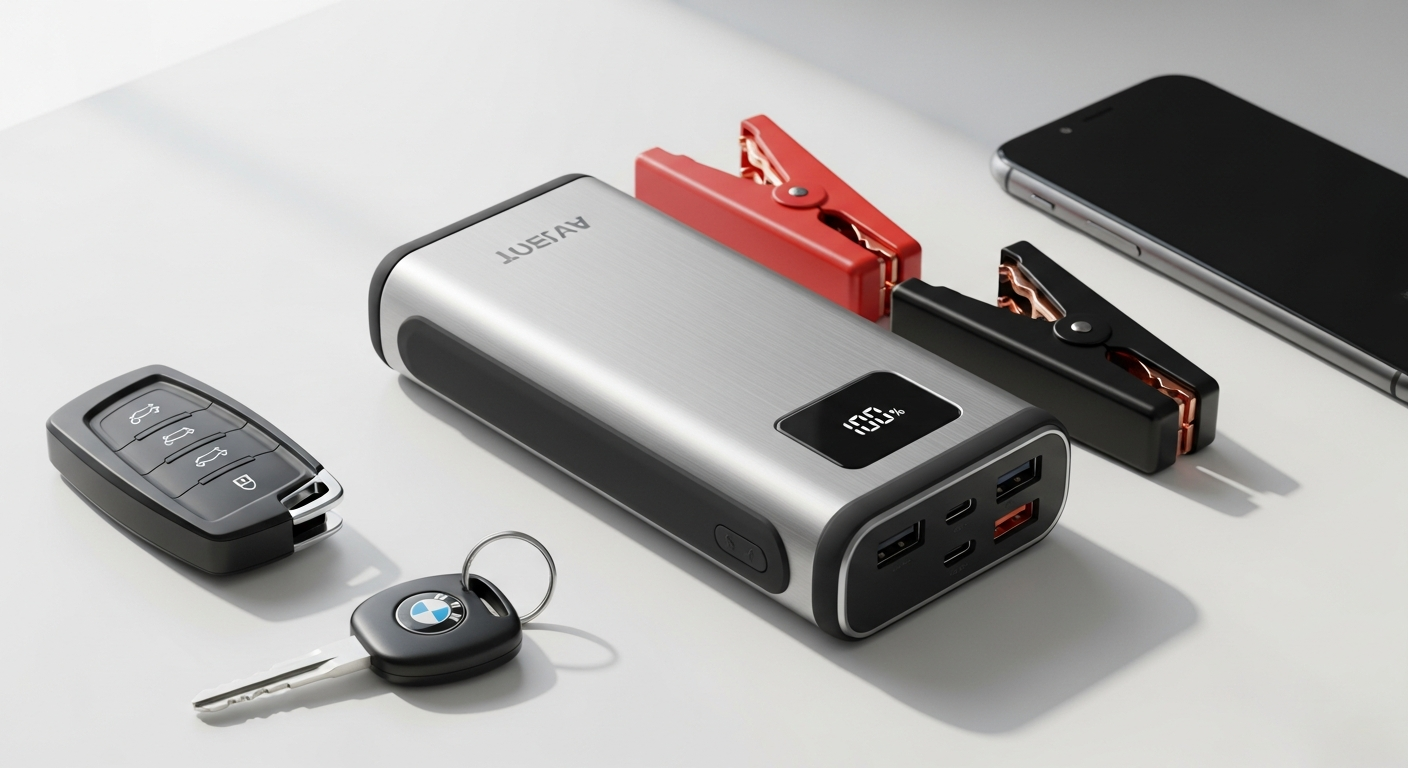
Picture yourself stranded on a dark highway with a dead car battery. No cell service. No other vehicles in sight. Your phone battery draining by the minute. This scenario unfolds for countless drivers every year, yet most remain dangerously unprepared. The portable car jump starter power bank has emerged as one of the most practical solutions for modern drivers, combining emergency jump-starting capability with smartphone charging and emergency lighting—all in a device smaller than a water bottle.
What makes this particular tool so transformative is its departure from conventional emergency equipment. Traditional jumper cables require another vehicle and working knowledge of proper connection procedures. Booster packs take up considerable trunk space. The jump starter power bank eliminates these barriers, offering independence and peace of mind without the bulk.
This guide breaks down what makes these devices tick, examines whether advertised specifications match reality, and helps you understand which features actually matter versus marketing hype. Explore portable jump starter power banks on Joom ES to find competitive pricing and extensive options.
The Three-in-One Emergency Device: What Sets Jump Starter Power Banks Apart
How jump starter power banks differ from traditional jumper cables and booster packs
Jump starter power banks represent a fundamental shift in how drivers approach battery emergencies. Traditional jumper cables demand a second vehicle with a functioning battery, plus the physical capability to connect cables correctly under stressful conditions. Booster packs of previous generations were bulky, heavy, and required regular maintenance to ensure they held a charge.
Modern jump starter power banks eliminate these dependencies entirely. They work independently, requiring nothing but the device itself and its built-in battery. This autonomy transforms emergency preparedness from a group effort into a solo capability. A driver can resolve their own situation without waiting for roadside assistance or flagging down strangers.
The evolution from single-function devices to multi-purpose emergency tools
The jump starter category has evolved dramatically over the past decade. Early generations served one purpose only—starting engines. They were specialized tools, nothing more.
Today's units integrate multiple functions into a single package. Beyond jump-starting, they include USB ports for charging smartphones and tablets, LED flashlights with various modes including SOS and strobe functions, and they operate as portable power banks for general electronic device charging. This convergence means drivers can justify keeping one device rather than carrying separate tools for different emergencies.
Why drivers are abandoning conventional solutions for compact alternatives
Space constraints in modern vehicles drive much of this shift. Glove compartments and trunk storage compete for real estate. Compact jump starter power banks slip into tight spaces traditional equipment cannot occupy.
Additionally, the psychological burden of maintaining separate emergency tools diminishes when a single device handles multiple scenarios. Drivers more consistently keep a jump starter power bank accessible when it also serves everyday charging needs during road trips and outdoor activities.
Real-world scenarios where this device proves invaluable for highway breakdowns and remote travel
Consider the scenario mentioned earlier—a dead battery on an isolated road. With a traditional jumper cable setup, the driver would be stuck. A jump starter power bank transforms this situation from crisis to minor inconvenience, typically resolving the issue within minutes.
Remote travel scenarios present another compelling use case. Weekend camping trips, mountain excursions, or cross-country drives all become less risky with a reliable jump-starting device. The integrated LED flashlight provides additional value during nighttime roadside work. The power bank functionality keeps phones charged throughout extended trips, critical for navigation and emergency communication.
Decoding Peak Current Ratings: What 3000A vs. 1200A Actually Means
Understanding peak current versus sustained current in jump-starting applications
Peak current represents the maximum electrical output the device can deliver in brief bursts—typically measured in milliseconds. This number looks impressive on product listings. Sustained current, by contrast, indicates what the device can reliably deliver over the duration needed to start an engine, usually 10-30 seconds.
Marketing teams highlight peak current numbers because they're larger and more attention-grabbing. A 3000A peak rating sounds far more powerful than 1200A. However, sustained current determines actual jump-starting success. A device boasting 3000A peak but only 800A sustained might struggle with the same engines a 1200A peak / 1000A sustained device handles reliably.
How peak current ratings determine compatibility with different engine types
Peak current directly correlates with engine size and type compatibility. Smaller gasoline engines require less current to turn over. A compact sedan might need only 400-600A sustained current to start reliably. Larger gasoline engines or diesel engines demand substantially more, potentially 1000A or higher.
The issue arises when manufacturers market peak current as though it's sustained capacity. A jump starter rated 3000A peak might legitimately start large engines—but only if the sustained current rating justifies that capability. If sustained current drops significantly below 1000A, diesel compatibility becomes questionable regardless of what the peak rating suggests.
Why higher amperage claims may not translate to better real-world performance
Physical limitations constrain what battery packs can deliver sustainably. A device's internal circuitry, battery chemistry, and thermal management all impose ceiling effects on sustained output. Some manufacturers achieve high peak ratings through clever engineering that releases energy quickly but cannot maintain that output level. Others resort to inflating specifications beyond what testing confirms.
Real-world performance depends heavily on internal design quality, something budget marketplace products sometimes compromise on to hit aggressive price points.
The gap between advertised specifications and actual usable power
Testing data consistently reveals discrepancies between manufacturer claims and independent verification. Products marketed with certain specifications frequently underperform when tested by neutral third parties. This gap stems from different measurement methodologies, testing conditions, and the straightforward reality that not all manufacturers maintain rigorous quality standards.
Check current customer reviews and specifications on Joom ES before making your purchase decision.
Battery Capacity Claims: Separating Fact from Marketing Fiction
Why mAh ratings can be misleading on budget marketplace products
Milliamp-hour (mAh) ratings measure battery energy storage capacity. Theoretically, a 99800mAh battery should charge a smartphone multiple times over. This math makes sense on paper—most modern phones have 3000-4000mAh batteries, so a 99800mAh pack should provide 20-30 full charges.
Reality diverges sharply from theory. Rated capacity frequently represents laboratory conditions under ideal circumstances. Real-world usage involves energy losses during charging transfer, voltage conversion, and device circuitry operation. A 99800mAh battery rarely delivers anywhere near that much usable power to your phone.
The difference between nominal capacity and actual usable capacity
Nominal capacity describes the battery under perfect conditions. Usable capacity accounts for voltage regulation losses, charging circuit inefficiency, and safety circuit power consumption. For many budget devices, usable capacity might represent only 60-75% of nominal capacity—meaning that 99800mAh rating might actually deliver 60,000-75,000mAh in practice.
This discrepancy isn't inherently dishonest, but marketing materials rarely distinguish between the two, leaving consumers confused about realistic expectations.
How 99800mAh claims stack up against real-world testing results
When independent reviewers test products with extreme mAh claims, the results frequently disappoint. A 99800mAh jump starter power bank might fully charge a smartphone three times—not twenty. While still genuinely useful, the gap between marketing and reality becomes obvious.
Part of this stems from the dual-purpose nature of these devices. Jump-starting an engine draws significant current to the starting circuit, depleting battery reserves. A device dedicating full capacity to jump-starting would have nothing left for phone charging, and vice versa. Manufacturers navigate this by partitioning battery capacity or using specifications that assume the device won't simultaneously perform both functions at maximum capacity.
Red flags that indicate exaggerated capacity claims and battery degradation patterns
Capacity claims exceeding 50000mAh warrant scrutiny, particularly at budget price points. Legitimate technology constraints make extreme capacities difficult to achieve affordably. Similarly, products claiming performance across impossibly wide engine ranges (gasoline and diesel, small to large) probably overstate actual capabilities.
Battery degradation patterns vary, but budget electronics sometimes experience rapid capacity loss within the first year. This degradation accelerates if the device undergoes repeated charge-discharge cycles or gets exposed to temperature extremes. Products from established manufacturers with quality control standards tend to degrade more slowly than budget alternatives.
Make Your Decision With Eyes Wide Open
The portable car jump starter power bank occupies a unique space in vehicle emergency preparedness. It's genuinely useful, surprisingly affordable, and genuinely practical for most drivers. However, specifications on budget platforms often stretch the truth, durability varies wildly between units, and you shouldn't expect professional-grade performance at this price point.
What matters most is understanding what you're actually buying: a device that genuinely works for most vehicles most of the time, with realistic expectations about battery capacity and peak current ratings. The multi-functional design—combining jump-starting, phone charging, and emergency lighting—makes it worth keeping accessible. The compact size means you'll actually store it rather than letting it collect dust. The price point ($56-$80.94) positions it as an affordable insurance policy against dead battery situations.
Before purchasing, ask yourself honest questions. How often do you drive? Do you travel long distances or mostly local commutes? How comfortable are you with budget electronics? Are you prepared to replace the device after 2-3 years if the battery degrades? Would you rather pay more for a warranty-backed unit with proven durability?
The choice ultimately depends on your driving habits, risk tolerance, and honest assessment of emergency preparedness priorities. For drivers seeking practical, affordable emergency capability without professional-grade demands, the jump starter power bank delivers genuine value. Just approach the purchasing decision with appropriate skepticism toward specifications and realistic expectations about what budget electronics can reliably achieve. Start your search for portable car jump starter power banks on Joom ES and compare options with detailed customer feedback.
Leave a Reply