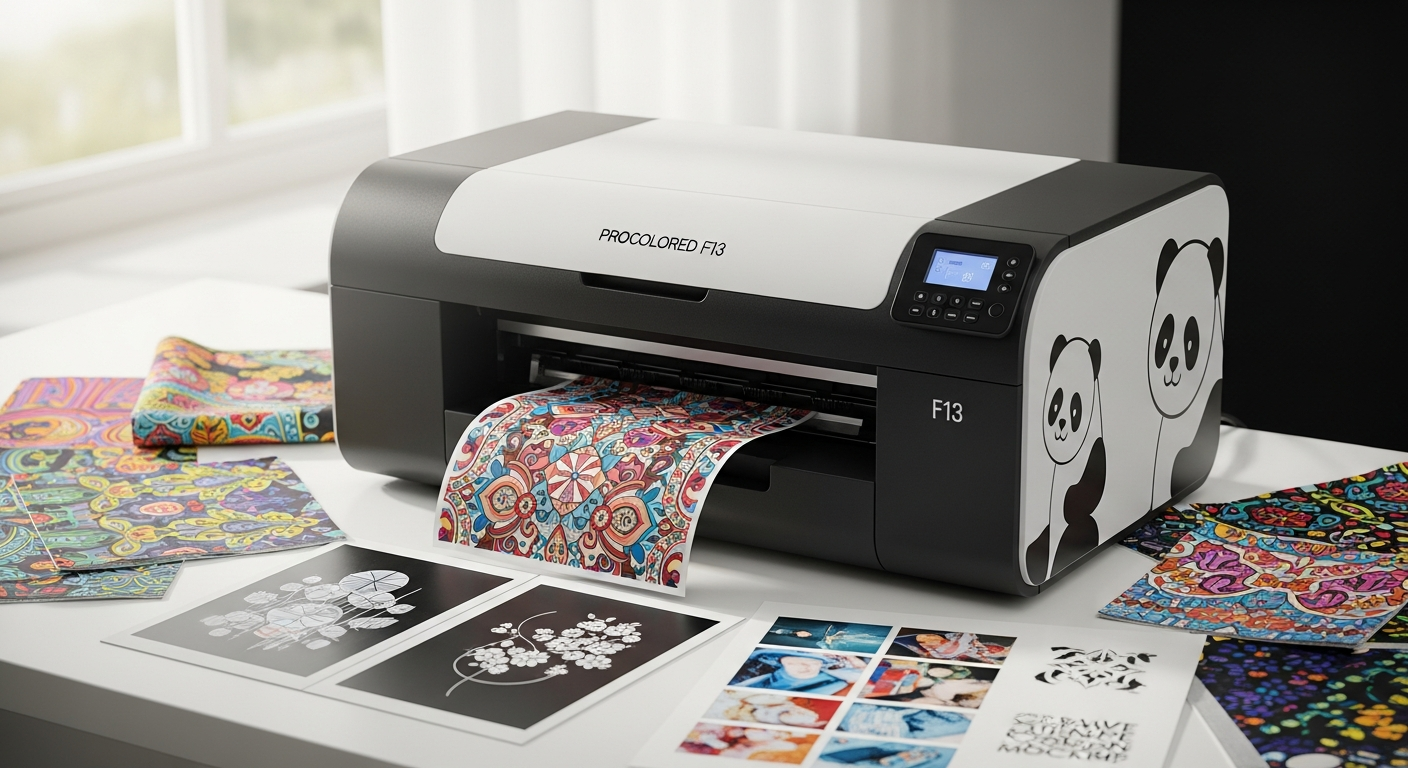
Over 60% of custom apparel businesses now rely on DTF printing technology to scale their operations. Yet choosing the right printer—one that balances industrial-quality output with affordability—remains a challenge for many shop owners and hobbyists alike. The Procolored F13 Panda has emerged as a frontrunner in this space, but does it truly live up to the hype?
The F13 Panda represents a significant shift in how small-to-medium businesses approach garment decoration. Unlike traditional screen printing or heat transfer vinyl, DTF technology prints directly onto film, which then transfers vibrant, full-color designs onto fabric—whether that's cotton, polyester, or blends. This A3-sized printer has captured the attention of creative makers and entrepreneurs seeking a reliable solution without the industrial-sized price tag.
Discover the complete Procolored F13 Panda specifications and current pricing here.
How DTF Printing Works: Understanding the F13 Panda's Technology
The complete DTF process: printing on film, curing, and heat transfer mechanics
The F13 Panda operates through a three-stage workflow that distinguishes it from traditional printing methods. First, the printer outputs your design directly onto a semi-transparent film using specialized DTF inks. The design then passes through a curing oven—included in most bundles—where heat sets the ink permanently onto the film. Finally, the film transfers onto your chosen garment using a heat press, where pressure and temperature bond the design to the fabric.
This process is notably different from vinyl cutting or screen printing. Where those methods require separate steps and different equipment, DTF consolidates quality and versatility into a single machine workflow.
Why CMYK plus white ink creates superior color vibrancy on dark fabrics
The F13 Panda's strength lies in its dual-layer printing capability. Standard CMYK inks create your design's full color spectrum, but the printer simultaneously applies a white ink layer on the back of the graphic. This white underbase is the game-changer when transferring to dark-colored fabrics. Without it, dark shirts would mute your colors significantly. With it, your designs pop with vibrant color accuracy regardless of fabric shade.
This dual-layer approach means you can print the same design on white cotton or black polyester and maintain consistent color fidelity. It's a technical advantage that explains much of the F13 Panda's appeal to serious operators.
How the semi-transparent film transfers designs onto various fabric substrates
The film itself acts as a temporary carrier. During the heat press stage, the film temporarily fuses to the fabric while the ink permanently bonds to the fibers. After cooling, the film peels away cleanly, leaving only the design embedded in the garment. This mechanism allows the F13 Panda to work across cotton, polyester, cotton-polyester blends, and even specialty materials like performance fabrics.
The role of the built-in slide cutter in streamlining your workflow
Time efficiency separates profitable operations from struggling ones. The F13 Panda's integrated slide cutter allows you to automatically trim designs between prints when using roll film. Rather than manually cutting each transfer, you load a roll, print, and the machine cuts automatically. For shops running multiple orders daily, this feature alone reduces handling time and waste.
Why DTF produces more durable transfers compared to vinyl alternatives
Vinyl transfers sit on top of fabric; DTF inks bond within the fiber structure itself. This fundamental difference means DTF transfers wash better, flex without cracking, and last significantly longer through repeated wear and laundering. Customers notice the difference immediately—transfers feel more natural and retain quality through hundreds of wash cycles rather than dozens.
Core Specifications and Print Capabilities
Maximum print width of 13 inches with designs up to 31 inches in length
The A3-sized specification translates to practical constraints and possibilities. Your maximum print width caps at 13 inches, which accommodates most standard garment placements but won't work for oversized chest graphics or full-back designs. However, the 31-inch length capacity opens opportunities for vertical designs, long-sleeve prints, and custom fabric rolls for non-garment applications.
L1800 print head technology and what it means for print quality
The L1800 print head delivers 1440 DPI native resolution, translating to sharp details and smooth color gradations. This isn't the highest resolution available in industrial settings, but it's sufficient for detailed designs, photographs, and fine text at practical production speeds. The print head's reliability record contributes significantly to the F13 Panda's reputation for consistency.
Industrial-grade output speeds and production efficiency metrics
The F13 Panda produces prints at speeds that enable profitable small-batch operations. Rather than measuring in prints-per-hour like industrial equipment, the F13 delivers quality per print that justifies longer setup times. For custom orders—where each design differs—speed matters less than consistency.
Fabric compatibility: cotton, polyester, blends, and specialty materials
Cotton prints beautifully and absorbs the white underbase effectively. Polyester requires slightly different heat press settings but works reliably. Blends perform well across both specifications. Specialty performance fabrics (moisture-wicking materials, athletic blends) also accept DTF transfers effectively, expanding your potential market beyond basic t-shirts.
Roll film handling and automatic cutter functionality
Operating from roll film rather than pre-cut sheets significantly reduces material waste and handling. The automatic cutter means you're not manually trimming between each print, streamlining production flow especially during high-volume days.
Bundle Options and Investment Breakdown
Standard bundle: printer plus curing oven (~$3,075 USD)
The entry-level bundle includes everything essential for operation. The printer and curing oven are non-negotiable components; you cannot produce finished transfers without both. At approximately $3,075 USD—discounted from original pricing around $3,586 USD—this bundle represents the minimum investment for operation.
Mid-tier packages with heat press additions
Mid-tier bundles add a heat press, removing the need to source that equipment separately. A quality heat press typically costs $400–$800 independently, so bundled pricing offers genuine savings for operators building their setup from scratch.
Premium bundles featuring inline auto shaker ovens ($2,599–$5,349 range)
The premium tier introduces an inline auto shaker oven, which automatically agitates the film during curing for more consistent results. These comprehensive packages range from $2,599 to $5,349 depending on specific equipment combinations. The broader range reflects different press sizes and specifications included.
Original pricing versus current promotional discounts
Procolored frequently runs promotional pricing, creating discrepancies between list prices and actual costs. Monitoring for seasonal sales or promotional periods can reduce your investment by $400–$500, making the timing of your purchase strategically important.
ROI timeline for small businesses and print shops
A print shop charging $15–$25 per transfer on custom garments can recover the initial investment within 500–1,000 orders. For active operations running 20–30 orders weekly, that's a 3–6 month payback timeline. Profitability accelerates significantly in subsequent months as equipment costs are already recouped.
Standout Strengths: Why Users Choose the F13 Panda
Beginner-friendly operation with minimal learning curve
The software interface is straightforward, and the physical workflow doesn't require deep technical knowledge. Most operators report productive results within their first week of operation. This accessibility removes barriers for hobbyists and entrepreneurs without printing backgrounds.
Exceptional color accuracy and full-color design reproduction
The F13 Panda consistently delivers what you see on your screen. Color matching isn't perfect—no DTF printer matches commercial offset perfectly—but the accuracy is genuinely impressive for this price category. Customers consistently praise the vibrancy and detail in reproduced designs.
Superior fabric bonding compared to competing DTF solutions
Users report that transfers bond exceptionally well to fabric. The combination of ink chemistry and the curing process creates durable transfers that resist peeling or cracking even under stress. This durability translates directly to customer satisfaction and repeat business.
Versatile project range from apparel to accessories
Beyond t-shirts, the F13 Panda handles hoodies, hats, bags, and specialty fabrics. This versatility enables entrepreneurs to diversify their product offerings without equipment changes.
Best-seller status backed by consistent positive user reviews
The F13 Panda's popularity reflects genuine user satisfaction. Positive reviews consistently outnumber complaints, and the "best-seller" designation reflects actual market demand rather than marketing hype.
Industrial-quality results at mid-market pricing
This is the core proposition: you're not getting consumer-grade output or paying industrial-equipment prices. The F13 Panda sits in a profitable middle ground where quality justifies investment and pricing remains accessible.
Explore the Procolored F13 Panda's detailed specifications and available bundles now.
Critical Limitations and Real-World Considerations
Windows-only software requirement and security dongle dependency
If your operation runs primarily on Mac systems, the F13 Panda creates friction. The Windows-only software requirement means purchasing a Windows machine or maintaining dual-system workflows. Additionally, the physical security dongle must remain plugged into your computer at all times for the software to function—losing or damaging it means replacing the dongle before you can print again.
Regular usage necessity to prevent ink drying and system clogs
The F13 Panda cannot sit idle indefinitely. Without regular printing cycles, ink within the system begins drying, potentially causing clogs that require professional cleaning or component replacement. Shops operating seasonally or intermittently face higher maintenance costs and frustration.
Not suitable for intermittent or seasonal printing operations
If your business follows seasonal patterns—busy periods followed by dormant months—the F13 Panda creates complications. Keeping the system operational during slow periods costs money in maintenance and preventative ink circulation with no corresponding revenue.
Documented support cases for black ink visibility issues
Some users report black ink not displaying properly in certain designs or requiring troubleshooting to resolve. These issues aren't widespread, but they're documented enough to represent a known consideration.
Isolated reports of premature hardware failure
While the F13 Panda generally performs reliably, isolated cases exist of printers failing within the first year or two of ownership. These represent outliers in the broader user base, but they highlight that equipment quality can vary.
Ongoing maintenance demands and potential downtime
Regular maintenance schedules and preventative care require time and occasional parts replacement. Unexpected issues mean potential production downtime while awaiting repairs or replacement parts.
Who Should (and Shouldn't) Invest in the F13 Panda
Ideal for: active print shops, custom apparel startups, and serious hobbyists
If you're operating a professional print shop or launching a custom apparel startup with serious commercial intent, the F13 Panda fits your needs perfectly. Serious hobbyists with regular design projects also find tremendous value in the system.
Best suited for consistent, regular production schedules
Operations that maintain steady, weekly printing activity benefit most from the F13 Panda. The equipment rewards consistent use with reliable performance and profitability.
Not recommended for occasional users or part-time operations
If you print designs quarterly or seasonally, the F13 Panda creates more problems than solutions. Maintenance costs and system upkeep outweigh benefits for low-frequency usage.
Considerations for Mac users and those requiring cross-platform compatibility
Mac-dependent operations face genuine barriers. Plan for either maintaining a Windows system specifically for printing or seeking alternative equipment that supports your existing infrastructure.
Business models that benefit most from high-volume, full-color capabilities
The F13 Panda shines for businesses built around custom, full-color designs on varied garment types. If your model relies on this capability, the investment justifies itself through consistent, profitable operations.
Getting Started: Setup, Training, and Support
Initial hardware assembly and configuration steps
Unboxing and assembly typically take 1–2 hours. Components arrive partially assembled, requiring connection of the print head, ink systems, and peripheral equipment. The process is mechanical rather than technical—most operators complete setup without complications.
Software installation and security dongle setup procedures
After hardware assembly, software installation follows Windows-standard processes. The security dongle plugs into your computer via USB, and software installation completes within 30 minutes. Initial configuration of print settings and color profiles requires slightly longer, but documentation guides most users through the process.
Learning resources and community support networks
Procolored provides documentation and online resources covering setup and operation. Additionally, active user communities exist on social media platforms where operators share troubleshooting solutions and best practices. This peer support proves invaluable for resolving minor issues quickly.
Manufacturer technical support availability and response times
Procolored's technical support responds to inquiries, though response times vary. During peak periods, support may experience delays. Email support typically provides responses within 24–48 hours, while critical issues may warrant expedited attention.
Maintenance schedules and preventative care protocols
The F13 Panda requires periodic cleaning cycles, regular ink system flushing, and component checks. Following recommended maintenance schedules prevents most issues. Documentation outlines specific intervals and procedures for different maintenance tasks.
Troubleshooting common issues before escalating to support
Many common issues resolve through documented troubleshooting: clearing ink lines, adjusting software settings, recalibrating color profiles, or replacing consumable components. Developing comfort with these procedures reduces support dependency and minimizes downtime.
The Bottom Line
The Procolored F13 Panda DTF printer stands as a genuinely capable machine for anyone serious about custom apparel production. It delivers on quality, offers impressive versatility, and won't drain your startup capital like industrial equipment. The real question isn't whether it can produce stunning prints—it absolutely can—but whether your workflow demands justify the commitment.
If you're running a consistent operation and your designs live in the full-color realm, this printer rewards you with durability and color vibrancy that outperforms vinyl alternatives. The best-seller status reflects genuine user satisfaction, and the pricing sits at an accessible point for small businesses and committed hobbyists.
However, Windows-only software limitations and maintenance demands create friction for certain operators. If you're testing the waters with occasional projects or operating primarily on a Mac, you'll hit points of frustration that make ownership cumbersome. Seasonal businesses face higher costs managing dormant equipment.
Weigh the strengths against the operational constraints before deciding. The F13 Panda excels at consistent, high-volume full-color production but struggles in part-time or intermittent use scenarios. For the right business model, the investment becomes an asset that pays for itself through quality output and operational efficiency.
Check the latest pricing and bundle options for the Procolored F13 Panda today.
Leave a Reply