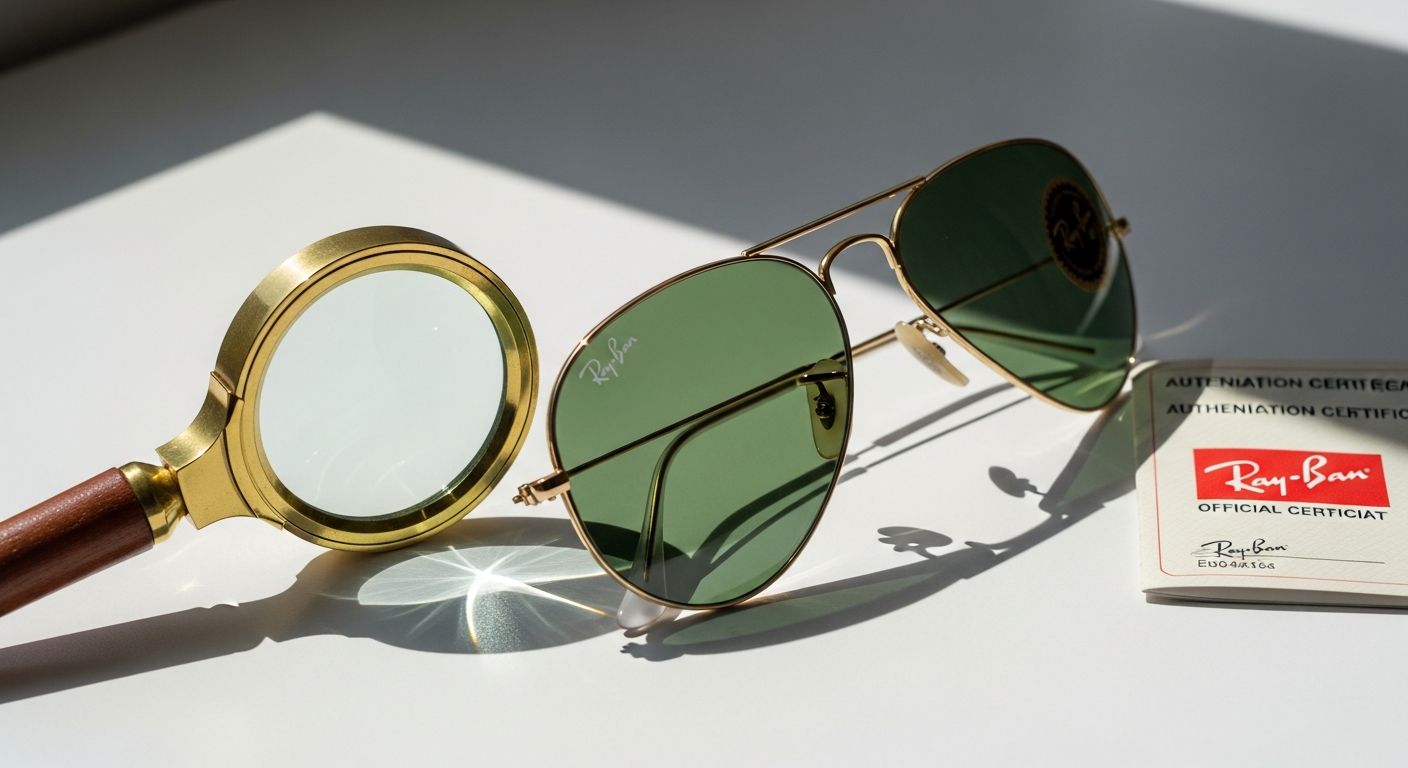
Counterfeits account for nearly 40% of sunglasses sold online today, and Ray-Ban Aviators remain the most frequently faked luxury eyewear on the market. The sheer volume of forgeries flooding e-commerce platforms means that unsuspecting buyers are throwing away hundreds of euros on optical fraud without realizing it.
The Ray-Ban Aviator Classic has been the gold standard since 1937—a teardrop-shaped icon with military heritage and undeniable style credentials. Their popularity makes them a prime target for counterfeiters who exploit the brand's reputation and premium pricing. What started as military-issue eyewear has evolved into a cultural phenomenon, worn by celebrities, professionals, and style-conscious consumers worldwide.
Your mission is straightforward: spot fakes instantly and know exactly where to invest your money for authentic, UV-protective eyewear that lasts. By understanding how counterfeiters operate, examining the specific details that separate genuine pairs from forgeries, and knowing which retailers deliver the real deal, you'll navigate the marketplace with certainty.
Discover authentic Ray-Ban Aviator Classic sunglasses from trusted retailers today.
The Counterfeit Problem: Why Ray-Ban Aviators Are Targeted
The economics of fake designer sunglasses and why Aviators are priority targets
Counterfeiters target Ray-Ban Aviators because the numbers work in their favor. A genuine pair retails between €150 and €250, while a fake costs as little as €10 to manufacture. The profit margins are extraordinary, sometimes exceeding 1,500%. Aviators command such high legitimate prices due to their heritage, optical quality, and brand cachet—precisely what makes them lucrative counterfeiting targets.
The economics incentivize mass production of fakes. A counterfeiting operation can produce thousands of pairs in a single facility, ship them globally through obscure channels, and disappear before authorities catch on. The risk-to-reward calculation heavily favors the criminals.
How counterfeiters operate and where fakes originate
Counterfeiting networks operate with surprising sophistication. Manufacturing typically occurs in countries with lax intellectual property enforcement, particularly in Southeast Asia. These facilities range from small workshops to industrial operations employing dozens of workers.
The distribution chain works like this: fakes are shipped to intermediaries who sell them to online marketplaces, street vendors, and unauthorized retailers. Some counterfeiters even set up legitimate-looking websites that closely mimic official Ray-Ban pages. Others infiltrate third-party seller networks on major platforms, hiding among thousands of legitimate vendors.
The scale of the problem: market data and consumer impact
The World Intellectual Property Organization estimates that counterfeit goods represent 3-5% of global trade. For luxury sunglasses specifically, fake products dominate certain channels. Online marketplaces see counterfeits comprise 40% or higher of available listings for popular brands.
Consumer impact extends beyond financial loss. Buyers receive substandard products, experience poor customer service, and face potential eye damage from inferior lenses. Return policies are non-existent or deliberately complicated. The frustration compounds when counterfeit sellers disappear after transactions, leaving buyers with no recourse.
Why price alone doesn't guarantee authenticity
Many assume that paying the full retail price guarantees authenticity. This assumption is dangerously wrong. Counterfeiters have learned to price their fakes competitively—sometimes matching or even exceeding legitimate retail prices to appear more credible.
A low price is certainly a red flag, but absence of a low price is not confirmation of authenticity. Seller reputation, packaging quality, serial number verification, and optical performance testing are what actually matter.
Real consequences of wearing counterfeit sunglasses
The dangers are medical, not merely aesthetic. Counterfeit lenses often fail to provide adequate UV protection. Some fake lenses block less than 50% of UV rays, exposing your eyes to accelerated cataract development, macular degeneration, and other serious conditions.
Additionally, counterfeit glass lacks the optical clarity of genuine G-15 lenses. Cheap plastic substitutes distort vision, causing eye strain and headaches. Over time, wearing inferior optical products can damage your eyesight. The initial savings of €100 becomes a bad bargain when you're facing ophthalmology bills years later.
Examining the Details: How to Spot Fake Ray-Ban Aviators
Frame construction quality: metal weight, finish, and alignment
Genuine Ray-Ban Aviators feature substantial metal frames—typically gold or silver-toned—with a specific weight that feels premium in hand. Counterfeit frames are noticeably lighter, using cheaper alloys or thin metal plating over base metals. Pick up a genuine pair and a fake side-by-side, and the difference is immediately apparent.
Inspect the finish closely. Authentic frames have consistent plating with smooth, even coloring. Counterfeit plating appears uneven, with spots where the base metal shows through or where plating thickness varies. Run your finger along the temples and bridge—genuine frames feel smooth and precisely finished, while fakes often have rough edges or inconsistent surfaces.
Lens alignment matters too. In genuine Aviators, the lenses sit perfectly perpendicular to the frame, with equal spacing around all edges. Counterfeit manufacturing tolerances are loose, resulting in misaligned lenses that sit crooked or with uneven gaps.
Lens clarity and optical properties of genuine G-15 glass vs. counterfeit plastic
Real Ray-Ban Aviators use G-15 glass lenses, which have distinctive optical characteristics. When you hold them up to light, genuine G-15 lenses transmit a warm, slightly greenish tint. The clarity is exceptional—you're looking through pure glass with no distortion.
Counterfeit lenses are typically plastic, which becomes obvious upon inspection. Plastic scratches easily and lacks the optical purity of glass. Hold the counterfeit lens to bright light and you'll see slight hazing or cloudiness. The color transmission is off—plastic "G-15" imitations often appear too gray or too brown, not matching the authentic warm-green tone.
Test optical clarity by looking through the lenses at fine details—text, tree branches, or distant objects. Genuine lenses preserve perfect sharpness. Counterfeit plastic causes slight blurring or color fringing at edges, a tell-tale sign of poor optical design.
Serial number and hologram placement on authentic pairs
Every genuine Ray-Ban Aviator includes a serial number etched into the right lens. This isn't a sticker or painted marking—it's actual engraving into the glass. The number is small but clearly visible when you look closely.
Counterfeits either lack serial numbers entirely or feature printed ones that you can scratch off with your fingernail. Genuine engravings are permanent and impossible to remove without destroying the lens.
Additionally, authentic Ray-Bans include a hologram on the inside of one temple. This hologram has specific visual characteristics: it reflects light in particular ways and shows Ray-Ban branding in 3D. Counterfeit holograms are flat, poorly printed, or completely absent.
Logo engraving: depth, font consistency, and positioning
The Ray-Ban logo appears in multiple places on authentic sunglasses: on the bridge, the temples, and sometimes on the lens. These engravings have significant depth, created through precision manufacturing. Run your fingernail over the bridge logo—you should feel noticeable texture, not a smooth surface.
Examine font consistency. Ray-Ban uses specific typefaces for all logos. Counterfeiters often use slightly different fonts or inconsistent letter spacing, visible only to trained eyes but detectable if you compare multiple authentic pairs.
Positioning is standardized on genuine pairs. The bridge logo sits at an exact distance from the lens. The temple logos appear at specific locations. Counterfeiters get these placements wrong, with logos positioned slightly too high, too low, or too far inward.
Shop verified authentic Ray-Ban Aviators from certified authorized retailers.
Trusted Retailers vs. Risky Platforms: Where to Buy With Confidence
Official Ray-Ban website and authorized dealer networks
The safest purchase point is Ray-Ban's official website or their official regional sites. These direct channels guarantee authenticity and include full return policies. Ray-Ban also maintains lists of authorized dealers on their website—retailers who have met their stringent requirements for product quality and customer service.
Major optical chains like Clearly, SmartBuyGlasses, and similar established eyewear retailers are authorized dealers. They carry authentic inventory and employ staff trained in Ray-Ban product authentication. Prices match official recommendations, and returns are hassle-free.
Established luxury eyewear retailers with authentication guarantees
Department stores with strong optical departments—Sunglass Hut locations within verified retail chains, for example—represent safe purchasing zones. These retailers have partnerships with Ray-Ban and implement authentication protocols at the supply chain level.
Luxury retailers specializing in eyewear conduct regular audits of their inventory. They authenticate products upon receipt and maintain relationships with distributors they've vetted over years. Their reputation depends on authenticity, so they invest heavily in verification systems.
Department stores with verified Ray-Ban partnerships
Major department stores occasionally stock Ray-Ban Aviators, but only purchase through authorized channels. Verify the partnership by checking Ray-Ban's authorized retailer list. If a major department store isn't listed, they likely obtained inventory through gray market channels.
Call the department store's optical department directly and ask whether their Ray-Ban stock comes through official Ray-Ban distribution. Legitimate retailers will confirm this without hesitation. If they're evasive or uncertain, shop elsewhere.
What makes a retailer 'authorized' and why it matters
Authorized status means Ray-Ban has vetted the retailer's business practices, supply chain integrity, and customer service standards. Authorized retailers purchase directly from Ray-Ban's official distributors, not through secondary markets or intermediaries.
This status matters because it creates accountability. If an authorized retailer sells counterfeit products, Ray-Ban will revoke their authorization and pursue legal action. The threat of losing Ray-Ban as a supplier keeps authorized retailers honest.
Unauthorized retailers—even if they occasionally carry genuine products—have no such accountability. They might source inventory from liquidation sales, gray market dealers, or directly from counterfeiters. You have no recourse if problems arise.
Lens Technology Deep Dive: Understanding What You're Actually Getting
G-15 glass lenses: specifications and performance standards
G-15 is a specific lens formulation, not a generic green tint. Ray-Ban developed this lens type decades ago, and it remains their gold standard. G-15 glass has precise optical properties established through laboratory testing.
These lenses absorb specific wavelengths of light while transmitting others. The result is natural color vision—objects don't look distorted or artificially colored. You see the world as it actually is, just with reduced brightness and UV protection.
G-15 lenses meet international optical standards for refractive error, ensuring your vision remains clear at all gaze angles. Cheap plastic imitations cannot achieve these standards due to material limitations and manufacturing tolerances.
How authentic lenses absorb 85% of visible light
The 85% light absorption specification means G-15 lenses reduce visible light transmission to 15%. This specific ratio provides optimal glare reduction without making vision too dark. It's the result of Ray-Ban's formula for the lens tint and glass composition.
This absorption rate is measured through optical testing equipment, not eyeball estimates. Counterfeit lenses might claim 85% absorption but actually absorb 60% or 90%, depending on the plastic dye used. The difference changes how your eyes work—either straining in insufficient darkness or struggling in excessive darkness.
Authentic G-15 lenses maintain consistent absorption across their entire surface. Counterfeit plastic often has uneven tinting, with some areas darker than others, creating visual inconsistencies as your gaze moves across the lens.
UV protection standards and what '100% UV protection' actually means
100% UV protection means the lenses block 100% of UVA and UVB radiation. This isn't a claim or estimate—it's a measurable specification verified through laboratory testing with specific equipment.
Genuine Ray-Ban lenses are tested and certified to meet or exceed UV protection standards established by optical regulatory bodies. This certification process ensures consistency across all Ray-Ban products.
Counterfeit lenses rarely undergo any testing. Many provide zero actual UV protection, despite stickers claiming otherwise. Others block some UV but fall short of 100%, still leaving your eyes vulnerable.
Why lens quality directly impacts your eye health
Your eyes are irreplaceable. Unlike other body parts, eye damage is often permanent. Excessive UV exposure accelerates cataract formation—clouding of the lens that eventually requires surgery. Macular degeneration causes vision loss in your central field. Blue light damage contributes to digital eye strain and potential retinal issues.
Optical distortion from poor-quality lenses causes different health consequences. Your eyes work harder to focus through warped glass or plastic, leading to chronic eye strain, tension headaches, and neck pain. Extended use of poor optics can actually alter your vision over time.
Genuine Ray-Ban lenses protect your eyes while preserving your vision clarity. The investment in authentic eyewear is an investment in long-term eye health. Counterfeits are a false economy—the initial savings create medical costs and suffering down the road.
Your Authentication Checklist: A Buyer's Quick Reference
Pre-purchase verification steps (seller check, packaging review)
Before purchasing, research the seller thoroughly. Check their return policy—legitimate sellers accept returns on sunglasses. Read recent customer reviews, specifically looking for comments about authenticity and product condition.
Visit Ray-Ban's authorized retailer list and verify the seller appears there. Contact Ray-Ban directly with the seller's name and ask whether they're authorized. Ray-Ban customer service will confirm or deny authorization.
Examine product photos carefully. Authentic packaging features specific design elements: crisp printing, proper Ray-Ban logo placement, and consistent color schemes. Counterfeit packaging often has blurry printing, misspellings, or color variations.
In-hand inspection checklist upon arrival
When your Aviators arrive, conduct a systematic inspection:
Frame examination: Feel the weight and finish. Does the frame feel substantial? Is the plating smooth and even? Check lens alignment—are they perpendicular to the frame? Examine all logos for depth and font consistency.
Lens inspection: Hold the lenses to bright light. Do they have the warm-green G-15 tone? Is the clarity perfect? Look for any cloudiness or distortion. Check for the serial number engraving on the right lens.
Hardware details: Check the nose pads. Genuine pairs have slightly thicker pads. Examine the temple hinges—authentic pairs have precise, smooth-operating hinges without rattling or looseness.
Hologram verification: Open the sunglasses and look at the inner temple. Locate the hologram. Does it have 3D depth? Does Ray-Ban branding appear in relief? Can you move it side-to-side and see the image change?
Serial number validation resources
Ray-Ban provides serial number lookup through their official website and customer service. You can submit a serial number for verification. If the serial number doesn't exist in their database, the sunglasses are counterfeit.
Document the serial number location—it appears etched into the right lens. Take a clear photo for your records. If you ever need warranty service or authentication confirmation, you'll have proof.
Some counterfeiters use real serial numbers from authentic pairs, copying them across multiple fakes. If this is the case, the serial number will appear in the database, but the hologram or other authentication elements will fail inspection.
Contact information for Ray-Ban customer service verification
Ray-Ban maintains customer service contact information on their official website. You can reach them by phone, email, or live chat. Submit photos of your purchase along with the seller information and ask for authentication verification.
Response times vary, but Ray-Ban's official channels will provide definitive authentication answers. Keep records of all communications. If you purchased from an unauthorized seller and the sunglasses are counterfeit, you'll have documentation for potential fraud reports.
Making Your Move: Protecting Your Investment in Authentic Eyewear
Buying Ray-Ban Aviator Classic sunglasses shouldn't feel like navigating a minefield. Armed with the authentication knowledge you now possess, you're equipped to spot fakes instantly and shop with genuine confidence. The difference between a €200 counterfeit and a legitimate pair isn't just about brand prestige—it's about protecting your eyes, securing a product that actually lasts, and knowing your money went toward quality craftsmanship.
Yes, the price tag stings. But when you consider the durability, optical performance, and timeless style of authentic Aviators, that investment becomes a no-brainer. Skip the sketchy marketplaces, verify seller credentials, and stick with authorized retailers who stand behind their products. Your eyes—and your wallet—will thank you for it.
Invest in authentic Ray-Ban Aviator Classic sunglasses from verified authorized retailers now.
Leave a Reply