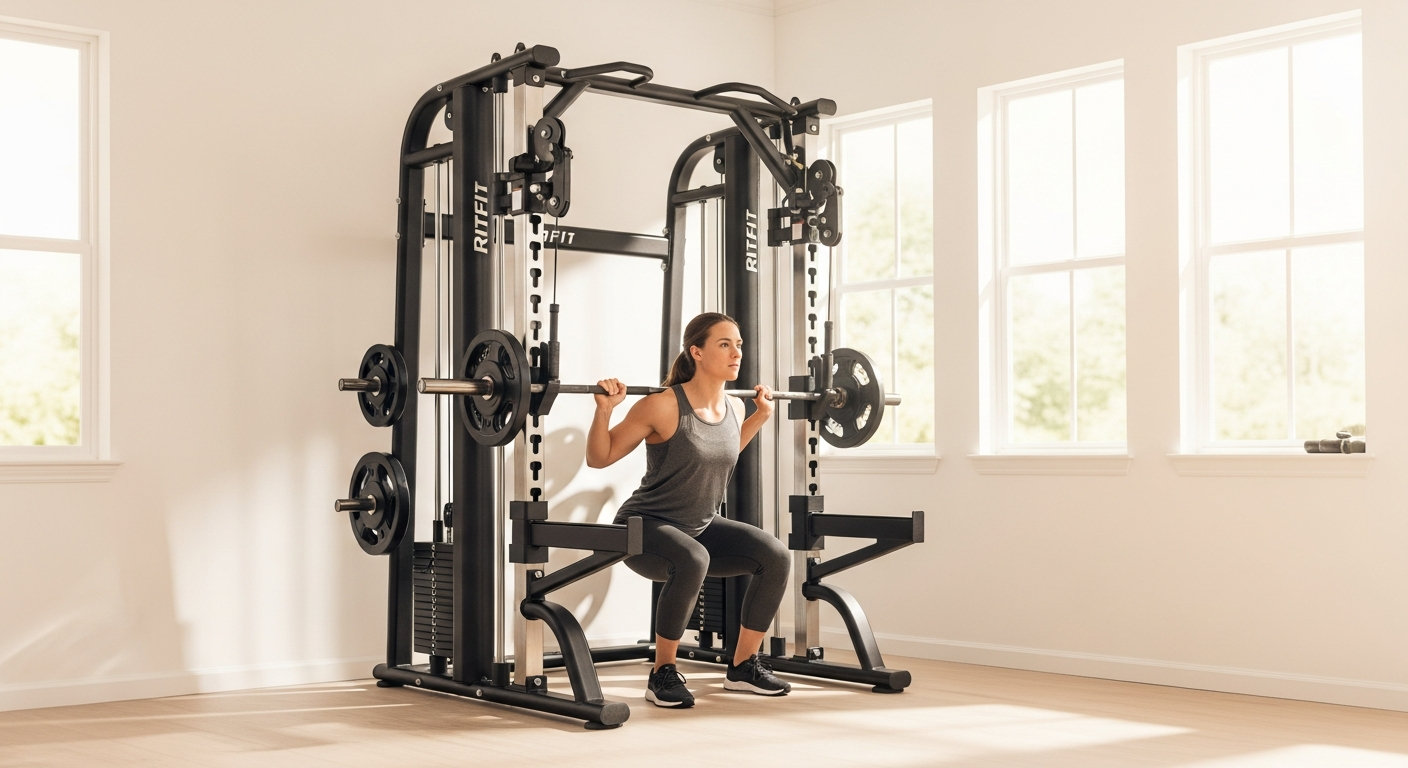
Building a complete home gym that fits in your spare bedroom without breaking the bank sounds almost too good to be true. Yet that's exactly what thousands of fitness enthusiasts are discovering with the RitFit M1 Multi-Functional Smith Machine. This all-in-one powerhouse delivers serious strength training versatility at a fraction of what commercial-grade competitors charge, and it's the best-selling model from RITFIT LLC for good reason.
The home gym equipment market has exploded over the past few years, yet most multi-functional systems still demand massive space and massive budgets. The M1 changes that equation entirely. By combining a Smith machine, power rack, cable system, pull-up bar, and landmine attachment into one compact unit, it solves the fundamental problem every home gym builder faces: how to maximize workout options while minimizing real estate.
Explore the RitFit M1 Multi-Functional Smith Machine and start building your home gym today.
Throughout this guide, you'll uncover exactly what makes the M1 tick—from its impressive cable system and smooth Smith machine operation to its actual weight capacities and real-world durability. The following sections break down the specifications that matter, compare it honestly against pricier alternatives, and reveal which home gym setups benefit most from this investment.
The All-in-One Design That Changed Home Gym Economics
The RitFit M1 represents a fundamental shift in how home gym equipment is engineered. Rather than purchasing separate machines for different exercise categories, you're getting complete equipment integration in a single footprint. The Smith machine serves as the primary lifting platform, while the integrated power rack provides stability and safety for heavy compound movements. A dedicated cable machine with lat pulldown and cable crossover capabilities allows for isolation work and upper body pulling movements. The multi-grip pull-up bar accommodates different hand positions, and the landmine attachment opens doors for rotational and pressing variations. Dip bars round out the package, creating a remarkably comprehensive training environment.
Space efficiency stands as one of the M1's most compelling advantages. Buying individual machines separately—a Smith machine here, a cable station there, a pull-up tower elsewhere—quickly consumes a garage or basement. The integrated design eliminates redundancy. Everything shares a common footprint, meaning you're not sacrificing square footage for breadth of movement options.
The 2-to-1 cable ratio is particularly clever engineering. This mechanical advantage maximizes resistance without requiring massive weight stacks. You can load less total weight while still creating challenging training stimulus, making the system more accessible for varied strength levels while reducing the overall machine's weight and footprint.
The plate-loaded trolley system represents the practical heart of the M1's cable operation. Rather than pin-selecting from a weight stack, you load standard barbell plates directly onto the carriage. This approach provides several real-world benefits: you can fine-tune resistance in smaller increments, you're not limited to whatever weight stack sizes the manufacturer selected, and you can use weight plates you already own from other equipment.
Performance Features That Matter for Serious Lifters
The Smith machine bar path and range of motion set the tone for the entire M1 system. The machine guides the barbell on fixed rails, which provides critical safety benefits for solo training. You can load heavy weight without a spotter, and the guided path helps reinforce proper movement patterns. For squats, the fixed path allows you to drive through your heels with confidence. Bench presses benefit from controlled descent and consistent pressing angles. Deadlifts become safer when you know the bar will follow a predictable vertical path.
The 500-pound weight capacity on the Smith machine handles most strength training scenarios effectively. This supports heavy compound lifts for intermediate and advanced lifters. A 225-pound bench press, 315-pound squat, or 405-pound deadlift—all realistic targets for serious home gym training—sit well within this capacity. The practical weight capacity in real-world use often exceeds manufacturer specifications when you factor in safe loading practices.
The aluminum pulleys featured in the M1 2.0 version represent a tangible improvement over standard hardware. Smoother cable travel means less friction, more consistent resistance curves throughout the range of motion, and reduced cable wear over time. This smoothness makes the lat pulldown and cable crossover feel more like commercial equipment and less like a budget compromise.
The thicker pull-up bar in the M1 2.0 iteration addresses a common complaint in home gym equipment. Grip comfort matters during high-rep sets or when performing weighted pull-ups. A thicker bar diameter reduces hand fatigue and distributes pressure more comfortably across your palm. It also increases durability across multiple hand positions—wide grip, narrow grip, neutral grip—without the risk of the bar flexing excessively.
Honest Pricing Breakdown and Value Comparison
The base model RitFit M1 typically ranges from $1,000 to $1,300, positioning it as a genuinely affordable entry point into multi-functional home gym equipment. Premium packages with enhanced cable systems, weight stacks, or additional attachments can reach $2,000 or beyond. Even at the higher end of this range, you're looking at significantly less than comparable commercial-grade systems.
The cost-per-exercise analysis reveals why the M1 generates so much enthusiasm. Traditional equipment pricing might run $800 for a quality Smith machine, $600 for a decent cable station, $300 for a pull-up bar, and $400 for a power rack setup—that's $2,100+ for less versatility than a single M1 unit. The M1 delivers more functionality at substantially lower cost.
Commercial-grade multi-functional systems from premium manufacturers typically cost $4,000 to $5,000 or more. These premium options offer heavier gauge steel, commercial-rated weight capacities, and industrial-quality components. However, for home gym use with one or two people training, the M1 delivers 85-90% of the functionality at 20-25% of the price.
The long-term investment perspective matters for home gym builders. Equipment depreciates slowly if maintained properly. A $1,200 M1 purchased today will likely retain 60-70% of its value in 5 years, making the true annual cost far lower than the purchase price suggests. Compare that to gym memberships (often $50-100+ monthly) and the payback period becomes obvious.
Strengths That Justify the Hype
Exceptional value-for-money stands as the primary strength. Few pieces of home gym equipment deliver this much versatility at this price point. You're genuinely getting more exercise options per dollar spent than almost any alternative.
Versatility for different training levels separates the M1 from single-purpose machines. Beginners benefit from guided movements that reinforce proper form. Advanced lifters appreciate the ability to handle heavy loads and perform sophisticated exercise variations. A couple training together can easily adjust weight between sets without complicated equipment changes.
Full-body workout capability without equipment hopping matters more than it might initially seem. Traditional home gym setups require moving between multiple machines—Smith machine for compound work, separate cables for isolation, pull-up bar in a different location. The M1 consolidates everything, reducing setup time and keeping your training focused and efficient.
Smooth Smith machine operation appears consistently in verified user reviews. The bar path feels natural, the carriage slides freely, and the safety catches inspire confidence. This operational smoothness directly impacts training quality and safety.
Limitations You Should Know Before Buying
Maximum weight capacity claims warrant skepticism in marketing materials. While the Smith machine's 500-pound capacity is genuine, some manufacturers exaggerate what their machines can practically handle. Real-world use at 500 pounds should feel stable and secure, but pushing significantly beyond this isn't advisable.
The lat pulldown weight limit of 165 pounds restricts advanced lifters. An experienced back training enthusiast might regularly work with 200+ pounds on this movement. The plate-loaded system maxes out around 165 pounds before practicality issues emerge. This limitation particularly affects those using the cable system for serious strength development rather than isolation work.
Cable carriage tolerances occasionally exhibit slight looseness in some user reports. This doesn't typically create functional problems during training—the resistance remains consistent under load—but it suggests the tolerances aren't as tight as premium equipment. Dust and debris inside the carriage can exacerbate this over time.
Premium feel and material quality don't match higher-priced alternatives. The M1 uses solid components, but the steel gauge, coating finish, and overall build quality feel appropriate to the price point rather than luxurious. This is an observation rather than a defect—you're making a reasonable trade-off for affordability.
Who Should Actually Buy the RitFit M1
Home gym beginners building their first complete setup with budget constraints represent the ideal M1 audience. You need versatility without spending $5,000, and you haven't yet determined which exercise variations you'll prioritize. The M1 provides options to experiment and discover your preferences without overcommitting financially.
Apartment and condo dwellers needing maximum functionality in minimal space benefit tremendously. The M1 occupies roughly the footprint of a standalone Smith machine while delivering 3-4x the exercise options. If you have one spare room or corner, this machine makes sense.
Solo lifters and couples training together without commercial gym access represent another core demographic. You don't need commercial durability or multiple weight stacks—you need reliable equipment that supports varied training. The M1 handles this precisely.
Budget-conscious fitness enthusiasts who prioritize variety over premium materials should seriously consider this option. You're making a deliberate choice: I'll accept slightly tighter tolerances and more basic materials in exchange for comprehensive functionality at a realistic price.
Real-World Setup and Space Considerations
The actual footprint dimensions vary slightly between models, but expect roughly 7-8 feet in length, 4-5 feet in width, and 6.5-7 feet in height. Most standard two-car garages accommodate this comfortably. Smaller spaces become more challenging but often still workable with careful arrangement.
Ceiling height requirements depend on your primary lifts. Overhead pressing and pull-ups demand sufficient clearance. A 7-foot ceiling works, but 8 feet provides noticeably more comfort. If your space has limited height, you'll need to modify overhead pressing or position the pull-up bar lower.
Flooring recommendations protect both the machine and your home. Rubber gym mats or stall mats distribute weight and reduce vibration transmission to floors below. Concrete garage flooring handles the weight easily. Wood floors need protective padding, especially if you're dropping weight or performing dynamic movements.
Integration with other home gym equipment works well. Dumbbells store near the M1 for accessory work. An adjustable bench pairs perfectly for dumbbell exercises the M1 doesn't cover. Cardio equipment fits in remaining space. Progressive equipment additions build around the M1 as your centerpiece.
M1 vs. M1 PRO vs. M1 2.0: Which Version Wins
The standard M1 represents the foundational model. It includes core components: Smith machine, power rack, basic cable system, pull-up bar, landmine attachment, and dip bars. If you're budget-conscious and simply need solid functionality, this version serves you well.
The M1 PRO designation sometimes appears in marketing, often referring to packages with enhanced components or additional accessories compared to base models. Verify exactly what separates the PRO version from standard M1 before purchasing—the distinction varies by seller and timing.
The M1 2.0 version incorporates meaningful improvements: a thicker pull-up bar that increases durability and grip comfort, and aluminum pulleys that smooth cable operation noticeably. These upgrades cost more—expect $200-400 additional investment—but they address legitimate wear points over extended use. If you'll use this machine 3-5 years or more, the M1 2.0 represents better long-term value.
Best version selection depends on your training timeline and priorities. Short-term home gym setup on a tight budget? The standard M1 works fine. Planning to use this for years with regular training? The M1 2.0's improvements justify the additional cost. Need maximum budget optimization? Stick with standard M1 but plan eventual upgrades.
Cable System Deep Dive: How It Powers Your Workouts
The 2-to-1 mechanical advantage ratio creates fascinating training possibilities. This means the cable system applies twice the force on the load compared to the force you exert. In practical terms, when you're performing a lat pulldown, the resistance feels more authentic than you might expect from the loaded weight. This mechanical advantage allows lighter loading while maintaining meaningful resistance, reducing overall system weight.
The plate-loaded trolley system operation involves stacking standard barbell plates onto a carriage that moves along the cable path. Weight changes become straightforward: add or remove plates as needed. This differs fundamentally from pin-selected weight stacks. You gain flexibility in resistance increments and can use weight plates from other equipment. The carriage moves smoothly when properly maintained, providing consistent resistance throughout each movement.
Cable durability and maintenance requirements deserve attention. Quality cables handle extensive use, but they wear over time. Inspect cables periodically for fraying or damage. Keep the cable paths clear of debris. Occasional light lubrication of the carriage mechanism maintains smooth operation. With reasonable care, cables typically last 5+ years of regular training.
Lat pulldown mechanics and range of motion matter for back development. The M1's cable positioning allows a full range of motion from extended arms to chest contact. Grip width variations accommodate different back muscle emphasis. The consistent resistance curve—thanks to smooth pulleys—supports quality muscle work throughout the entire movement range.
Building Your Complete Home Gym Around the M1
The M1 serves as an exceptional centerpiece for a multi-equipment setup. Rather than viewing it as your complete gym, think of it as the foundation that handles primary compound movements and cable work. Everything else builds outward from this core.
Complementary equipment pairs well with the machine. Adjustable dumbbells handle unilateral movements and accessory work the M1 doesn't optimize for. A quality flat/incline/decline bench expands pressing options beyond the Smith machine. Barbell collars and plates support exercises requiring free-standing barbell work, like floor presses or deficit movements.
Dumbbell and barbell integration works seamlessly. Use dumbbells for unilateral rows, shoulder presses, and carries. Reserve the M1 for heavy bilateral compound work where the guided rails provide safety advantages. This combination covers virtually every legitimate strength training movement.
Progressive training programming maximizes M1 functionality. Early phases focus on learning movement patterns using the Smith machine's guided path. Intermediate phases increase load and volume on compound lifts while introducing cable isolation work. Advanced phases use cable variations and dip bar work for specialized strength development. The machine's versatility supports periodized programming across months and years of training.
The Bottom Line: Making Your Home Gym Investment Count
The RitFit M1 Multi-Functional Smith Machine isn't just another piece of fitness equipment—it's a practical solution for anyone serious about building a functional home gym without commercial-grade pricing. I've detailed its strengths, acknowledged its limitations, and walked through the real-world considerations that separate smart purchases from impulse buys.
The truth is straightforward: if you're training solo or with one partner, operating on a realistic budget, and working with limited space, this machine delivers exceptional value that's genuinely difficult to beat. The 500-pound Smith capacity, 165-pound cable system, and comprehensive exercise selection cover the vast majority of strength training goals for home gym users.
What matters most is matching the M1 to your actual training needs and lifestyle. Measure your available space carefully. Honestly assess your training goals for the next 3-5 years. Consider whether you'll primarily use it or if it'll become storage for other items. If full-body strength training in a compact footprint aligns with your vision, this machine deserves serious consideration.
Your next step? Take precise measurements of your available space, verify ceiling height, and review your training goals realistically. If the answers align with what the M1 offers, you've found an investment that delivers both functionality and value.
Start your home gym transformation with the RitFit M1 Multi-Functional Smith Machine today.
Leave a Reply