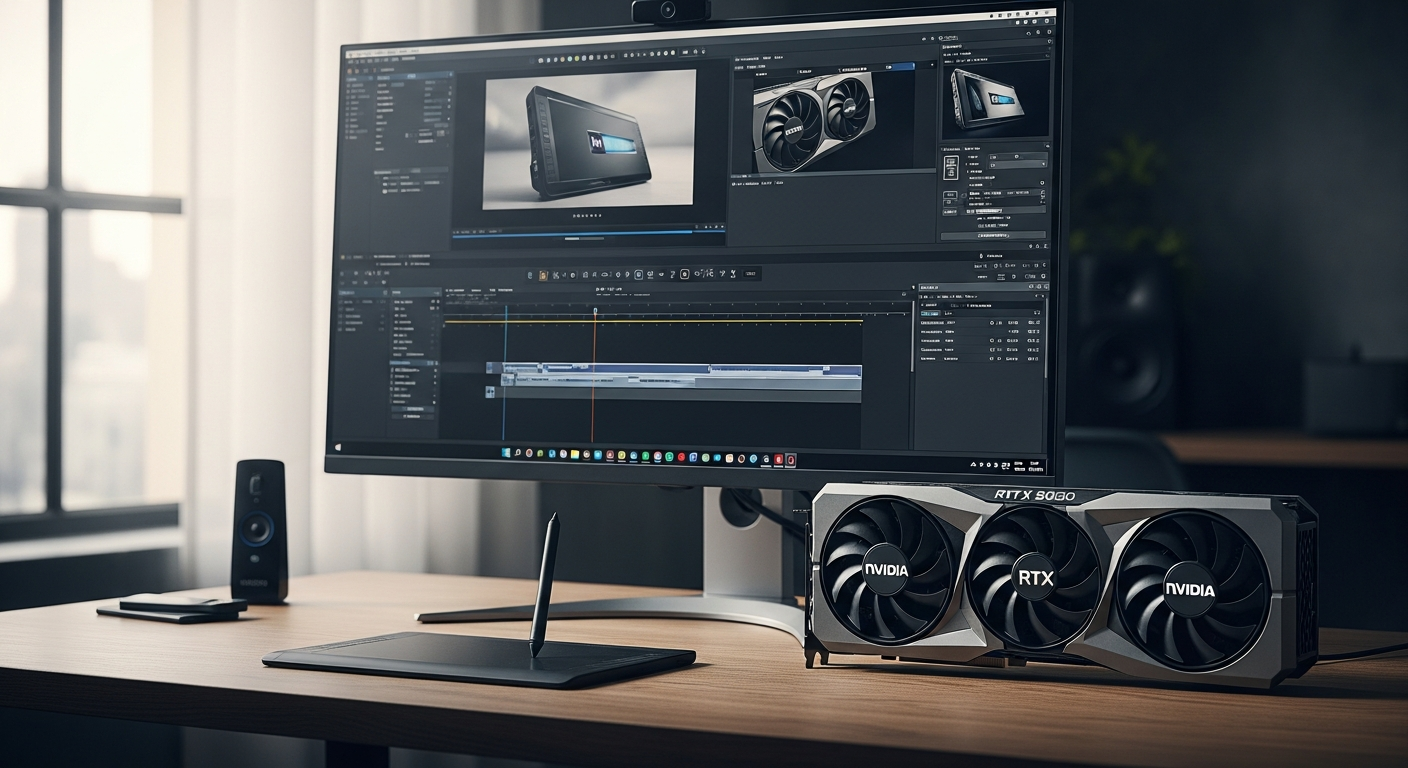
The performance expectations for professional graphics cards have fundamentally shifted. For years, creators accepted a simple trade-off: pay premium prices for workstation GPUs, or compromise on capability with consumer-grade alternatives. The NVIDIA GeForce RTX 5090 shatters this false choice entirely, delivering professional-tier performance through gaming-focused architecture that costs significantly less than traditional workstation solutions.
The line separating gaming graphics cards from professional workstation GPUs has blurred almost beyond recognition. The RTX 5090 stands at the center of this convergence, combining NVIDIA's latest architectural innovations with the specialized tools that creative professionals actually need. With 32 GB of GDDR7 memory, 21,760 CUDA Cores, and advanced tensor acceleration, this card provides the computational muscle for everything from 8K video editing to machine learning acceleration.
Discover how the RTX 5090 transforms professional workflows by visiting our detailed product guide.
Why Content Creators Are Switching to the RTX 5090 from Workstation GPUs
Professional rendering performance has traditionally required dedicated workstation GPUs costing multiple times what the RTX 5090 demands. This card obliterates that cost differential while maintaining rendering speeds that match or exceed specialized professional hardware. The 32 GB GDDR7 memory with 512-bit interface handles massive texture libraries and complex scene data without bottlenecking, allowing artists to work with real-world asset sizes rather than constantly optimizing for memory constraints.
The 21,760 CUDA Cores enable parallel processing that dramatically accelerates render times across industry-standard applications. Blender users experience measurably faster CUDA rendering compared to previous generations. Cinema 4D workflows benefit from the increased core count during both viewport interactions and final frame production. 3ds Max's native CUDA support translates directly into shorter project timelines, whether you're rendering architectural visualizations, product shots, or complex visual effects.
The real advantage emerges when examining cost-per-performance metrics. Workstation cards often deliver specialized features for applications that remain unused by most professional creators. The RTX 5090 provides practical horsepower without the premium attached to certification and enterprise support, freeing budget for additional hardware investments elsewhere in your studio setup.
NVENC Gen 8 and AV1 Encoding—Game-Changer for Professional Streamers
Hardware encoding transforms live production environments by eliminating the CPU burden of real-time compression. The NVENC Gen 8 encoder handles 4K resolution streaming without impacting simultaneous render performance, a critical capability for studios juggling multiple simultaneous tasks. This means you can stream production updates to clients in real-time while maintaining full rendering performance on the GPU.
AV1 codec support positions the RTX 5090 for next-generation streaming platforms and archival workflows. As streaming services gradually transition to AV1 for bandwidth efficiency, this card future-proofs your infrastructure. The encoder simultaneously manages the dual demands of live production—streaming to current platforms while archiving in tomorrow's format standard.
Reduced CPU overhead represents a substantial practical benefit. Encoding tasks that previously taxed your processor now execute on dedicated hardware, freeing CPU resources for color correction, effects processing, or media management. Studios operating at maximum capacity discover that NVENC Gen 8 support effectively adds processing headroom without additional investments in CPU upgrades.
AI-Accelerated Workflows: Tensor Cores Transform Creative Processes
The 3,352 5th Generation Tensor Cores introduce AI acceleration capabilities previously confined to specialized machine learning hardware. DLSS technology enables real-time ray-traced previews in professional 3D applications, transforming viewport interactions from sluggish approximations into responsive, photorealistic representations of final output. Artists working in Cinema 4D or 3ds Max experience dramatically faster iterative feedback when evaluating lighting and material changes.
Tensor-powered upscaling maintains image quality while reducing render times by 40-60%, depending on resolution and complexity. This technology proves particularly valuable when working with demanding ray-tracing effects, where traditional rendering approaches would require substantially longer computation periods. A photorealistic architectural visualization that previously required four hours of GPU time might complete in 90 minutes with tensor-accelerated rendering enabled.
Machine learning acceleration extends beyond traditional rendering into video editing and post-production workflows. AI-assisted video editing identifies scene cuts and color-corrects footage with minimal manual intervention. Noise reduction powered by neural networks cleans footage captured in challenging lighting conditions. Adobe Creative Suite integration means that GPU-accelerated effects processing happens automatically within familiar professional applications, requiring no specialized knowledge of machine learning or AI workflows.
4K and 8K Video Editing Performance Under Real-World Conditions
The RTX 5090 enables seamless playback of 8K RAW footage without proxy workflows, a capability that substantially accelerates post-production timelines. Professional editors working in Premiere Pro or Final Cut Pro experience fluid playback of uncompressed formats, allowing real-time evaluation of color grading and effects decisions. This responsiveness means creative professionals spend more time refining work and less time waiting for rendering operations to complete.
GPU-accelerated effects processing eliminates the timeline scrubbing lag that frustrates editors working with complex projects. Adding color correction layers, temporal effects, or multi-clip compositing no longer forces playback to stutter or pause. The GPU handles effect computation in parallel with playback, creating an interactive editing experience that fundamentally changes creative workflow efficiency.
Multi-GPU scaling capabilities address ultra-high-resolution projects requiring distributed processing across multiple cards. Studios managing 8K+ timelines can scale rendering resources horizontally, with additional RTX 5090 cards contributing proportional increases in processing capability. Hardware-accelerated color grading through DaVinci Resolve's CUDA optimization means professional color correction workflows maintain full responsiveness even when processing massive RAW footage libraries.
Thermal Design and Power Considerations for Studio Environments
The 3 to 3.5 expansion slot footprint demands thoughtful case planning but ensures adequate thermal headroom for sustained operation. The GPU Boost Clock reaching 2527 MHz maintains thermal stability during extended rendering sessions, a crucial capability for studios operating render farms 24/7. Advanced thermal management through the card's substantial cooling solution prevents thermal throttling even during demanding production workloads.
Power supply requirements exceed standard 600W recommendations, but this investment proves worthwhile for studios treating their workstation as production infrastructure rather than consumer equipment. Adequate power delivery ensures stable operation under peak loads, preventing the voltage fluctuations that compromise render quality or stability. Planning for appropriate PSU headroom costs less than managing unstable rendering environments or replacing damaged components.
Unlocking Professional Potential: The RTX 5090 Verdict for Creators
The NVIDIA GeForce RTX 5090 represents a genuine paradigm shift for professional content creators. This isn't merely another gaming GPU—it functions as a legitimate workstation alternative delivering professional-grade performance while maintaining the accessibility and affordability that gaming-focused development provides. The combination of 32 GB GDDR7 memory, 21,760 CUDA Cores, and specialized tensor acceleration creates an environment where 8K video editing flows smoothly, 3D renders complete in hours rather than days, and AI-accelerated workflows become practical rather than aspirational.
What makes this card particularly compelling is its versatility. Whether you're streaming at 4K with AV1 encoding, training machine learning models, or rendering photorealistic architectural visualizations, the RTX 5090 adapts to creative demands without compromise. The performance-per-dollar value proposition becomes undeniable when compared against traditional workstation alternatives costing multiple times the investment.
For creators serious about eliminating render farm bottlenecks and accelerating project completion timelines, the RTX 5090 demands consideration. The choice between professional workstation hardware and cutting-edge gaming architecture has fundamentally changed—and the gaming-focused approach now wins on nearly every practical metric that matters to working professionals.
Leave a Reply