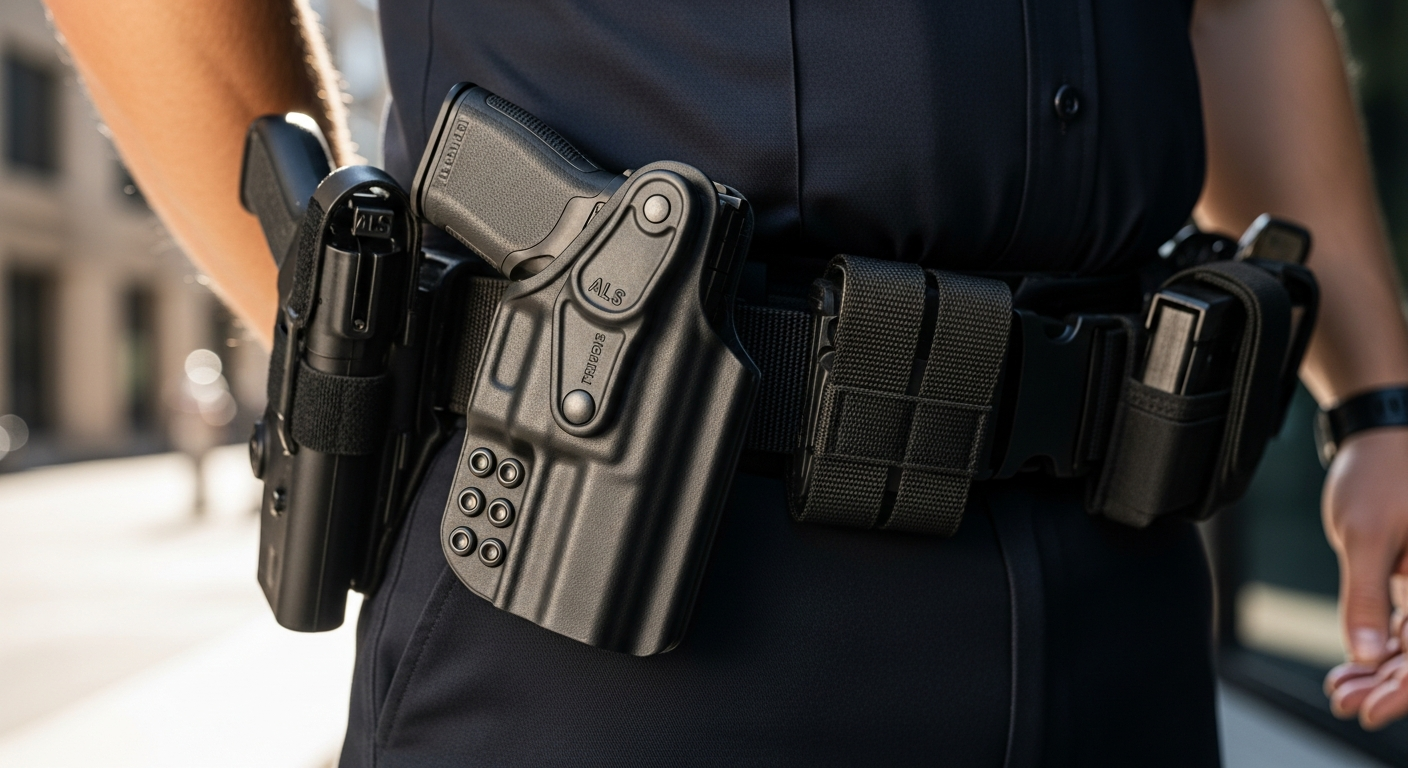
Understanding the Safariland 6360: The Gold Standard in Duty Weapon Retention
Weapon retention isn't a luxury in law enforcement—it's a matter of life and death. Officers face unpredictable threats where a firearm secured by anything less than superior retention systems becomes a liability rather than protection. The Safariland 6360 ALS/SLS Duty Holster has emerged as the industry benchmark for active retention duty systems, trusted by military units and law enforcement agencies nationwide.
With dual locking mechanisms delivering Level III retention and compatibility with modern red dot optics, the 6360 keeps weapons secure while maintaining accessibility for trained operators. The holster's engineering addresses the critical gap between maximum security and operational functionality—a balance that separates professional-grade systems from consumer alternatives.
Understanding Dual Retention Technology in the Safariland 6360
ALS® (Automatic Locking System) Mechanics
The ALS® secures firearms automatically upon insertion, locking the weapon in all directions without requiring deliberate activation by the officer. This passive security measure eliminates human error from the retention equation. Drawing the firearm involves a simple thumb-lever mechanism that releases the lock, allowing straight-up presentation of the weapon. The system engages instantly upon holstering, meaning officers transitioning between duty scenarios maintain consistent protection without additional steps or conscious actions.
SLS® (Self Locking System) Functionality
The rotating hood design creates an additional barrier against unauthorized access. This secondary retention layer requires a forward-and-downward motion to disengage, preventing accidental removal during physical contact or weapon grab attempts. The hood remains in place during normal carry and only disengages when the officer intentionally executes the proper draw sequence. This redundancy transforms the holster from a single-point-failure system into a multi-stage security architecture.
Level III vs. Level IV Retention
The standard 6360 configuration delivers Level III retention—sufficient for the vast majority of law enforcement applications. Agencies requiring maximum security can upgrade to Level IV by adding the optional Sentry device, which further restricts holster access. This modular approach allows departments to calibrate security levels based on operational threat assessments and deployment contexts. Higher retention levels correlate with longer draw times, making the choice between Level III and Level IV a calculated decision rather than an automatic upgrade.
Retention Advantages in High-Risk Encounters
Dual-system redundancy prevents weapon takeaway attempts during physical altercations and close-quarters engagements. Officers retaining control of their firearms during struggles significantly improve survival odds and maintain their primary defensive tool. The psychological advantage of carrying a genuinely secure weapon—one that requires coordinated mechanical actions to access—provides confidence that extends beyond the physical safeguards themselves.
Training Requirements for Smooth Deployment
Officers transitioning to active retention systems face a definable learning curve. The draw sequence differs from passive holsters, requiring muscle memory development through repetitive practice. Initial draw times may exceed those achieved with basic retention designs, but trained operators quickly achieve proficiency that rivals or exceeds their baseline performance. Agencies implementing the 6360 must allocate training time and realistic scenario practice to ensure officers achieve competent deployment under stress conditions.
The 6360RDS Variant—Adapting to Optics-Equipped Duty Pistols
Red Dot Optics Adoption in Law Enforcement
Law enforcement agencies increasingly recognize the performance advantages of reflex sights mounted on duty weapons. Red dot optics reduce target acquisition time, improve accuracy across varying lighting conditions, and streamline the learning curve for newly qualified officers. The industry shift toward RDS-equipped duty pistols reflects evidence-based adoption of technology that demonstrably improves hit probability and shot placement consistency. Consequently, holster designs must evolve to accommodate these modern firearms without compromising retention capabilities.
Protective Hood Design for Optics
The 6360RDS variant features a protective hood specifically engineered to shield red dot systems from impact and environmental damage without compromising sight picture or creating unwanted obstruction. This design consideration prevents the optic from striking objects during holstering or movement, eliminating a common failure mode in standard holsters adapted for optics use. The hood protection extends firearm system longevity while maintaining the sight's zero and optical clarity.
Compatibility with Popular Optic Platforms
The 6360RDS accommodates Trijicon RMR, Holosun, and other common duty-grade reflex sights through carefully engineered hood geometry. This compatibility spans the primary optics platforms adopted by federal agencies, state police departments, and municipal law enforcement. Agencies selecting the RDS variant gain holster compatibility with their optics-equipped arsenals without requiring specialized or proprietary mounting solutions.
Weapon-Mounted Light Accommodation
The 6360 series supports Streamlight TLR-1 and Surefire X300 series lights alongside optics, addressing the reality that modern duty weapons frequently carry multiple accessories. This integrated approach eliminates the need for separate holsters based on accessory configurations. Officers can maintain consistent muscle memory and retention reliability across equipment variations, simplifying training and equipment management.
Why the RDS Variant Matters for Modern Agencies
The RDS variant addresses the gap between standard holsters and the evolving loadout requirements of contemporary law enforcement. Rather than forcing agencies to choose between optics-equipped weapons and proven retention systems, the 6360RDS delivers both capabilities. This innovation maintains the platform's relevance as duty weapon configurations advance beyond iron sight configurations, ensuring the gold standard status extends into the modern operational environment.
SafariLaminate™ Construction & Material Durability
SafariLaminate™ Advantages Over Traditional Leather
SafariLaminate™ represents a significant advancement over full-leather duty holsters, delivering enhanced longevity and weather resistance without compromising aesthetic appeal. The material withstands extreme temperature fluctuations, moisture exposure, and UV degradation that gradually degrade traditional leather. Officers maintain professional appearance through leather-like finish while gaining the durability benefits of synthetic material engineering. Maintenance demands drop substantially compared to leather alternatives, eliminating the need for conditioning treatments and reducing long-term care requirements.
Suede Lining Protection
The interior suede coating serves dual protective functions: preserving firearm finishes from abrasive contact and preventing sight snags during draw sequences. This lining material maintains its protective properties across extended service life, resisting compression that degrades performance in lower-quality holsters. The suede's tactile properties also facilitate positive weapon positioning, ensuring consistent draw presentation.
Durability in Demanding Environments
The 6360 performs reliably across extreme temperatures, moisture exposure, and repeated daily wear patterns that challenge lesser duty holsters. Law enforcement and military personnel operating in diverse climates and weather conditions consistently validate the material's durability. Holsters that fail prematurely create equipment continuity issues, forcing officers to transition between systems or operate with compromised retention—situations the 6360's construction prevents through engineered longevity.
Aesthetic Appeal and Professional Appearance
Institutional standards require duty equipment to project professionalism and reliability. The 6360's leather-like finish satisfies these aesthetic requirements while delivering synthetic material benefits that leather alternatives cannot match. Officers carrying the holster present the appearance of traditional leather professionalism without the maintenance burden or accelerated degradation associated with full-leather designs.
Long-Term Value Proposition
Cost-per-use analysis reveals substantial savings over extended service life when comparing the 6360's durability to lower-cost alternatives. A duty holster operating across a 5–10 year service period with minimal maintenance and no replacement cycles provides superior value despite higher initial acquisition costs. Agencies evaluating procurement decisions often overlook this long-term economic advantage, focusing exclusively on upfront expense rather than total cost of ownership.
Firearm Compatibility & Universal Belt Loop Attachment
Extensive Firearm Fit Options
The 6360 series accommodates Glock models across the Gen 3–5 spectrum, Smith & Wesson M&P platforms, Sig Sauer P226/P229 configurations, and numerous other duty-standard firearms. This expansive compatibility eliminates the need for multiple holster designs when deploying across firearm platforms. Agencies standardizing on duty weapons still benefit from available configurations that match specific pistol models, barrel lengths, and accessory configurations.
Universal Belt Loop (UBL) Design
The standardized 2.25-inch belt loop attachment accommodates duty belt systems across agencies without requiring specialized hardware or mounting solutions. This universality simplifies equipment procurement and reduces compatibility verification overhead. Officers transitioning between assignments or departments carry familiar holster systems without adjustment periods.
Mid-Ride Positioning Benefits
The mid-ride belt loop placement positions the weapon close to the body, balancing body concealment with quick-access draw angles. This positioning creates ergonomic advantages by reducing leverage during weapon grab attempts while maintaining accessibility for trained operators. Officers find the mid-ride height comfortable for all-day carry, particularly when wearing extended shift uniforms or duty gear.
Compact Profile Advantages
The slim design allows comfortable all-day carry without excessive printing or movement. Officers maintain professional appearance while carrying genuinely secure retention systems that don't advertise weapon position through visible bulges or holster outline. The compact profile also reduces snag points during movement through doorways, vehicles, or confined spaces.
Customization Options by Firearm
Tailoring holster fit to specific pistol models, barrel lengths, and accessory configurations ensures optimal retention and draw reliability. Standard configurations accommodate most common duty pistols, while specialized variants address less common platforms or unique departmental requirements. This customization approach maintains the 6360's accessibility while serving agencies with specific equipment specifications.
Pricing, Investment Considerations & Competitive Positioning
Price Range Breakdown
The 6360 typically ranges from approximately $140 to over $300, depending on firearm fit, finish options, and retailer pricing. This price spectrum reflects different configurations and availability factors rather than quality variations within the standard lineup. Agencies budgeting for duty holster procurement should establish clear specifications before soliciting quotes, as customized configurations command premium pricing.
Factors Affecting Cost Variations
RDS variants, light-compatible models, and premium finishes influence final pricing structures. Holsters equipped for optics-specific platforms cost more than basic iron sight configurations due to additional engineering and protection mechanisms. Custom finishes beyond standard SafariLaminate colorways further increase acquisition costs. Bulk quantity pricing provides leverage for agencies outfitting multiple personnel simultaneously.
Return on Investment for Agencies
Higher upfront costs justify themselves through extended service life and reduced replacement frequency. A holster functioning reliably across 7–10 years of daily use substantially outperforms cheaper alternatives requiring replacement every 3–4 years. Transition costs—retraining officers on new systems, managing equipment continuity—create hidden expenses that the 6360's longevity eliminates. Agencies comparing procurement options should calculate total cost of ownership rather than isolated purchase price.
Comparison to Budget Holster Alternatives
Cheaper retention systems may compromise officer safety through inferior security mechanisms, inadequate material durability, or draw reliability issues. Budget alternatives frequently demonstrate failure modes under operational stress that the 6360's engineered redundancy prevents. The cost differential between the 6360 and lower-tier options represents genuine performance and reliability investment rather than unnecessary premium spending.
Bulk Purchasing Considerations
Agencies outfitting multiple personnel simultaneously gain negotiating leverage for volume discounts. Centralizing procurement through established Safariland distributors often reduces per-unit costs below retail pricing. Standardizing on the 6360 across departments simplifies training, equipment management, and spare parts inventory compared to fragmented holster selections.
Real-World Performance & Operational Limitations
Advantages in High-Stress Scenarios
The 6360's proven security record during physical confrontations and weapon retention challenges validates its reputation as the industry benchmark. Law enforcement and military personnel operating in genuine threat environments consistently demonstrate the system's reliability when threats escalate to physical altercations. This operational validation exceeds theoretical testing or laboratory scenarios, providing confidence rooted in field-proven performance.
Draw Speed Considerations for Untrained Personnel
Dual-retention systems inherently require more deliberate draw sequences than passive holster designs. Officers unfamiliar with ALS® and SLS® mechanics may experience initially slower deployment times compared to basic retention systems. Dedicated practice substantially reduces this disadvantage, with trained operators achieving draw speeds that rival or exceed their baseline performance with simpler holsters. Untrained personnel should expect 6–8 weeks of regular practice before achieving proficient deployment.
Bulk Perception Among Some Users
The robust retention features, protective hood, and SafariLaminate™ construction create a holster that occupies more physical space than minimalist passive designs. Officers accustomed to ultra-slim holsters may perceive the 6360 as bulky, though this perception typically diminishes after extended carry experience. The compact profile still ranks among the slimmest duty-rated retention systems, but absolute minimalism sacrifices the security features that define the platform.
Training Time Investment
Agencies must allocate resources to ensure officers master the ALS® and SLS® mechanisms. Initial qualification cycles require extra range time and dry fire practice beyond standard duty holster transitions. Departments implementing the 6360 should budget for increased training hours during the transition period, though long-term training demands normalize once proficiency becomes established.
Transition Challenges from Passive Holsters
Officers switching from basic retention systems should expect an adaptation period characterized by longer draw times and muscle memory confusion. The mechanical differences between passive and active retention systems require conscious retraining rather than simple equipment substitution. Realistic scenario training accelerates this transition, allowing officers to develop proficiency in conditions approximating actual operational stress.
Why Agencies Continue to Trust the Safariland 6360
Industry Benchmark Status
The 6360 became the gold standard against which competitors measure themselves through decades of proven performance and continuous innovation. Equipment manufacturers recognize the platform's dominance and engineer competitive offerings that attempt to match its feature set and reliability. This benchmark status reflects genuine operational advantages rather than marketing positioning.
Adoption Across Military and Law Enforcement
Federal agencies, state police departments, and municipal law enforcement forces nationwide standardize on the 6360 or designate it as approved equipment. This widespread adoption creates ecosystem benefits including readily available spares, abundant training resources, and established performance standards. Officers transitioning between agencies often encounter the same platform, reducing equipment learning curves.
Proven Performance Record
Decades of operational validation in real-world law enforcement and military applications provide confidence that surpasses laboratory testing or theoretical analysis. Thousands of officers have depended on the 6360 during genuine threat encounters, demonstrating its reliability when stakes exceed training scenarios. This operational pedigree attracts new agencies seeking proven equipment rather than experimental designs.
Continuous Innovation Alignment
The RDS variant and ongoing accessory compatibility development ensure the platform remains relevant as duty weapons evolve beyond iron sight configurations. Safariland demonstrates commitment to the platform's longevity rather than cycling through generational redesigns that obsolete existing inventory. This alignment with industry evolution maintains the 6360's relevance across changing operational requirements.
Manufacturer Reputation and Support
Safariland's commitment to quality, warranty support, and ongoing product refinement provides confidence in long-term platform viability. The manufacturer's reputation for stand-behind service and genuine product improvement—rather than cosmetic redesigns—attracts agencies valuing equipment reliability over trendy innovation.
The 6360 Standard: Investing in Uncompromising Weapon Security
The Safariland 6360 ALS/SLS Duty Holster represents far more than a gear purchase—it's a commitment to officer safety and operational reliability. The dual retention systems deliver the security that matters when lives hang in the balance, while the RDS variant ensures your agency doesn't sacrifice modern optics capabilities for retention excellence.
Agencies worldwide have validated that this investment pays dividends through reduced liability, enhanced officer confidence, and proven performance in critical moments. The long-term cost advantages, durability track record, and operational flexibility position the 6360 as the pragmatic choice for departments serious about comprehensive duty equipment standards.
If your department is evaluating duty holster upgrades or modernizing your optics-equipped arsenals, the 6360 warrants serious consideration. Start with a small pilot program if transitioning from passive retention systems, allocate time for proper training, and you'll quickly understand why the 6360 remains the benchmark against which all other duty holsters are measured.
Leave a Reply