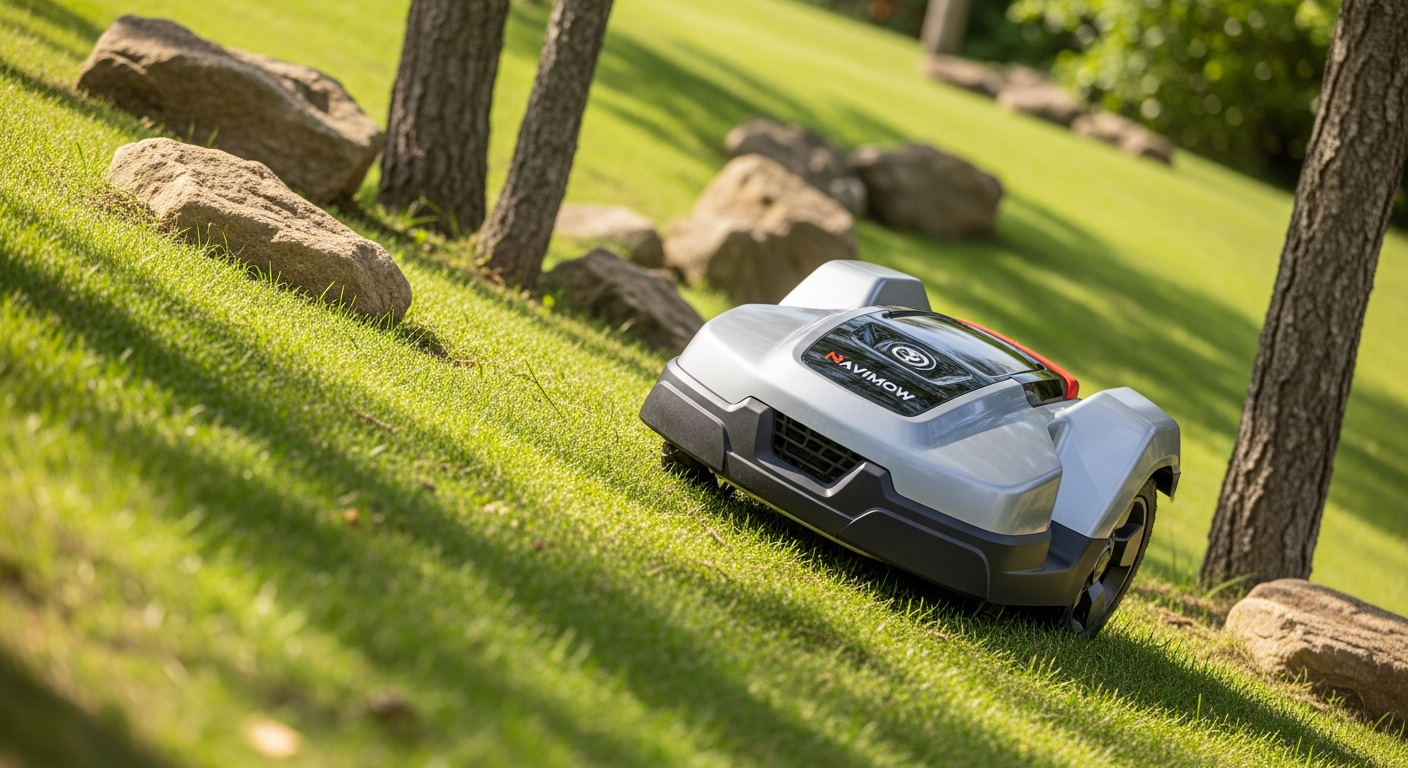
Most robotic mowers slip and fail on slopes steeper than 30%, leaving homeowners with missed patches and mounting frustration. The Segway Navimow i2 series changes this dynamic entirely. With AWD variants capable of tackling inclines up to 45°, this is engineering built specifically for demanding terrain—not an afterthought.
Homeowners with hilly properties or yards packed with obstacles have traditionally faced a harsh reality: hire expensive professionals, push a manual mower yourself, or accept mediocre results from standard robotic solutions. The Navimow i2 rewrites that equation by combining all-wheel-drive technology with real-time navigation systems that map complex environments as they work. Terrain and obstacles are the primary reasons people abandon robotic mowers altogether, so addressing both directly matters considerably.
Explore Navimow i2 models that handle your challenging yard.
This breakdown covers which Navimow i2 models perform best on challenging terrain, how the AWD and LiDAR variants differ in handling obstacles, and whether this mower truly delivers on steep slopes. You'll also discover practical considerations for installation and operation in complex yards—everything needed to determine if it's the right fit for your property.
AWD vs. LiDAR: Which Navimow i2 Model Conquers Your Yard Type?
All-wheel-drive models excel precisely where traditional mowers fail. The upgraded powertrain and traction system transform slopes and uneven terrain from obstacles into manageable challenges. That 45% slope capability (24° angle) positions AWD variants as the primary choice for hilly properties where losing traction means losing control.
LiDAR-equipped models prioritize entirely different environments. Instead of focusing on slope handling, they excel in obstacle-dense yards where high-resolution spatial mapping becomes critical. These models navigate complex environments by building precise 3D maps independent of satellite signals.
The terrain-specific advantages become clear when you consider your property's primary challenge. AWD shines on hills and varied ground with significant elevation changes. LiDAR dominates complex yards where garden beds, decorative items, and fixed obstacles create navigation puzzles. Both models share RTK navigation and VisionFence™ technology, meaning they cover different pain points while maintaining the same core precision advantages.
Real-world performance differences emerge in traction, power distribution, and ground contact on steep grades. AWD models maintain consistent cutting quality because their traction prevents slipping—essential for steep properties. LiDAR models, conversely, maintain mowing accuracy in obstacle-rich environments by understanding their surroundings in minute detail.
Navigating Obstacles with Precision: VisionFence™ and LiDAR Technology
VisionFence™ represents a genuine leap in obstacle detection. This AI system identifies over 200 obstacle types with 1 cm precision using a 140° RGB camera—precise enough to detect garden furniture, decorative items, pet toys, garden beds, and unexpected hazards without hesitation.
Solid-state LiDAR in the i2 LiDAR models adds another dimension. This technology enables independent navigation without relying on satellite signals, a crucial advantage for yards with poor GPS reception or dense tree canopy. Real-time collision avoidance prevents damage to the mower, obstacles, and pets in dynamic yard environments where children or animals might appear unexpectedly.
Performance in dense tree cover demonstrates the system's sophistication. RTK + Vision (EFLS™ NRTK) maintains centimeter-level accuracy even when satellite signals weaken—critical for properties where overhead coverage would traditionally blind standard robotic mowers. The system learns and adapts to new obstacles over time, meaning your yard's mapping improves with each mowing cycle rather than becoming fixed at installation.
Terrain Handling Performance: What to Expect on Slopes and Uneven Ground
The 45% slope capability translates into practical terms most homeowners can visualize: a 1-meter rise for every 2.2 meters of horizontal distance. For sloped yards, this means the mower handles terrain that would simply defeat standard robotic solutions. The all-wheel-drive mechanics prevent slipping by distributing power across all four wheels, maintaining traction where single-wheel or two-wheel drive systems lose contact with the ground.
Ground contact and cutting quality matter tremendously on hills. Missed patches and scalping—where the blade cuts soil instead of grass—become real concerns on uneven terrain. The Navimow i2's design maintains consistent blade height and ground contact, ensuring systematic cutting patterns even as elevation changes. Battery performance on inclines deserves consideration as well. Slope difficulty affects runtime and charging frequency, with steeper terrain consuming battery capacity more rapidly.
Some models' floating deck design accommodates extremely uneven terrain by allowing the cutting deck to follow ground contours naturally. Models without this feature may require workarounds on severely uneven properties. Compared to manual mowing on challenging topography, the time savings and consistency benefits become immediately obvious—no more pushing heavy equipment uphill or retracing missed sections.
Check current Navimow i2 models for your terrain specifications.
Wire-Free Navigation in Complex Yards: The RTK + Vision Advantage
The Network RTK (Real-Time Kinematic) positioning system eliminates boundary wires entirely—a game-changing simplification compared to traditional robotic mowers. Virtual boundary setup happens through the intuitive mobile app without any physical installation hassle.
GeoSketch™ multi-zone mapping allows precise control over which areas get mowed and which remain protected. This matters tremendously in yards with flower beds, vegetable gardens, or other zones requiring mowing exclusions. Centimeter-level accuracy ensures systematic mowing patterns and complete coverage even in irregular yard shapes where traditional mowers miss corners or create overlapping paths.
Satellite signal independence in LiDAR models makes this approach particularly valuable for yards with poor GPS reception or dense tree canopy. The mower doesn't depend on perfect satellite visibility to function—it builds its own environmental map and navigates accordingly. Scheduling flexibility adapts to complex property layouts, allowing different mowing routines for various sections of your yard based on terrain and obstacle patterns.
Smart Home Integration and App Control for Challenging Terrain Management
Mobile app features provide monitoring and remote control across your entire property. You track the mower's progress, receive notifications when it encounters obstacles, and adjust boundaries on-the-fly without stopping the mower or manually reprogramming anything. Alexa and Google Home compatibility adds voice-activated control—genuinely convenient for hands-free operation.
Real-time alerts notify you when the mower completes specific zones or encounters challenges. This feedback loop proves invaluable on terrain-demanding properties where understanding exactly what's happening helps you optimize mowing patterns over time.
Multi-zone scheduling enables different mowing routines for slopes, flat areas, and obstacle zones. Your property becomes a collection of distinct mowing zones, each with parameters optimized for its specific challenges. Troubleshooting capabilities allow remote diagnostics when the mower struggles with particular terrain sections, helping you refine boundaries or adjust cutting heights.
Battery Life and Charging on Hilly Properties
Battery capacity varies significantly across models. The i206 AWD includes a 2.55 Ah battery, while the i220 LiDAR tops out at 10 Ah. Slope impact on runtime is real—inclines consume battery capacity faster than flat terrain because the mower works harder to maintain traction and speed on elevation changes.
Charging times scale with capacity: smaller units charge in 60 minutes, while larger capacity batteries require up to 130 minutes. Coverage area specifications range from 500 m² to 2000 m² depending on terrain difficulty and slope percentage. Docking station placement becomes strategic on properties with elevation changes—optimal positioning near the steepest section prevents the mower from exhausting its battery climbing toward home.
Battery management in frequent-use scenarios on challenging terrain requires understanding your property's total mowing time. Steeper properties consume more battery per unit area, potentially requiring multiple charging cycles for complete coverage on larger lots.
Installation and Setup Considerations for Uneven and Obstacle-Rich Yards
Wire-free installation advantages become immediately apparent compared to traditional robotic mowers requiring physical boundary cable installation. The Navimow i2 needs only docking station placement and app-based boundary definition—dramatically faster and more flexible.
The initial mapping process allows the mower to learn your yard's layout, obstacles, and terrain variations over multiple cycles. This adaptive approach beats static installation because the system improves continuously. LiDAR models show temporary mapping limitations around raised beds and new obstacles during initial operation, but this improves substantially within the first week as the mower learns spatial relationships.
Docking station placement on slopes and uneven ground requires thought—reliable charging depends on stable positioning where the mower can navigate smoothly in both directions. Virtual boundary precision lets you set exact mowing zones around obstacles and protected areas through the app interface. Professional setup options exist for complex properties where DIY installation might miss nuances, though most homeowners handle the process independently without difficulty.
Noise Level and Weather Resistance During Outdoor Operation
Quiet operation at 58-59 dB(A) makes early morning or evening mowing feasible without disturbing neighbors or family. This noise level falls within typical conversational range—noticeable but not intrusive.
IP66 weather rating provides comprehensive protection against rain, dust, and debris. The mower operates reliably in wet conditions without performance degradation, handling spring mud, summer storms, and autumn leaves without issue. Easy cleaning after exposure to mud and grass clippings keeps the unit functioning optimally through seasons of intensive outdoor use.
Seasonal considerations matter on hilly terrain where spring runoff, summer heat, and autumn leaf drop create changing environmental conditions. Durability in these demanding conditions reflects robust build quality engineered for intensive use on challenging properties rather than manicured suburban lawns.
Pricing and Value for Terrain-Demanding Yards
Entry-level pricing starts around €899 for the i205 AWD—accessible for smaller hilly properties. Mid-range LiDAR models command €1,299–€1,649 for complex yards with numerous obstacles. The value proposition becomes compelling when compared to professional lawn care services, which cost thousands annually.
Model selection matches yard size to coverage area specifications. The i206 AWD handles 500 m², the i210 LiDAR covers 1000 m², and the i220 LiDAR manages 2000 m². Terrain difficulty and obstacle density influence which size makes sense for your property. Long-term savings accumulate rapidly—reduced labor costs and consistent results on challenging terrain eliminate the expense of professionals or the time investment of manual mowing.
Retailer variations across European markets sometimes offer seasonal promotions, so checking multiple sources before purchasing makes financial sense.
Real-World Limitations and Honest Trade-Offs
Manual cutting height adjustment represents the primary operational limitation. The blade height requires physical access to the mower rather than app-based control, though this affects operation only occasionally. Floating deck absence in some models creates potential for missed spots on extremely uneven ground—important consideration for severely rolling properties.
LiDAR initial learning curve means temporary mapping constraints around raised beds and new obstacles that improve over time. Slope limitations beyond 45° exceed the mower's capability—properties steeper than this need alternative solutions. Obstacle detection gaps exist for extremely small items or camouflaged objects that might not register against the yard background.
Weather-related performance considerations include heavy rain or snow temporarily reducing navigation accuracy. These limitations remain minor relative to the advantages, but understanding them prevents disappointment after purchase.
Is the Navimow i2 Right for Your Challenging Yard?
Ideal use cases include hilly properties, obstacle-dense yards, and complex terrain layouts. Best-fit models align with your primary challenge: i2 AWD for slopes, i2 LiDAR for obstacles, or both variants for combined challenges.
A property assessment checklist helps identify which model makes sense. Measure your slope percentage using basic geometry or online slope calculators. Count obstacles and estimate their distribution across your property. Evaluate terrain variation by walking the yard and noting elevation changes.
Comparison to alternatives reveals that the Navimow i2 stacks against other robotic mowers much more favorably for challenging terrain than standard budget options. Hybrid solutions combining robotic mowing with manual touch-ups in extremely difficult areas work well for properties with mixed terrain difficulty. Future-proofing matters if you plan yard modifications or expansions—the modular app-based approach adapts to changing layouts easily.
Making Challenging Yards Manageable: Your Navimow i2 Decision
The Segway Navimow i2 series genuinely transforms how homeowners with difficult terrain approach lawn care. Whether you're battling steep slopes, navigating obstacle courses, or managing both simultaneously, the combination of AWD traction, advanced navigation, and intelligent obstacle avoidance delivers results that traditional robotic mowers simply can't match.
Wire-free setup eliminates installation headaches entirely. The intuitive app puts control directly in your hands—even on properties that would otherwise require professional services. The i2 AWD handles slopes other mowers won't touch. LiDAR variants map complex environments with remarkable precision. Both options operate quietly enough for residential neighborhoods while maintaining weather resistance that handles rain and mud without performance loss.
Yes, minor trade-offs exist—manual cutting height adjustments and occasional initial mapping quirks—yet these pale against the convenience and reliability you gain. For terrain-demanding yards, the value proposition proves genuinely compelling.
If you've resigned yourself to manual mowing or expensive professional services because your property seemed too challenging, the Navimow i2 deserves serious consideration. Assess your yard's specific demands: measure slope percentage, count obstacles, and evaluate terrain variation. Then match those characteristics to either the AWD or LiDAR model fitting your needs.
The result? A genuinely intelligent lawn maintenance solution working with your challenging property instead of against it. Reclaim your weekends and stop fighting your yard.
Discover if the Navimow i2 is right for your challenging yard today.
Leave a Reply