The 7S36 Automatic Movement: Engineering Reliability at Its Core
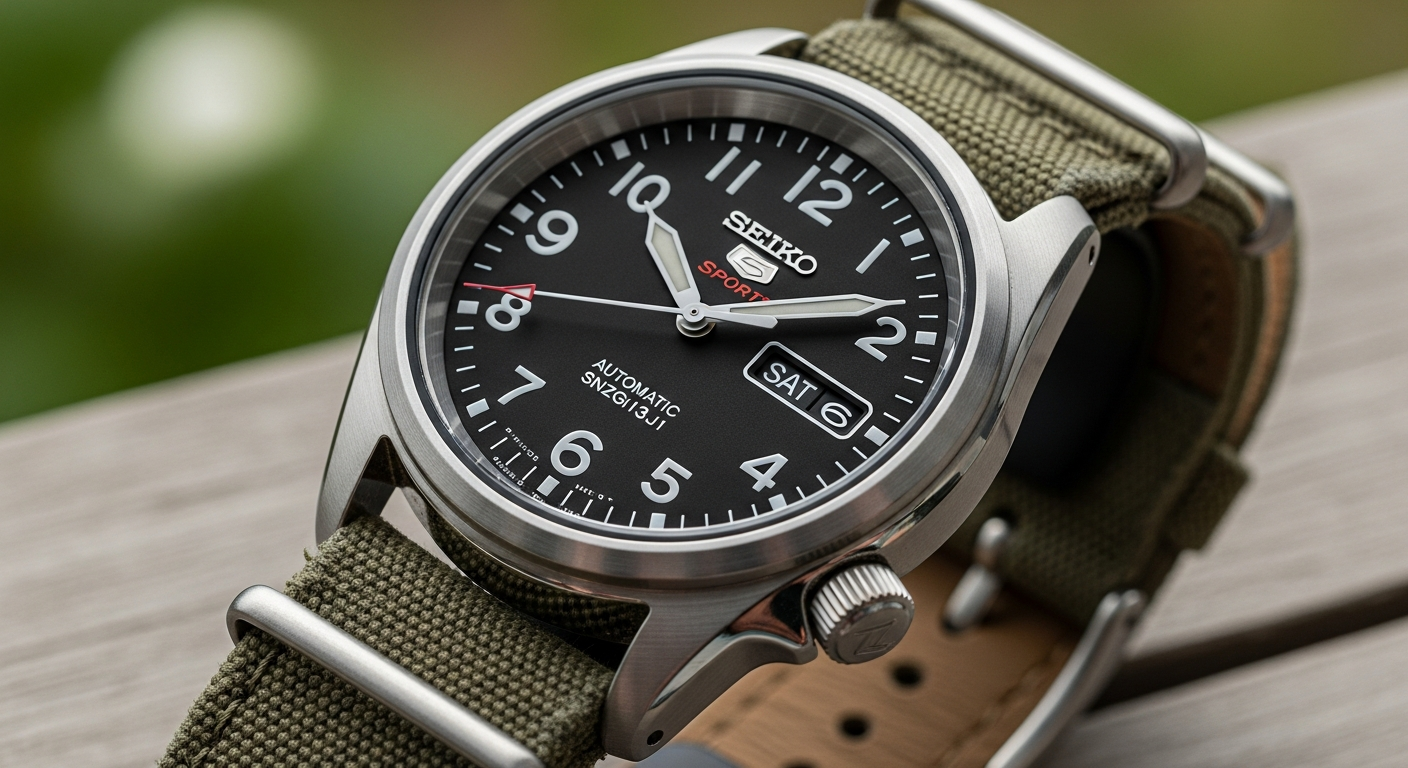
Over 40 hours of continuous power. A transparent case back revealing a beating mechanical heart. And a price tag under $200. The Seiko 5 Sports SNZG13J1 shatters the myth that quality automatic watches demand premium pricing. The Seiko 5 Sports line represents decades of Japanese watchmaking heritage, and the SNZG13J1 specifically captures the utilitarian spirit of military field watches. This isn't some flashy fashion piece; it's a tool designed for real-world performance.
The J1 designation tells you it's manufactured in Japan, a detail that resonates deeply with collectors who value authentic craftsmanship and reliability. With its 42mm stainless steel case, in-house 7S36 automatic movement, and bulletproof construction, this watch has earned a reputation as the thinking person's entry into mechanical timekeeping. You'll explore the mechanical movement that keeps it ticking, examine the design choices that make it so versatile, understand its water resistance capabilities, and discover why some collectors consider it the perfect gateway into automatic watches.
In-house Seiko engineering: Why the 7S36 movement represents genuine mechanical craftsmanship
The 7S36 movement stands as a testament to Seiko's commitment to vertical integration. Rather than purchasing movements from external suppliers, Seiko manufactures this caliber entirely in-house. This approach ensures complete quality control over every component, from the balance wheel to the escapement. The result is a movement that reflects decades of refinement and proven reliability across millions of watches.
Owning a watch with an in-house movement carries weight beyond mere specification. It represents a manufacturer's confidence in their engineering and a commitment to standing behind their product. When something goes wrong—which rarely happens with the 7S36—Seiko's service infrastructure supports it without passing responsibility to third parties.
23-jewel construction: Understanding jewel count and its role in reducing friction
The 7S36 features 23 jewels, synthetic rubies strategically placed at friction points throughout the movement. Each jewel serves a specific purpose: reducing wear on the steel components that would otherwise experience constant rotation. Where two metal surfaces meet and move, a jewel bearing dramatically extends the lifespan of both parts.
The 23-jewel count places this movement firmly in the reliable range. While higher jewel counts exist in more expensive watches, additional jewels beyond 23 rarely provide functional benefits—they represent diminishing returns in diminishing friction. At this count, the movement has achieved the sweet spot between cost-effectiveness and longevity.
40-41 hour power reserve: What this means for daily wear
The 7S36 stores approximately 40-41 hours of energy when fully wound. This practical specification means you can remove the watch, leave it unworn for a night and day, then put it back on knowing it will still be running and reasonably accurate. This power reserve significantly exceeds what many entry-level automatics offer, reducing the anxiety some new collectors experience about their watches stopping.
In practice, this translates to genuine convenience. Take it off Friday evening, wear a different watch Saturday, and put it back on Sunday morning—it will still be ticking. This flexibility makes the SNZG13J1 more accommodating for daily life than watches with 38-hour reserves.
Automatic winding mechanism: How the rotor captures wrist motion
The automatic rotor, visible through the transparent case back, swings freely as the wearer moves their wrist. This motion winds the mainspring without requiring any manual intervention. The beauty of this system lies in its simplicity: physics does the work. Every natural movement of your arm contributes to keeping the watch wound.
This is where the magic happens for new enthusiasts. Watching the rotor spin and knowing that your own movement powers the watch creates an immediate connection to mechanical horology. It's tangible, observable, and fundamentally different from the battery-powered experience.
Movement finishing and visibility: The transparent case back advantage
The transparent case back opens a window into Seiko's manufacturing quality. You can observe the beveling on the bridges, the polishing of the plates, and the overall assembly craftsmanship. While the 7S36 isn't finished to the standard of ultra-luxury movements, it displays honest, competent finishing that reflects its price positioning.
This visibility serves educational purposes as well. New collectors use the case back view to understand how an automatic movement functions. You can track the rotor's motion, observe the balance wheel oscillating at roughly 21,600 beats per hour, and appreciate the engineering that makes everything work in harmony.
Limitations of the 7S36: Addressing the absence of hacking and manual winding
The 7S36 lacks two features found in more sophisticated movements: hacking and manual winding. Hacking means the ability to stop the seconds hand by pulling the crown outward, enabling precise time synchronization. Manual winding allows you to wind the mainspring by hand, which is useful when the watch hasn't been worn for extended periods.
These absences represent cost-saving measures rather than design flaws. The movement operates perfectly without these functions; they simply represent nice-to-have conveniences rather than necessities. For someone just entering the mechanical watch world, their absence is imperceptible during everyday wear.
Reliability track record: Why this movement has become legendary
The 7S36 has earned a reputation as one of the most durable, least problematic movements in the watch industry. Multiple decades of continuous production mean countless field reports from real-world users. Stories abound of SNZG13J1 watches running flawlessly after 10, 15, or 20 years with minimal servicing.
This reliability forms the foundation of the watch's cult status. It doesn't have the prestige of a Swiss movement, but it has something more valuable for practical users: a documented track record of not failing. When choosing an entry-level automatic, you're not taking a risk with the 7S36—you're following millions of satisfied owners.
Case Design and Build Quality: Built Like a Tank
42mm stainless steel case: Proportions that work for various wrist sizes
The 42mm diameter occupies a sweet spot in modern watch sizing. It's substantial enough to command attention without overwhelming smaller wrists, and large enough to satisfy those with bigger frames. The stainless steel construction offers durability without precious metal pricing, and the material's neutral tone pairs with virtually any strap or outfit.
The case thickness sits at a reasonable proportion to the diameter, avoiding the chunky appearance that some larger watches develop. The lug-to-lug distance—the measurement that actually determines how the watch sits on your wrist—remains manageable for the wrist sizes this watch traditionally attracts.
Japanese manufacturing standards: What Made in Japan (J1 designation) signifies
The J1 designation confirms this specific model is assembled and manufactured in Japan, subject to Seiko's domestic quality control standards. This carries genuine significance beyond marketing appeal. Japanese manufacturing processes emphasize consistency, precision, and attention to detail in ways that differ from mass-production operations in other regions.
Collectors distinguish between watches manufactured in Japan, assembled in Japan, or simply having Japanese movements. The SNZG13J1's full Japanese production means every step—from case making through final assembly—occurs under Seiko's direct oversight.
Case construction durability: Why collectors describe this watch as bulletproof
The stainless steel case exhibits a robustness that justifies the "bulletproof" description. The case is thicker than fashion watches, with substantial lugs that resist breakage from impacts. The bezel is raised slightly, protecting the crystal from accidental contact with surfaces.
This durability doesn't stem from exotic materials or precious metals—it comes from competent engineering and appropriate material thickness. A watch doesn't need to cost thousands to withstand daily wear and tear. The SNZG13J1 proves this emphatically.
Hardlex crystal protection: Balancing scratch resistance with optical clarity
The Hardlex crystal represents Seiko's proprietary mineral glass. It's more scratch-resistant than standard mineral glass but less so than sapphire crystal. Over years of ownership, tiny scratches will accumulate. These scratches matter more to perfectionists than pragmatists—they don't affect timekeeping or readability.
The trade-off is economical. Sapphire crystal watches start significantly higher in price. For someone unconcerned about eventual surface marring, Hardlex offers exceptional value and still provides excellent optical clarity.
Transparent case back: The practical and aesthetic benefits
The clear exhibition case back serves dual purposes. Practically, it lets you monitor the rotor's motion and confirms the movement is functioning. Aesthetically, it transforms the watch into a conversation piece—many people find the visible mechanics genuinely captivating.
Regular case back gasket inspection preserves the water resistance seal at the back. This is a minor maintenance consideration but an important one if you plan to use the watch for water activities.
Case finishing and brushing: How the surface treatment contributes to appearance
The stainless steel case features brushed finishing on the top surfaces with polished bevels on the lugs. This two-tone approach—combining matte and reflective surfaces—creates visual sophistication without pretension. The brushing also hides daily wear marks better than pure polishing would.
The finishing quality reflects the watch's honest approach. It's not mirror-polished to luxury watch standards, but it's competent and appropriate for the price point. Over time, the brushing will polish slightly from wear, which adds character rather than detracting from it.
Water resistance at 100 meters (10 ATM): Suitable applications and limitations
The 100-meter water resistance rating indicates suitability for swimming and snorkeling but not diving. You can wear this watch while swimming laps, splashing in the ocean, or getting caught in the rain without worry. The push-pull crown rather than a screw-down design is the limiting factor—at greater depths, water pressure can gradually work past the crown seal.
This specification matches the watch's intended use as a field watch and everyday tool. It's more than adequate for legitimate aquatic activities short of professional diving.
Dial Legibility and Lume Performance: Visibility When It Counts
Black dial with Arabic numerals: Why this classic configuration remains the gold standard
The black dial with Arabic numerals at 12, 3, 6, and 9 positions represents optimal legibility design. The high contrast between black background and white numerals ensures you can read the time instantly, even in poor lighting or peripheral vision. This configuration has remained standard on military field watches for decades because it simply works.
Modern design trends sometimes favor minimalism—hour markers instead of numerals, or applied indices. These choices prioritize aesthetics over function. The SNZG13J1 prioritizes function, which explains its appeal to those valuing practical utility.
Dual 12-hour and 24-hour markings: Practical applications
The dial features both standard 12-hour markings and military-style 24-hour numerals printed around the chapter ring. This dual system accommodates users who think in 24-hour time—common among military personnel, pilots, and those working non-standard schedules.
Even if you never use the 24-hour markings, their presence doesn't clutter the dial. They occupy the outer ring without interfering with the central, most-read area.
LumiBrite proprietary lume: How Seiko's luminous coating outperforms
Seiko's proprietary LumiBrite coating provides exceptional low-light visibility compared to standard lume alternatives. The hands and hour markers glow distinctly bright when charged by ambient or direct light. In complete darkness, the lume remains visible far longer than competitors' versions.
This practical feature matters when you check your watch in a darkened bedroom, during evening outdoor activities, or whenever ambient light is limited. The quality lume separates watches that accommodate real-world use from those optimized only for daylight visibility.
Day-date window at 3 o'clock: The convenience factor
The day and date window at the 3 o'clock position provides essential information without cluttering the dial. You can glance at the watch and know whether it's Monday or Friday, and whether you're looking at the 5th or 15th of the month. This eliminates the need to remember or check a calendar separately.
The white text on black background in this window maintains the legibility standard of the rest of the dial.
Hand design and contrast: How the hand shape and size contribute to quick time reading
The hands are appropriately sized for the dial, with sufficient contrast to the dial background. The design emphasizes clarity—the hour hand, minute hand, and seconds hand are distinctly different shapes, allowing instant differentiation even in peripheral vision.
The hand design avoids decorative flourishes that would compromise readability. Form follows function throughout.
Dial symmetry and balance: The aesthetic appeal of the layout
The dial layout achieves visual balance despite the day-date window breaking perfect symmetry. The numerals are properly spaced, the indices are evenly distributed, and the overall composition feels professional and intentional rather than cluttered or sparse.
This aesthetic quality elevates the watch beyond purely utilitarian tools—it's pleasant to look at repeatedly throughout the day.
Aging characteristics: What to expect from lume brightness over years
LumiBrite lume maintains brightness better than older luminous materials, but no lume remains equally bright indefinitely. After 5-10 years, the glow will gradually diminish slightly. After 20-30 years, the lume may be noticeably dimmer than when new. This represents normal aging rather than defect.
If lume brightness becomes important to you, luminous material can be refreshed during servicing, though this requires professional work.
The Military Field Watch Aesthetic: Versatility Across Contexts
Historical design inspiration: Tracing the SNZG13J1's lineage
The SNZG13J1 descends directly from military field watches designed for genuine operational use. The large Arabic numerals, the day-date window, the simple black dial, and the robust case all trace their heritage to instruments issued to soldiers, pilots, and field personnel.
This isn't retro-styling or nostalgia—it's the perpetuation of design principles proven effective in demanding conditions. The military field watch aesthetic endures because the underlying design logic remains valid.
Dress-down capability: Pairing with casual wear
Swap the stainless steel bracelet for a NATO strap in black, olive, or tan, and the SNZG13J1 transforms into a casual tool watch perfectly suited to weekend wear, outdoor activities, and everyday informality. The field watch aesthetic aligns naturally with casual contexts—hiking boots, jeans, work clothes, and athletic wear.
The NATO strap adds durability and authenticity while reducing the formality that the bracelet sometimes conveys.
Dress-up potential: How the stainless steel bracelet works with business casual
The stainless steel bracelet and formal black dial can accompany business casual attire or even business formal wear without appearing out of place. The watch reads as a serious, functional instrument rather than a casual accessory. Many wearers successfully incorporate it into their professional wardrobe.
The size works in business contexts—it's present enough to be noticed but not so large as to seem ostentatious.
Strap compatibility and modularity: Why this watch thrives with aftermarket options
The standard 20mm lug width accommodates countless aftermarket straps. Leather, NATO, Zulu, fabric, rubber—virtually every strap style available in 20mm will fit. This modularity transforms the watch into a customizable tool that can be adapted to different activities and occasions.
Many collectors own multiple straps and rotate them based on context, transforming their SNZG13J1 into multiple distinct watches.
Timeless design philosophy: Understanding why military aesthetics transcend fashion
Military field watch design prioritizes function so completely that aesthetic results emerge as a byproduct. The visual identity that results—clean lines, high contrast, minimal ornamentation—transcends fashion trends because it's grounded in practical necessity rather than style preference.
This timelessness explains why military watches appeal to such diverse audiences. They're never "dated" in the way watches designed around specific aesthetic movements become dated.
Collector appeal: Why both newcomers and seasoned enthusiasts gravitate toward this design
New collectors appreciate the straightforward honesty—a watch that does exactly what it appears it will do. Experienced collectors value the historical continuity and the proven design language. The watch speaks across experience levels.
The Seiko 5 Sports line has achieved something difficult: cult status among both those seeking their first serious watch and those with collections worth tens of thousands of dollars.
Professional contexts: Suitability for aviation, outdoor work, and technical professions
Pilots, outdoor professionals, field technicians, and those working in environments where reliability matters choose this watch not for nostalgia but for practical suitability. The dial legibility matters when checking time during critical tasks. The durability matters when the watch might contact rough surfaces. The accuracy of the quartz timing— wait, this is automatic, not quartz—the reliability of the mechanical movement matters when you can't run to a repair shop mid-project.
The watch hasn't been designed for a specific profession, but its design language appeals to professionals across multiple fields.
Bracelet and Wearability: The Trade-Off Between Value and Premium Feel
Stainless steel bracelet construction: Materials and assembly methods
The stainless steel bracelet uses solid links—not the hollowed construction found in some budget watches. The metal thickness is appropriate for everyday wear, though it's not as substantial as bracelets on more expensive watches. The assembly is functional and secure without being particularly refined.
The bracelet closes with a fold-over clasp that provides adequate security for normal wear. The clasp mechanism is straightforward and rarely problematic.
Comfort and fit: How the bracelet adjusts for various wrist sizes
The bracelet includes removable links allowing sizing for different wrist circumferences. The adjustment process requires basic tools—typically included with the watch. Most wearers find the sizing straightforward, and the final fit comfortable for all-day wear.
The bracelet doesn't feel luxurious against the skin in the way expensive gold or platinum bracelets might, but it's comfortable for everyday use.
Rattle and movement: Common feedback about bracelet looseness
Users commonly note that the bracelet exhibits slight play between the links—a minor rattling or movement when you shake the watch. This represents a recurring criticism and reflects the cost-conscious construction. The bracelet functions entirely adequately and the rattle has no impact on performance, but many users notice it immediately.
This complaint forms one of the primary reasons owners migrate to aftermarket straps—the upgrade in perceived quality often justifies the swap.
Durability considerations: Expected lifespan and maintenance
The bracelet will function reliably for years of daily wear. The links are unlikely to break under normal use. Occasional cleaning to remove dirt from the link gaps preserves appearance and longevity.
Eventually—perhaps after 5-10 years of consistent use—the clasp may loosen or links may accumulate wear. At that point, replacement becomes economical.
Aftermarket upgrade potential: Why many owners immediately swap
The 20mm lug width opens extensive possibilities for superior straps. Quality leather straps, higher-end NATO options, and specialty fabric straps transform the watch's presence without spending additional money on the timepiece itself.
A significant percentage of SNZG13J1 owners quickly migrate to aftermarket straps, indicating that while the original bracelet is acceptable, upgrading is common and worthwhile.
Cost-benefit analysis: How bracelet quality reflects overall pricing strategy
The decision to use this particular bracelet reflects Seiko's commitment to accessible pricing. Investing in a premium bracelet would have increased the watch cost by $30-50, pricing it out of the sub-$200 category that defines its appeal.
The bracelet trade-off represents a rational business decision and a reasonable compromise for buyers seeking an affordable mechanical watch.
Clasp mechanism: Functionality and security of the fastening system
The fold-over clasp secures the bracelet adequately. It's not as refined as bracelets on significantly more expensive watches, but it holds dependably during daily wear. The mechanism rarely fails or loosens unexpectedly.
Pricing and Value Proposition: Where the SNZG13J1 Stands
$190-$270 price range: Market positioning relative to competitors
The SNZG13J1 occupies the sweet spot where automatic watches become accessible to budgets that would exclude mechanical timekeeping entirely. At this price, you're obtaining a Japanese-made automatic movement, stainless steel construction, and proven reliability.
Quartz alternatives cost less but sacrifice the mechanical experience. Automatic watches at twice the price offer refinements that appeal primarily to experienced collectors.
Creation Watches typical pricing: Why this retailer offers competitive rates
Creation Watches consistently prices the SNZG13J1 around $199.00, undercutting many competitors while maintaining margin. Their volume and purchasing power allow this positioning, making them a natural destination for buyers.
Value-for-money breakdown: Comparing movement cost, case materials, and manufacturing location
A movement with 23 jewels, 40-hour power reserve, and made-in-Japan credentials typically costs more than the entire finished watch's retail price. The stainless steel case with transparent back, sapphire alternative crystal, and water resistance represents legitimate value. Japanese manufacturing adds overhead that budget alternatives avoid.
The pricing appears generous when you itemize the components.
Entry-level automatic positioning: Why this watch serves as ideal stepping stone
Countless collectors report that their SNZG13J1 served as the gateway into serious watch appreciation. The affordable price removes financial pressure, allowing genuine mechanical experience without significant investment. If mechanical watches don't resonate, you haven't overcommitted. If they do, you have a timepiece that retains value and utility as you expand your collection.
Long-term ownership value: Resale potential and collectibility
The SNZG13J1 maintains value remarkably well in the secondary market. While not appreciating in price, a used example typically sells for 60-75% of its original price years after purchase. This represents better value retention than most consumer goods and better than many fashion watches costing significantly more.
Collectibility drives some of this demand—these watches have achieved status that justifies secondary market interest.
Cost per wear analysis: How the initial investment translates to affordability
A $200 watch worn daily for five years costs approximately $0.11 per day. Most users wear their SNZG13J1 for longer than five years, making the cost-per-wear even more negligible. The math becomes compelling when you factor in the genuine reliability and the emotional satisfaction of mechanical operation.
Warranty and support: What buyers can expect from Seiko's service infrastructure
Seiko stands behind its products with standard warranties covering manufacturing defects. The movement can be serviced through Seiko's official channels, and parts are readily available. This support infrastructure wouldn't exist for watches without customer base and brand commitment.
The warranty period varies by region, but purchasers receive documented support that budget brands don't provide.
Water Resistance in Practice: Understanding Real-World Limitations
100 meters (10 ATM) rating explained: What this specification actually permits
The 100-meter water resistance rating indicates the watch can tolerate the pressure equivalent to 100 meters of freshwater immersion. In practical terms, this means:
- Safe: Daily water exposure including handwashing, showering, and swimming
- Generally safe: Snorkeling and casual water activities
- Not recommended: Diving, high-pressure water jets, or activities where water enters the crown
The rating assumes proper gasket maintenance and that the crown remains in the normal position.
Push-pull crown implications: Why the non-screw-down design affects water resistance
The push-pull crown (as opposed to a screw-down crown) means the crown provides minimal additional sealing. Water at depth can eventually work past the crown seal, limiting practical depth. For everyday activities and swimming, this presents no problem. For serious diving applications, a screw-down crown is essential.
This design choice reflects the watch's purpose—an everyday field watch rather than a professional diving instrument.
Suitable activities: Swimming, snorkeling, and water sports compatibility
Wear this watch confidently while swimming, snorkeling, paddling, or engaging in general water sports. The water resistance provides genuine safety for these applications. The watch won't fail from normal water exposure during these activities.
Unsuitable applications: Why diving and high-pressure water exposure require different watches
Scuba diving, freediving to significant depths, or high-pressure water activities like jet skiing at high speeds exceed this watch's design specifications. Professional water sports requiring submersion require watches specifically engineered and certified for that purpose.
This isn't a limitation of the watch—it's a realistic acknowledgment of its designed purpose.
Maintenance for water resistance: How regular gasket inspection preserves the seal
The case back gasket and crown gasket deteriorate gradually. Periodic inspection by a qualified watchmaker ensures the seals remain effective. During normal servicing of the movement—typically every 5-7 years—the gaskets can be replaced proactively.
This minor maintenance preserves the water resistance that makes the watch suitable for swimming and water activities.
Saltwater exposure considerations: Care requirements after ocean use
Saltwater is more corrosive than freshwater. After saltwater exposure, rinsing the watch under fresh running water prevents salt residue from accumulating. The stainless steel case resists corrosion well, but the seams where different components meet are vulnerable points.
Regular freshwater rinsing after ocean use ensures longevity.
Depth rating comparisons: How the SNZG13J1 stacks against competitors
Many entry-level automatics feature 100-meter water resistance, making the SNZG13J1 competitive in its class. Some budget watches offer less protection. Professional diving watches feature 300+ meter ratings with appropriate crown designs. The SNZG13J1's rating represents appropriate specifications for its intended use.
Entry-Level Automatic Watch Comparison: The SNZG13J1 in Context
Versus quartz alternatives: Mechanical reliability versus battery convenience
Quartz watches cost less and require no winding—the battery powers the electronic oscillator. They're more accurate than mechanical watches and require minimal maintenance. The SNZG13J1 costs more, requires winding, and isn't as accurate.
Yet many buyers choose automatic despite these disadvantages. The mechanical experience—the visible movement, the tactile winding, the connection to centuries of horological tradition—resonates emotionally in ways quartz cannot replicate. This isn't about practicality; it's about the human value of mechanical engagement.
Competing automatic models: How the SNZG13J1 performs against other sub-$250 options
Other Japanese manufacturers offer entry-level automatics near this price point. Citizen, Orient, and other Seiko models present alternatives. The SNZG13J1's advantages center on brand recognition, proven reliability, and the J1 (made-in-Japan) designation. Competitors sometimes offer interesting complications or styling, but few combine the specific blend of affordability, reliability, and prestige the SNZG13J1 delivers.
Seiko 5 line positioning: Where this specific model sits within the broader family
The Seiko 5 Sports line encompasses diverse designs and price points. The SNZG13J1 represents the military field watch variant—more utilitarian than some sports models, less specialized than others. Within the line, it occupies a comfortable position as perhaps the most versatile and widely appreciated variant.
Japanese manufacturing advantage: Quality control differences versus imported movements
Seiko's made-in-Japan production incorporates different quality control standards than facilities in other regions. Japanese manufacturing emphasizes consistency and precision, with different cultural and industrial expectations around reliability. This doesn't mean watches from other regions are inferior—it means production philosophy differs, and that difference translates to measurable quality at this price point.
Brand reputation factor: Why Seiko's heritage influences collector confidence
Seiko manufactured watches for the Japanese military, equipped professional divers, and equipped mountaineers on major expeditions. This heritage creates legitimate confidence. The brand's reputation isn't marketing fantasy—it's built on decades of genuine achievement. New buyers sense this heritage and trust the product accordingly.
Upgrade path consideration: How ownership leads to advanced watches
Most collectors who fall into mechanical watches report entry through entry-level automatics. The SNZG13J1 serves this gateway function beautifully. Once the mechanical experience captures you, you naturally upgrade to watches with more sophisticated movements, exotic materials, or specialized complications. But you began somewhere, and this watch serves that role for many collectors.
Investment potential: Whether entry-level automatics appreciate or depreciate
Entry-level automatics don't typically appreciate significantly in value. However, they depreciate slowly—far less than consumer electronics or fashion items. The secondary market values these watches based on condition and functionality rather than scarcity or prestige. This modest value retention, combined with the enjoyment of ownership, creates reasonable economics even if investment appreciation isn't the goal.
Collector and Enthusiast Perspectives: Real-World Ownership Insights
Community feedback patterns: What long-term owners consistently praise and criticize
Long-term SNZG13J1 owners consistently praise:
- Bulletproof reliability after years of ownership
- Exceptional legibility in all lighting conditions
- Durability that accepts punishment without complaint
- Reasonable accuracy for a mechanical movement
- The satisfying mechanical experience
They consistently criticize:
- The bracelet's initial rattle
- The inability to hack seconds or manually wind
- Surface-level scratches on the Hardlex crystal
- Occasional time variation beyond ±10 seconds per day
Notably, most owners consider these compromises acceptable given the price.
Modification culture: Popular customizations
The SNZG13J1 attracts modifiers who swap:
- Dials (alternative colors while maintaining the field watch aesthetic)
- Hands (updated styles or colors that refresh appearance)
- Straps (nearly universal, as mentioned earlier)
- Crystals (sapphire upgrades for scratch resistance)
- Bezels (in rare cases where alternatives are found compatible)
This culture indicates the watch's appeal as a customization platform and the community's enthusiasm for personalizing their specimens.
Longevity reports: Documented cases of SNZG13J1 watches functioning reliably
Multiple owners report specimens functioning flawlessly after 15+ years with minimal intervention. Some have accumulated only a year or two of cumulative wear despite decades of existence. These longevity reports form the foundation of the watch's reputation.
The 7S36 movement's simplicity and proven design contribute to this track record.
Beginner-friendly attributes: Why this watch teaches mechanical watchmaking fundamentals
The visible rotor and transparent case back become an educational tool. New collectors use the view to understand how rotors function, how the balance wheel oscillates, and how all the components work together. The straightforward operation teaches fundamental mechanical principles.
Professional watchmakers sometimes recommend this watch as an educational tool for those considering horological study.
Emotional connection: The satisfaction of owning a tool watch with genuine utility
Beyond specifications, owners report genuine satisfaction from wearing a watch that operates mechanically, performs its function reliably, and improves through familiarity and use. This emotional connection—the feeling that you're wearing something real, something substantial, something that works—resonates deeply with mechanical watch enthusiasts.
Photography and social appeal: Why the SNZG13J1 photographs exceptionally well
The watch photographs beautifully. The high contrast dial, the legible dial, and the interesting dial geometry (with the day-date window) create visually compelling images. In watch enthusiast communities and on social media, the SNZG13J1 generates engagement disproportionate to its price point.
Generational appeal: Attracting both vintage watch purists and modern minimalists
Vintage watch enthusiasts appreciate the historical design language. Minimalists appreciate the no-nonsense aesthetic without unnecessary complication. Tool watch aficionados value the utilitarian purpose. This broad appeal across different collector demographics demonstrates the watch's versatility as a canvas for different appreciation approaches.
The Bottom Line: A Mechanical Foundation Worth Building On
The Seiko 5 Sports SNZG13J1 doesn't pretend to be something it isn't. It's a straightforward, honest timepiece that executes its mission with precision and durability. The 7S36 movement ticks reliably, the case withstands punishment, and the dial remains legible in virtually any lighting condition. Yes, the bracelet rattles slightly. Yes, you can't manually wind it or hack the seconds hand. Yes, the Hardlex crystal scratches more easily than sapphire. But when you're paying under $200 for a Japanese-made automatic watch, these compromises feel entirely reasonable.
What genuinely sets this watch apart is its role as a mechanical gateway. Countless collectors trace their passion for horology directly back to strapping on an SNZG13J1 and experiencing the magic of automatic movement for the first time. Whether you're a first-time automatic buyer seeking reliability, a seasoned collector hunting for a beater watch, or someone simply wanting a dependable field watch that won't break the bank, the SNZG13J1 deserves serious consideration. It's earned its best-seller status through consistent performance and authentic value.
View the Seiko 5 Sports SNZG13J1 in detail and start your mechanical watch journey with confidence.
Leave a Reply