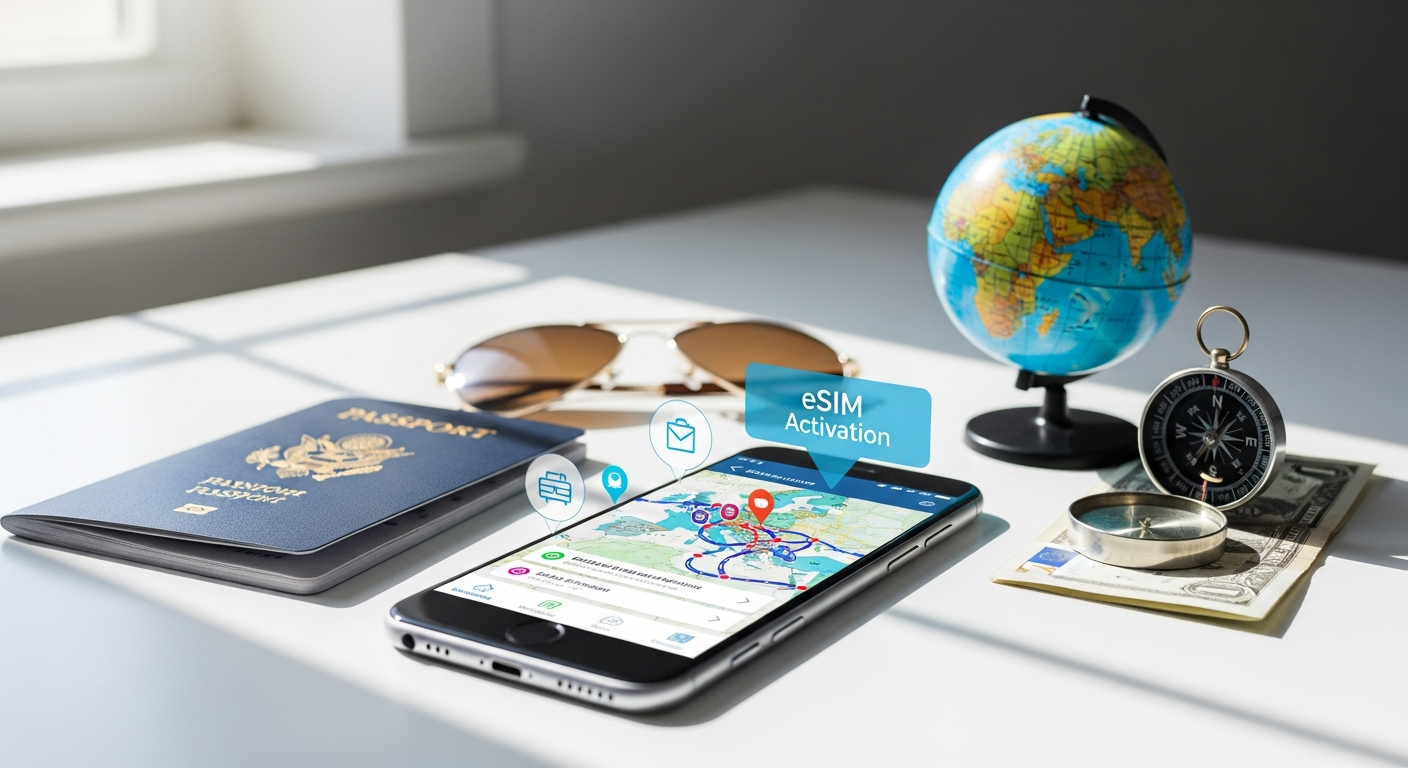
Over 70% of international travelers admit they've been hit with shocking roaming charges that nearly ruined their trip—yet most don't realize there's a better way. The frustration of unexpected bills and spotty connectivity abroad has plagued travelers for decades, but that's changing. Sim Local's travel eSIM service has revolutionized how we stay connected by letting you activate plans in over 220 destinations before you even land, eliminating the scramble for a local SIM card or the temptation to use expensive roaming.
The shift toward eSIM technology represents a genuine breakthrough in travel connectivity. Rather than juggling physical cards, dealing with complicated activation processes at airport kiosks, or watching your data speeds plummet after a threshold, you gain instant access to local networks the moment you need them. This approach appeals to everyone from remote workers to casual tourists, each with different connectivity demands.
Discover how to choose the perfect Sim Local eSIM plan for your travel style.
Understanding Your Data Consumption While Traveling
Before selecting any plan, you need an honest assessment of how you actually use data while abroad. Are you constantly streaming videos, uploading Instagram stories, or checking emails between sightseeing sessions? The answer matters because it directly shapes which plan prevents overage stress without wasting money on unused data.
Start by thinking about your typical daily activities. Video streaming devours data—a single HD movie can consume 3GB. Social media uploads with photos and videos demand more than simple browsing. Navigation apps, messaging services, and email run relatively lean. Video calls through WhatsApp or FaceTime sit somewhere in the middle. If you're planning downtime at cafes with WiFi, your active data usage drops significantly.
Consider the rhythm of your trip too. A two-week tour might have days where you're hiking without phone service, followed by evenings at hotels where you connect to WiFi. These lighter-usage days balance out heavier days when you're navigating cities or keeping up with work. Calculate a realistic daily average rather than assuming peak usage every single day.
Device connectivity matters as well. If you're carrying multiple devices—a phone, tablet, and laptop—and want all three connected simultaneously through the eSIM, your data needs increase. Some travelers only need phone connectivity while relying on laptops through hotel WiFi, making this distinction practical rather than theoretical.
Comparing Sim Local's Flexible Plan Options for Different Travel Styles
Sim Local's strength lies in its variety. Fixed-data plans appeal to travelers with predictable usage patterns. You know exactly what you're getting—perhaps 2GB for five days—and you know exactly what it costs. This straightforward approach suits budget-conscious travelers and those taking quick city breaks where data needs remain manageable.
The unlimited daily allowance plans serve a different crowd entirely. Plans offering 5GB or 10GB per day work beautifully for content creators, remote workers, and travelers who can't afford connectivity gaps during their trip. These plans typically reset daily, meaning your allowance refreshes each morning regardless of whether you used everything yesterday.
What distinguishes Sim Local further is the inclusion of calls and texts in certain plans for popular destinations. Many eSIM providers focus purely on data, leaving you dependent on internet-based calling apps. Sim Local's approach of bundling voice and text capabilities addresses real travel needs—booking accommodations, receiving SMS two-factor authentication codes, or contacting local services without needing internet connectivity first.
Duration flexibility matters equally. Short trips benefit from day passes, while three-month plans suit digital nomads and extended travelers. The per-day cost typically improves with longer commitment periods, so a 30-day plan often costs less per day than multiple 7-day plans.
Destination-Specific Coverage and Network Quality Across Regions
Coverage quality separates mediocre eSIM services from genuinely useful ones. Sim Local partners with leading local networks in each destination, which meaningfully impacts your real-world experience. These partnerships ensure access to 4G and often 5G infrastructure rather than slower 3G alternatives that make even basic tasks feel sluggish.
Europe represents one of the most developed markets. Major cities like Barcelona, Berlin, and London offer comprehensive 4G and emerging 5G coverage. Even smaller towns and rural areas typically maintain solid 4G connectivity. The USA similarly provides excellent coverage across both coasts and most interior regions, though coverage thins in remote mountain or desert areas.
Mexico and Caribbean destinations have expanded their 4G infrastructure substantially, making them increasingly reliable for travelers. Popular tourist corridors maintain excellent speeds, though coverage in remote villages may revert to 3G. Understanding your itinerary's specifics—whether you're sticking to major cities or venturing into countryside—shapes realistic expectations.
The difference between advertised coverage and actual speeds matters too. Some competitors throttle data speeds significantly after a certain threshold, making their "unlimited" claims misleading. Sim Local's approach of offering genuine high-speed data across its plans, without the speed-reduction games, represents a significant advantage for sustained usage throughout your trip.
Check Sim Local's coverage map for your specific destinations.
Price Breakdown: Finding the Best Value for Your Budget
Sim Local's pricing spectrum ranges from approximately $6.75 per day to $120.50 for three-month plans, offering genuine flexibility across different trip lengths and budgets. This range seems broad, but examining actual scenarios reveals where value concentrates.
The daily rate model—$6.75 or similar per-day costs—suits travelers taking short trips to single destinations. A five-day city break might cost $35, perfectly reasonable for maintaining connectivity. These daily rates also serve as comparison benchmarks against traditional international roaming, which frequently costs $10 to $15 per day or triggers outrageous overage fees.
Weekly plans typically offer per-day savings, so a seven-day plan might work out to $5 per day rather than $6.75. Monthly options push the per-day cost even lower, sometimes reaching $3 or $4 per day. This scaling rewards longer trips financially.
The three-month plan at $120.50 represents the longest commitment option, ideal for digital nomads, extended sabbaticals, or slow travelers planning to spend significant time abroad. Breaking this down reveals roughly $1.35 per day—an extraordinary value for uninterrupted global connectivity across over 220 destinations.
Comparing against traditional roaming charges crystallizes the value proposition. Your home carrier's international roaming often costs $10 to $15 daily or charges per-megabyte rates that skyrocket during heavy usage. Travelers report saving 50% or more by switching to Sim Local, with some calculations showing even greater savings for heavy data users.
The key is matching plan length to your actual trip duration. Buying three months of data for a two-week trip wastes money. Conversely, purchasing daily passes for a three-month journey means missing the per-day savings that longer plans provide. Accurate trip planning directly translates to budget optimization.
The Activation Process and Pre-Arrival Setup Strategy
The five-minute-or-less setup process through QR code scanning represents a major convenience advantage. Rather than fumbling through complicated carrier systems, you simply scan a code on your Sim Local purchase confirmation—your phone handles the technical installation automatically.
The Sim Local app streamlines this further. Download it before your trip, complete verification, and purchase your plan while still home. Your eSIM downloads and installs on your device before you ever board a flight. Landing at your destination, you simply switch your phone to the Sim Local profile, and connectivity activates immediately. No airport kiosks, no SIM card trays, no language barriers with local staff.
This pre-arrival activation addresses one of travel's genuine friction points. Many travelers face the anxiety of landing with no connectivity—unable to contact their accommodation, access airport instructions, or find transportation. With Sim Local, that problem vanishes. You're connected the moment your plane touches down.
Device compatibility requires attention. Modern iPhones (XS and newer) support dual eSIM functionality, as do many Android flagship models. Checking your phone's capabilities before purchasing prevents disappointing discoveries at the airport. Sim Local's website includes a compatibility checker for verification.
Keeping Your Home Number Active: The Dual SIM Advantage
Dual-SIM functionality represents one of eSIM technology's most practical advantages, yet many travelers overlook it. Your phone can maintain your home physical SIM while activating the Sim Local eSIM simultaneously. This means continuing to receive calls and text messages from home without switching SIM cards.
The practical benefits prove significant beyond simple convenience. Two-factor authentication codes arrive via SMS to your home number, ensuring security for banking apps and critical accounts. Friends and family can reach you directly rather than through internet-dependent services. Emergency contacts maintain a reliable connection to your actual number.
Business travelers benefit substantially. Colleagues and clients reach you through your established business line regardless of your location. You're not juggling a new temporary number or creating confusion about how to contact you. Your professional availability remains uninterrupted.
Not all phones support simultaneous dual-SIM operation. iPhones with dual eSIM capability allow two eSIMs simultaneously but sacrifice physical SIM functionality. Phones with physical SIM slots plus eSIM capability offer the true dual-SIM advantage—your home carrier's physical SIM coexists with the Sim Local eSIM. Understanding your phone's specific capabilities prevents planning around non-existent features.
Evaluating Plan Suitability for Digital Nomads and Heavy Data Users
Digital nomads operate under different connectivity demands than vacation travelers. Video conferencing, cloud uploads, and sustained high-speed connectivity aren't luxuries—they're job requirements. Selecting an appropriate Sim Local plan means assessing whether the plan reliably delivers what your work actually demands.
Video conferencing through Zoom, Teams, or Google Meet consumes roughly 2.5GB per hour in HD quality. A digital nomad attending multiple meetings daily quickly approaches or exceeds 5GB daily. Plans offering 10GB per day daily allowances fit this usage pattern comfortably, with buffer for other work tasks like email and file transfers.
Cloud syncing and backup operations run continuously in the background, pulling data steadily throughout the day. Uploading photos and videos to cloud storage, backing up work files, or synchronizing databases shouldn't trigger stress about data limits. High-allowance plans prevent this background anxiety.
Reliability matters beyond raw data quantities. Dropped connections during important client calls create far more damage than data overages. Sim Local's partnerships with leading local networks and consistent high-speed delivery address this professional requirement directly. Heavy users report consistently strong performance across diverse destinations.
Content creators—photographers, videographers, podcasters—face even heavier demands. Uploading 4K video files to production servers consumes gigabytes rapidly. The highest allowance plans ($120.50 three-month spans, for instance) target exactly this user. The per-day cost amortized across months becomes negligible compared to the value of uninterrupted production capability.
Real-World Scenarios: Which Plan Fits Your Travel Profile
Weekend City Explorer
You're taking a quick Friday-to-Sunday break in a European capital. You'll navigate with maps, share photos and stories on social media, check emails occasionally, and maybe video call home once. Daily data needs likely stay under 2GB. A three or four-day plan at the daily rate ($6.75 per day range) costs $20 to $27 total—minimal expense for reliable navigation and communication without roaming charges.
Adventure Backpacker
You're spending six weeks traveling through multiple Southeast Asian countries with a fixed daily budget. You're using maps heavily, checking accommodation details constantly, uploading travel photos to share with friends, and video calling home weekly. You want budget optimization without sacrificing connectivity reliability. A monthly plan at the improved per-day rate hits your sweet spot—perhaps $80 to $90 for the month, with automatic renewal as you move to new countries. The per-day cost ($2.67 to $3) dramatically beats traditional roaming.
Business Traveler
You're attending a conference in the USA, followed by client meetings in Mexico. You need flawless email access, video call capability, and reliable phone connectivity to home. Missing a single important call or email creates professional risk. A 14-day plan with high data allowance (perhaps 5GB or 10GB daily) costs $70 to $100 and eliminates connectivity worry. The investment returns instantly through professionalism and responsiveness.
Content Creator
You're traveling while filming content, uploading 4K video daily, maintaining social media presence, and backing up footage constantly. Daily data consumption runs 15-20GB comfortably. The three-month plan at $120.50 becomes the smart choice—this spreads to roughly $1.35 daily while providing the 10GB+ daily allowances content work demands. The financial relief compared to daily plans ($6.75 × 90 days = $607.50) becomes obvious immediately.
Making Your Final Decision: Checklist and Next Steps
Before committing to any plan, work through a personalized decision checklist. First, determine non-negotiable features: Do you need calls and texts, or is data alone sufficient? How much daily data actually supports your activities—2GB, 5GB, 10GB? What's your trip duration, and do you want one continuous plan or multiple destination-specific purchases?
Second, cross-reference your destination against Sim Local's coverage map. Visit the website, search your countries of travel, and verify not just that coverage exists but that 4G or 5G infrastructure supports your work and activities. Check coverage in specific cities and regions you'll visit—coverage in downtown Bangkok differs from rural Thai villages.
Third, calculate your estimated trip cost precisely. Multiply your daily rate by trip duration, factor in destination changes if applicable, and compare this total against what traditional roaming would cost from your home carrier. This comparison often becomes the most motivating factor in the eSIM switch.
Fourth, verify device compatibility. Check whether your phone supports eSIM, whether it allows dual-SIM functionality, and whether you need simultaneous dual-SIM operation or can switch between profiles as needed. Five minutes now prevents frustration later.
Finally, remember Sim Local's 100% refund policy. If something about your experience doesn't meet expectations, you can reverse the purchase without penalty. This safety net removes pressure from the decision, encouraging you to move forward confidently.
Your Connected Journey Starts Here
Choosing the right Sim Local travel eSIM plan isn't about finding the cheapest option—it's about matching your specific travel style with the connectivity solution that eliminates stress and maximizes your experience abroad. Whether you're a digital nomad needing bulletproof 5G speeds, a budget backpacker stretching every gigabyte, or a business traveler who can't afford a single dropped call, Sim Local's flexibility across 220+ destinations means there's a plan built for you. The combination of seamless activation, strong network partnerships, and competitive pricing transforms how you stay connected globally.
Stop settling for roaming charges that drain your bank account or unreliable connectivity that derails your plans. Your next adventure deserves connectivity that works as hard as you do—something that frees you to focus on experiences rather than worrying about communication.
Leave a Reply