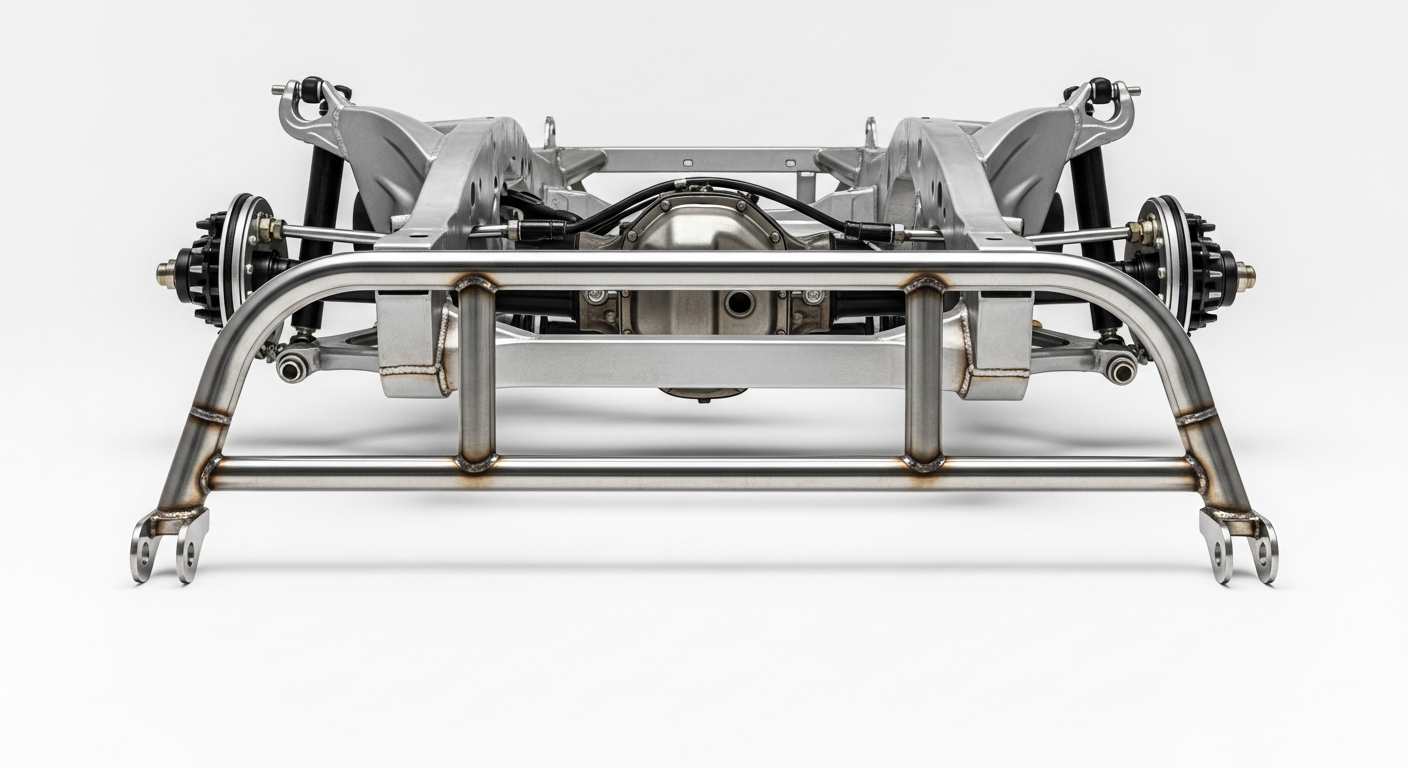
Your rear axle shifts under acceleration, squat during braking, and drifts during hard cornering—losing tenths of seconds on every lap. Track day drivers know that milliseconds separate podium finishes from the back of the grid, and rear suspension geometry is the silent killer most overlook. The Spohn Adjustable Panhard Bar with Del-Sphere Pivot Joints addresses this exact problem by maintaining precise rear axle centering while allowing the articulation needed for smooth suspension movement.
This precision tool is designed for drivers who refuse to leave performance on the table. Whether you're running your F-Body or Mustang at the track or pushing harder on the street, rear suspension geometry determines how your vehicle responds to the inputs you make. Stock panhard bars introduce variables that cost you consistency, and that inconsistency translates directly to lap time losses and reduced confidence behind the wheel.
The Del-Sphere Joint: Engineering That Changes Everything
The Del-Sphere pivot joint is where Spohn Performance separates itself from conventional panhard bar manufacturers. At its core, you're looking at a proprietary spherical ball design surrounded by Delrin bushing cups—a combination that solves problems that have plagued suspension builders for decades.
Traditional rod ends offer articulation but introduce harshness, noise, and deflection that compromises your axle location when cornering loads build. Rubber and polyurethane bushings eliminate the harshness but fail to prevent binding during aggressive suspension movement. The Del-Sphere design splits the difference by delivering articulation capacity up to 28 degrees of rotation without binding, while the spherical ball design eliminates the deflection that traditional joints can't avoid.
When you're driving hard into a corner, your suspension cycles through multiple planes of motion simultaneously. The Del-Sphere joint absorbs that complexity without sacrificing precision. The Delrin bushing cups handle shock absorption and road noise reduction, meaning you get performance without the harshness typically associated with track-oriented rod ends. That translates to a ride quality suitable for both street driving and serious track work—genuine dual-purpose capability.
The rebuildable joint design extends the component's lifespan significantly, reducing long-term ownership costs and keeping your investment performing like new.
Rear Axle Geometry: Why Centering Matters for Track Performance
Lowered and modified suspensions create axle misalignment issues that factory engineers never anticipated. Drop your chassis three inches and your rear axle no longer sits centered under the car—it shifts laterally, creating a geometry problem that cascades through every aspect of your suspension's behavior.
The relationship between axle centerline and handling balance is fundamental. When your axle drifts, it alters the suspension's roll center, changes the effective spring rates on each side, and introduces asymmetrical compliance. That asymmetry means your car doesn't handle the same in left-hand corners as it does in right-hand corners. Competitors running properly centered axles will feel planted and consistent; you'll feel like something's off without understanding why.
Axle drift directly impacts traction, braking stability, and cornering grip. During acceleration out of a corner, if your axle shifts outboard, you lose the optimal geometry for weight transfer. Brake hard with a miscentered axle and you introduce unpredictable yaw tendencies. Lateral load transfer and its effect on tire contact patches becomes compromised—you're not using your tires at their peak efficiency.
Adjustability is the key advantage here. Different track conditions demand different setups. A technical, tight course might benefit from slightly different axle centering than a high-speed circuit. The Spohn bar's adjustable design allows fine-tuning for different track conditions without fabricating new components or replacing the entire assembly.
Explore the adjustable design options available through Spohn's comprehensive panhard bar lineup.
Material Science: Chrome Moly vs. Standard Steel Construction
The 4130 chrome moly variants offer strength-to-weight ratio advantages that matter at speed. When you're trying to minimize unsprung weight while maximizing durability, the material choice becomes critical. Chrome moly delivers higher tensile strength than standard steel at equivalent diameters, meaning Spohn can use thinner-walled tubing without sacrificing safety margins.
Unsprung weight reduction translates to suspension responsiveness. Your suspension can react faster to track surface inputs because there's less mass it needs to accelerate and decelerate. Over the course of a lap, this responsiveness compounds—better traction, quicker weight transfer, more consistent feedback to the driver.
Durability under extreme track conditions and repeated stress cycles separates weekend parts from real performance components. Standard steel can fatigue; chrome moly's metallurgical composition resists fatigue cracking under the cyclic loading that track driving imposes. You're running corner after corner, acceleration after acceleration, brake application after brake application—thousands of stress cycles per lap. Material choice determines whether your panhard bar survives for years or fails unexpectedly mid-season.
The powder-coated and zinc-plated finish options provide corrosion resistance, protecting your investment whether you're storing the car through winter or exposing it to salt environments. Fatigue resistance in high-performance applications means the component maintains its structural integrity through extended track duty without degradation.
Handling Transformation: What You'll Actually Feel Behind the Wheel
When you install a properly centered panhard bar with Del-Sphere articulation, the sensation is immediate and unmistakable. Your rear-end feel during aggressive cornering shifts from vague and uncertain to planted and responsive. The car stops shifting its weight around; it sits where you expect it to sit.
You'll notice reduced axle roll as your suspension maintains geometry throughout the corner. Weight distribution becomes predictable. Your tires are working on a consistent platform rather than a constantly shifting geometry. That consistency is what separates a good suspension from a great one.
Enhanced traction on acceleration out of corners comes naturally when your axle isn't drifting as you're applying throttle. Your suspension is transferring power to the ground efficiently instead of fighting its own geometry. Lap times drop almost immediately because traction events that previously felt sketchy now feel planted and confident.
Braking stability improves because your axle isn't wandering during heavy deceleration. You can brake deeper into corners without worrying about mid-corner surprises. Consistency lap-to-lap replaces the variables that stock panhard bars introduce. Your best lap today should feel nearly identical to your best lap next week—that repeatability is invaluable for competitive driving.
Spohn Adjustable Panhard Bar vs. Competing Solutions
Standard polyurethane bushed panhard bars offer cost advantages but require compromising performance. You're buying something that's better than completely stock but still introduces deflection and binding under hard cornering. The cost versus performance trade-off only makes sense if you're prioritizing budget over results.
Spherical rod end joints deliver superior articulation but introduce harshness, noise, and deflection concerns that make street driving tedious. You get the performance on track but sacrifice civility everywhere else. Track-only vehicles might accept this trade-off; dual-purpose cars shouldn't have to.
Rubber-bushed components offer compliance and a smooth ride but fundamentally can't prevent axle drift under cornering loads. Their limitations are engineering constraints, not cost-saving measures. If you're serious about suspension geometry, you've outgrown what rubber bushings can deliver.
Adjustable versus fixed bar designs matter significantly. Fixed designs force you to accept whatever geometry the manufacturer chose. Adjustable designs let you dial in the perfect setup for your specific application, vehicle height, and performance goals. The flexibility is worth the investment alone.
Price positioning reflects value proposition. Yes, the Spohn Adjustable Panhard Bar with Del-Sphere joints sits at the higher end of the market, typically between $200 and $400 depending on your vehicle application and material selection. You're paying for engineering, durability, and performance that competing solutions can't match at any price point.
Installation, Adjustment, and Maintenance Essentials
Pre-installation alignment and measurement procedures establish your baseline geometry. You need to know where your axle sits before and after installation to verify you've achieved the centering you're targeting. This isn't something to skip—accurate measurements guide proper installation.
The step-by-step installation process requires basic tools and mechanical competence, but the procedure isn't complicated. You're removing the old panhard bar, installing the new one, and securing it properly. Required tools include standard wrenches, a torque wrench for proper fastener tension, and a jack to safely support your vehicle.
Adjustment methodology for optimal axle centering involves measuring from fixed reference points on your chassis and axle housing. The adjustable design gives you fine-tuning capability—typically an inch or more of adjustment range. Use this range to dial in the centerline that works best for your setup.
Maintenance intervals are minimal. Inspect connection points periodically for looseness. Check the Del-Sphere joint periodically for proper operation and any signs of wear. Regular inspection catches problems before they become critical.
Rebuildable joint service keeps your component performing like new indefinitely. The Delrin bushing cups wear over time with heavy use, but replacement procedures are straightforward and affordable. This rebuildable design is a major advantage over welded or sealed alternatives.
Maximizing Your Suspension's Potential
The Spohn Adjustable Panhard Bar with Del-Sphere Pivot Joints represents a fundamental shift in how serious drivers approach rear suspension geometry. You're not just buying a component—you're investing in precision, consistency, and the kind of handling refinement that separates competitive drivers from the rest. The Del-Sphere joint technology delivers that rare combination of track-ready performance and street-level civility.
Your rear axle control directly impacts everything from traction to braking stability to cornering confidence. When you remove the variables introduced by deflection and binding, your vehicle responds predictably, lap after lap, corner after corner. That repeatability is what builds driver confidence and shaves time off your best efforts.
Whether you're chasing podium finishes or simply demanding the best from your F-Body or Mustang, this upgrade deserves serious consideration. The engineering is proven, the reputation is earned, and the performance gains are measurable. Your suspension geometry should support your driving, not hold it back.
Leave a Reply