StackPath promised something compelling: a unified platform where content delivery, security, and edge computing converged in one place. With 50+ Points of Presence scattered across the globe and a staggering 65 Terabits per second of throughput capacity, the service attracted thousands of businesses seeking an alternative to the industry’s heavyweight players. Yet in June 2024, the entire operation shut down without warning, leaving customers facing an abrupt migration scramble.
The collapse wasn’t inevitable. For years, StackPath carved out meaningful market share by offering robust features at accessible price points—DDoS protection, Web Application Firewall capabilities, and free SSL certificates bundled into starter plans. Developers appreciated the instant purging, customizable EdgeRules, and straightforward API documentation. The platform positioned itself as the pragmatic middle ground between complexity and capability.
Discover how to evaluate CDN alternatives that won’t disappear on you.
What Was StackPath CDN? A Complete Platform Overview
StackPath built its reputation on integration. Rather than forcing businesses to juggle multiple vendors for CDN, security, and DNS services, the platform consolidated these functions into a single control panel. The global edge network spanned more than 50 Points of Presence concentrated across North America, South America, and Europe—regions representing the majority of internet traffic worldwide.
The unified architecture meant that DDoS protection operated alongside content acceleration, and Web Application Firewall rules applied automatically to all traffic flowing through the network. Free SSL certificates came standard across all subscription tiers. This bundled approach eliminated the friction of vendor selection and deployment management, which particularly appealed to growing companies lacking dedicated infrastructure teams.
Global Edge Network with 50+ Points of Presence
StackPath’s geographic footprint prioritized high-traffic corridors. North American presence was particularly dense, with strategic nodes across the United States and Canada. European coverage extended throughout major markets, while South American infrastructure served the Latin American region. Organizations with customers concentrated in these areas experienced solid performance metrics.
The architecture supported HTTP/2 for enhanced performance negotiation and included origin shield capabilities to reduce load on primary servers. Segmented file downloading addressed the specific challenge of distributing large assets without overwhelming origin infrastructure.
Unified Platform Combining CDN, WAF, DNS, and Edge Compute
Consolidating multiple services meant organizations could manage security policies, routing rules, and performance tuning from a single dashboard. This reduced operational complexity significantly. When DDoS attacks occurred, the same team responding to the threat could simultaneously adjust cache behavior and modify WAF rules—all without context switching between platforms or vendor support channels.
The edge compute capabilities allowed custom logic execution at Points of Presence, enabling behaviors like request rewriting, dynamic origin selection, and conditional content serving based on geographic location or device type.
The Architecture That Made StackPath Stand Out
StackPath’s infrastructure centered on 65 Terabits per second of aggregate network capacity. For context, this ranked among the highest throughput claims in the CDN industry during its operational years. The strategic geographic distribution meant that traffic routing algorithms could balance requests across the most optimal nodes based on real-time conditions.
Advanced caching infrastructure incorporated sophisticated TTL management and intelligent invalidation mechanisms. Rather than serving stale content, StackPath’s systems could refresh specific objects while preserving cache benefits for unchanged assets. This reduced both origin server load and client-side latency simultaneously.
Real-time analytics dashboards provided visibility into traffic patterns, cache hit rates, and geographic distribution. Organizations could observe which content types benefited most from edge acceleration and identify geographic regions where performance optimization offered the highest returns.
Why Businesses Chose StackPath Over Competitors
Single vendor consolidation represented perhaps the strongest draw. Managing one relationship, one billing system, and one support channel proved operationally simpler than orchestrating multiple CDN and security providers. This reduced the overhead of coordinating between vendors when issues arose—nobody wants to troubleshoot whether a performance problem stems from the CDN layer, WAF configuration, or DNS propagation delays.
The accessibility factor cannot be overstated. StackPath designed its interface and documentation for developers without advanced networking backgrounds. Configuration tasks that might require specialized knowledge at competitors could be accomplished through straightforward UI workflows. This democratization of edge computing extended StackPath’s addressable market beyond enterprise organizations with dedicated infrastructure teams.
Robust security features rivaled enterprise competitors while maintaining mid-market pricing. The combination of DDoS mitigation, Web Application Firewall functionality, and SSL management at starting plans around $10-$25 monthly represented genuinely competitive value. Bundle packages incorporating DNS, monitoring, and WAF services started near $20 monthly, with discounts available for annual commitments.
Learn which CDN providers offer transparent pricing and stable operations you can count on.
Critical Limitations That Hindered Growth
Performance across truly global traffic patterns sometimes underperformed leading competitors. While response times were generally acceptable, latency-sensitive applications occasionally suffered compared to Cloudflare or Akamai deployments. The performance gap wasn’t dramatic, but in a market where milliseconds determine customer experience, it mattered.
Web Application Firewall functionality, though valuable, lacked the advanced customization available through specialized security vendors. Organizations requiring granular rule customization or machine learning-powered threat detection often found themselves outgrowing StackPath’s WAF capabilities. The simplistic rule framework worked adequately for common attack patterns but struggled with sophisticated threat scenarios.
Geographic coverage limitations affected global-scale operations. Organizations serving customers across Asia, Africa, or the Pacific regions faced significant latency when content originated from StackPath’s North American or European nodes. This constraint made the platform unsuitable for truly worldwide operations, limiting market expansion into emerging regions.
The Collapse: Why StackPath Shut Down in June 2024
StackPath faced a challenging competitive landscape from increasingly well-funded providers with broader service ecosystems. Cloudflare expanded aggressively into enterprise segments. AWS CloudFront deepened integration with Amazon’s cloud platform. Fastly captured media and streaming companies with superior performance. These competitors possessed financial resources and customer bases that StackPath couldn’t match through incremental innovation.
Financial strain from aggressive pricing strategies undermined profitability. The company attempted to compete on price while maintaining feature parity with larger competitors—an unsustainable position. Lower margins meant less capital for infrastructure investment and customer acquisition. As the business model contracted, reinvestment capabilities diminished.
Market consolidation ultimately favored larger players. Customers increasingly preferred consolidated relationships with established cloud providers rather than maintaining separate vendor relationships. The shift toward cloud-native architectures meant that CDN selection became secondary to broader platform ecosystems—a dynamic that favored AWS, Azure, and Google Cloud integration.
The final blow involved deteriorating customer support and surprise pricing increases. Organizations reported support quality declining noticeably and unexpected rate hikes without transparent communication. When pricing changes coincide with service quality declines, customer trust evaporates rapidly. Retention became impossible, revenue declined, and the financial death spiral accelerated.
Migration Essentials: Moving Away From StackPath
Organizations departing StackPath should begin by conducting thorough configuration audits. Document all active EdgeRules, cache settings, origin configurations, and security policies. Screenshot the dashboard to preserve references for how traffic routing was previously configured. This documentation proves invaluable when translating configurations to alternative platforms.
Bandwidth usage patterns and traffic distribution data require careful analysis. Extract historical metrics showing peak traffic periods, geographic distribution, and content type breakdown. This information informs capacity planning at the replacement platform and identifies optimization opportunities that might not be immediately obvious in day-to-day operations.
Analytics and performance data should be exported before service termination. Historical metrics provide performance baselines for comparison purposes and reveal which content types and geographic regions benefited most from acceleration. This baseline becomes essential for validating that migration actually improves performance rather than merely maintaining existing conditions.
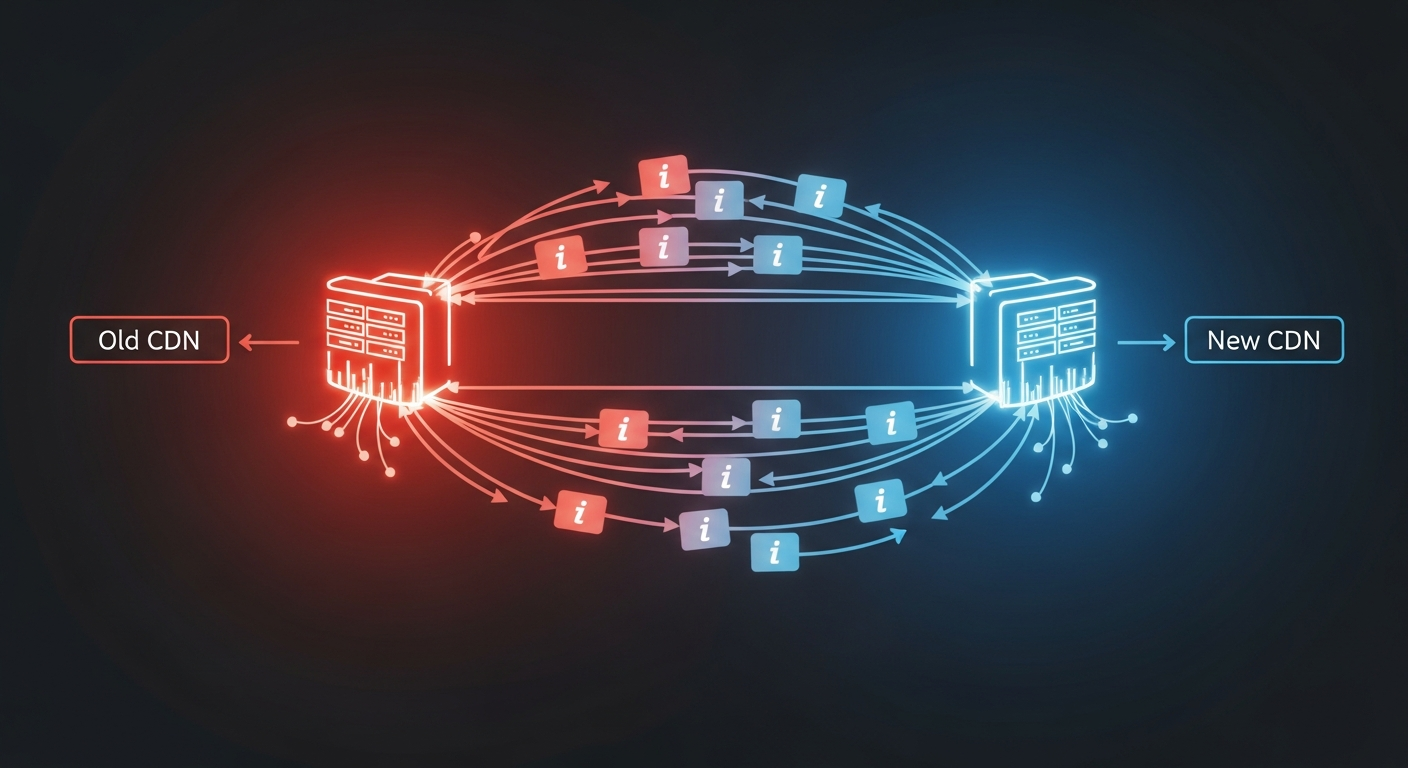
DNS records require special attention during migration. Update CNAME entries to point toward the replacement platform’s edge network. Coordinate timing carefully—DNS propagation delays mean that some traffic may route through StackPath infrastructure even after the migration begins. Plan for a transition window where both platforms receive traffic.
Top StackPath Alternatives for 2026
Cloudflare CDN operates one of the industry’s largest global networks with Points of Presence on every continent. Performance metrics consistently rank among the highest available. Integrated Web Application Firewall, DDoS protection, and DNS services mean that Cloudflare replicates StackPath’s unified platform approach while maintaining superior performance at competitive pricing tiers.
AWS CloudFront provides enterprise-grade edge distribution with seamless integration into Amazon’s broader cloud ecosystem. Organizations already operating on AWS infrastructure benefit from simplified authentication, unified billing, and native integration with S3, Lambda, and other services. CloudFront’s global network rivals the largest competitors, and AWS’s financial stability eliminates concerns about service discontinuation.
Fastly dominates the streaming and media segment through exceptional performance and real-time purging capabilities. The platform appeals to organizations requiring fine-grained control over edge behavior through VCL (Varnish Configuration Language). API-first design and rapid development iteration cycles make Fastly attractive for technical teams prioritizing control.
Bunny CDN offers budget-friendly edge acceleration with surprisingly comprehensive global coverage. The platform delivers strong value for cost-conscious organizations without requiring significant performance sacrifice. Transparent pricing and straightforward feature sets appeal to businesses seeking alternatives to enterprise vendors without complexity overhead.
Lessons From StackPath’s Market Exit
Competitive differentiation requires continuous innovation, not merely bundling features that competitors already offer. StackPath consolidated existing capabilities without developing proprietary advantages that justified premium positioning. The unified platform approach eventually became table stakes rather than distinctive advantage—competitors matched functionality while investing more aggressively in performance improvements.
Customer trust erodes with surprising speed when pricing changes occur without transparent communication or advance notice. Organizations that felt blindsided by unexpected rate increases began exploring alternatives immediately. In competitive markets, dissatisfied customers don’t negotiate—they migrate. StackPath’s failure to communicate clearly about pricing strategy accelerated customer defection.
Support quality directly impacts retention rates and market reputation. As support responsiveness declined, organizations lost confidence in the company’s long-term viability. When primary value delivery falters, secondary factors become dealbreakers. StackPath discovered this lesson the difficult way—improved technical support might have retained customers willing to overlook competitive performance gaps.
Learning From StackPath’s Legacy
StackPath CDN represented an ambitious effort to democratize edge computing and security through integrated platform delivery and developer-friendly tooling. The shutdown reveals candid truths about the CDN market: performance matters profoundly, support quality directly impacts business continuity, and pricing transparency isn’t optional.
If migrating from StackPath, treat this transition as an opportunity to comprehensively reassess your content delivery strategy. Today’s alternatives offer superior performance, more reliable support, and demonstrated financial stability. Organizations should conduct thorough performance benchmarking against multiple platforms rather than simply replicating existing StackPath configurations.
Your migration positions the organization for sustainable growth with a provider built to scale. Evaluate candidates based on technical performance, customer support responsiveness, pricing transparency, and long-term financial viability—not merely feature count. The right platform supports your growth trajectory without creating dependency on unstable infrastructure.
Start your migration plan today with a CDN provider committed to long-term stability.
Leave a Reply