The Engineering Behind Performance Excellence: Understanding the T-H Marine ATLAS Hydraulic Jack Plate
When you look at the winner's circle in competitive bass fishing, a striking pattern emerges—over 80% of tournament-winning boats feature a hydraulic jack plate, and the vast majority of those run the T-H Marine ATLAS. This isn't random selection or marketing hype. The ATLAS has become the gold standard because it delivers measurable, repeatable results that competitive anglers and professional boat builders cannot ignore. Professional teams don't gamble on their equipment; they specify what works.
The hydraulic jack plate market may sound like a specialized corner of marine engineering, but it represents a fundamental shift in how modern boats perform. These systems enable captains to adjust their outboard motor height in real-time, unlocking everything from explosive hole shots to improved fuel economy and access to shallow waters that would otherwise be unreachable. T-H Marine didn't just enter this market—they redefined it with the ATLAS, a self-contained hydraulic system that transformed boating performance standards.
Discover why the ATLAS dominates the performance boating market today.
The Engineering Behind the ATLAS Hydraulic Jack Plate System
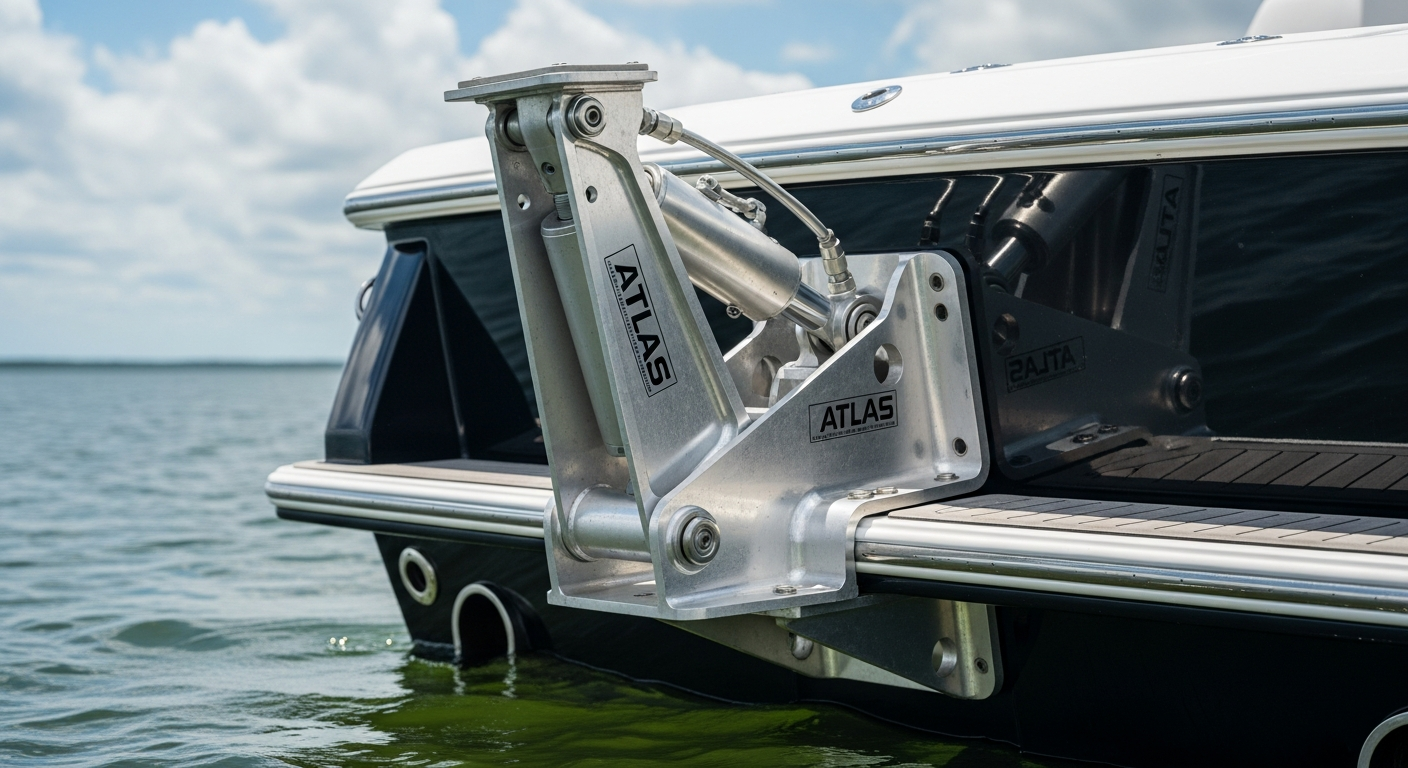
The ATLAS represents a fundamental engineering achievement: a completely self-contained hydraulic system that integrates pumps and fluid directly into the plate itself. This design philosophy eliminates the need for bulky interior components, providing boat builders with cleaner, more streamlined installations that maximize usable cabin space. Instead of routing hydraulic lines throughout the vessel, everything the system needs operates within the jack plate assembly.
Manufacturing precision drives reliability. The actuator—the heart of any jack plate system—is manufactured in the U.S.A., ensuring consistent quality control and performance standards that offshore production cannot replicate. This commitment to domestic manufacturing becomes evident when comparing the ATLAS track record against competitors.
The structural foundation consists of a robust, one-piece design reinforced with high-tech polymer lift rods engineered to handle substantial loads without flexing or degradation. These materials were selected specifically for their ability to maintain performance under the dynamic stresses of tournament fishing, where boats routinely push their limits across multiple runs per day.
Hydraulic response defines practical usability. The ATLAS transitions from fully down to fully up in approximately eight seconds—fast enough for dynamic performance adjustments without creating dangerous delays. Whether you're raising the motor to clear a shallow sandbar or dropping it for aggressive acceleration, the system responds consistently.
Safety architecture includes a heavy-duty cable rated to support the full engine weight, providing redundant protection should the hydraulic system fail. Pre-drilled mounting points for shallow water anchors come factory-installed, allowing crews to secure the motor in critical shallow-water situations without field modifications. The design also eliminates the need for regular grease lubrication, simplifying maintenance schedules and reducing the likelihood of performance degradation from inadequate service.
Explore ATLAS jack plate configurations matched to your boat's specifications.
Setback Options and Hull Compatibility Explained
The ATLAS comes in six distinct setback configurations: 4, 6, 8, 10, 12, and 14 inches. This range exists because different hull designs require different motor positioning to achieve optimal weight distribution and hydrodynamic efficiency. Setback selection directly influences how a boat planes, accelerates, and handles across varying conditions.
Compact Applications: 4-Inch Setback
The 4-inch option suits compact hulls and lighter outboard motors. Smaller center console boats and specialty designs where engine weight sits relatively close to the transom benefit from minimal setback. These installations maintain the boat's original handling characteristics while still providing the performance advantages of adjustable motor height.
Mid-Range Versatility: 6-8 Inch Setback
Six to eight inch setback configurations dominate the mid-sized bass boat market. These dimensions align with center console configurations and standard fishing boat designs where engine weight distribution plays a crucial role in hole shot performance. Most popular bass boat models from major manufacturers come factory-equipped with 6 or 8-inch ATLAS systems.
Performance Optimization: 10-12 Inch Setback
Tournament-oriented boats and specialized builds mounting larger V8 engines typically specify 10 or 12-inch setback. These configurations move the engine weight further back, optimizing the center of gravity for explosive acceleration and maintaining composure during high-speed maneuvers. Professional boat builders routinely select these setbacks when targeting high-performance applications.
Extreme Shallow-Water Engineering: 14-Inch Setback
The 14-inch setback represents the engineering frontier for extreme shallow-water applications. Specialized builds designed specifically for accessing minimal-water environments utilize this configuration, allowing crews to raise the motor completely clear of the water while maintaining sufficient setback for stable operation when the motor is fully down.
Performance Advantages That Drive Professional Adoption
Hole shot acceleration separates winning boats from the rest of the field. The ATLAS enables precise motor height adjustment that optimizes the engine's thrust angle during initial acceleration, translating to measurably faster times off the starting line. Tournament competition demands tenths-of-a-second advantages, and adjustable motor height delivers this consistently.
Shallow-water navigation capability fundamentally changes where a boat can operate. Rather than running through channels dredged to accommodate standard motor depth, ATLAS-equipped boats access spawning areas, feeding zones, and structure that competitors cannot reach. In tournament conditions where competitors fish the same public waters, this advantage compounds significantly.
Fuel economy improvements emerge from sustained cruising at optimized trim angles. The ability to fine-tune motor height for different water conditions and load configurations allows captains to find the sweet spot where fuel consumption drops while maintaining desired speed. Over the course of a fishing season, these improvements translate to measurable cost savings.
Ride quality smoothness benefits from the continuous adjustment capability. Rather than choosing between aggressive climb and low-speed response, drivers can adjust motor height throughout the day as conditions, loads, and water states change. This dynamic tuning maintains comfort and control that fixed installations cannot match.
Real-time motor height adjustment converts the jack plate from a static installation component into a dynamic performance tool. Crews develop sophisticated trim strategies that change between practice rounds and tournament days, between shallow spawning areas and deep offshore structure, and between morning and afternoon conditions.
Faster planing characteristics reduce the time boats spend in transition, allowing them to reach optimal cruising speed more efficiently. This acceleration characteristic becomes particularly valuable in tournament situations where rapid repositioning between fishing zones occurs frequently throughout the day.
Investment Considerations and Pricing Structure
The T-H Marine ATLAS price range spans from $1,940.51 to $2,549.15, with variations depending on specific model configurations and horsepower ratings. Standard models rated for V6/V8 outboards up to 300 horsepower position themselves at the lower end of this spectrum, while heavy-duty versions capable of handling 400 horsepower engines command premium pricing.
Cost-per-benefit analysis reveals favorable economics. The performance gains—quantifiable improvements in acceleration, fuel efficiency, and shallow-water access—accumulate over a boat's operational lifetime. Professional boat builders factor ATLAS costs into premium vessel pricing strategies, recognizing that buyers of high-performance boats expect this specification.
Return on investment potential extends beyond immediate performance gains. Boats equipped with ATLAS systems command higher resale values, with buyers recognizing the installed system as a significant advantage. Fuel savings accumulate over seasons of operation, particularly for boats running extensive tournament schedules or commercial fishing operations.
Specialized models may require manufacturing lead times of 4-6 weeks, particularly for custom configurations or heavy-duty versions. This timeline reflects the domestic manufacturing of critical components and the made-to-order nature of specific setback options matched to particular hull designs.
The Bottom Line on ATLAS Dominance
The T-H Marine ATLAS Hydraulic Jack Plate has achieved global market leadership through engineering excellence and proven performance. Its self-contained hydraulic system, U.S.A.-manufactured actuator, and robust one-piece construction deliver the reliability that professional boat builders and fishing competitors demand. The comprehensive range of setback options—from 4 to 14 inches—ensures compatibility with virtually any hull design, while the heavy-duty construction withstands the stresses of tournament competition and saltwater environments.
The investment does sit higher than budget alternatives, typically ranging between $1,940 and $2,550. However, when analyzing the complete value equation, the picture shifts dramatically. Performance improvements in hole shot acceleration, shallow-water access, fuel economy, and ride quality combine with enhanced resale values and reduced maintenance requirements. The ATLAS becomes a strategic specification decision that aligns with long-term boating objectives rather than a cost center to minimize.
Whether you're building a high-performance boat from the ground up, upgrading an existing vessel to tournament specifications, or simply seeking to understand what separates industry-leading equipment from budget alternatives, the ATLAS represents the performance standard against which all other systems are measured.
Learn more about ATLAS specifications and find the perfect configuration for your boat.
Leave a Reply