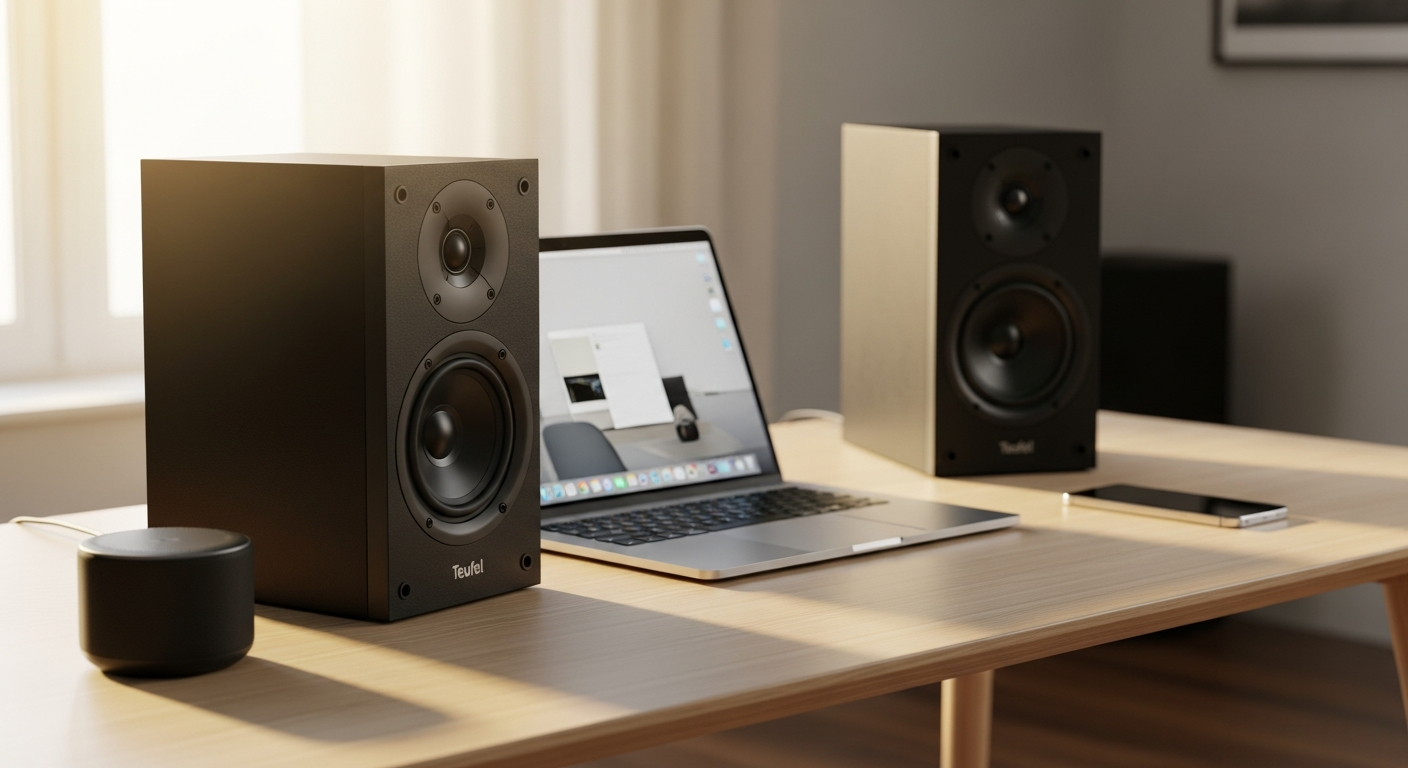
The Teufel Ultima 40 represents a masterclass in speaker engineering that doesn’t require a PhD to understand. This three-way passive architecture organizes sound reproduction across distinct frequency ranges, allowing each driver to do what it does best without fighting against the others.
At the top end sits a 25mm textile tweeter equipped with a phase plug and waveguide. These features work together to ensure high frequencies project precisely, maintaining clarity even when you’re not sitting dead-center in front of the speakers. The phase plug acts as a buffer, controlling how sound disperses, while the waveguide shapes the acoustic output for consistent performance across different listening positions.
The midrange driver—a 165mm Kevlar unit—anchors the speaker’s tonal character. Kevlar, the same material found in body armor, offers exceptional rigidity while remaining lightweight. This combination delivers articulate vocals and instruments without the coloration that softer materials can introduce. Rich, present mids define how engaging these speakers sound during both critical listening and casual background music.
Bass reproduction relies on dual 165mm fiberglass woofers working in concert with a bass reflex system featuring a down-firing tube. This configuration extends the low-frequency response, allowing the speakers to pressurize your room effectively. The dual-woofer setup distributes bass workload, reducing distortion while the reflex tube channels energy downward, leveraging floor reflections to enhance perceived depth.
The cabinet itself uses MDF (medium-density fiberboard), a material that balances cost with acoustic performance. MDF damps internal resonances effectively, preventing cabinet vibration from coloring the sound. The Ultima 40 arrives in black or white finishes with gold-plated screw terminals supporting bi-amping and bi-wiring for those willing to invest in additional amplifier channels.
Technical Specifications That Actually Matter for Your Setup
Numbers mean nothing without context. Here’s what Teufel’s specifications actually tell you about real-world performance.
The 45-20,000 Hz frequency response (-3dB) covers the entire audible spectrum and then some. Everything from Adele’s voice to movie explosions to the highest notes in orchestral recordings falls within this range. The -3dB notation indicates where output begins dropping noticeably, not where sound disappears entirely.
Power handling specs list 120W continuous and 200W peak capacity. The continuous rating represents sustainable power delivery without risk of damage. Peak capacity shows momentary handling for dynamic transients. With a nominal impedance of 4-8 Ohms, these speakers work with virtually any modern amplifier. The 87 dB sensitivity rating means they’ll play reasonably loud from modest amplifiers—Teufel recommends a minimum 20W output, making them accessible to budget equipment buyers.
Physical dimensions measure 106cm high, 21.5cm wide, and 32.7cm deep. Each speaker weighs 20.3 kg, heavy enough for stability but manageable for repositioning. This footprint requires genuine floor space; you can’t squeeze these into tight corners and expect optimal performance.
Real-World Audio Performance Across Content Types
The true test occurs away from specification sheets and in actual listening environments.
When playing music, the Ultima 40 delivers a balanced soundstage with excellent instrument separation. Acoustic guitars maintain natural decay, drums punch without muddiness, and string instruments sing without harshness. Genre versatility shows across rock, jazz, classical, and electronic content—these aren’t speakers tuned for one type of music but rather engineered for broad musical competence.
Movie and home cinema performance highlights the speaker’s capability across dynamic ranges. Dialogue clarity stands out; actors’ voices anchor cleanly in front channels without disappearing into effects. When action sequences demand bass impact, the dual woofers respond immediately. The treble extension handles sound design effectively without fatiguing ears during extended viewing.
Gaming audio reproduction reveals these speakers’ strength with fast transient response. Footsteps pinpoint directionally, reload sounds crack with authority, and ambient environmental audio creates genuine immersion. The room-filling capability means you experience sound washing across your space rather than emanating from discrete points.
One consistent observation across reviews: bass character sits slightly dominant in the Ultima 40’s personality. This isn’t a flaw—it’s intentional voicing optimized for typical living rooms where bass naturally attenuates. In smaller spaces, this forward bass can become slightly boomy. Proper placement and room treatment address this completely.
Passive vs. Active: Choosing Your Teufel Ultima 40 Version
Teufel offers two paths forward, each with distinct advantages.
The standard passive Ultima 40 at €499.99 per pair requires separate amplification. This approach demands upfront research into amp selection but unlocks flexibility. You choose the sonic character of your amplifier, upgrade components independently, and avoid tying expensive active components to passive drivers. Long-term, passive speakers offer superior value—decades from now, you replace the amp while keeping the drivers that sound beautiful.
The Ultima 40 Active 3 at €699.99 integrates a powered amplifier directly into each cabinet. HDMI ARC connectivity interfaces directly with televisions, eliminating receiver requirements for simple TV setups. Bluetooth aptX enables wireless streaming from phones and tablets. Setup simplifies dramatically—connect a source and play. The tradeoff: if the integrated amplifier fails years from now, repair or replacement becomes expensive and complex.
Warranty coverage reflects these differences. Passive models receive a 12-year guarantee on components. Active models include an 8-week money-back trial period, acknowledging that integrated systems require careful setup validation.
Choose passive if you already own decent amplification, appreciate flexibility, or plan decades-long ownership. Choose active if convenience matters more than future modularity, your space supports hidden cables, and you value simplified setup.
Strengths That Justify the Hype
The Ultima 40’s bestseller status rests on tangible advantages that compound over ownership.
The price-to-performance ratio remains difficult to match. Speakers costing twice as much don’t sound twice as good—audio quality follows diminishing returns curves. The Ultima 40 lands in that sweet spot where modest price increases yield disproportionate sonic improvements. That €500 investment delivers sound character typically associated with €1,000+ speakers.
Build quality impresses immediately upon unboxing. The cabinet feels substantial, drivers resist vibration testing, and finish quality avoids any sense of cutting corners. This translates directly to longevity—these speakers sound today and in twenty years.
Room-filling capability means you experience sound everywhere in your listening space, not just in the “sweet spot” directly in front. The waveguide and cabinet design work together to project audio across wider listening areas than similarly-priced alternatives.
Teufel’s direct-to-consumer sales model removes middleman markups. You purchase directly from the manufacturer, not through retailers taking percentages. This advantage materializes in pricing that undercuts traditional audio brands.
The warranty and trial period remove financial risk entirely. Test these speakers in your space for eight weeks. If they don’t deliver, return them. The 12-year passive guarantee means Teufel stands behind engineering quality for an era most speakers don’t even survive.
Limitations and Realistic Expectations
Honest evaluation requires acknowledging trade-offs.
Bass dominance becomes noticeable in small rooms or when listening at close distances. Teufel voiced these speakers for typical living rooms, assuming some distance and acoustic absorption. Place them in a bedroom or apartment and bass may overwhelm certain frequencies. Room treatment—bass traps, absorption panels, or strategic furniture placement—addresses this completely, but it requires action beyond unboxing and playing.
Treble character can sound searing when positioned on-axis (seated directly in line with the tweeter). Slight toe-in angles or off-axis positioning eliminates this, but newcomers to critical listening may find the initial presentation bright. This reflects the speakers’ detailed character rather than a flaw; they reveal exactly what recordings contain, including mastering choices and equipment artifacts.
Midrange concerns appear in older user reviews, describing occasional recession where vocals sit slightly behind instruments. Newer iterations appear to address this, though vintage units may exhibit this tendency.
Size constraints eliminate these speakers from genuinely compact spaces. The 106cm height and 32.7cm depth require dedicated floor area. Wall-mounting isn’t practical, and cramming them into corners degrades acoustic performance significantly.
Passive model dependence means amplifier quality affects overall sound. Pair these with entry-level budget amplifiers and they’ll still sound good, but upgrading to better amplification yields proportional sonic improvements. This interconnection works both ways—excellent amplification maximizes what the Ultima 40 offers.
Audiophile precision trade-offs appear when comparing to speakers costing €2,000+. The ultimate accuracy and refinement of higher-end designs remain unreachable at this price. That’s not a realistic expectation; rather, it acknowledges the performance ceiling in this category.
How the Ultima 40 Compares to Market Alternatives
The €400-600 speaker market contains options worth considering.
Direct competitors include KEF’s Q series floorstanding models, which offer similarly balanced tonality but with different cabinet materials and tweeter designs. KEF speakers often cost more for comparable specifications. Klipsch Reference speakers in this range emphasize dynamic character more aggressively than the Ultima 40’s balanced approach, appealing to listeners preferring prominent treble. Elac speakers prioritize neutral accuracy, reducing the bass-forward character present in Teufel’s voicing.
Teufel’s brand positioning emphasizes direct sales, manufacturer warranty backing, and German engineering heritage. Established audio brands carry longer retail histories but lack the direct-sales pricing advantage. Support quality varies—Teufel’s reputation for responsive customer service consistently appears in user testimonials.
Sound signature differences matter profoundly. The Ultima 40’s slightly bass-forward character suits contemporary music well but differs from neutral or bright-voiced competitors. Your music preferences and room acoustics should guide these choices rather than assuming neutral always means better.
Build quality comparison shows MDF cabinets trading places with veneer or composite alternatives. MDF’s resonance control performs excellently; veneer offers aesthetic variety. Materials don’t determine sound quality absolutely—implementation matters more than substance names.
Connectivity options contrast dramatically. Passive simplicity versus active model versatility affects setup complexity and future adaptability. Resale value typically favors passive speakers—replacement parts cost less and buyers value flexibility.
User satisfaction metrics across multiple platforms consistently rank the Ultima 40 above similarly-priced alternatives. This consensus suggests genuine value rather than marketing success alone.
Optimizing Your Ultima 40 Setup for Maximum Performance
Excellence requires deliberate implementation beyond unboxing.
Amplifier pairing considers wattage, impedance matching, and sonic characteristics. The 20W minimum ensures even modest amplifiers work, but 50-100W allows headroom for dynamic peaks without strain. Impedance compatibility—the 4-8 Ohm specification—works with virtually any amplifier, but matching cable gauges to speaker impedance prevents signal degradation.
Speaker placement strategies dramatically affect performance. Distance from walls matters enormously—bass reinforces heavily near boundaries. Experiment with placement one-third or one-quarter into the room rather than against walls. Toe-in angles (angling speakers toward listening positions) smooth treble presentation and improve imaging. Room positioning relative to windows, furniture, and reflective surfaces determines how sound interacts with your environment.
Acoustic treatment addresses how room geometry affects bass response and tonal balance. Hard floors cause reflections; carpets and rugs control these. First-reflection points (wall areas where sound bounces to listening positions) benefit from absorption. Strategic furniture placement acts as absorption and diffusion simultaneously.
Bi-amping and bi-wiring benefits appeal to experienced enthusiasts. Using separate amplifiers for woofers and midrange/tweeter isolates power demands, allowing each amplifier to specialize. Bi-wiring (separate cable runs from amp to woofer and tweeter terminals) theoretically reduces crosstalk, though benefits remain subtle in most scenarios.
Cable quality and connectivity impact overall sound quality. Cheap cables introduce noise and degrade signal transmission. Investing in adequate (not exotic) cabling ensures signal integrity. Gold-plated connectors resist corrosion over decades.
Breaking-in periods allow drivers to settle. New speakers typically sound slightly bright initially. After 20-50 hours of normal operation, materials relax and sonic character matures into final form. Patience yields sonic refinement.
Maintenance and care protect your investment. Avoid liquids near cabinets, dust drivers periodically, and verify connections remain tight annually. These simple steps ensure reliable performance across decades.
Who Should Buy the Teufel Ultima 40 and Who Shouldn’t
Clear-eyed assessment prevents mismatched purchases.
Ideal candidates include budget-conscious audiophiles valuing sound quality over brand prestige, music lovers seeking versatile performance across genres, and home theater enthusiasts wanting theatrical dynamics without €5,000 investments. Anyone upgrading from bookshelf speakers will experience transformation in room-filling capability and bass depth.
Space requirements checklist addresses critical limitations. These speakers demand floor space—minimum two meters between cabinets for proper soundstaging, one meter from back walls for optimal bass response. Compact apartments or bedrooms require creative solutions or alternative speaker types.
Amplifier ownership determines setup path. Existing decent amplification makes passive models immediately attractive. Lacking amplification, you choose between purchasing one separately (adding cost) or selecting active models for convenience.
Sound preference alignment considers whether bass-forward voicing matches your listening taste. If you prefer lean, analytical presentations, these forward-tuned speakers may disappoint. If you enjoy contemporary music, action films, and gaming, the bass character suits perfectly.
Use case suitability applies to planned application. These excel at music, movies, gaming, and multi-purpose listening. Smaller secondary rooms might benefit from more compact designs.
Patience for setup determines success. Those willing to experiment with placement, treatment, and amplifier selection maximize performance. Those expecting plug-and-play perfection risk disappointment.
Long-term commitment weighs passive model investment against active model convenience. Passive speakers reward owners planning 10+ year ownership. Active models suit those preferring simplicity over future flexibility.
The Verdict: Value, Performance, and Real-World Satisfaction
The Teufel Ultima 40 floorstanding speakers have earned their bestseller status through consistent delivery of exceptional value. While not perfect—bass can dominate certain rooms and proper amplification and placement are essential—they transform casual listening into something genuinely engaging. Music becomes more textured, movies gain presence, and games feel immersive at under €500 per pair.
The combination of robust engineering, thoughtful driver selection, and Teufel’s direct-sales advantage creates a compelling package that resists easy dismissal. Three-way architecture prevents the sonic compromises present in cheaper two-way designs. Kevlar and fiberglass materials prove their worth across thousands of listening hours. The cabinet construction remains solid decades later when other speakers deteriorate.
The 12-year warranty and 8-week trial period remove purchase risk entirely. Test them in your environment. Place them deliberately. Pair them with amplification matching your equipment quality and space. Prepare to hear your music, movies, and games with fresh clarity.
For most people seeking meaningful sound improvement without financial strain, the Ultima 40 represents a genuinely smart audio investment. They reward attention to setup while remaining forgiving enough for casual implementation. That balance—accessible excellence—explains their consistent popularity across Europe and beyond.
Leave a Reply