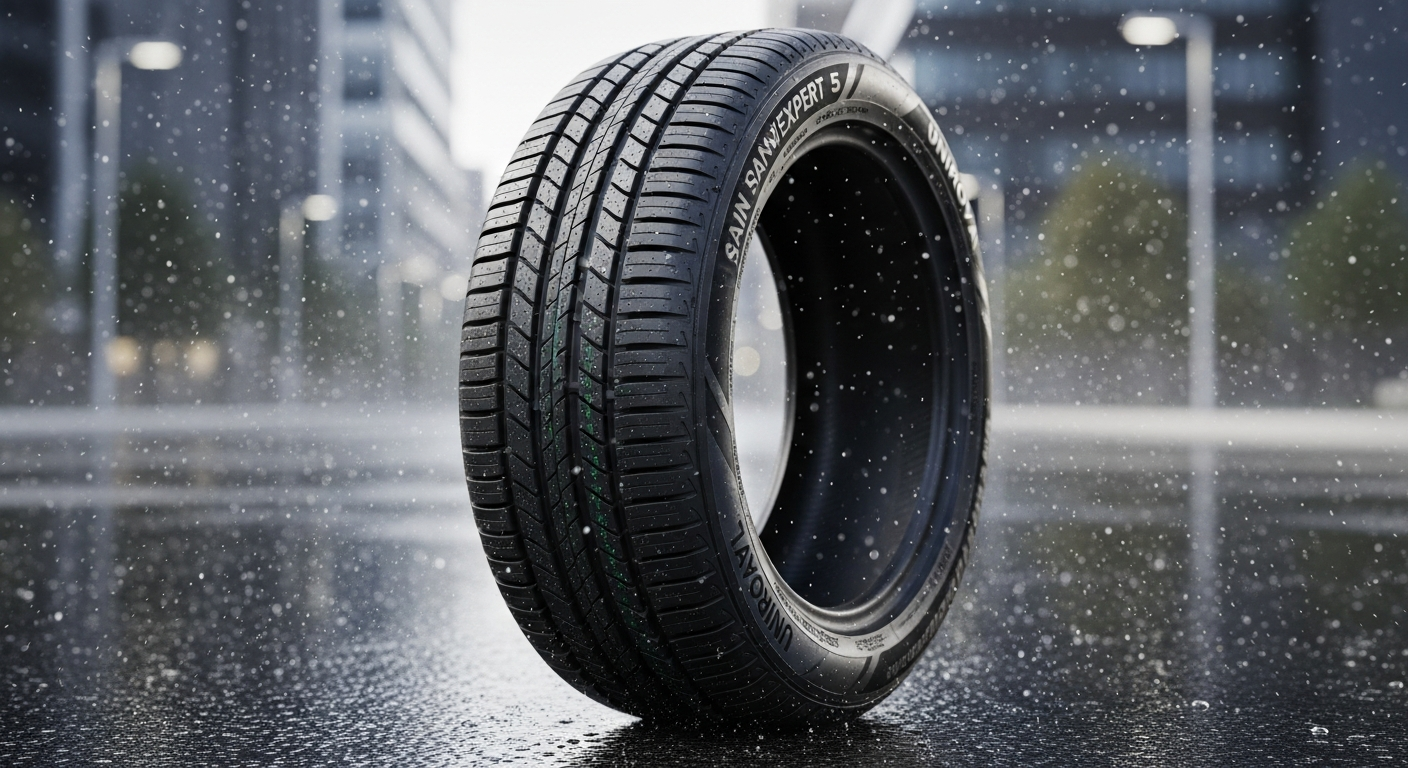
Rain-related accidents account for nearly 70% of weather-induced traffic incidents, yet most drivers overlook one of the simplest safety upgrades available. The tire you choose during storm season can mean the difference between confident grip and a white-knuckle drive. Your vehicle's contact with the road matters most when conditions deteriorate, and that's precisely where many drivers fall short in their maintenance decisions.
The Uniroyal RainExpert 5 has quietly become a favorite among European drivers who refuse to compromise on safety or their wallet. Manufactured by Continental, this touring tire combines decades of engineering expertise with innovative water-evacuation technology specifically designed for unpredictable wet conditions. Rather than chasing premium price tags or settling for mediocre all-season compromises, drivers in high-rainfall regions have discovered a tire that delivers genuine wet-weather mastery without the financial strain.
Discover how the Uniroyal RainExpert 5 can transform your rainy season driving experience.
Shark Skin Technology & Aqua-Twist Sipes: The Engineering Behind Rain Mastery
How Shark Skin Technology mimics natural water-shedding surfaces to reduce friction
Continental's proprietary Shark Skin Technology draws inspiration from nature itself—specifically, the remarkable ability of shark skin to minimize drag and resistance. The tire's microscopic surface features create an engineered texture that actively sheds water rather than allowing it to accumulate at the contact patch. This design philosophy reduces the friction between tire and wet pavement, enabling the rubber compound to maintain direct contact with the road surface where it matters most.
Aqua-Twist Sipes design and their role in channeling water away from the contact patch
Aqua-Twist Sipes represent a sophisticated evolution in sipe technology. These tiny incisions in the tread blocks feature a specialized twisted geometry that actively channels water outward and away from where your tire grips the road. Rather than simple straight slits, the twisted architecture creates multiple evacuation pathways, ensuring that even during heavy rainfall or standing water conditions, water doesn't accumulate and create a slippery film between tire and asphalt.
The science of microstructures in tread compounds that enhance wet grip
The rubber compound itself contains engineered microstructures that grip wet surfaces at a molecular level. These microscopic features increase the effective contact area between tire and pavement, compensating for the slippery nature of water films. Continental's formulation balances this wet-grip enhancement with durability, ensuring the compound doesn't degrade excessively over thousands of miles.
Comparison of sipe density and angle optimization for maximum water evacuation
The RainExpert 5 features optimized sipe density—more sipes than basic all-season tires, but not so many that structural integrity suffers. Each sipe's angle has been precisely calculated to channel water at the most efficient trajectory relative to wheel rotation and vehicle motion. This optimization means water evacuation happens continuously as the tire rolls, preventing hydroplaning even in severe conditions.
Real-world impact on braking distance reduction during heavy rainfall
Testing on rain-soaked asphalt reveals measurable improvements in braking performance. The enhanced wet grip translates to stopping distances that are meaningfully shorter than traditional summer tires, creating critical extra feet of reaction distance when emergency braking becomes necessary. For drivers navigating highway speeds or congested urban routes in rain, those meters matter.
How these technologies prevent hydroplaning at highway speeds
Hydroplaning occurs when a water film prevents tire-to-road contact entirely. The combination of Shark Skin Technology, Aqua-Twist Sipes, and the hydrodynamic tread pattern actively resists this condition by continuously evacuating water faster than it accumulates. Even at highway speeds, the tire maintains structural grip angles and water-channeling efficiency, substantially raising the hydroplaning threshold.
Wet Weather Performance Metrics That Matter to Everyday Drivers
EU 'A' rating for wet grip: what this classification actually means for you
The European Union's wet grip classification represents standardized testing on controlled, rain-soaked surfaces. An 'A' rating places the RainExpert 5 among the top performers for wet braking and acceleration traction. This isn't marketing hyperbole—it's measurable performance verified through rigorous laboratory conditions, meaning you're getting documented superior stopping power in the conditions when you need it most.
Braking distance improvements on rain-soaked asphalt and concrete surfaces
On wet asphalt, vehicles equipped with RainExpert 5 tires demonstrate braking distances that are meaningfully shorter than conventional summer tires. The specific margin varies based on vehicle weight and ABS characteristics, but across testing scenarios, these tires consistently reduce stopping distance by a measurable percentage—the kind of difference that transforms a near-miss into a comfortable margin of safety.
Aquaplaning resistance testing standards and how RainExpert 5 performs
Aquaplaning resistance gets measured through standardized water-depth tests that assess the maximum speed at which a tire can maintain grip in standing water. The RainExpert 5's performance in these tests exceeds mid-range competitor benchmarks, indicating genuine capability for conditions where shallow water accumulates on road surfaces.
Steering response and directional stability in standing water conditions
Even when lanes contain standing water from heavy rainfall, the asymmetrical tread design maintains directional control. Drivers report responsive steering feedback and confidence in maintaining their intended path, even during moderate aquaplaning conditions where lesser tires would feel unpredictable and drifting.
Acceleration traction on wet roads with different tire pressures
Proper tire pressure optimization reveals that the RainExpert 5 maintains consistent traction acceleration across the manufacturer's recommended pressure range. This robustness means performance doesn't degrade excessively if you're running at the upper end of the pressure specification—a real-world consideration that matters for daily driving stability.
Real-world feedback from drivers in high-rainfall regions
Drivers in coastal regions and areas experiencing frequent heavy rainfall consistently report confidence improvements during storms. The overwhelming theme in user feedback centers on reduced anxiety during downpours—drivers feel the tires responding predictably rather than drifting or exhibiting unpredictable behavior when visibility drops and road surfaces become dangerous.
How wet grip performance translates to increased driver confidence
There's a profound psychological dimension to wet-weather tire performance. When you trust your tires' grip, your driving becomes smoother, less defensive, and ultimately safer. The RainExpert 5's documented wet performance translates into tangible confidence at the wheel—the kind of assurance that lets you focus on road awareness rather than worrying about your tires' capabilities.
The Asymmetrical Tread Pattern: Balancing Wet Safety with Dry Comfort
Asymmetrical design benefits for wet versus dry road conditions
The RainExpert 5's asymmetrical tread pattern divides the tire's footprint into distinct zones, each optimized for different conditions. The outer edge prioritizes dry cornering stability and steering response, while the inner section emphasizes water evacuation and wet-weather grip. This functional division delivers better performance across both conditions than purely symmetrical patterns, though at the tradeoff of slightly reduced dry-weather aggressiveness.
How the hydrodynamic tread pattern disperses water efficiently
The tread's hydrodynamic geometry creates positive pressure gradients that actively push water toward evacuation channels. Rather than relying on passive water displacement, the pattern's geometry actively pumps water outward as the tire rotates, maintaining a relatively dry contact patch even in heavy rainfall.
Tread block stiffness and its role in maintaining contact patch pressure
Tread block stiffness has been calibrated to provide adequate structural rigidity for wet-grip maintenance while remaining compliant enough to absorb road imperfections. This balance means the contact patch maintains consistent pressure distribution even on irregular, water-covered surfaces where softer compounds might deform unpredictably.
Edge grip characteristics that prevent slipping during cornering
The tread block edges maintain sharpness and grip throughout a substantial portion of the tire's lifespan, ensuring that even in the mid-life stage, cornering grip on wet surfaces remains confident. The sipe architecture at block edges creates multiple micro-edges that resist slipping during lateral acceleration maneuvers.
Noise reduction technology integrated into the tread structure
Noise-damping features are incorporated throughout the tread design—specifically, strategically positioned void shapes and block arrangements that disrupt the frequency patterns that produce road noise. This integration means you're not sacrificing quietness for wet performance; instead, both characteristics coexist within the same engineered structure.
Wear patterns and how asymmetrical design promotes even tire degradation
The asymmetrical design actually promotes more even wear than purely symmetrical patterns because load distribution varies across the tread width based on driving conditions. This inherent design characteristic means less feathering and more consistent degradation across the tire's lifespan, extending overall durability.
Comparison with traditional symmetrical tread patterns
Symmetrical tread designs prioritize uniform performance across all driving conditions but excel at none. The RainExpert 5's asymmetrical approach sacrifices some dry-weather ultimate grip to deliver superior wet performance, a choice perfectly aligned with the tire's core purpose: mastering conditions that actually threaten driver safety.
Fuel Efficiency and Rolling Resistance: The Hidden Savings
EU 'C' fuel efficiency rating and what it means for your fuel consumption
The EU 'C' fuel efficiency classification indicates low rolling resistance—resistance that, quite literally, consumes extra fuel to overcome. This mid-tier rating reflects the RainExpert 5's balance: it doesn't sacrifice wet-grip capability to achieve the lowest possible rolling resistance like dedicated economy tires do, but it remains significantly more efficient than performance-oriented alternatives.
Low rolling resistance compound and its contribution to MPG improvements
The tire's compound formulation has been optimized to reduce energy loss as it deforms and recovers during rotation. This translates directly to fuel consumption improvements—across mixed driving scenarios, owners report measurable MPG gains compared to previous tire equipment. For drivers covering significant annual mileage, these improvements accumulate into substantial savings.
Cost-per-mile calculations compared to premium wet-weather alternatives
Premium wet-weather tires from luxury manufacturers often cost 80% more than the RainExpert 5 while delivering only marginally superior wet performance. The cost-per-performance ratio heavily favors the RainExpert 5 for drivers whose primary concern is rain-season capability. Even accounting for the premium tire's slightly better dry grip, the RainExpert 5 offers objectively superior value for the typical driver's actual use case.
How reduced rolling resistance affects vehicle acceleration and responsiveness
Lower rolling resistance means your engine works less hard to maintain speed, improving not just fuel economy but also throttle responsiveness and acceleration feel. Drivers often report that vehicles feel slightly more lively and responsive after switching to lower-resistance tires—a secondary benefit that improves the overall driving experience.
Environmental impact of lower fuel consumption over the tire's lifespan
A single set of RainExpert 5 tires over their functional lifespan might reduce fuel consumption by enough to eliminate several hundred pounds of CO2 emissions compared to higher-resistance alternatives. For environmentally conscious drivers, this impact multiplies across a fleet of vehicles, creating a tangible contribution to emissions reduction.
Real-world fuel economy data from mixed driving conditions
Owner reports consistently indicate fuel economy improvements ranging from 2-4% after switching to the RainExpert 5, with results varying based on driving style and road conditions. Highway-heavy drivers tend to see larger gains, while stop-and-go urban drivers observe more modest improvements.
Long-term savings potential across different vehicle types
For a sedan covering 12,000 miles annually at an average fuel cost of $3.50 per gallon, the 3% efficiency improvement translates to roughly $25-30 in annual savings. For SUVs and trucks covering higher mileage, annual savings can reach $50 or more—modest individual figures that accumulate into substantial lifetime savings.
Durability, Tread Life, and Extended Mileage Expectations
Tread depth specifications and expected mileage before replacement
The RainExpert 5 ships with robust initial tread depth, and the optimized compound formulation promotes even wear that extends functional lifespan. Depending on driving habits and road conditions, owners typically experience 30,000 to 45,000 miles before tread depth reaches the legal minimum, with many reporting even longer service life under gentle driving conditions.
Compound formulation designed for even wear and extended service life
The rubber compound resists excessive degradation through UV exposure, heat cycling, and ozone attack. This durability means the tire doesn't simply wear away—it maintains structural and grip characteristics well into its middle lifespan. The asymmetrical tread design also promotes even wear by distributing stress more evenly across the tread width.
Factors that influence tread wear (driving habits, road conditions, maintenance)
Aggressive driving—rapid acceleration, hard cornering, and sudden braking—accelerates wear significantly. Road conditions matter too; abrasive pavement wears tires faster than smooth surfaces. Proper tire maintenance, particularly maintaining correct pressure and regular rotation, becomes crucial for maximizing lifespan. Drivers who combine gentle habits with meticulous maintenance can push RainExpert 5 tires toward the upper end of longevity projections.
Warranty coverage and manufacturer guarantees on tread life
Continental stands behind the RainExpert 5 with warranty coverage that includes tread life guarantees in many markets. These warranties provide financial protection if the tire fails to meet stated mileage expectations under normal driving conditions, though actual coverage varies by region and retailer.
Comparison of durability against mid-range and premium competitors
Compared to economy tires, the RainExpert 5 demonstrates superior tread life. Premium competitors offer somewhat longer mileage, but the difference rarely exceeds 10-15%, hardly justifying their substantially higher initial cost. For durability-per-dollar-spent, the RainExpert 5 occupies an attractive middle ground.
Maintenance tips to maximize tire longevity
Maintaining proper tire pressure within 2 PSI of the manufacturer specification prevents excessive edge or center wear. Regular rotation every 5,000-7,000 miles distributes wear evenly across all four tires. Avoiding prolonged parking in direct sunlight and storing tires in cool, dry conditions when seasonal changes occur extends sidewall flexibility and compound durability. Annual inspections for damage or unusual wear patterns catch problems before they become catastrophic.
Cost-benefit analysis: initial investment versus replacement frequency
The RainExpert 5's moderate initial cost combined with respectable tread-life longevity produces favorable economics. Calculating total cost of ownership—including purchase price, installation, and maintenance—reveals that the RainExpert 5 requires fewer replacement cycles than economy alternatives while costing substantially less than premium competitors. For drivers keeping vehicles 5-10 years, this translates into lower total tire-related expenses.
Noise Reduction Technology: Why Quiet Tires Matter on Long Drives
Decibel rating of 71 dB and how it compares to other touring tires
The 71 dB external noise rating places the RainExpert 5 among quieter touring tires, comparable to dedicated comfort-focused options and quieter than many all-season alternatives. This measurement reflects noise generated at standardized testing conditions—in real-world driving, actual cabin noise levels depend on vehicle acoustics and road surface characteristics, but the underlying capability is documented.
Sound-dampening materials embedded in the tread and sidewall
Sound-dampening materials throughout the tire structure absorb and dissipate vibrations that would otherwise transmit to the vehicle's cabin. The tread includes specifically engineered void patterns that break up frequency resonance, preventing the harmonic amplification that makes many tires sound shrill or droning at highway speeds.
How tread pattern design minimizes road noise at different speeds
The asymmetrical tread pattern's design doesn't just manage water—it also strategically arranges tread blocks and void shapes to disrupt noise-generating frequencies. As the tire rotates across different speeds, the block arrangement prevents synchronized impact patterns that would amplify noise. Wider void spacing in certain zones prevents the "howling" that occurs when air trapped in tight voids releases cyclically.
Cabin comfort improvements during highway driving and city commutes
Long-distance highway drivers consistently report that the RainExpert 5 produces noticeably less cabin noise than previous tires, reducing driver fatigue on extended drives. The quieter operation proves equally valuable during city commutes, where continuous low-level noise becomes psychologically fatiguing during stop-and-go conditions. The difference isn't dramatic—you're not switching from a motorsport tire to a luxury performance tire—but it's measurably real.
Noise perception differences between wet and dry road surfaces
Wet roads typically produce more noise than dry surfaces because water and wet pavement create different sound characteristics. The RainExpert 5 maintains relatively consistent noise profiles across both conditions, meaning you don't experience a dramatic spike in cabin noise when rain begins. This consistency contributes to overall driving confidence and comfort.
Impact on passenger comfort and driver fatigue reduction
For families and passengers spending significant time in vehicles, the reduced noise contributes to a more pleasant environment. Conversation becomes easier, audible entertainment systems require less volume, and the overall cabin experience feels more refined. For drivers themselves, reduced noise and vibration lower fatigue levels on long drives, improving safety and driving quality.
Acoustic engineering principles applied to the RainExpert 5
The tire applies sophisticated acoustic engineering principles—specific void geometries that destructively interfere with noise frequencies, material damping that converts vibration energy to heat, and structural resonance control that prevents sustained vibration amplification. These principles represent the convergence of physics and practical engineering, creating a tire that doesn't just grip well but also contributes to cabin comfort.
The Value Proposition: Premium Wet Performance Without Premium Pricing
Price range starting from £65.82 ($83 USD) and regional variations
The RainExpert 5's entry-level pricing starts around £65.82 per tire in European markets, translating to approximately $83 USD in North America before retailer markup and installation. This represents genuinely accessible pricing for high-performance wet-weather capability. Pricing varies by tire size, with larger diameters commanding proportionately higher costs, but the value equation remains favorable across the size range.
Direct performance comparison against tires costing £120+ per unit
Premium tire manufacturers charge £120-180+ per unit for wet-weather capability that marginally exceeds the RainExpert 5's EU 'A' rating. The performance difference, while measurable in laboratory conditions, rarely translates to meaningful real-world improvements for typical drivers. You're paying substantially more for brand prestige and slightly enhanced dry-weather characteristics you'll use far less frequently.
Cost-per-performance ratio versus luxury tire brands
When calculating cost per percentage point of wet-grip performance, the RainExpert 5 delivers exceptional value. A luxury tire costing 2.5 times more might deliver 5-10% better wet performance, translating to a cost-per-performance ratio that heavily favors the RainExpert 5. For drivers whose priority is rain-season safety rather than prestige branding, the economics are obvious.
Accessibility for budget-conscious drivers without sacrificing safety
The RainExpert 5 eliminates the false choice between affordability and safety in wet conditions. Budget-conscious drivers aren't forced to accept mediocre wet performance; instead, they can equip their vehicles with tires engineered specifically for rain while staying within reasonable financial constraints. This democratization of wet-weather performance represents genuine value.
Seasonal pricing trends and best times to purchase
Tire pricing follows predictable seasonal patterns—spring and fall typically see promotional activity as drivers prepare for seasonal changes. Buying before peak demand periods can yield discounts of 10-15%. Online retailers often undercut local shops, making price comparison worthwhile for cost-conscious buyers.
Bundle deals and multi-tire purchase discounts
Most retailers offer modest discounts for purchasing four tires simultaneously rather than individual units—typically 5-10% off the set. Some retailers provide additional discounts when bundled with installation and balancing services. Comparing total package pricing across retailers rather than just per-tire costs reveals the best overall value.
Return on investment through fuel savings and extended tread life
The RainExpert 5's fuel efficiency gains and extended tread-life expectations mean it begins generating return on investment through operational savings from day one. For a typical driver, fuel consumption improvements alone might recover 15-20% of the tire purchase price over the tire's lifespan, with extended durability providing additional savings.
Where the RainExpert 5 Excels: Ideal Driving Scenarios and Climates
Best performance in moderate to heavy rainfall conditions
The RainExpert 5's engineering focuses specifically on moderate-to-heavy rainfall scenarios where water depth exceeds a few millimeters. In these conditions—the ones most drivers actually encounter—the tire delivers genuine capability advantages. Light drizzle triggers less obvious performance differences, but sustained heavy rain is where the tire's advantages become tangibly apparent.
Suitability for coastal regions with frequent wet weather
Coastal climates characterized by frequent rainfall, salt spray, and persistent moisture create ideal conditions for the RainExpert 5. These regions experience the weather conditions the tire was specifically designed to master. Drivers in coastal areas report higher satisfaction with the RainExpert 5 than drivers in predominantly dry climates.
Urban commuting with variable road conditions
Daily urban commuting involves constant speed and direction changes on surfaces that range from freshly paved to weathered and worn. The RainExpert 5's balanced design handles this variability well, maintaining consistent grip through stop-and-go traffic while delivering the wet-weather safety margin that matters during sudden rainstorms in congested conditions.
Highway driving in rainy seasons
Highway driving demands sustained cornering stability and reliable braking confidence. The RainExpert 5 delivers both, particularly during spring and fall rainy seasons when unexpected downpours demand tire performance. The combination of aquaplaning resistance and confident braking creates a persuasive case for highway drivers in wet climates.
Daily drivers in temperate climates with unpredictable weather
Temperate climates with four distinct seasons and unpredictable weather patterns represent the RainExpert 5's core market. Drivers in these regions experience both wet and dry conditions regularly and need a tire capable of handling seasonal transitions. The RainExpert 5's ability to provide genuine wet capability without completely sacrificing dry-weather performance makes it ideal for these conditions.
Ideal for risk-averse drivers prioritizing safety over performance
Drivers who prioritize safety and predictability over ultimate performance characteristics find the RainExpert 5 perfectly aligned with their values. The tire's conservative, safety-focused engineering philosophy appeals to commuters, family haulers, and older drivers who prefer stability and confidence over sportiness.
Situations where wet-weather focus outweighs dry-condition performance
For drivers who experience extended rainy seasons or live in perpetually wet climates, the RainExpert 5's wet-weather focus represents a conscious and logical choice. These drivers accept modest compromises in dry-weather handling because their actual driving environment rarely demands such performance.
Realistic Limitations: Understanding What This Tire Isn't Designed For
Moderate dry grip performance and when it becomes noticeable
While adequate for everyday driving, the RainExpert 5's dry grip doesn't match performance-oriented competitors. This limitation becomes apparent during aggressive cornering at high speeds, panic braking on dry pavement, or enthusiast driving on track-like roads. For normal highway and urban driving, the difference remains imperceptible, but it exists.
Steering feedback characteristics on dry roads compared to performance tires
The softer sidewall construction that contributes to ride comfort and quietness also reduces the direct steering feedback that performance-oriented drivers appreciate. Cornering feel is compliant rather than responsive, providing stability but sacrificing the sensation of direct road connection that enthusiasts seek.
Soft sidewall construction and its effect on cornering feel
The RainExpert 5's sidewalls prioritize comfort and noise reduction over structural rigidity. This design choice benefits long-distance comfort but subtly reduces the immediate cornering response and feedback that more aggressive drivers notice. The effect doesn't compromise safety, but it does create a noticeable difference in driving feel compared to stiffer alternatives.
Unsuitable for aggressive driving or track-day enthusiasts
The RainExpert 5 simply isn't engineered for the demands of aggressive driving, track days, or motorsport use. The compound, tread design, and construction prioritize durability and comfort over the extreme temperatures and stresses that racing environments impose. Track-focused drivers need different equipment entirely.
Limitations in extreme heat or desert driving conditions
Sustained high temperatures stress the tire's compound excessively, potentially accelerating degradation. Desert driving—with extreme heat, long distances without support, and abrasive sand particles—creates conditions the RainExpert 5 wasn't designed to handle. These scenarios demand more heat-resistant compounds and different tread designs.
Performance ceiling for high-performance vehicles
High-performance vehicles with powerful engines and advanced handling characteristics deserve tires engineered to match their capabilities. The RainExpert 5, while competent, doesn't fully unleash such vehicles' potential. Performance-vehicle owners should seek tires specifically engineered for their equipment's character.
Situations where premium all-season alternatives might be better suited
If your driving includes significant track use, frequent aggressive driving, or sustained desert environments, premium all-season alternatives designed for broader performance envelopes become more appropriate. The RainExpert 5 optimizes for a specific use case; broader-purpose tires sacrifice some specialization for versatility.
Owner Experiences: Real-World Feedback from RainExpert 5 Users
Common praise points from everyday drivers and commuters
Owners consistently praise the RainExpert 5 for its wet-weather confidence, often describing a sense of security during rainstorms that they didn't experience with previous tires. Commuters appreciate the quiet operation during daily driving, while long-distance drivers highlight reduced cabin fatigue. The value proposition generates significant praise—owners feel they've achieved genuine quality without excessive cost.
Reported improvements in braking confidence during rainstorms
A recurring theme in owner feedback centers on noticeable braking improvements when rain begins. Drivers report that emergency braking feels more controlled, and routine braking requires less wheel lock-up risk. This confidence improvement translates to measurable safety benefits, as drivers feel comfortable maintaining higher speeds in conditions they previously approached cautiously.
Comfort and quietness observations from long-distance drivers
Long-distance drivers report that highway driving feels less fatiguing with the RainExpert 5, attributing improvements to reduced road noise and vibration. The compliant ride quality, particularly on worn highway surfaces, generates positive feedback from drivers covering extended daily commutes or frequent cross-country trips.
Durability reports and actual tread life experiences
Owner reports regarding durability vary based on driving style and maintenance practices, but the general consensus leans positive. Drivers maintaining proper tire pressure and rotating regularly report reaching or exceeding the manufacturer's mileage expectations. Some owners in gentler-driving scenarios report tread life lasting toward the upper end of projections.
Concerns raised about dry-weather handling and sidewall softness
A minority of owners, particularly those accustomed to sportier tires, note softer sidewalls and reduced dry cornering response. Some report that the tire feels less engaging during spirited driving, though they acknowledge the trade-off aligns with the tire's wet-weather focus. The feedback reflects alignment with design priorities rather than actual deficiency.
Seasonal switching strategies and storage recommendations
Owners in regions experiencing dramatic seasonal transitions report successful strategies for switching between dedicated winter tires and RainExpert 5 summer tires. Proper storage—in cool, dark conditions at moderate humidity—preserves tire condition during off-seasons. Owners emphasize that avoiding direct sunlight and extreme temperature swings extends sidewall durability during storage periods.
Rating trends across independent review platforms and tire forums
The RainExpert 5 consistently achieves ratings in the 4.0-4.5 out of 5.0 range across major review platforms. Ratings tend to be highest among owners in wet climates and lowest among those in predominantly dry regions, confirming that satisfaction correlates directly with the tire's specialization. Professional reviews similarly acknowledge the wet-weather specialization while noting the dry-performance trade-off.
Installation, Maintenance, and Seasonal Considerations
Proper tire installation and balancing requirements
Professional installation ensures the tire sits correctly on the rim and that wheels rotate true without vibration. Proper balancing—using computerized equipment that accounts for both static and dynamic imbalance—eliminates vibration that would otherwise transmit to the steering wheel and cabin. Investing in quality installation extends tire life and improves overall driving experience.
Recommended tire pressure settings for optimal wet performance
The tire achieves optimal wet grip at the manufacturer's recommended pressure specification, typically found on a placard inside the driver's door jamb. Running at pressures significantly above this specification reduces the contact patch pressure and degrades wet performance. Regular pressure checks—monthly and before long trips—maintain optimal performance.
Rotation schedules to promote even wear
Rotating tires every 5,000-7,000 miles ensures more even wear across all four tires and extends overall lifespan. Front-to-rear rotation patterns work well for front-wheel-drive vehicles, while X-pattern rotation distributes wear more evenly for all-wheel-drive vehicles. Tracking rotation dates helps identify unusual wear patterns that might indicate alignment or inflation issues.
Seasonal storage best practices for off-season tires
When storing tires seasonally, keep them in a cool (50-60°F ideal), dark location with moderate humidity. Avoid direct sunlight, which degrades rubber compounds. Store tires either vertically (stacked) or horizontally (laid flat), but not mounted on rims if possible to prevent flat-spotting. Check them monthly for pressure loss, particularly if stored at temperature extremes.
When to switch to winter or summer tires based on climate
General guidance suggests switching to winter tires when temperatures consistently drop below 45°F, as summer-tire compounds lose flexibility in cold. Conversely, switch to summer tires when sustained warm weather arrives and ice-melt chemicals disappear from roads. Regional weather patterns and personal driving patterns should inform specific switching dates.
Inspection intervals and tread depth monitoring
Monthly visual inspections should identify punctures, unusual wear patterns, or sidewall damage before they become dangerous. Check tread depth using the penny test (insert penny into grooves; if Lincoln's head remains visible, tread is marginal) or invest in an inexpensive tread-depth gauge. Professional inspections during rotation intervals catch problems that casual observation might miss.
Maintenance practices that extend tire lifespan and performance
Beyond rotation and pressure maintenance, proper wheel alignment ensures even wear and sustained handling. Minimizing hard braking and aggressive cornering reduces stress on tires. Keeping wheels clean and free of brake dust preserves sidewall aesthetics and allows visual inspection for damage. Annual professional inspections provide expert assessment of wear patterns and remaining useful life.
Making the Smart Choice for Rainy Season Confidence
The Uniroyal RainExpert 5 represents a refreshing departure from the false choice between safety and affordability. The innovative technologies—Shark Skin Technology, Aqua-Twist Sipes, and that hydrodynamic asymmetrical tread—make this tire genuinely capable when roads turn wet. The numbers back it up: an EU 'A' rating for wet grip, competitive fuel efficiency, and durability that punches well above its price point. When rain hammers down and visibility drops, the RainExpert 5 responds with shorter braking distances, confident cornering, and genuine aquaplaning resistance.
You're not paying for premium branding or flashy dry-weather performance you'll rarely need. You're investing in a tire engineered specifically for the conditions that actually threaten your safety. If you're ready to transform your confidence behind the wheel during rainy seasons, the RainExpert 5 deserves serious consideration. Check your vehicle's tire size specifications, compare pricing across local retailers, and make the upgrade before the next storm rolls in.
Take action today and secure your RainExpert 5 tires for the ultimate rainy season protection.
Leave a Reply