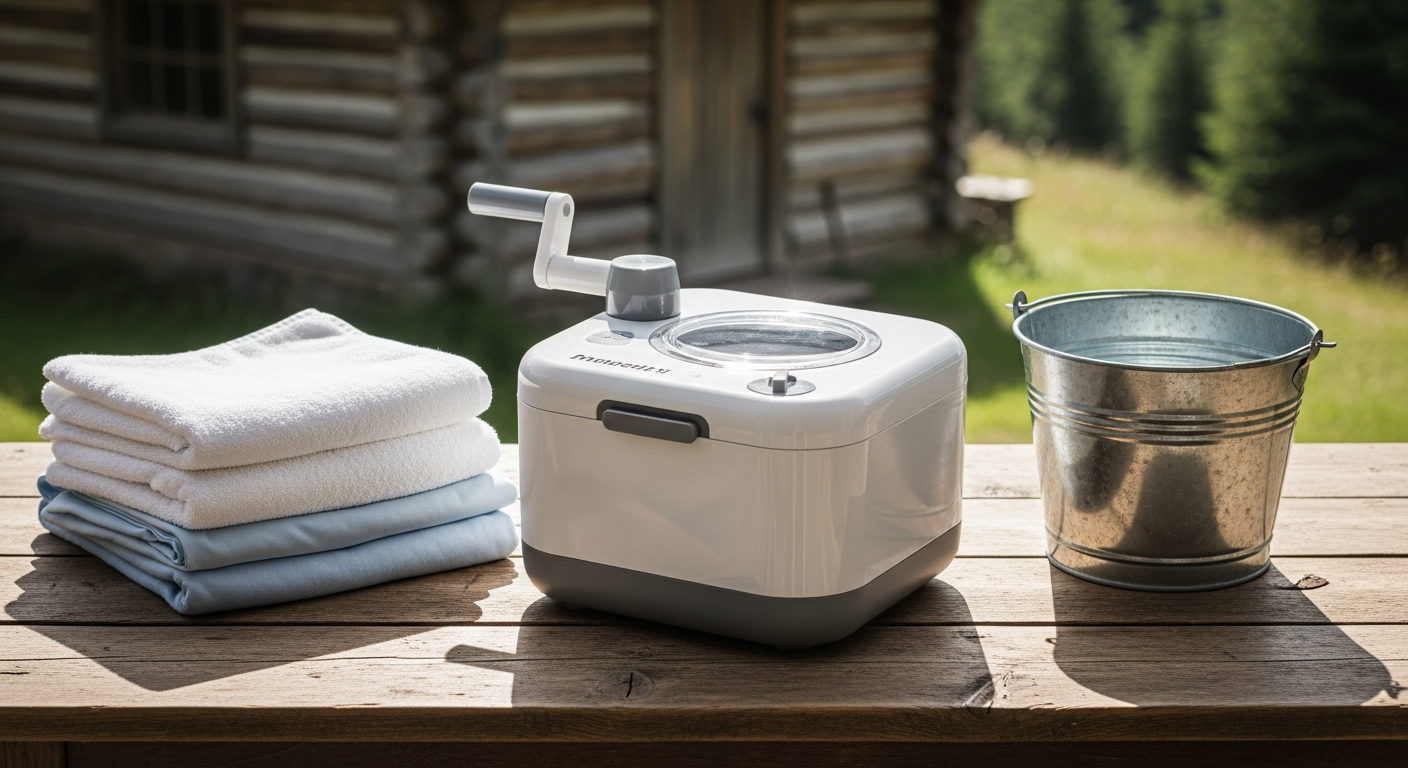
WonderWash Portable Washing Machine Review
Introduction
Over 2 million Americans now live in RVs or tiny homes, and they're discovering a laundry problem that traditional washers can't solve. The manual laundry movement has gained real momentum among people tired of grid dependency and water waste. For them, finding a practical solution isn't just about convenience—it's about aligning their daily routines with their values.
The WonderWash Portable Washing Machine has quietly become the go-to solution for off-grid enthusiasts, minimalist travelers, and eco-conscious households looking to ditch electricity-dependent appliances. Made by The Laundry Alternative Inc., this machine isn't just another gimmicky appliance. It's a carefully engineered tool built for people who value self-sufficiency, water conservation, and freedom from the grid. With prices hovering between $50 and $100, it's affordable enough to try without breaking the bank, yet robust enough to handle regular use.
Discover the WonderWash Portable Washing Machine and transform your laundry routine today.
This review breaks down exactly what makes the WonderWash tick, who it's actually designed for, and whether the tradeoffs are worth it for your situation. You'll learn about its performance on different fabric types, real-world capacity limitations, and how it stacks up against other portable washing solutions. By the end, you'll know precisely whether this manual marvel belongs in your laundry routine.
How the WonderWash Manual Crank System Actually Works
Mechanical operation overview
The WonderWash operates on pure mechanical simplicity—hand-crank design requires no electricity, making it ideal for off-grid environments and emergency situations. There's something refreshingly straightforward about a machine with no plug, no battery, and no dependence on external power sources. This makes it genuinely useful in places where electricity is either unavailable or prohibitively expensive.
Water and detergent requirements
The water efficiency is where this machine truly shines. It uses significantly less water than conventional machines—typically 2-3 gallons per load compared to 20+ gallons for standard washers. This isn't just a marketing claim; it's a fundamental advantage of the manual design. Detergent requirements drop proportionally, stretching your cleaning supplies further and reducing chemical runoff into the environment.
Wash cycle duration
Manual cranking takes approximately 5-7 minutes of continuous motion to complete one wash cycle. The rhythm becomes meditative for some users and tedious for others—your experience largely depends on your physical condition and mindset. Unlike electric machines that work while you attend to other tasks, the WonderWash demands your active participation.
Agitation mechanism
The internal basket design creates gentle, oscillating motion that's effective yet safe for delicate fabrics. This mechanical agitation provides consistent cleaning power without the aggressive tumbling that can damage fine materials. The basket moves back and forth rather than spinning, which prevents the tangling and stress that conventional washers impose on clothing.
Drain system
A simple gravity-fed drainage system with a straightforward spigot mechanism requires minimal maintenance. There are no complex pumps or filters to clog. You simply open the drain valve and let water flow out—fundamentally reliable in a way that complex machinery rarely achieves.
Load capacity specifics
The machine handles roughly 5 pounds of dry clothing per load, equivalent to 3-4 shirts or one pair of jeans. This small capacity is the machine's most significant practical limitation. Understanding this upfront prevents the disappointment of expecting a full week's laundry to fit in one session.
Real-World Performance: What the WonderWash Actually Delivers
Cleaning effectiveness on everyday fabrics
The WonderWash performs admirably on cotton, linen, and synthetic blends, removing dirt and light stains efficiently. Everyday wear and normal soiling respond well to the gentle agitation combined with proper detergent. Users report that regular clothes come out visibly cleaner after the 5-7 minute wash cycle, provided you're not dealing with heavy soil or stubborn stains.
Delicate garment handling
The gentle washing action makes the WonderWash superior to conventional machines for silks, woolens, and vintage clothing. Fashion-conscious users and those with heirloom garments appreciate how the machine treats fabrics with respect. This specific advantage has created a loyal following among people who previously hand-washed delicate items out of necessity.
Heavy-duty stain removal
Heavy-duty stain removal shows the machine's limitations. It has limited effectiveness on stubborn stains and may require pre-soaking or hand-scrubbing for tough marks. If you're dealing with set-in stains from weeks ago, expect to do some preliminary work before loading clothes into the WonderWash.
Water temperature control
Cold water operation is standard with the WonderWash. However, some users report heating water separately for improved cleaning power, especially during winter months or when tackling particularly dirty loads. This flexibility means you're not entirely constrained by the machine's design—you can adapt it to your specific needs.
Detergent efficiency
The machine works with standard laundry detergent effectively. Liquid formulas tend to dissolve more evenly than powders, creating more consistent cleaning results. The reduced water volume means your detergent goes further, another advantage for budget-conscious and environmentally aware users.
Noise and vibration levels
Quiet operation with minimal vibration stands out as a significant advantage for apartment dwellers and RV residents. Unlike electric washers that rumble and shake, the WonderWash operates silently. This characteristic has particular value for people living in tight quarters or traveling in RVs where noise sensitivity is a genuine concern.
Drying limitations
The lack of a spin cycle means clothes require manual wringing or air-drying. This is perhaps the most frustrating aspect of WonderWash ownership. Clothes emerge from the rinse cycle dripping wet, and separate spin dryer purchases have become common among frequent users. Air-drying takes 6-12 hours depending on humidity and fabric type, which can be inconvenient in humid climates.
Who Should Buy the WonderWash (And Who Shouldn't)
Ideal users
RV travelers, off-grid homeowners, tiny home residents, minimalist lifestyle enthusiasts, and sustainability-focused families represent the WonderWash's core audience. These people have already made lifestyle choices that align with manual operation and smaller capacity. For them, the WonderWash doesn't feel like a compromise—it feels like the right tool for the right job.
Supplementary laundry needs
The machine is perfect for households that want to reduce their primary washer usage and lower utility bills. Many people use the WonderWash for delicates, travel, or to handle overflow loads while extending the time between large loads in their main machine.
Travel and camping scenarios
The lightweight and portable design makes the WonderWash unbeatable for extended trips and temporary living situations. Campers and travel enthusiasts consistently rate this as one of the most practical portable solutions available.
Environmental advocates
The machine appeals to eco-conscious consumers seeking to minimize water consumption and eliminate electrical dependency. For people whose values demand environmental responsibility, the WonderWash offers tangible alignment between daily practice and personal principles.
Budget-conscious buyers
The affordable entry point serves those testing alternative laundry methods before committing to larger investments. At $50-$100, the financial risk of experimentation is minimal.
Not suitable for
Large families, people with mobility limitations, those requiring quick laundry turnarounds, or anyone washing heavy fabrics regularly should look elsewhere. These groups face genuine friction with the WonderWash's fundamental design.
Capacity mismatch
The machine becomes impractical as a primary washer for households generating 5+ loads per week. The time investment of running multiple sessions simply becomes unsustainable for families with high laundry volume.
Comparing the WonderWash to Other Portable Washing Options
Versus electric portable washers
Manual operation offers zero electricity costs but requires physical effort. Electric models are faster but less eco-friendly and significantly more expensive upfront. The choice between them depends entirely on whether you value speed and convenience over environmental impact and cost.
Versus traditional laundromats
The WonderWash eliminates travel time and ongoing costs. Laundromats offer larger capacity and faster processing but require you to leave your home or vehicle and pay per load. For RV dwellers especially, the convenience of on-site washing justifies choosing the WonderWash.
Versus hand-washing
The WonderWash reduces physical strain and improves cleaning consistency compared to hand-washing. Hand-washing uses less equipment but demands substantially more labor. Anyone who has scrubbed clothes by hand understands the appeal of mechanical agitation.
Versus compact electric machines
The WonderWash is significantly cheaper upfront but slower. Electric portables handle larger loads faster, making them more practical for people with higher laundry volumes who don't mind paying for electricity.
Versus bucket-and-plunger methods
The WonderWash provides better agitation and more consistent results than DIY alternatives. While a plunger and bucket cost almost nothing, the WonderWash's design delivers superior cleaning with less physical effort.
Price-to-value ratio
The machine offers exceptional value for niche users. It's far less practical for mainstream households with standard laundry volumes and access to conventional washing equipment.
Setup, Maintenance, and Long-Term Durability
Initial assembly requirements
Minimal setup characterizes the WonderWash experience. Most units arrive ready to use with basic instructions for first-time operation. Unlike many appliances, you won't spend hours wrestling with confusing assembly steps.
Storage footprint
The compact 12-18 inch diameter makes it suitable for closets, RV cabinets, and under-sink spaces. This portability advantage extends beyond just washing—storage between uses becomes genuinely manageable in space-constrained environments.
Cleaning and sanitizing
Simple rinse-down maintenance keeps the machine functional. There are no complex internal components to maintain or replace, which is refreshing compared to modern appliance complexity.
Durability concerns
Plastic construction holds up well for regular use. Hinges and lids may show wear after 2-3 years of frequent operation, which is a reasonable lifespan for a machine in this price range.
Replacement parts availability
Lids, gaskets, and drain spigots are available through The Laundry Alternative Inc. and various retailers. Full machine replacement is often more economical than major repairs, though basic parts remain accessible.
Warranty coverage
The machine typically includes a limited 1-2 year manufacturer warranty, though this varies by retailer and model generation. Checking warranty terms before purchasing protects your investment.
Lifespan expectations
With proper care, most units function reliably for 3-5 years of regular use. Some users report machines lasting longer, while heavy use can shorten this timeframe. Reasonable maintenance extends the machine's working life considerably.
Pricing, Value, and Where to Buy
Standard price range
The WonderWash typically costs $50-$100 depending on model generation, retailer, and seasonal promotions. This price point positions it as an impulse-friendly purchase compared to any motorized alternative.
Budget-friendly positioning
The machine is significantly cheaper than entry-level electric portable washers, which typically run $200-$400. This price advantage makes it accessible to people experimenting with alternative laundry methods.
Bulk purchase options
Some retailers offer discounts for multiple units, useful for RV communities or shared living situations. Buying in bulk can reduce per-unit costs meaningfully.
Seasonal sales patterns
Price drops often occur during spring cleaning season and before summer travel months. Planning purchases around these windows yields better value.
Retailer comparison
The machine is available through Amazon, specialty outdoor retailers, RV supply stores, and direct manufacturer channels. Price and availability vary, so comparing options before purchasing makes sense.
Shipping considerations
The lightweight design keeps shipping costs low, and the machine often qualifies for free delivery on larger orders. Shipping represents a minimal component of total cost.
Return policies
Most retailers offer 30-day returns, which is important given the niche nature of this product. This grace period allows you to test the machine in your actual situation before committing fully.
Honest Limitations and Potential Workarounds
Physical effort requirement
Continuous hand-cranking can be challenging for people with arthritis, limited mobility, or upper body weakness. This isn't a minor inconvenience—it's a legitimate barrier for some users that no workaround fully addresses.
Time investment
Washing a week's worth of laundry requires multiple sessions. For time-constrained lifestyles, this becomes impractical regardless of how efficiently each individual load washes.
Drying challenge
The lack of a spin cycle means clothes remain damp after washing. Air-drying takes 6-12 hours depending on humidity and fabric type. Pairing the WonderWash with a separate spin dryer ($30-$60) addresses this limitation effectively.
Capacity constraints
Multiple loads become necessary for families or anyone generating significant weekly laundry volumes. Accepting this reality prevents frustration and helps you determine whether the WonderWash fits your actual needs.
Learning curve
First-time users often over-fill or use too much detergent. Proper technique improves results dramatically, so give yourself a few loads to find your rhythm.
Climate limitations
Cold water operation in winter climates may reduce cleaning effectiveness without supplemental heating. Users in cold regions frequently report heating water separately to maintain consistent cleaning power.
Workaround solutions
Pairing the WonderWash with a separate spin dryer, using heated water, or combining it with electric washers for larger loads maximizes the machine's practical utility. These combinations allow you to leverage the WonderWash's strengths while minimizing friction from its limitations.
Customer Experiences and Real-World Feedback
Positive user testimonials
RV travelers and off-grid residents consistently praise the WonderWash's reliability and water savings. These users often report that the machine exceeded their expectations for durability and cleaning performance.
Sustainability satisfaction
Eco-conscious owners report genuine fulfillment from reducing their environmental footprint. For people whose values demand sustainable living, this satisfaction transcends mere functionality.
Unexpected benefits
Users highlight quiet operation, gentle fabric handling, and the meditative quality of manual washing. The absence of noise appeals particularly to RV dwellers and apartment residents. Some users describe the rhythmic cranking as almost therapeutic.
Common complaints
Repetitive cranking fatigue, slow drying times, and frustration with capacity limitations appear frequently in user feedback. These complaints aren't isolated experiences—they represent genuine tradeoffs inherent to the design.
Family usage patterns
Multi-person households report using the WonderWash for delicates and supplementary loads rather than primary laundry. This hybrid approach allows families to benefit from the machine without expecting it to replace their main washer.
Long-term satisfaction
Most owners who purchase with realistic expectations report high satisfaction. Those expecting full-replacement functionality show disappointment. Realistic expectations are the primary determinant of satisfaction.
Community recommendations
Strong endorsements within RV, tiny home, and homesteading communities create word-of-mouth momentum. Less enthusiasm emerges from mainstream users, reflecting the machine's inherent niche appeal.
Making Your Decision: Is the WonderWash Right for You?
Assessment checklist
Evaluate your lifestyle, laundry volume, physical capabilities, and environmental priorities before purchasing. Honest self-assessment prevents regrettable purchases and helps you determine actual fit.
Trial period strategy
Consider renting or borrowing before committing. Many RV communities have loaner programs that allow potential buyers to test the machine in real-world conditions before investing.
Budget allocation
Factor in potential spin dryer purchase ($30-$60) if you plan regular use. This additional investment might be necessary to achieve acceptable drying times.
Lifestyle alignment
The machine works best for people whose values and living situations genuinely match the product's capabilities. Forcing fit where none exists leads to frustration.
Hybrid approach
Using the WonderWash alongside your primary washer maximizes benefits while minimizing frustration. This combination strategy often yields the best practical results for households with variable laundry needs.
Future scalability
Consider whether this solution will work as your household circumstances change over time. Life changes, and a tool that's perfect now might become impractical later.
Alternative consideration
Evaluate whether electric portable models better serve your actual needs despite higher upfront costs. Sometimes spending more upfront prevents frustration and regret.
The Bottom Line: When Manual Laundry Makes Sense
The WonderWash Portable Washing Machine delivers exactly what it promises—reliable, electricity-free laundry for people living unconventional lifestyles. It's genuinely impressive for RV travelers, off-grid homeowners, and minimalist households willing to embrace manual operation. The combination of affordability, portability, and environmental benefits creates real value for a specific demographic.
That said, this machine succeeds through honest limitations rather than despite them. The manual crank, small capacity, and lack of spin-drying aren't design flaws—they're fundamental tradeoffs that make the WonderWash what it is. If you're expecting a replacement for your primary washer, you'll find disappointment. If you're seeking a supplementary solution that aligns with your values and lifestyle, you'll likely become a devoted user.
The WonderWash works most brilliantly for people already committed to sustainable living, RV travel, or off-grid existence. It's a practical tool that delivers within its intended purpose. For everyone else, carefully consider whether the physical effort and time investment align with your actual laundry needs before purchasing. The $50-$100 investment is low-risk enough to try, but informed expectations determine whether you'll view this manual marvel as a game-changer or a novelty.
Start your sustainable laundry journey with the WonderWash Portable Washing Machine today.
Leave a Reply