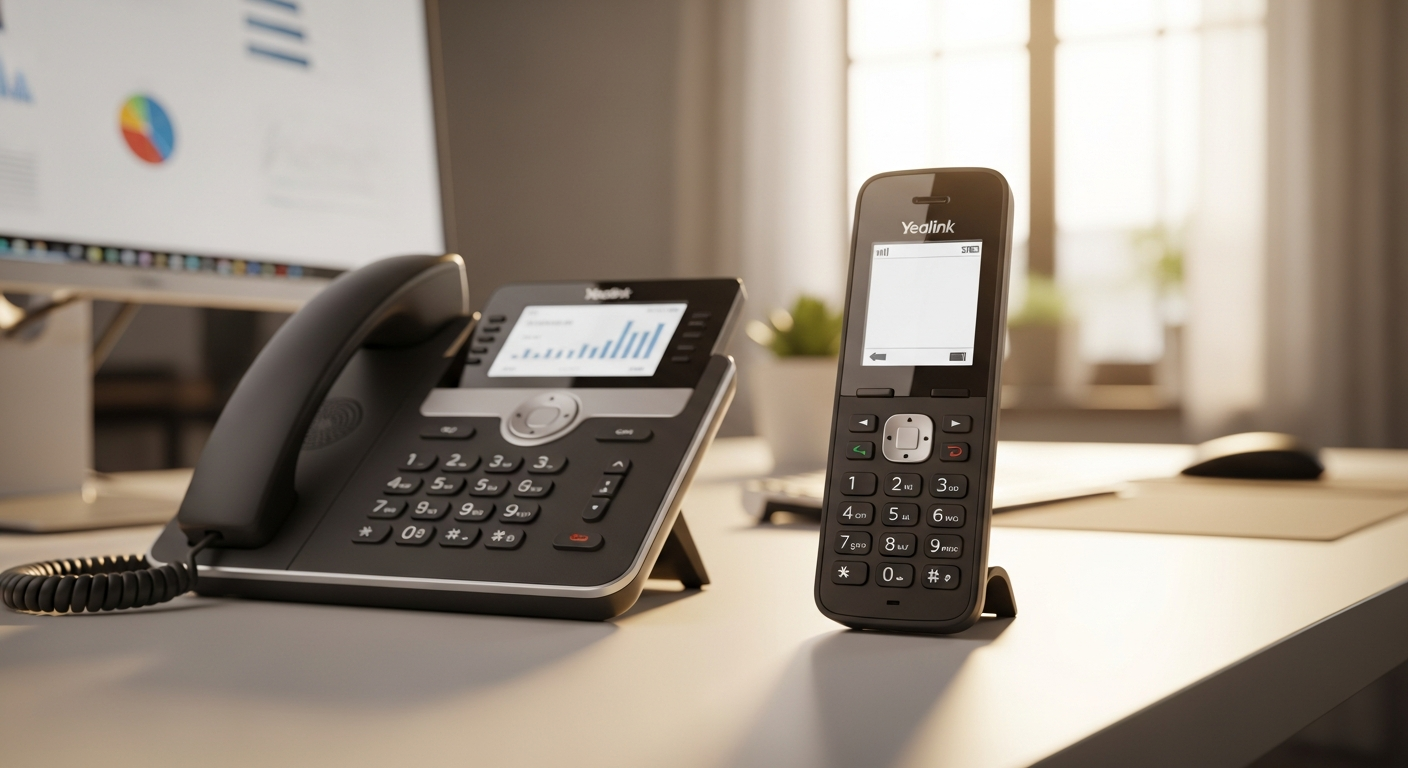
Why Mobile Workforces Demand More from Cordless Handsets
The operational reality of warehouse, retail, and hospitality environments
Stationary phones belong in offices with fixed workstations. The moment your team operates across multiple floors, loading docks, retail floors, or kitchen stations, traditional desk phones become obstacles rather than tools. Workers either waste time returning to a fixed location to make calls or they miss critical communications entirely. This isn't a minor inconvenience—it's a direct hit to operational efficiency and customer satisfaction.
Communication gaps that cost productivity and customer satisfaction
When employees can't reach each other quickly, problems compound. A warehouse associate can't notify the shipping department about a delayed pallet. A retail associate misses a customer question because they're in the stockroom. A hospitality manager can't coordinate between front-of-house and back-of-house operations. These gaps add up to approximately 2.5 hours per week in lost productivity for each manager, according to industry estimates. Multiply that across a team of ten, and you're looking at 25 lost hours weekly—time that directly impacts revenue and customer experience.
The difference between consumer-grade cordless phones and business-class DECT handsets
Consumer cordless phones from retail stores operate on unlicensed frequencies with limited range and inconsistent performance. Business-class DECT (Digital Enhanced Cordless Telecommunications) handsets are engineered for high-traffic environments, regulatory compliance, and integration with enterprise VoIP systems. The W56H operates on a secure, business-grade standard that delivers consistent range, superior audio quality, and seamless integration with your existing infrastructure—capabilities that consumer-grade alternatives simply cannot match.
Battery Performance That Actually Lasts Through Your Shift
30 hours of continuous talk time keeps your operation running without interruption
A cordless handset that dies mid-shift creates the same communication vacuum as no handset at all. The W56H delivers up to 30 hours of continuous talk time on a single charge, meaning most operations can run a full work week without needing a recharge. For organizations with multiple shifts or high call volumes, this translates to a handset that stays operational even during peak usage periods. Workers don't need to manage charging schedules or swap between devices—they simply work.
400 hours of standby time ensures handsets stay ready when needed
Beyond talk time, standby duration matters equally. The W56H maintains a 400-hour standby capability, which means if a handset sits unused for two weeks, it still powers on with a full battery. This matters for backup devices, seasonal operations, or coverage extensions that aren't used daily. Operations managers appreciate this reliability because they don't need to worry about batteries draining during slower periods.
Quick-charge functionality delivers 2 hours of talk time from just 10 minutes of charging
Not every situation allows for a full recharge cycle. The W56H's quick-charge feature delivers 2 hours of talk time from just 10 minutes of charging, making it practical for lunch breaks or shift transitions. Employees can charge during a brief pause and immediately return to full productivity. The included charging cradle and USB/110V charging options provide flexibility across different facility types and available power sources.
Crystal-Clear Audio in Noisy Environments
HD Voice technology and Opus codec deliver superior audio quality in high-noise settings
Warehouse floors, retail environments, and kitchens are loud. Standard audio codecs compress voice in ways that make speech harder to understand when background noise is present. The W56H uses HD Voice technology with the Opus codec, which prioritizes voice intelligibility at the expense of other frequencies. This means conversations remain clear even when forklifts are running, machinery is operating, or multiple conversations happen nearby. The technical result is human: better understanding, fewer miscommunications, and more efficient operations.
Yealink Noise Reduction System cuts through warehouse and retail background noise effectively
Beyond the codec itself, the W56H includes Yealink's proprietary Noise Reduction System, which actively filters background noise during calls. This system distinguishes between voice and environmental noise, suppressing the latter while preserving natural speech patterns. Callers on both ends of the conversation hear clearer audio, which reduces the need for repetition and clarification. In high-noise environments, this feature alone justifies the investment.
Full-duplex speakerphone capability enables hands-free operation for busy teams
Employees often need their hands free—for carrying inventory, operating equipment, or assisting customers. The W56H's full-duplex speakerphone allows natural two-way conversations without holding the handset to the ear. This capability is particularly valuable in warehouse and retail operations where employees are constantly moving and managing multiple tasks simultaneously.
Coverage and Range Across Large Facilities
50-meter indoor range covers multi-floor offices and warehouse sections
The W56H delivers up to 50 meters of indoor range when paired with a compatible DECT base station. For most warehouse sections, retail floors, and office buildings, this coverage eliminates dead zones. A single base station can typically cover an entire floor of a standard commercial building, and multiple base stations can be deployed to cover larger facilities with seamless handoff between coverage areas.
300-meter outdoor range supports loading docks, parking areas, and exterior operations
Operations that extend outdoors—loading docks, parking areas, yard operations—benefit from the W56H's extended outdoor range of up to 300 meters. This capability is critical for organizations where coordination between indoor and outdoor teams is necessary. Logistics operations, construction sites, and facilities with significant outdoor activity areas all benefit from this extended coverage.
Compatible with Yealink W60B, W70B, W80B, and W90B base stations
The W56H functions as an expansion handset for Yealink's established DECT base station lineup. If your organization already operates a Yealink base station, adding the W56H requires no infrastructure overhaul. This compatibility approach is fundamental to the handset's appeal—it works within existing systems rather than demanding complete replacement.
Seamless Integration with Your Existing Yealink System
Expansion handset design adds mobility without replacing your current infrastructure
Rather than requiring organizations to swap out their entire phone system, the W56H slots into existing Yealink DECT deployments as an additional handset. This expansion approach means organizations can scale mobility gradually, adding handsets as budget allows and as operational needs become clearer. Existing base stations, configurations, and integrations continue functioning unchanged.
Microsoft Teams integration through SIP Gateway support enhances collaboration
Modern organizations increasingly rely on Microsoft Teams for communication. The W56H, through Yealink's SIP Gateway support, enables Teams calls directly from the cordless handset. This means employees can use the W56H for both traditional VoIP calls and Teams communication, creating a unified communication platform across the facility.
Setup and pairing process is straightforward for new handset deployments
DECT handset pairing is relatively straightforward—far simpler than configuring wireless devices over WiFi networks. The setup process typically involves pairing the handset with the base station through a simple registration procedure. IT departments appreciate this simplicity because it reduces support tickets and deployment time.
Get started with the W56H today and transform how your team communicates across your facility.
Practical Design Features That Improve Daily Usability
2.4-inch color display provides intuitive navigation and call management
A full-color 240 x 320 pixel display eliminates the limitations of monochrome screens. Call logs, contacts, and menu navigation are clear and easily readable. The color screen also supports visual indicators for signal strength, battery life, and call status—information that helps employees understand their connectivity without additional explanation.
Illuminated keypad with lock function prevents accidental calls during movement
The illuminated keypad ensures usability in low-light environments—dimly lit warehouses, retail back rooms, or kitchens with minimal overhead lighting. The integrated keypad lock function prevents accidental button presses while the handset moves through crowded or tight spaces, eliminating misdirected calls or unwanted transfers.
Ergonomic form factor designed for all-day wear and comfortable handling
A handset that feels uncomfortable during an 8-hour shift becomes a liability rather than an asset. The W56H's ergonomic design distributes weight comfortably and fits naturally in hand or ear. The device is light enough for all-day use but robust enough to withstand the wear and tear of mobile environments.
Cost-Effectiveness Analysis for Your Team
Price range of $89.95–$129.00 per handset fits most business budgets
Individual handset cost falls in the range of $89.95 to $129.00, positioning the W56H as an affordable option for organizations deploying multiple units. Compared to replacement desk phones or higher-end mobile communication solutions, the per-unit cost is reasonable for the capabilities provided.
Total cost of ownership includes handset, base station, and infrastructure investment
Organizations without existing DECT infrastructure will need to budget for at least one base station in addition to handsets. However, each additional handset paired with an existing base station requires minimal incremental investment. Organizations with existing Yealink DECT systems add handsets with virtually no infrastructure costs beyond the device itself.
Productivity gains from improved communication quickly offset hardware costs
The productivity value of eliminating communication breakdowns is substantial. If the W56H reduces lost coordination time by even 30 minutes per employee per week across a team of ten, that's 5 hours of recovered productivity weekly—roughly equivalent to a full workday. Over the course of a year, this productivity gain justifies the hardware investment multiple times over.
Real-World Use Cases Where the W56H Delivers Results
Warehouse operations benefit from reliable inventory management and shipping coordination
Warehouse teams constantly move between receiving, storage, and shipping areas. The W56H keeps supervisors and associates connected throughout these transitions. Associates can report inventory discrepancies in real-time, shipping coordinators can direct dock operations, and receiving teams can confirm incoming shipments without walking to fixed phone locations. This constant connectivity accelerates operations and reduces errors.
Retail environments see improved floor coverage and customer service responsiveness
Retail associates spend most of their shift on the sales floor. The W56H enables instant communication between the floor, stockroom, and management office. Associates can call stockroom staff to verify inventory without leaving customers. Managers can coordinate floor coverage and respond to customer needs immediately. The result is faster customer service and more responsive operations.
Hospitality settings achieve seamless guest services and kitchen communication
Hotels, restaurants, and event venues require constant coordination between front-of-house and back-of-house operations. The W56H enables kitchen staff to communicate with dining room managers, housekeeping to coordinate room assignments, and reception to reach maintenance staff instantly. The result is faster guest service and smoother operations across all facility areas.
Limitations and Considerations Before You Buy
Requires compatible Yealink DECT base station for operation
The W56H is an expansion handset—not a standalone device. Organizations without a Yealink DECT base station must purchase one separately. This infrastructure requirement represents an initial investment that extends beyond the handset purchase price.
Initial setup investment extends beyond the handset purchase price
Budget for at least one base station, cabling, and potentially installation services. The total infrastructure investment depends on facility size and existing equipment, but it's essential to factor this into purchase decisions rather than viewing the handset as a standalone cost.
DECT frequency availability varies across different geographic regions
DECT operates on unlicensed frequency bands that differ by country and region. Organizations in some geographic areas may face regulatory limitations or frequency conflicts. Before committing to a deployment, verify that DECT frequencies are available and clear in your specific location.
Making the Decision: Is the W56H Right for Your Team?
Assessment checklist includes facility size, team mobility, budget, and infrastructure needs
Evaluate your facility layout, the percentage of time employees spend moving versus stationary, your current communication infrastructure, and available budget. Larger facilities with higher employee mobility and existing Yealink systems are ideal candidates for the W56H.
Compare the W56H against alternative DECT handsets and cordless solutions available
The market includes other DECT handsets and cordless solutions. Compare features, battery life, audio quality, and price across competitors. The W56H's combination of exceptional battery life, HD audio, and affordability positions it competitively, but thorough comparison helps ensure the best fit for your specific needs.
Questions to ask your VoIP provider about compatibility and ongoing support
Before purchasing, confirm with your VoIP provider that the W56H is compatible with your specific system configuration. Ask about support availability, warranty coverage, and any firmware updates that may enhance functionality. A supportive provider relationship ensures smooth implementation and ongoing reliability.
The Bottom Line—Wireless Communication That Works When Your Team Needs It
The Yealink W56H DECT cordless handset represents a genuine solution for businesses where mobility isn't optional—it's operational. The combination of exceptional battery life, crystal-clear audio, and reliable DECT connectivity makes this handset worth serious consideration. If your team spends more time moving than sitting, if background noise is a constant challenge, or if you need to expand your existing Yealink system without major infrastructure changes, this handset delivers measurable value.
The $89.95–$129.00 investment per unit quickly pays for itself through improved productivity and reduced communication failures. Workers no longer miss critical calls. Supervisors coordinate operations instantly rather than playing phone tag. Customers receive faster service because staff can reach each other immediately. The cumulative effect is an organization that responds faster, coordinates more effectively, and serves customers better.
Start by assessing your facility layout, base station compatibility, and team size—then reach out to your VoIP provider to discuss a trial deployment. Your mobile workforce deserves communication tools that keep pace with their pace.
Leave a Reply