I've watched countless cyclists hesitate at the price tag of new e-bikes—often $1,500 to $3,000 or more. Yet what if I told you that you could electrify your existing bicycle for under $600? The Yose Power E-Bike Conversion Kit makes this reality possible, breathing new life into bikes gathering dust in garages and sheds across the globe.
With over 15 years of engineering expertise and certifications including CE, UKCA, and RoHS, Yose Power has built a reputation for delivering reliable conversion solutions. This isn't some experimental gadget—it's a battle-tested system that transforms ordinary bicycles into capable electric machines. The brand has proven itself through thousands of successful installations worldwide, earning trust from DIY enthusiasts and practical cyclists alike.
Explore the Yose Power conversion kit and start your electric cycling journey today.
What's Inside the Box: Complete Component Breakdown
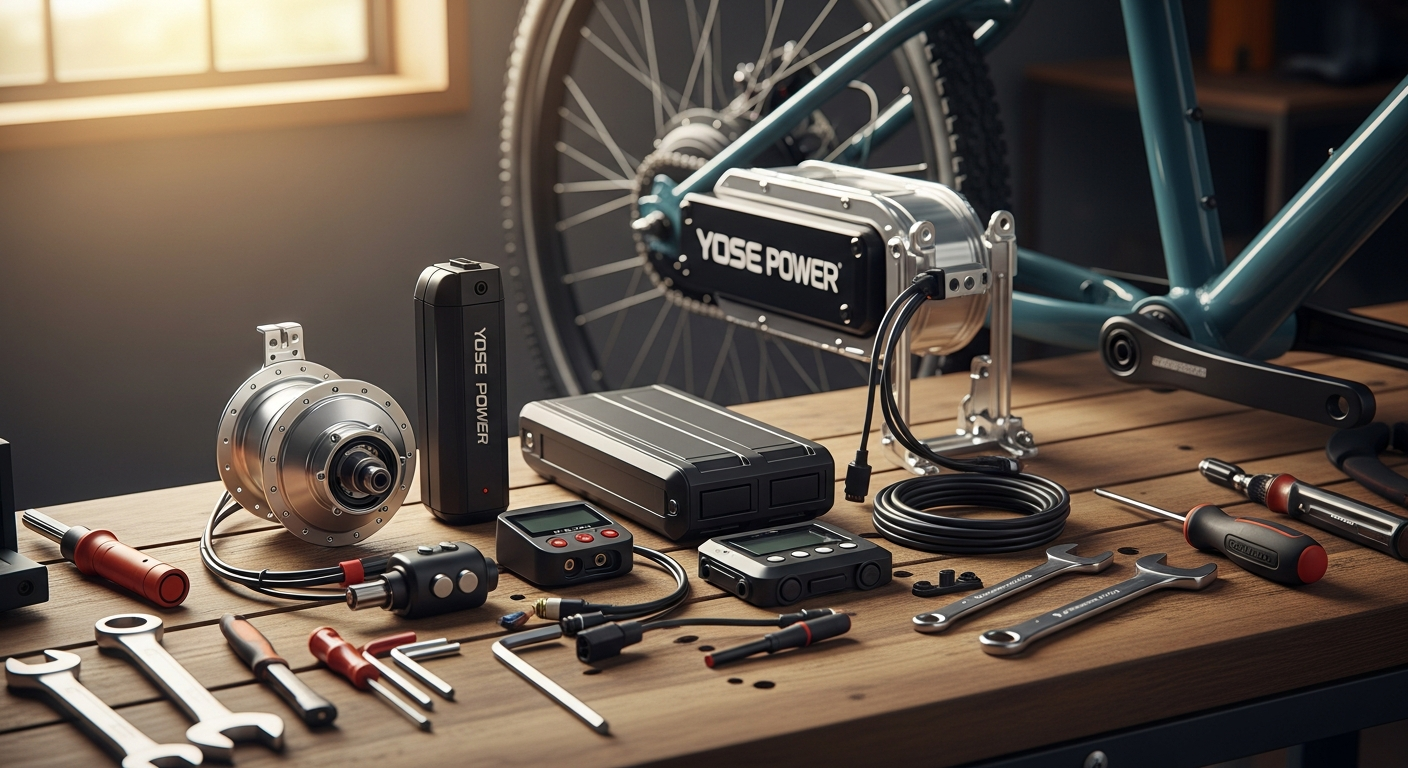
The Yose Power conversion kit arrives with everything needed to transform your ride. A rear hub motor wheel forms the electrical heart, available in 250W, 350W, and 500W configurations to match your terrain and riding style. Paired with this motor is a lithium-ion battery pack offered in 36V or 48V configurations, with capacity options ranging from 13Ah to 18Ah depending on your range requirements.
The kit includes a motor controller that intelligently manages power delivery and system communication between components. An LCD display mounts to your handlebars, showing speed, distance, battery percentage, and assist mode in real time. For flexibility, you get both a throttle mechanism for direct motor engagement and a pedal-assist sensor (PAS) that detects your cadence and adjusts power automatically.
Safety features are built in: brake levers come with integrated motor cut-off switches that disengage the motor when you brake. A comprehensive wiring harness arrives pre-assembled to minimize confusion during installation. Installation hardware and mounting brackets are sized for standard bicycle frames, though you may need to adapt certain elements depending on your specific bike geometry.
Motor Power Options: Choosing the Right Wattage for Your Riding Style
250W Motors for Urban Commuting
A 250W motor excels on flat terrain and urban commuting routes. This power level maintains road-legal status in most European markets, which strictly cap electric bicycle motors at 250W. If you value simplicity, compliance with regulations, and moderate assistance for daily trips, this option delivers consistent performance without legal complications.
350W Motors for Balanced Performance
The 350W motor strikes a middle ground, offering noticeably better acceleration than 250W while remaining within acceptable ranges for many regions. Mixed terrain riding—combining flat commute sections with occasional rolling hills—suits this wattage perfectly. You'll experience genuine power boost without excessive battery drain on longer journeys.
500W Motors for Serious Power
A 500W motor brings aggressive acceleration and serious hill-climbing ability. Off-road conditions, steep grades, and rapid acceleration all fall within this motor's wheelhouse. Power delivery is immediate and forceful, though battery consumption increases accordingly. Be aware that 500W motors exceed legal limits in many European jurisdictions and may face restrictions depending on your location.
Motor wattage directly affects how quickly your battery depletes. Higher wattage means faster acceleration but shorter range per charge. Consider your typical riding distances and terrain profile when selecting motor power.
Battery Specifications and Real-World Range Expectations
36V Systems for Light Urban Use
A 36V battery suits lighter riders and urban commuting scenarios. These systems consume less total energy and charge faster than higher-voltage alternatives. If your daily range stays under 25 miles and terrain remains predominantly flat, 36V delivers satisfactory performance at a lower price point.
48V Systems for Extended Range
A 48V system provides superior hill-climbing ability and extended range for longer journeys. The higher voltage means more efficient power delivery and better performance under load. For riders tackling varied terrain or covering 30+ miles regularly, 48V becomes the more practical choice despite the premium cost.
Capacity Impact on Total Distance
Battery capacity—measured in amp-hours (Ah)—directly determines how far you travel per charge. A 13Ah battery suits minimal commuting; 15.6Ah covers moderate daily use; 18Ah enables weekend adventures and longer commutes. Battery capacity interacts dynamically with motor wattage. A 500W motor with an 18Ah battery drains faster than a 250W motor with the same capacity, yet still covers greater absolute distance.
Charging time typically ranges from 4 to 8 hours depending on battery capacity and charger specifications. Proper lithium-ion battery maintenance—avoiding complete discharge, storing in cool conditions, and following manufacturer charging protocols—extends battery lifespan to 3-5 years of regular use.
Check the detailed battery specifications and choose the right capacity for your riding needs.
Installation Reality Check: What Beginners Should Expect
Installing a Yose Power conversion kit requires basic mechanical skill and proper tools, but it's absolutely achievable for patient DIY enthusiasts. The process begins with wheel removal—you'll take off your rear wheel and replace it with the motorized hub wheel. This step demands standard bike tools and careful attention to rim compatibility.
Frame clearance assessment comes next. The battery rack must fit securely without interfering with your seat tube or existing components. Compact frames and vintage bikes sometimes require creative mounting solutions or additional brackets. Measure your frame before ordering to avoid compatibility surprises.
Brake lever integration ensures motor cut-off switches function reliably. You'll need to properly route brake cables and test that pulling your brakes immediately disengages the motor. This safety feature requires accurate adjustment to prevent accidents.
The pedal-assist sensor alignment with your crank arms represents a common friction point. Certain crank configurations force you to adapt sensor placement or explore alternative mounting positions. Some users find this step requires careful measurement and occasional trial-and-error.
Wiring harness routing demands attention to detail. You'll thread cables through frame tubes and along the downtube without pinching or damaging insulation. Secure routing prevents electrical shorts and ensures long-term reliability.
Compatibility Challenges: Will This Kit Fit Your Bike?
Wheel size requirements demand careful verification. The motor wheel must match your current rim diameter exactly. Standard sizes include 26", 27.5", and 29" for mountain bikes, plus 700c for road bikes. Ordering the wrong size wastes time and money.
Frame geometry assessment prevents installation headaches. Battery rack clearance becomes critical on step-through designs and compact frames. Measure your seat tube diameter and available space before committing to purchase.
Crank arm configuration directly affects pedal-assist sensor accuracy. Bottom bracket types and crank arm thickness influence where the sensor can mount. Some configurations demand spacer solutions or alternative sensor brackets.
Derailleur and chain compatibility matter when installing a rear hub motor. The motor wheel must integrate smoothly with your existing drivetrain. Certain derailleur types require minor adjustments to function optimally with the new motor system.
Brake type considerations shape your installation approach. Rim brakes and disc brakes interact differently with the motorized hub wheel. Both work, but disc brake systems integrate more cleanly with the motor assembly.
Cost-Benefit Analysis: Conversion vs. Buying New
A complete Yose Power E-Bike Conversion Kit with battery costs between €400–€500 EUR or $400–$600 USD. This represents an extraordinary value proposition compared to purchasing a new electric bicycle.
New e-bikes typically start at $1,500–$3,000 for entry-level models and climb significantly higher for premium brands. You're looking at a three-to-five-fold price difference. The conversion route democratizes electric cycling by removing the financial barrier that keeps many people using traditional bikes.
Hidden costs deserve consideration: professional installation (if you choose that route), replacement brake pads worn by increased stopping power, potential tire upgrades for reliability, and safety equipment like lights and reflectors. Even factoring these additions keeps your total investment well below new e-bike pricing.
The long-term value of preserving a bike you already know matters psychologically and practically. You understand how your current bike handles, how it fits, and what you like about it. Why abandon that familiarity for a mass-produced alternative? A conversion kit respects your existing investment while adding modern capability.
Customization advantages tip the scales heavily in favor of conversion. Pre-built e-bikes come with fixed specifications—you're locked into their motor choice, battery capacity, and component selections. A conversion kit lets you mix and match: want more power for hills? Upgrade to a 500W motor. Need extended range? Choose an 18Ah battery. Your setup reflects your actual needs, not a designer's compromises.
Taking the Leap: Is a Yose Power Conversion Right for You?
The Yose Power E-Bike Conversion Kit represents a genuine opportunity to democratize electric cycling. You're not locked into expensive new purchases or compromised by cookie-cutter designs—you're building something uniquely yours. The 15-year legacy, international certifications, and proven track record mean you're working with engineering that's been battle-tested by thousands of riders.
This isn't a plug-and-play solution for everyone. If you're mechanically inclined, enjoy tinkering, and have a bike worth upgrading, you're looking at an exceptional value proposition. The installation requires patience and attention to detail, but the reward—a fully customized electric bike for under $600—speaks for itself.
Your old bike gets a second life. Your commute transforms. Your relationship with cycling deepens. The real question isn't whether Yose Power makes a quality kit. The question is whether you're ready to invest a weekend of effort for years of electric-assisted riding.
If that sounds like your speed, reach out to Yose Power's support team, verify compatibility with your specific frame, and start planning your conversion. Your electrified future is waiting—and it's more affordable than you think.
Transform your bike into an electric powerhouse with the Yose Power conversion kit.
Leave a Reply