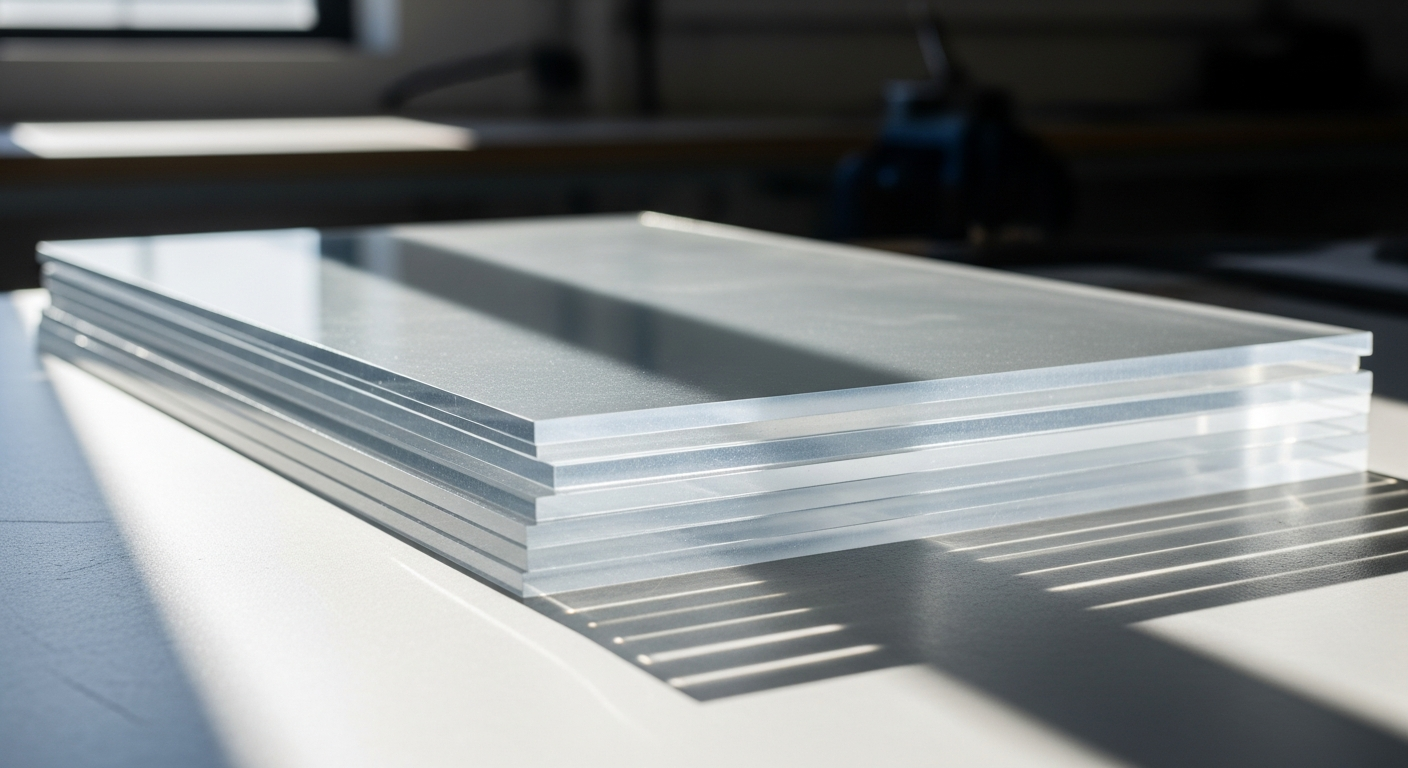
Over 92% light transmission—that’s clearer than most glass you’ll find on the market today. Yet Clear Cast Perspex Acrylic Sheet delivers something glass simply cannot: the ability to be precision-cut, laser-engraved, and thermoformed into virtually any shape your project demands. For architects, manufacturers, and designers tackling complex specifications, this material isn’t just a choice—it’s a game-changer.
Cast acrylic represents the premium tier of transparent plastics, engineered through a meticulous cell-casting process that yields uniform thickness and superior optical properties. The term Perspex carries weight in the UK and Australia as shorthand for genuinely high-quality acrylic, and for good reason. This material bridges the gap between glass-like aesthetics and plastic-like workability, making it indispensable for projects where both form and function matter equally.
Explore premium Clear Cast Perspex Acrylic Sheet options to elevate your next project.
Precision Fabrication Capabilities: What Makes Cast Acrylic Different from Extruded Alternatives
Cell-casting vs. extrusion methods: How the manufacturing process creates superior optical clarity and uniform thickness
The distinction between cast and extruded acrylic fundamentally shapes material performance. Cell-casting involves pouring liquid acrylic resin into molds, allowing it to cure slowly and evenly. This controlled process creates sheets with consistent thickness and eliminates the internal stress that often characterizes extruded alternatives. Extruded acrylic, by contrast, passes melted material through rollers at speed, which can introduce microscopic variations and internal tensions that affect long-term stability and optical properties.
Cast acrylic’s superior clarity stems directly from this manufacturing approach. The slow curing process allows air bubbles and impurities to naturally escape, resulting in uniform molecular structure throughout the sheet. The outcome is optical transmission exceeding 92%—performance that rivals or surpasses many glass formulations.
Machinable properties: Cutting, drilling, routing, and routing capabilities without cracking or stress fractures
Cast acrylic’s uniform internal structure translates to predictable machining behavior. Cutting operations produce clean edges without the stress fractures common in extruded variants. Standard tools—circular saws, band saws, and CNC routers—work efficiently on cast acrylic with minimal chipping or edge degradation.
Drilling requires straightforward technique: moderate feed rates, sharp bits, and slight backing to prevent exit blow-out. The material responds well to conventional metalworking practices, making it accessible to both industrial shops and precision fabrication facilities. Routing operations enable the creation of grooves, decorative edges, and complex profiles without risk of brittle failure.
Laser engraving precision: Why cast acrylic’s smooth surface produces sharper, more detailed engravings than alternatives
The smooth, homogeneous surface of cast acrylic creates ideal conditions for laser engraving. Unlike extruded acrylic’s occasional surface irregularities, cast sheets present uniform density at every depth. This consistency allows laser beams to focus precisely, producing crisp edges and repeatable mark quality.
Engraving depth control becomes predictable and repeatable. Professional fabricators can achieve micro-level precision without post-processing cleanup. Whether creating fine text, detailed logos, or decorative patterns, cast acrylic’s surface qualities enable results that reflect the quality of your brand or project specification.
Thermoforming potential: Heating and shaping capabilities for creating curved, three-dimensional custom components
Cast acrylic responds excellently to controlled heating and forming processes. When warmed to approximately 160-180°C, the material becomes pliable without degrading, allowing it to be shaped into curved panels, domed covers, and three-dimensional components. The uniform thickness maintained throughout the casting process means that heated sections bend and form uniformly without localized weakness.
This capability opens possibilities for custom architectural features, protective enclosures, and bespoke display cases that combine optical clarity with sculptural form.
Thickness Specifications and Load-Bearing Applications: Selecting the Right Gauge
Thickness range overview: Standard options from 2mm through 50mm with common industrial specifications (3mm, 5mm, 6mm, 12mm)
Clear Cast Perspex Acrylic Sheet availability spans from 2mm up to 50mm, with most applications utilizing standard gauges. A 3mm sheet provides lightweight transparency ideal for lightweight signage and display frames. Five and six millimeter thicknesses represent the practical middle ground, offering meaningful impact resistance while remaining economical and easy to handle.
Twelve millimeter and thicker sheets serve structural glazing applications where load-bearing capacity and exceptional durability take priority. Standard sheet dimensions typically measure 3050mm × 2030mm (approximately 10 feet by 6.6 feet), though custom sizing modifies these specifications based on your fabrication needs.
Impact resistance scaling: How thickness directly correlates to shatter-resistance (8-30x stronger than glass depending on gauge)
Impact resistance scales directly with thickness. Thinner sheets (3-6mm) deliver approximately 8 to 10 times the impact resistance of equivalently thick glass. Thicker gauges (12mm and beyond) can reach 30 times greater impact resistance than comparable glass.
This relationship means that a 12mm acrylic sheet can withstand impacts that would shatter standard 12mm glass. For applications in high-traffic areas, protective barriers, or environments where accidental impact poses a safety concern, thickness selection becomes a critical safety specification.
Weight distribution advantages: Calculating load capacity while maintaining the lightweight benefit (approximately 50% of glass weight)
A fundamental advantage of cast acrylic across all thicknesses is its weight profile. At approximately 1.19 g/cm³ density, acrylic weighs roughly half that of glass. A 12mm acrylic sheet weighs substantially less than equivalent glass, simplifying installation and reducing structural load requirements.
For architectural applications, this weight savings allows for simpler support systems and reduces overall building load calculations. For portable or mobile applications, the weight difference translates to practical handling advantages.
Structural glazing applications: Using thicker sheets (12mm+) for skylights, windows, and architectural installations
Architectural projects increasingly specify 12mm or thicker cast acrylic for skylights, atrium windows, and structural glazing where both optical performance and mechanical strength matter. The material’s UV stability ensures that these installations maintain clarity for decades without yellowing or optical degradation.
Twelve millimeter thickness provides sufficient impact resistance for most building applications while remaining workable for custom fitting and installation in complex architectural geometries.
Environmental Resilience: Outdoor Performance and UV Stability
UV resistance mechanisms: How cast acrylic resists yellowing and optical degradation in extended sunlight exposure
Cast acrylic incorporates UV stabilizers that protect the polymer chain from photodegradation. Extended sunlight exposure that yellows lesser-quality plastics leaves quality cast acrylic optically transparent. This resistance stems from the material’s inherent chemical structure combined with protective additives formulated specifically to endure outdoor conditions.
The result is consistent optical performance across seasons and years, maintaining the brilliant clarity that initially distinguished your project.
Weather resistance timeline: Expected longevity for outdoor installations (skylights, signage, protective covers)
Outdoor cast acrylic installations typically maintain full performance for 10 years or more, with many installations exceeding 20-year service life. Skylights and protective covers benefit from this extended durability, reducing replacement frequency and maintenance costs.
Weather cycling—freeze-thaw, rain exposure, thermal expansion and contraction—does not compromise cast acrylic’s structural integrity or optical properties. The material expands and contracts predictably within its operating temperature range, allowing proper installation techniques to accommodate these movements without cracking.
Temperature tolerance range: Operating safely between -34°C to 80°C without brittleness or warping
The working temperature range of -34°C to 80°C covers most real-world applications from arctic facilities to intense solar exposure environments. Cold temperatures do not induce brittleness as they do in some polymers; the material remains impact-resistant and workable even at temperature extremes.
High-temperature environments up to 80°C present no dimensional instability or surface degradation. This broad operating range expands application possibilities across diverse climates and industrial conditions.
Chemical compatibility: Resistance to common industrial solvents, cleaners, and environmental contaminants
Cast acrylic demonstrates solid chemical compatibility with most common industrial solvents, cleaners, and environmental contaminants. Standard maintenance with soap and water causes no degradation. Most commercial cleaners formulated for plastic surfaces remain compatible.
Certain aggressive solvents—strong ketones or chlorinated hydrocarbons—require avoidance, but typical maintenance and environmental exposure present no chemical compatibility concerns.
Laser Engraving and Marking Precision: Achieving Professional Results
Surface quality for engraving: Why cast acrylic’s smooth finish produces superior detail compared to other plastics
The uniform, smooth surface characteristic of cast acrylic creates an ideal substrate for laser engraving. Microscopic surface irregularities present in extruded alternatives scatter laser energy, reducing mark definition. Cast acrylic’s homogeneous surface concentrates laser energy precisely, producing crisp edges and clean mark transitions.
Fine text, detailed logos, and intricate decorative patterns emerge with professional clarity that reflects positively on your brand or project specification.
Engraving depth control: Achieving precise mark depths for branding, numbering, and decorative applications
Laser power and dwell time settings translate directly and predictably to engraving depth on cast acrylic. Shallow cosmetic marks and deep structural engravings become reliably repeatable. Fabricators can dial in exact depth specifications for numbering systems, asset tracking, or decorative applications without material-related variability.
Edge quality characteristics: Clean, chip-free engraving edges without post-processing requirements
Quality laser engraving on cast acrylic produces clean, chip-free edges without secondary finishing requirements. The engraved surface exhibits smooth transitions rather than the rough, fractured edges sometimes seen in lesser materials. Professional appearance emerges directly from the fabrication process.
Speed and efficiency: Faster processing times compared to glass or other transparent materials
Laser processing on acrylic occurs faster than equivalent operations on glass or metal substrates. The material’s responsiveness to laser energy means shorter processing times, lower energy consumption, and faster project completion. For high-volume engraving or marking applications, this efficiency advantage compounds into meaningful production gains.
Cost Structure and Budget Planning: Navigating Pricing Variables
Thickness-based pricing: How gauge selection dramatically impacts per-sheet costs ($15-$40 for 3mm vs. hundreds for 12mm)
Sheet cost correlates directly with thickness and material volume. A 3mm sheet of standard dimensions might cost $15-$40, depending on supplier and purchase quantity. The same sheet dimensions in 6mm thickness doubles or triples cost. At 12mm thickness, per-sheet pricing escalates into the hundreds, reflecting substantially greater material quantity and manufacturing requirements.
This relationship means that thickness selection carries immediate budget implications. Specifying only the thickness necessary for your application optimizes cost-effectiveness without compromising functionality.
Sheet size economics: Standard dimensions (3050mm x 2030mm) versus custom sizing and waste reduction
Standard sheet dimensions (3050mm × 2030mm) represent the most economical option, as suppliers stock these sizes and price them competitively. Custom-sized sheets incur additional cutting and handling costs.
For projects requiring specific dimensions, custom cutting often proves more economical than purchasing oversized standard sheets and performing in-house cutting. Professional fabricators can optimize layout to minimize waste, reducing your overall material cost despite custom-cutting premiums.
Custom cutting premiums: Labor costs associated with precision cutting and edge finishing services
Professional custom cutting carries labor costs ranging from modest fees for simple straight cuts to substantially higher charges for complex geometry requiring precision tooling and finishing. Edge finishing—beveling, polishing, or flaming—adds further cost but produces professional results that justify the investment for visible edges.
Budget planning should account for these services as separate line items, allowing clear visibility into total material and fabrication costs.
Volume discounts: Pricing advantages for bulk orders and long-term supply agreements
Suppliers typically offer volume discounts for large orders or ongoing supply relationships. Projects requiring multiple sheets or organizations with regular acrylic needs should negotiate volume pricing. The savings often exceed 10-15% for substantial orders, creating meaningful budget advantages.
Moving Forward with Clear Cast Perspex Acrylic Sheet
Your project’s success hinges on material selection that balances aesthetic excellence, functional durability, and fabrication flexibility. Clear Cast Perspex Acrylic Sheet delivers across all three dimensions—offering optical clarity that rivals glass, impact resistance that outperforms it, and workability that opens creative possibilities neither material can match. Whether you’re engineering a protective barrier for industrial equipment, designing an architectural feature that demands precision, or creating a bespoke display that reflects your brand’s quality, cast acrylic provides the technical foundation your vision deserves.
The investment in premium-grade cast acrylic pays dividends through extended service life, minimal maintenance requirements, and the ability to execute complex specifications without compromise. Understanding thickness options, fabrication capabilities, and environmental resilience allows you to specify with confidence and budget accurately.
Leave a Reply